 Image from pexels.com
Related guides:
Key takeaways
- What Is Cybersecurity as a Service (CSaaS): Cybersecurity as a Service is a modern approach to cybersecurity that offers a subscription-based model, allowing businesses to outsource all or part of their cybersecurity operations to specialized vendors.
- Fully Managed Security Services (MSSP): This model is the most comprehensive form of CSaaS.
- Co-managed Security: In a co-managed security model, the CSaaS provider works alongside an organization’s existing internal IT team.
In 2025, the average cost of a data breach is expected to exceed $5 million , with small and medium-sized businesses (SMBs) increasingly falling prey to sophisticated attacks. From phishing emails to ransomware holding entire networks hostage, the modern threat landscape doesn’t discriminate.
So, Cybersecurity as a service (CSaaS) has emerged not just as a defensive strategy but as a lifeline for organizations that cannot afford the staggering financial, operational, and reputational losses caused by a breach.
Yet many businesses still lag. Whether due to misconceptions, budget constraints, or the false sense of security that basic firewalls offer, countless organizations are leaving the digital door wide open.
Let’s explore what cybersecurity as a service means and why ignoring it could cost you more than you think.
What Is Cybersecurity as a Service (CSaaS)?
Cybersecurity as a Service is a modern approach to cybersecurity that offers a subscription-based model, allowing businesses to outsource all or part of their cybersecurity operations to specialized vendors.
Instead of investing in costly in-house systems and personnel, organizations get access to enterprise-grade security tools, 24/7 monitoring, and incident response teams for a predictable monthly fee. CSaaS provides a more flexible, scalable, and expert-driven solution.
10 Best Cybersecurity Companies That You Can Trust in 2025
Your Go-To Cybersecurity Power List
Types of CSaaS Models
Fully Managed Security Services (MSSP)
This model is the most comprehensive form of CSaaS. A Managed Security Service Provider (MSSP) takes on the entire burden of an organization’s cybersecurity. This includes the management and monitoring of all security devices and systems, such as firewalls, intrusion detection systems (IDS), endpoint protection, and security information and event management (SIEM) platforms.
The MSSP’s role is to act as a complete security team, handling everything from initial setup to continuous threat monitoring and incident response.
This is ideal for small to medium-sized businesses (SMBs) that lack the resources or expertise to build their in-house security team.
Co-managed Security
In a co-managed security model, the CSaaS provider works alongside an organization’s existing internal IT team. Instead of replacing the internal team, the provider augments their capabilities.
This approach is beneficial for companies that have some in-house security expertise but need specialized support for complex tasks, such as advanced threat analysis, penetration testing, or vulnerability management.
The co-managed model allows the internal team to focus on day-to-day IT operations while leveraging the provider’s specialized skills and tools for enhanced security.
Security Monitoring and Response (MDR)
Managed Detection and Response (MDR) focuses specifically on threat detection and incident response. It goes beyond simple monitoring by actively hunting for threats that may have bypassed traditional security measures.
MDR services typically involve a team of security analysts who use advanced analytics and threat intelligence to identify suspicious activity and take immediate action to neutralize threats.
This is a crucial service for organizations that face a high risk of cyberattacks and require a rapid response to minimize potential damage.
Compliance as a Service
Compliance as a Service (CaaS) helps organizations meet and maintain regulatory and industry standards. This model is particularly important for businesses in regulated sectors like healthcare (HIPAA), finance (PCI-DSS), and those operating in regions with strict data privacy laws (GDPR).
The provider assists in implementing the necessary security controls, conducting regular audits, and generating reports to demonstrate compliance. This not only helps avoid legal and financial penalties but also builds trust with customers and partners.
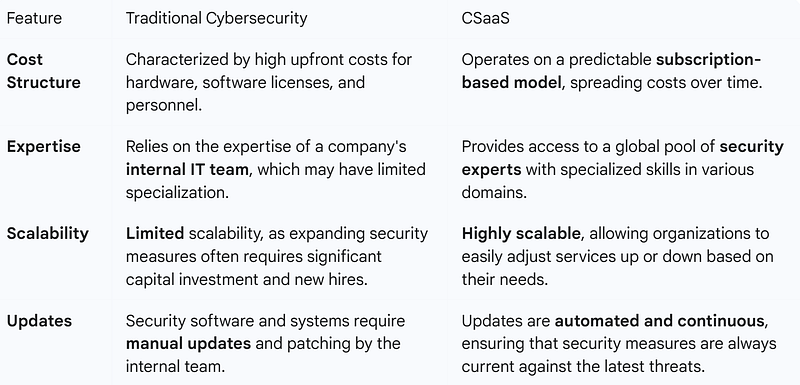
CSaaS vs. Traditional Cybersecurity Approaches
Why Businesses Are Shifting to Cybersecurity as a Service
Cyber threats today are automated, driven by AI, and constantly changing. Attackers work around the clock, so your defenses must too. Cybersecurity as a Service (CSaaS) offers a solution by providing a dynamic, expert-driven approach to security. Here’s why it’s a critical component for businesses of all sizes:
Keeping Pace with Evolving Threats
CSaaS providers use cutting-edge detection tools, artificial intelligence, and global threat intelligence to stay one step ahead of attackers.
This proactive approach allows them to identify and neutralize sophisticated, AI-driven threats that might bypass conventional security systems.
By continuously updating their methods and technology, CSaaS vendors ensure your defenses are always current and robust.
Budget Flexibility and Predictability
Building and maintaining an in-house cybersecurity team is a significant financial commitment, often costing hundreds of thousands of dollars a year in salaries, training, and tools.
CSaaS offers a more cost-effective solution with scalable, subscription-based pricing. This model makes enterprise-level protection accessible to startups and small businesses without the prohibitive upfront costs, allowing for better budget management and predictability.
24/7 Access to Security Experts
Cybersecurity is not a 9-to-5 job; threats can emerge at any time. CSaaS provides 24/7 vigilance and rapid incident response, with a team of experts ready to neutralize threats the moment they appear.
This round-the-clock coverage is especially crucial for businesses with global operations that need protection across different time zones.
Enhancing Scalability and Agility
CSaaS solutions are inherently scalable, allowing businesses to easily adjust their security posture as they grow or their needs change. Whether you’re adding new employees, expanding into new markets, or dealing with seasonal fluctuations, CSaaS can adapt quickly without the need for significant capital investment or the hassle of hiring and training new staff.
This agility is key to protecting a business in a fast-paced environment.
How to Choose the Right CSaaS Provider
Choosing the right CSaaS provider is a critical decision that impacts your business’s security posture, budget, and operational efficiency. A thorough evaluation process is essential to find a partner that aligns with your specific needs.
Key Evaluation Criteria
When assessing potential CSaaS providers, consider the following factors:
- 24/7 Monitoring and Support: Cyber threats don’t adhere to business hours. Ensure the provider offers round-the-clock monitoring and has a dedicated team of experts available at all times to detect and respond to incidents.
- Proven Track Record: Look for a provider with a strong reputation and a history of successful engagements. Check for case studies, customer testimonials, and reviews to gauge their effectiveness and reliability.
- Industry Certifications: Certifications like SOC 2 and ISO 27001 demonstrate a provider’s commitment to robust security practices. These certifications indicate that they have been independently audited and meet strict standards for managing customer data and security controls.
- Customization and Scalability: A one-size-fits-all approach to security is rarely effective. The right provider should be able to customize their services to fit your unique infrastructure and business requirements. The solution should also be highly scalable, allowing you to easily adjust services as your business grows or changes.
- Clear Service Level Agreements (SLAs): A well-defined SLA is crucial. It should clearly outline the provider’s responsibilities, including guaranteed uptime, response times for incidents, and the processes for communication and reporting. This ensures you know exactly what to expect from their service.
How to Get SOC 2 Certification and Build Strong Customer Trust
Fast Track Your Compliance Journey
Questions to Ask Potential Vendors
To make an informed decision, engage with potential providers using these key questions:
- How do you handle threat detection and incident response?
- What industries do you specialize in?
- How do you ensure compliance with evolving regulations?
- Do you offer co-managed options with internal IT?
Cost of Breaches vs. Cost of Prevention with CSaaS
According to IBM, the average data breach cost in 2024 was $4.45 million. The average CSaaS solution costs a fraction of that annually , often delivering ROI within the first year by preventing even a single incident.
The cost of a data breach includes both direct and indirect expenses. Direct costs are things like incident response, legal fees, and regulatory fines, while indirect costs include reputational damage, customer churn, and lost business. These costs can be devastating, especially for small and medium-sized businesses.
The annual subscription cost of a CSaaS solution is a predictable and manageable expense that effectively acts as an insurance policy against these potentially ruinous costs.
ROI Metrics You Can Track
To measure the value of a CSaaS provider, businesses can track specific metrics that demonstrate the effectiveness of their security investment. These metrics quantify the provider’s performance and the tangible benefits of their service.
- Number of blocked threats: This metric directly shows how many attacks were stopped before they could cause harm.
- Mean time to detection (MTTD): This measures how quickly a provider can identify a threat. A lower MTTD indicates a more efficient and proactive security system.
- Mean time to response (MTTR): This metric measures the time it takes for a provider to contain and neutralize a detected threat. A lower MTTR minimizes the potential damage and cost of a breach.
- Downtime reduction: This tracks the decrease in operational downtime caused by security incidents. By preventing or quickly resolving breaches, CSaaS helps maintain business continuity.
- Compliance audit pass rates: This metric reflects the effectiveness of the CSaaS provider in helping the business meet regulatory requirements, which in turn helps avoid hefty fines and legal issues.
Conclusion
Cyberattacks are no longer a question of “if” but “when.” In a world where data is currency and downtime costs millions , adopting cybersecurity as a service is not just a smart move, it’s a necessary one. CSaaS delivers enterprise-grade protection, compliance assurance, and peace of mind for a predictable price.
Ready to Streamline Compliance?
Building a secure foundation for your startup is crucial, but navigating the complexities of achieving compliance can be a hassle, especially for a small team.
SecureSlate offers a simpler solution:
- Affordable: Expensive compliance software shouldn’t be the barrier. Our affordable plans start at just $284/month.
- Focus on Your Business, Not Paperwork: Automate tedious tasks and free up your team to focus on innovation and growth.
- Gain Confidence and Credibility: Our platform guides you through the process, ensuring you meet all essential requirements, and giving you peace of mind.
Disclaimer (legal note)
SecureSlate is not a law firm, and this article does not constitute or contain legal advice or create an attorney-client relationship. When determining your obligations and compliance with respect to relevant laws and regulations, you should consult a licensed attorney.
Need compliance without the complexity?
SecureSlate automates ISO 27001, SOC 2, GDPR, HIPAA, and more. Built for growing teams. See it in action.
Find compliance gaps in 30 seconds