

Related guides:
Key takeaways
- What Is a Cybersecurity Monitoring Service: A Cybersecurity Monitoring Service is a managed or in-house solution that continuously tracks your organization’s digital infrastructure for signs of unauthorized activity, system vulnerabilities.
- Why Continuous Cybersecurity Monitoring Is Essential: The nature of cyber threats is not static.
- What Are the Types of Cybersecurity Monitoring Services: Several monitoring services operate across different layers of your infrastructure.
In today’s digital-first business landscape, the cost of undetected cyber threats can be devastating. That’s where Cybersecurity Monitoring Services come in. They act as a continuous line of defense; observing, analyzing, and responding to threats in real time, 24/7.
No capes. No dramatic music. Just continuous vigilance so your business stays secure even when your team is offline.
This guide provides a professional overview of cybersecurity monitoring: what it entails, the different service types available, how to evaluate vendors, and the 15 must-have capabilities every business should expect.
What Is a Cybersecurity Monitoring Service?
A Cybersecurity Monitoring Service is a managed or in-house solution that continuously tracks your organization’s digital infrastructure for signs of unauthorized activity, system vulnerabilities, and emerging threats.
Its core responsibilities include:
- Real-time detection of suspicious behavior
- 24/7 event log monitoring and analysis
- Correlation of security events across systems
- Alert generation and incident response initiation
Many services also support compliance documentation, helping organizations meet requirements under standards like SOC 2, HIPAA, ISO 27001, and PCI DSS.
Why Continuous Cybersecurity Monitoring Is Essential
The nature of cyber threats is not static. Attackers operate globally and around the clock, and many modern exploits evade traditional defenses.
According to IBM’s 2023 Cost of a Data Breach Report, it takes an average of 204 days to identify a breach. That’s nearly seven months of potential damage before a team even notices.
Cybersecurity Monitoring Services offer critical advantages:
- Timely Alerts: Early detection enables faster response, which minimizes harm.
- Enhanced Visibility: Gain centralized insights across cloud platforms, devices, users, and networks.
- Audit Readiness: Maintain an audit trail and real-time compliance posture.
By investing in continuous monitoring, organizations reduce the likelihood of data breaches, minimize dwell time, and improve operational resilience.
What Are the Types of Cybersecurity Monitoring Services
Several monitoring services operate across different layers of your infrastructure. Here’s an overview:
1. Security Information and Event Management (SIEM)
SIEM platforms collect and normalize logs from endpoints, cloud environments, applications, and devices. They analyze this data using rules or AI to detect anomalies and generate alerts.
Top 10 SIEM Tools That Stop Hackers in 2025
Discover the SIEM Tools You’ll Need to Outsmart Hackers
2. Managed Detection and Response (MDR)
MDR services provide outsourced security operations. They actively monitor, investigate, and respond to threats, often combining technology with human analysts who assess alerts and escalate when necessary.
3. Endpoint Detection and Response (EDR)
Focused on endpoint devices such as laptops, servers, and mobile phones, EDR solutions monitor behaviors and provide real-time response capabilities, such as process isolation or rollback.
4. Network Traffic Monitoring
This involves deep inspection of traffic across internal and external networks to detect scanning attempts, lateral movement, and exfiltration patterns.
5. Cloud Security Monitoring
As organizations adopt multi-cloud infrastructure, monitoring must adapt. Cloud-specific monitoring tools track identity access, API interactions, misconfigurations, and non-compliant deployments.
What to Look for in a Cybersecurity Monitoring Service
To be effective, a monitoring solution should provide a robust combination of visibility, automation, and flexibility. Below are the 15 essentials:
- 24/7 Coverage: Monitoring that operates continuously, not just during business hours.
- Intelligent Alerting: Minimize alert fatigue with context-rich, prioritized notifications.
- Threat Intelligence Integration: Leverage threat feeds to detect emerging global attacks.
- Log Correlation Across Systems: Surface risks by connecting events from disparate sources.
- Predefined Response Playbooks: Enable rapid mitigation using tested and approved workflows.
- Multi-Cloud Compatibility: Ensure AWS, Azure, and GCP activity is fully visible and auditable.
- File Integrity Monitoring: Detect unauthorized file modifications, additions, or deletions.
- User and Entity Behavior Analytics (UEBA): Identify deviations from typical user behavior.
- Built-in Compliance Reporting: Automate evidence collection and documentation for frameworks like SOC 2 and HIPAA.
- Secure Data Handling: Encrypt monitoring data in transit and at rest.
- Risk-Based Alert Prioritization: Focus on incidents that present real business impact.
- Automated Threat Containment: Proactively block IPs, kill processes, or isolate hosts.
- Third-Party Risk Monitoring: Include vendors and partners in your threat surface visibility.
- Open API Access: Integrate monitoring data into internal dashboards or other tools.
- Elastic Scalability: Support growth from a small environment to enterprise-grade infrastructure.
How to Choose the Right Cybersecurity Monitoring Service
Selecting a monitoring provider is a long-term decision that impacts every facet of your security strategy. Here’s a structured approach:
1. Understand Industry Experience
Look for a partner with clients in your sector. Regulatory needs and threat profiles vary significantly by industry.
2. Review SLAs and Support Guarantees
Evaluate service level agreements. Key metrics include time-to-alert, escalation procedures, and analyst availability.
3. Evaluate Compatibility with Your Stack
A good provider should support your full environment; on-prem, cloud, hybrid including operating systems, APIs, and third-party integrations.
4. Assess Reporting and Dashboard Usability
You’ll need more than raw data. Quality reporting enables security teams, auditors, and leadership to stay aligned.
5. Determine Support Model
Some services are largely automated, while others offer dedicated analysts and regular briefings. Match the support style to your internal team’s needs.
What Cybersecurity Monitoring Service Won’t Do (But You Still Need)
Cybersecurity monitoring is powerful, but it’s not a cure-all. You still need complementary measures:
- Security Training for Staff: Human error remains the leading cause of breaches.
- Patch and Vulnerability Management: Monitoring alerts you to issues but doesn’t patch them.
- Policy and Governance: Controls and rules remain your responsibility.
In short, think of monitoring as an alarm system. It alerts and responds, but it can’t enforce security hygiene alone.
What Cybersecurity Monitoring Services Typically Cost
Pricing varies based on the size of your environment, the depth of coverage, and the provider’s capabilities. Here’s a general overview:
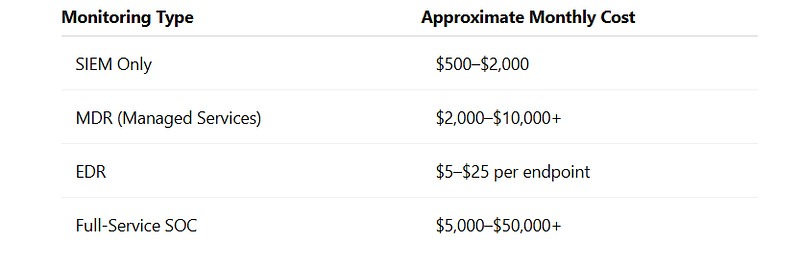
Costs may also depend on log volume, the number of users, or the number of integrations.
Signs Your Current Monitoring Provider Is Underperforming
Not every solution on the market delivers meaningful value. Watch for these warning signs:
- Alert Overload: You receive thousands of alerts daily, with no real prioritization.
- Opaque Analysis: The provider can’t clearly explain what triggered an alert.
- Limited Cloud Support: Gaps in coverage for your SaaS platforms or virtual infrastructure.
- No Incident Reporting: You lack actionable summaries and root cause analysis.
- Delayed Responses: Alerts take hours (or worse, days) to be acknowledged.
A well-run Cybersecurity Monitoring Service should act as a true partner, providing both timely insights and support. If it feels like you’re managing the tool more than it’s helping, it may be time to re-evaluate.
Conclusion
A reliable Cybersecurity Monitoring Service is no longer a luxury for large enterprises, but it’s a baseline requirement for any organization that values uptime, data protection, and customer trust.
Whether you’re managing an internal security operations team or looking to augment your capabilities with a third-party partner, 24/7 monitoring ensures that threats don’t slip by unnoticed.
When evaluating services, look beyond the buzzwords. Focus on how the service delivers actionable intelligence, supports compliance, and integrates with your existing stack.
The threat landscape isn’t static, and neither should your monitoring strategy be.
Ready to Streamline Compliance?
Building a secure foundation for your startup is crucial, but navigating the complexities of achieving compliance can be a hassle, especially for small teams.
SecureSlate offers a simpler solution:
- Affordable: Expensive compliance software shouldn’t be a barrier. Our affordable plans start at just $284/month.
- Focus on Your Business, Not Paperwork: Automate tedious tasks and free up your team to focus on innovation and growth.
- Gain Confidence and Credibility: Our platform guides you through the process, ensuring you meet all essential requirements and giving you peace of mind.
Disclaimer (legal note)
SecureSlate is not a law firm, and this article does not constitute or contain legal advice or create an attorney-client relationship. When determining your obligations and compliance with respect to relevant laws and regulations, you should consult a licensed attorney.
Need compliance without the complexity?
SecureSlate automates ISO 27001, SOC 2, GDPR, HIPAA, and more. Built for growing teams. See it in action.
Find compliance gaps in 30 seconds
