
 Image from pexels.com
Related guides:
Key takeaways
- The Problem: Manual Compliance Processes Don’t Scale: When we managed HIPAA compliance manually, everything required effort.
- Why We Prioritized HIPAA Compliance Automation: HIPAA doesn’t allow shortcuts, but it doesn’t prohibit efficiency.
- How We Automated Our HIPAA Compliance Program: Here’s a breakdown of how we transitioned from a manual HIPAA compliance process to a fully automated system.
Preparing for a HIPAA audit can be a significant operational burden, especially for growing organizations with lean teams. The regulatory expectations are clear, but the day-to-day effort of maintaining continuous compliance is often resource-intensive, repetitive, and error-prone.
That used to be our reality.
In our early days, HIPAA compliance meant digging through spreadsheets, following up with various teams, and scrambling for evidence ahead of every audit. It was manual, reactive, and unsustainable.
So we re-evaluated. We implemented HIPAA compliance automation.
And the result was substantial: an 80% reduction in audit preparation time , with improved visibility and far greater consistency.
This post outlines how we made that shift, the systems we automated, and the measurable impact it had on our compliance program.
The Problem: Manual Compliance Processes Don’t Scale
When we managed HIPAA compliance manually, everything required effort:
- Training records were distributed across departments
- Evidence of encryption and access control needed to be pulled manually
- Policies were static and disconnected from daily operations
- Risk assessments involved lengthy interviews and disorganized notes
- Documentation was tracked across multiple locations with no central oversight
It was possible, but inefficient. Our compliance team spent upwards of 30 hours preparing for each audit, often duplicating work that had been done in previous quarters.
As the company grew, so did the complexity. We needed a scalable approach, one that could reduce manual intervention without sacrificing audit readiness.
Why We Prioritized HIPAA Compliance Automation
HIPAA doesn’t allow shortcuts, but it doesn’t prohibit efficiency. The Security Rule is designed to be flexible, technology-neutral, and adaptable. That gave us room to implement a system that automated control monitoring, policy enforcement, and evidence collection, without compromising on compliance integrity.
Our goals were clear:
- Reduce repetitive manual work
- Ensure continuous visibility across all HIPAA-related controls
- Improve audit readiness at any point in time
- Free up engineering and compliance resources for higher-value tasks
Automation was the path forward.
HIPAA Security Rule: Are You Compliant or at Risk?
Stay Audit-Ready with These Security Practices
How We Automated Our HIPAA Compliance Program
Here’s a breakdown of how we transitioned from a manual HIPAA compliance process to a fully automated system:
1. Mapped HIPAA Controls to System Data
We began by translating HIPAA’s requirements into specific technical and administrative controls that matched our systems and workflows.
For example:
- The Access Control standard was aligned with our SSO platform, IAM policies in AWS, and user management in Google Workspace.
- The Audit Controls requirement was covered through integrations with logging services that tracked user and system activity across our stack.
- The Security Awareness Training standard was addressed by linking our LMS to our compliance dashboard to automate training verification.
Each control was tied to a real system action. We configured our automation platform to pull relevant evidence automatically, on a continuous basis.
2. Centralized and Automated Policy Management
Instead of manually drafting and updating HIPAA policies, we used an automation tool that generated policies based on our environment and system architecture. These policies were mapped directly to the appropriate controls and reviewed quarterly.
Policy acknowledgments were collected automatically through our onboarding workflows. New hires were required to sign off on policies during their first week, and our dashboard tracked completion rates in real time.
This eliminated the need for manual follow-ups or last-minute documentation sprints before audits.
3. Integrated with Our Existing Tooling
One of our non-negotiables was deep integration with our existing tech stack. We didn’t want another siloed tool. We needed something that worked with our current systems.
We integrated the HIPAA compliance platform with:
- GitHub for version control and approval tracking
- AWS for infrastructure visibility and logging
- Okta for identity and access management
- Google Workspace for user lifecycle management
- Slack for compliance alerts and task assignments
Each integration added a layer of automation; whether in monitoring access controls, verifying encryption at rest, or ensuring MFA was enforced across accounts.
4. Established Real-Time Monitoring and Alerts
Our compliance tool continuously monitored controls and generated alerts when something went out of scope. For example:
- If a new user was added without MFA enabled, we received an immediate alert
- If a risk assessment was due for review, it was automatically flagged and assigned
- If a policy expired or changed, stakeholders were notified
We replaced our static spreadsheets with a live dashboard that reflected our compliance posture in real time. This allowed the team to resolve issues proactively well before an audit approached.
How Startups Can Get HIPAA Compliance (Free Guide)
Fast-Track Your HIPAA Compliance
The Impact: 80% Reduction in Audit Preparation Time
Before automation, our HIPAA audit prep required over 30 hours of manual work; spread across engineering, HR, and compliance stakeholders.
After automation, the time required dropped below 7 hours. Here’s a side-by-side comparison:
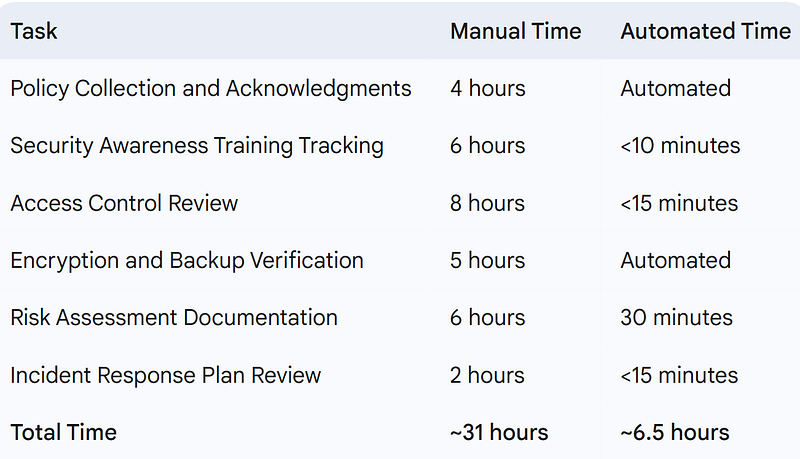
Beyond time savings, automation brought accuracy, consistency, and reliability. We were no longer scrambling to piece together documentation or verify controls. Everything was collected, tracked, and ready to go, at any time.
Lessons Learned from Automating HIPAA Compliance
Early Investment Pays Long-Term Dividends
We implemented automation several months before our next scheduled audit. This gave us time to test, adjust, and train stakeholders. When the audit came around, the difference was clear, and measurable.
Tool Selection Matters
Not every compliance automation platform supports HIPAA-specific requirements. We chose a system that aligned closely with healthcare regulations, supported the Security Rule framework, and provided audit-friendly reporting.
Look for solutions that include:
- Pre-built HIPAA control mapping
- Real-time evidence collection
- Automated policy and training management
- Audit-ready reporting features
- Integration with your tech stack
Compliance Still Requires Oversight
Automation reduces effort, but doesn’t eliminate responsibility. We designated a compliance lead to review alerts, oversee risk assessments, and manage any manual tasks that remained.
With automation in place, this role became more strategic and less reactive.
Auditors Took Notice
The benefit wasn’t just internal. Our auditor appreciated the transparency and structure the automated system provided. We could demonstrate compliance across all HIPAA Security Rule standards without excessive documentation requests or delays.
Audit interviews were more focused. Evidence was centralized. Questions were answered quickly. The process was smoother for everyone involved.
7 Best HIPAA Compliance Software for 2025
Avoid Penalties with Top-Rated HIPAA Compliance Tools
Conclusion
HIPAA compliance automation transformed the way we manage security and privacy obligations. What was once a reactive, resource-heavy process is now proactive, consistent, and streamlined.
By automating the most time-consuming aspects of HIPAA compliance, we not only reduced audit prep time by 80%, but also improved our overall security posture and created space for our team to focus on growth.
If your organization is still managing HIPAA requirements manually, it’s worth reconsidering your approach. The tools and systems available today can dramatically improve efficiency without compromising compliance integrity.
Compliance shouldn’t be a bottleneck. It should be a byproduct of good system design and smart automation.
Ready to Streamline Compliance?
Building a secure foundation for your startup is crucial, but navigating the complexities of achieving compliance can be a hassle, especially for small teams.
SecureSlate offers a simpler solution:
- Affordable: Expensive compliance software shouldn’t be a barrier. Our affordable plans start at just $284/month.
- Focus on Your Business, Not Paperwork: Automate tedious tasks and free up your team to focus on innovation and growth.
- Gain Confidence and Credibility: Our platform guides you through the process, ensuring you meet all essential requirements and giving you peace of mind.
Disclaimer (legal note)
SecureSlate is not a law firm, and this article does not constitute or contain legal advice or create an attorney-client relationship. When determining your obligations and compliance with respect to relevant laws and regulations, you should consult a licensed attorney.
Need compliance without the complexity?
SecureSlate automates ISO 27001, SOC 2, GDPR, HIPAA, and more. Built for growing teams. See it in action.
Find compliance gaps in 30 seconds

