

Related guides:
Key takeaways
- What Is the HIPAA Enforcement Rule: The HIPAA Enforcement Rule outlines how the U.S.
- Why Business Associates Are Under Increasing Legal: The landscape of HIPAA compliance has drastically shifted, placing Business Associates (BAs) under unprecedented scrutiny and legal pressure from the OCR.
- The Breach Origin Shift: The core reason for this intensified focus is simple: many significant healthcare data breaches now originate from third-party vendors.
Ensuring compliance with the HIPAA Enforcement Rule isn’t just a responsibility for healthcare providers; Business Associates (BAs) are now equally accountable. From cloud storage companies and billing providers to IT service firms and third-party administrators, any organization handling Protected Health Information (PHI) must meet strict federal standards. Failure to comply can result in substantial fines, legal repercussions, and lasting reputational damage.
In this guide, we break down what the HIPAA Enforcement Rule means for Business Associates, how it’s enforced, and what steps you must follow to stay compliant.
Stop losing sleep over security: Learn the SecureSlate strategy top CTOs use to guarantee system integrity.
What Is the HIPAA Enforcement Rule?
The HIPAA Enforcement Rule outlines how the U.S. Department of Health and Human Services (HHS) and the Office for Civil Rights (OCR) investigate violations and enforce penalties related to:
- Privacy Rule
- Security Rule
- Breach Notification Rule
Essentially, the Enforcement Rule gives HIPAA real “teeth,” allowing the government to hold organizations accountable for the misuse or mishandling of PHI.
For Business Associates, this means you are no longer exempt from violations; OCR can penalize you directly.
Why Business Associates Are Under Increasing Legal Pressure
The landscape of HIPAA compliance has drastically shifted, placing Business Associates (BAs) under unprecedented scrutiny and legal pressure from the OCR. Historically, OCR’s primary focus was on Covered Entities (CEs), healthcare providers and health plans. However, due to a troubling trend, BAs are now firmly in the enforcement crosshairs.
The Breach Origin Shift
The core reason for this intensified focus is simple: many significant healthcare data breaches now originate from third-party vendors. Whether these are billing companies, cloud service providers, IT vendors, or SaaS companies that handle Protected Health Information (PHI), their security failures are directly exposing patient data.
Primary Drivers of Business Associate Liability
OCR investigations have repeatedly highlighted critical failures within Business Associate operations that lead to breaches:
- Weak Cybersecurity Protocols: Many BAs lack the robust, enterprise-level cybersecurity infrastructure necessary to protect sensitive patient data, making them easy targets for malicious actors.
- Lack of Encryption: Failure to encrypt PHI, both at rest (stored data) and in transit (data being shared), is a common violation that significantly escalates the risk exposure during a breach.
- Insufficient Employee Training: Employees of BAs often do not receive specialized, recurring training on the nuances of HIPAA, the HITECH Act, and recognizing social engineering or phishing attempts.
- Poor Access Controls: Granting overly broad or unnecessary access to PHI is a major vulnerability. Without stringent role-based access controls, a single compromised account can expose massive data.
- Unsecure Data Sharing: Using non-compliant tools or methods (like personal email or consumer file-sharing services) to exchange PHI with Covered Entities or other vendors creates vulnerable points outside of a secure environment.
The Active Auditing Environment
With the volume and severity of data breaches skyrocketing, the OCR is no longer waiting for a breach report to act. They are now actively initiating audits of Business Associates, just as they do with Covered Entities, to proactively assess compliance before an incident occurs.
HIPAA Enforcement Rule Requirements for BAs
The HITECH Act of 2009 and the Omnibus Rule of 2013 dramatically expanded the direct legal obligations of Business Associates, subjecting them to the same audit and enforcement authority as Covered Entities (CEs).
To mitigate significant risk and comply with the HIPAA Enforcement Rule, BAs must adhere to the following four core requirements:
1. Implement Administrative, Technical, and Physical Safeguards (The Security Rule)
The Security Rule is not negotiable for BAs and requires a comprehensive, documented, and proactive security program.
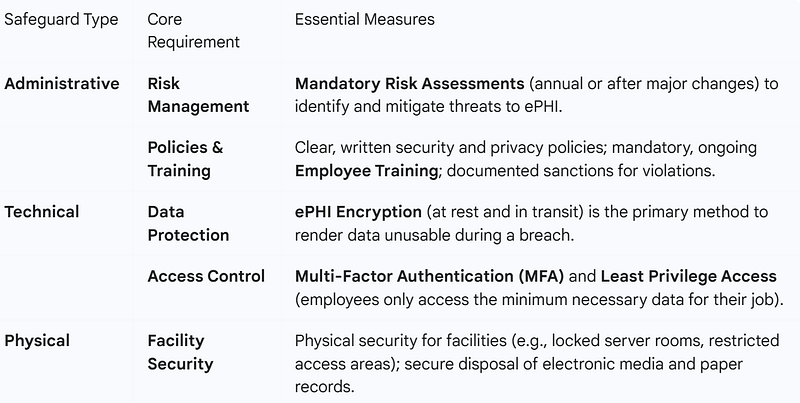
The failure to conduct a thorough, enterprise-wide Risk Assessment is one of the most common and costly violations cited by the OCR during enforcement actions.
2. Sign a Business Associate Agreement (BAA)
A BAA is a mandatory, legally binding contract required before a Business Associate can receive, create, maintain, or transmit PHI on behalf of a Covered Entity.
- Contractual Scope: The BAA legally binds the BA to adhere to the Privacy, Security, and Breach Notification Rules. It clarifies and limits how the BA can use or disclose PHI. It can only be used for the purposes defined in the BAA or as required by law.
- Termination Clause: The BAA must authorize the Covered Entity to terminate the contract if the BA commits a material breach or violation of the agreement.
- Enforcement Risk: Missing or incomplete BAAs are a top trigger for OCR penalties for both the CE and the BA. The BAA is the foundational document that defines the relationship and HIPAA responsibilities.
3. Monitor and Contractually Bind Subcontractors
HIPAA liability does not stop with the primary Business Associate; it flows down the chain to every vendor that touches the PHI.
- Flow-Down Mandate: Any Subcontractor (referred to as a “downstream BA”) who creates, receives, maintains, or transmits PHI for the BA is also directly liable for compliance with the Security Rule.
- Required BAA: The original Business Associate must enter into a Subcontractor BAA with every downstream vendor. This BAA must mirror the same restrictions and conditions that apply to the original BA.
- Active Oversight: Simply signing a BAA is not enough. BAs must have a program of due diligence and monitoring (such as periodic security reviews or evidence requests) to ensure their subcontractors are meeting the required safeguards.
4. Maintain Breach Notification Procedures (The Breach Notification Rule)
In the event of a security incident involving unsecured PHI, BAs have strict, time-sensitive reporting obligations.
- Identify and Contain: BAs must have protocols to identify and contain any breach or security incident immediately.
- Prompt Notification: The BA must notify the affected Covered Entity (CE) of the breach without unreasonable delay. While the rule sets an absolute outer limit of 60 calendar days from discovery, best practice and case history show the OCR expects notification much faster.
- Detailed Information: The notification to the CE must include sufficient information to allow the CE to perform a risk assessment and notify the affected individuals and the OCR (e.g., the date of the breach, the types of PHI involved, and the mitigation steps taken).
- Documentation: All security incidents, even those that do not qualify as a formal breach, must be thoroughly documented and retained for at least six years.
Any delay in reporting or failure to properly document a breach is a direct violation and can result in significant financial penalties.
Penalties for Business Associates Under the Enforcement Rule
The HIPAA Enforcement Rule subjects Business Associates to significant financial and legal consequences for non-compliance, similar to those faced by Covered Entities. Penalties are divided into civil and criminal categories, depending on the nature and intent of the violation.
Civil Penalties (Tiered Structure)
The Office for Civil Rights (OCR) uses a structured, four-tier system to determine the severity and fine amount for civil violations. The fines are calculated based on the BA’s knowledge and level of diligence in preventing the violation.
HIPAA Civil Penalties for Business Associates (Tiered Structure)
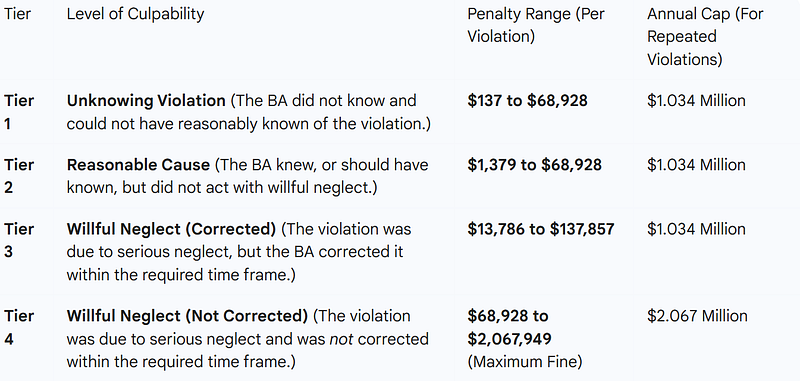
Criminal Penalties
Criminal penalties are pursued by the Department of Justice (DOJ) and apply when PHI is obtained or disclosed with intent that goes beyond simple negligence.
Criminal penalties typically apply when PHI is accessed, used, or disclosed:
- For Personal Gain: Using PHI to gain financially or achieve a personal advantage.
- For Malicious Purposes: Stealing or exposing PHI with harmful intent.
- With Harmful Intent: Intentional misuse that causes injury or damage to the individual whose PHI was exposed.
These serious offences can result in substantial fines (up to $250,000) and imprisonment (up to 10 years).
Common Violations by Business Associates
Based on OCR enforcement actions, certain areas consistently demonstrate the greatest risk for Business Associates. These failures often lead directly to breaches and subsequent penalties:
- Failure to Complete a Required Risk Assessment: This is the single most common enforcement action. BAs often fail to conduct a thorough, accurate, and documented analysis of risks and vulnerabilities to their electronic PHI (ePHI).
- Not Encrypting PHI: Storing or transmitting PHI without appropriate data encryption is a severe violation, particularly as encryption is a key addressable standard under the Security Rule.
- Lack of Business Associate Agreements (BAA): Operating without a signed BAA or having an incomplete/outdated BAA with a Covered Entity or a downstream subcontractor is a fundamental compliance failure.
- Insufficient Employee HIPAA Training: Employees handling PHI must receive regular, documented training specific to their roles and HIPAA obligations to prevent human error and social engineering attacks.
- Sharing PHI Insecurely: Using standard email, text messages, or consumer-grade file-sharing services instead of HIPAA-compliant, secure transmission methods.
- Not Reporting Breaches Promptly: Failing to notify the Covered Entity of a discovered breach within the required 60-day timeframe (and ideally much sooner) is a direct violation of the Breach Notification Rule.
How to Be Compliant Under the HIPAA Enforcement Rule
To safeguard your organization from severe penalties under the HIPAA Enforcement Rule, Business Associates must establish a culture of security and follow a structured compliance program. Here is how BAs can practically implement the necessary safeguards:
1. Conduct Regular Risk Assessments (The Foundation)
A comprehensive Risk Assessment is the single most critical and mandatory requirement under the Security Rule, often cited as the root cause of non-compliance in enforcement actions. It is a continuous process, not a one-time event.

- Identify Vulnerabilities: Systematically audit every area where electronic Protected Health Information (ePHI) is created, received, maintained, or transmitted. This includes reviewing:
- Software and Hardware: Operating systems, applications, and network devices.
- Physical Access: Security for server rooms and workstations.
- Data Storage: Cloud environments, backups, and local drives.
- Network Architecture: Firewalls, remote access points, and Wi-Fi networks.
- Mitigation Plan: Based on the assessment, you must develop and implement a prioritized plan to remediate identified risks.
- Requirement: The OCR requires BAs to conduct a risk assessment annually or whenever a significant change occurs in their environment (e.g., implementing a new system or merging with another company).
2. Train Staff on HIPAA Standards (The Human Factor)
Human error is repeatedly identified as the #1 cause of PHI breaches. Even the strongest technical security can be undermined by an untrained employee.
- Mandatory, Recurring Training: Training must be provided to all workforce members who handle PHI and should be repeated at least annually.
- Focus on Prevention: Training must focus on practical security hygiene, including:
- Email Security: Recognizing malicious attachments and suspicious links.
- Password Hygiene: Using strong, unique passwords and Multi-Factor Authentication (MFA).
- Recognizing Phishing: Teaching staff to identify social engineering attempts.
- Reporting Suspicious Activity: Establishing clear procedures for reporting potential security incidents promptly.
- Documentation: Maintain detailed records of all training sessions, including dates, attendees, and content covered.
3. Encrypt All PHI (The Key to Liability Reduction)
Encryption is an addressable standard under the Security Rule, but it is effectively mandatory for BAs due to its ability to significantly reduce liability.
- Data at Rest: All ePHI stored on servers, hard drives, laptops, backups, and cloud storage must be encrypted.
- Data in Transit: All ePHI transmitted over public networks (like the internet) must be encrypted using secure protocols (e.g., TLS/SSL).
- The Safe Harbor Provision: If a breach occurs involving data that was properly encrypted according to NIST standards, the BA is generally relieved of the full weight of the Breach Notification Rule, which significantly mitigates financial and reputational damage.
4. Use Secure Communication Channels
BAs must establish and enforce policies to prevent the use of consumer-grade, unencrypted services for transmitting PHI.
- Avoid Public Services: Never use public email services (like standard Gmail or Yahoo), consumer file-sharing platforms (like Dropbox or Google Drive without a BAA), or unencrypted messaging tools for transmitting PHI.
- Implement Compliant Solutions: Utilize secure, encrypted channels such as secure portals, SFTP, or email services specifically designed to meet HIPAA and HITECH standards.
5. Maintain Thorough Documentation (Proof of Diligence)
The OCR views strong documentation as the primary proof of a BA’s good-faith compliance efforts. If an auditor cannot see it in writing, they assume it was never done.
- Document Everything: Maintain complete, organized records for all required activities, including:
- Risk assessments and resulting remediation plans.
- Security and Privacy Policies and Procedures.
- Employee training logs.
- Records of sanction actions taken against employees.
- Security incident and breach documentation.
- Retention: All HIPAA-related documentation must be retained for a minimum of six years from the date of creation or the date it was last in effect.
6. Review and Update BAAs
The Business Associate Agreement (BAA) is your legal compliance cornerstone.
- Active Review: Regularly review every BAA with Covered Entities and downstream Subcontractors to ensure they:
- Explicitly address the requirements of the HITECH Act and the Omnibus Rule.
- Clearly define your permitted uses and disclosures of PHI.
- Include up-to-date language regarding breach notification timelines and security measures.
- Subcontractor Compliance: Confirm that all downstream vendors who handle PHI have a current and compliant BAA with your organization.
Future Trends: Stricter HIPAA Enforcement Ahead
Due to historic highs in cyberattacks targeting healthcare, the Office for Civil Rights (OCR) is adopting a zero-tolerance approach to negligence, putting severe pressure on Business Associates (BAs) who handle Protected Health Information (PHI).
Key Areas of Intensified scrutiny
BAs should prepare for regulatory shifts that emphasize proactive security:
- More Frequent Audits: The OCR will increase proactive, sector-wide audits of BAs, moving beyond investigations triggered only by breaches. They will scrutinize security documentation, Risk Assessments, and BAAs to ensure compliance before incidents occur.
- Higher Fines: Expect maximum financial penalties for willful neglect violations (Tier 3 and 4) to increase, with the OCR less willing to negotiate lower settlement amounts.
- Cloud & IT Vendor scrutiny: Focus will intensify on major Cloud Service Providers (CSPs) and IT vendors, which represent a significant single point of failure. Detailed inquiries into their data encryption, access controls, and overall infrastructure security will be common.
- Pressure on Subcontractors: Liability will continue to flow down the supply chain. The primary BA will be fully accountable for security failures by downstream subcontractors, requiring vigorous due diligence and robust contractual controls over all third-party vendors.
- Stronger Cybersecurity Regulations : The OCR is adopting advanced frameworks like the NIST Cybersecurity Framework, meaning BAs must adopt security practices beyond the basic text of the HIPAA Security Rule (e.g., continuous monitoring and stronger incident response) to demonstrate reasonable protection of PHI.
Conclusion
The HIPAA Enforcement Rule places significant responsibility on Business Associates to safeguard PHI and follow strict compliance standards. With OCR increasing enforcement actions, no organization working with healthcare data can afford to overlook its obligations.
By implementing strong security measures, conducting regular risk assessments, and maintaining up-to-date BAAs, Business Associates can stay compliant and avoid costly penalties.
Staying ahead of HIPAA Enforcement Rule requirements isn’t just good practice; it’s essential to protecting your business, your partners, and patient trust.
Ready to Streamline Compliance?
Building a secure foundation for your startup is crucial, but navigating the complexities of achieving compliance can be a hassle, especially for a small team.
SecureSlate offers a simpler solution:
- Affordable: Expensive compliance software shouldn’t be the barrier. Our affordable plans start at just $284/month.
- Focus on Your Business, Not Paperwork: Automate tedious tasks and free up your team to focus on innovation and growth.
- Gain Confidence and Credibility: Our platform guides you through the process, ensuring you meet all essential requirements and giving you peace of mind.
Disclaimer (legal note)
SecureSlate is not a law firm, and this article does not constitute or contain legal advice or create an attorney-client relationship. When determining your obligations and compliance with respect to relevant laws and regulations, you should consult a licensed attorney.
Need compliance without the complexity?
SecureSlate automates ISO 27001, SOC 2, GDPR, HIPAA, and more. Built for growing teams. See it in action.
Find compliance gaps in 30 seconds
