
 Image by AI
Related guides:
Key takeaways
- CVE-2025–55182: Why It Is Difficult for SOC Teams: From a SOC perspective, CVE-2025–55182 is challenging because it operates primarily at the application logic layer , not the infrastructure layer.
- Foundational Visibility Requirements for SOC Teams: Before discussing detection techniques, SOC teams must ensure foundational visibility is in place.
- Application Logging Requirements: SOC teams should confirm that application logs include.
CVE-2025–55182 has quickly emerged as a high-risk vulnerability actively targeted by attackers looking to compromise modern web applications. Unlike opportunistic scanning vulnerabilities, CVE-2025–55182 exploitation often blends into normal application traffic, making detection difficult without well-tuned monitoring and response workflows.
For SOC teams, the challenge is twofold:
- Detect exploit attempts early , before attackers establish persistence or exfiltrate data
- Respond decisively , even when exploitation signals are subtle or fragmented across logs
This article explains how SOC teams can effectively monitor for CVE-2025–55182 exploit attempts, detect active exploitation, and respond in a controlled, repeatable manner that minimizes operational disruption while reducing attacker dwell time.
Stop losing sleep over security: Learn the SecureSlate strategy top CTOs use to guarantee system integrity.
CVE-2025–55182: Why It Is Difficult for SOC Teams to Detect
From a SOC perspective, CVE-2025–55182 is challenging because it operates primarily at the application logic layer , not the infrastructure layer. Exploit attempts may:
- Use valid endpoints and HTTP methods
- Return normal response codes
- Avoid triggering obvious input validation failures
- Occur at low frequency to evade rate-based detection
This means SOC teams cannot rely exclusively on perimeter tools or traditional IDS signatures. Detection requires contextual awareness of how the application normally behaves and the ability to identify deviations that indicate malicious intent.
Another complicating factor is asset diversity. Many organizations operate multiple application versions across environments. SOC teams may face incomplete visibility into which assets are vulnerable at any given time, increasing the likelihood of delayed response.
Foundational Visibility Requirements for SOC Teams
Before discussing detection techniques, SOC teams must ensure foundational visibility is in place. Without sufficient telemetry, even well-designed detection logic will fail.
Application Logging Requirements
SOC teams should confirm that application logs include:
- Full request paths and parameters
- HTTP methods and response codes
- Timestamps with sufficient granularity
- Error and exception details
- User or service account identifiers where applicable
Logging should be centralized and retained long enough to support forensic analysis. Missing or truncated logs severely limit investigation quality.
Web Server and Middleware Telemetry
Web servers and middleware components often provide early indicators of exploitation attempts. SOC teams should monitor:
- Request parsing errors
- Unhandled exceptions
- Memory or thread exhaustion warnings
- Abnormal worker restarts
These signals frequently appear before full compromise and provide valuable detection context when correlated with application logs.
WAF and Reverse Proxy Visibility
For organizations using a WAF or reverse proxy, these controls offer an additional layer of insight. SOC teams should ingest:
- Rule-triggered alerts
- Blocked or challenged requests
- Rate-limiting events
- Header or payload anomalies
Importantly, WAF alerts should not be treated as isolated indicators. SOC teams must correlate WAF activity with downstream application behavior to confirm whether exploit attempts succeeded.
Monitoring Strategies for CVE-2025–55182 Exploit Attempts
Detecting Abnormal Request Patterns
CVE-2025–55182 exploit attempts often involve crafted requests designed to reach unintended application states. SOC teams should monitor for:
- Repeated access to rarely used endpoints
- Unusual combinations of query parameters
- Parameter values that deviate significantly from normal ranges
- Repeated requests that trigger partial failures without full errors
Baseline analysis is essential. SOC teams should establish what “normal” traffic looks like for each application and alert on statistically significant deviations rather than fixed thresholds.
Identifying Low-and-Slow Exploitation Techniques
Attackers frequently probe for CVE-2025–55182 using low-frequency requests to avoid detection. SOC teams should look for:
- Consistent probing over extended time periods
- Similar request structures from different IP addresses
- Slight variations in payloads targeting the same endpoint
Detection logic should aggregate events over time and across sources. A single request may be benign; a pattern indicates intent.
Monitoring Application State Changes
Successful exploitation often results in unexpected application behavior. SOC teams should alert on:
- Sudden increases in memory or CPU usage without deployment changes
- Unplanned application restarts
- Configuration file modifications
- Changes in feature flags or runtime settings
These indicators often signal exploitation even when no explicit exploit alert is triggered.
Host and Endpoint Detection Considerations
If CVE-2025–55182 allows code execution or unauthorized access, host-level telemetry becomes critical.
SOC teams should monitor for:
- Child processes spawned by application services
- Execution of shell commands or scripting engines
- File writes outside expected directories
- Modification of startup scripts or scheduled tasks
Correlation between application-layer events and endpoint alerts significantly improves detection confidence.
SIEM Correlation and Detection Engineering
Building High-Fidelity Detections
SOC teams should design SIEM detections that combine:
- Application log anomalies
- WAF or proxy alerts
- Network flow deviations
- Endpoint activity
Single-source alerts are often noisy. Multi-source correlation increases precision and reduces false positives.
Detections should be explicitly labeled with CVE-2025–55182 to support reporting, threat tracking, and retrospective analysis.
Tuning and Validation
Detection logic must be continuously tuned. SOC teams should:
- Test rules against historical data
- Validate alerts with application owners
- Adjust thresholds based on environment-specific behavior
- Suppress known benign patterns
Untuned detections lead to alert fatigue and delayed response during real incidents.
Indicators That Active Exploitation Is Occurring
SOC teams should escalate investigations when they observe combinations of the following:
- Repeated abnormal requests followed by normal responses
- Gradual performance degradation
- Unexpected authentication events tied to application service accounts
- Outbound network connections from application servers to unknown destinations
These signals often indicate attackers have moved beyond reconnaissance into exploitation or post-exploitation.
SOC Incident Response Workflow for CVE-2025–55182
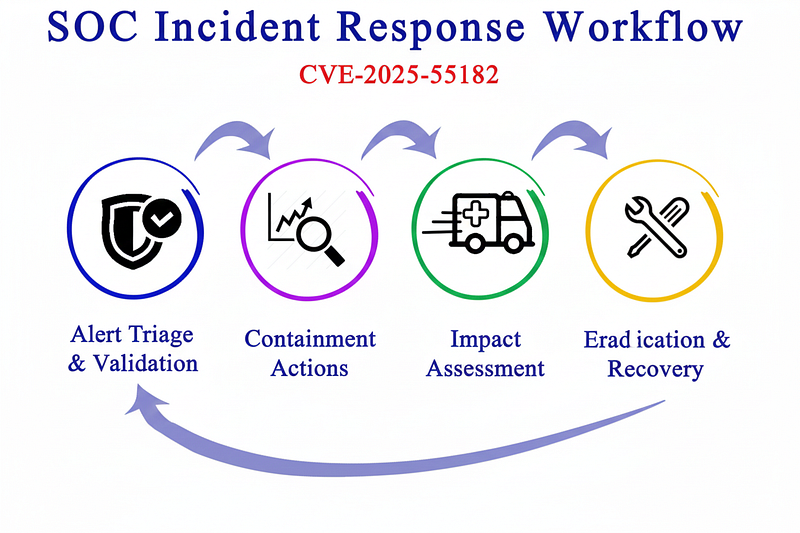 Image by AI
Step 1. Alert Triage & Validation
- Verify Vulnerability: Confirm application versions and patch status to deprioritize non-impacted systems.
- Analyze Patterns: Review request logs for abnormal sequences or edge-case parameters against established baselines.
- Correlate: Identify similar activity across the environment to distinguish isolated anomalies from coordinated attacks.
Step 2. Containment Actions
- Perimeter Blocking: Use WAF or API gateways to block malicious signatures while maintaining legitimate traffic.
- Isolation: Apply rate limits or isolate high-risk instances in coordination with infrastructure teams.
- Log Preservation: Secure all system states and traffic logs immediately to support forensic analysis.
Step 3. Impact Assessment
- Determine Scope: Collaborate with owners to identify if the exploit led to Remote Code Execution (RCE) or privilege escalation.
- Credential Audit: Check for unauthorized access to service accounts, API keys, or sensitive databases.
- Data Exfiltration: Review outbound traffic and database logs to assess potential data loss for regulatory reporting.
Step 4. Eradication & Recovery
- Remediation: Apply formal patches for CVE-2025–55182 and remove all malicious artifacts.
- Credential Rotation: Reset passwords and keys for all affected services and accounts.
- Restoration: Return systems to a known-good state and verify integrity before resuming full operations.
Post-Incident Detection and Process Improvements
After the incident is resolved, SOC teams should update detection logic with observed indicators and improve logging where visibility gaps were identified. Response playbooks should be refined to reflect lessons learned and improve decision-making speed.
A focused post-incident review should assess detection time, response coordination, and containment effectiveness. Each CVE-2025–55182 incident should strengthen overall SOC readiness for future application-layer threats.
Metrics SOC Teams Should Track
To measure the effectiveness of monitoring and response efforts for CVE-2025–55182, SOC teams should track the following key metrics:
- Mean Time to Detect (MTTD): Measures how quickly SOC teams identify CVE-2025–55182 exploit attempts after they begin. High MTTD values often indicate gaps in application visibility, insufficient correlation, or delayed alerting.
- Mean Time to Respond (MTTR): Tracks the time required to contain and remediate confirmed exploit activity. Elevated MTTR can signal unclear escalation paths, manual response processes, or coordination issues with application and infrastructure teams.
- Detection Coverage Across Application Assets: Indicates how much of the application environment is actively monitored for CVE-2025–55182-related behavior. Limited coverage creates blind spots that increase risk, even when detection logic performs well on monitored systems.
- False Positive Rate for CVE-2025–55182 Alerts: Reflects the accuracy of detection logic. High false-positive rates slow analyst response and erode trust in alerts, while extremely low rates may suggest overly narrow detection rules.
These metrics enable continuous improvement by revealing weaknesses in detection and response processes. They also support executive reporting by providing clear, measurable insight into SOC effectiveness and risk posture.
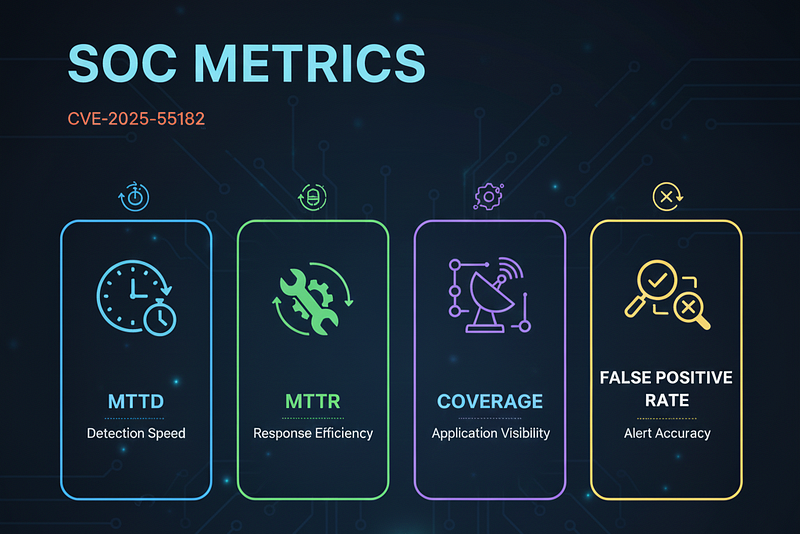 Image by AI
Conclusion
CVE-2025–55182 demonstrates why SOC teams must evolve beyond perimeter-centric detection. Application-layer vulnerabilities require deep visibility, behavioral analysis, and coordinated response workflows.
By combining robust telemetry, well-engineered detections, and disciplined incident response, SOC teams can detect and disrupt CVE-2025–55182 exploit attempts before attackers achieve lasting impact. The same principles apply broadly to modern application security threats, making these investments critical beyond a single CVE.
Ready to Streamline Compliance?
Building a secure foundation for your startup is crucial, but navigating the complexities of achieving compliance can be a hassle, especially for a small team.
SecureSlate offers a simpler solution:
- Affordable: Expensive compliance software shouldn’t be the barrier. Our affordable plans start at just $284/month.
- Focus on Your Business, Not Paperwork: Automate tedious tasks and free up your team to focus on innovation and growth.
- Gain Confidence and Credibility: Our platform guides you through the process, ensuring you meet all essential requirements and giving you peace of mind.
Disclaimer (legal note)
SecureSlate is not a law firm, and this article does not constitute or contain legal advice or create an attorney-client relationship. When determining your obligations and compliance with respect to relevant laws and regulations, you should consult a licensed attorney.
Need compliance without the complexity?
SecureSlate automates ISO 27001, SOC 2, GDPR, HIPAA, and more. Built for growing teams. See it in action.
Find compliance gaps in 30 seconds
