
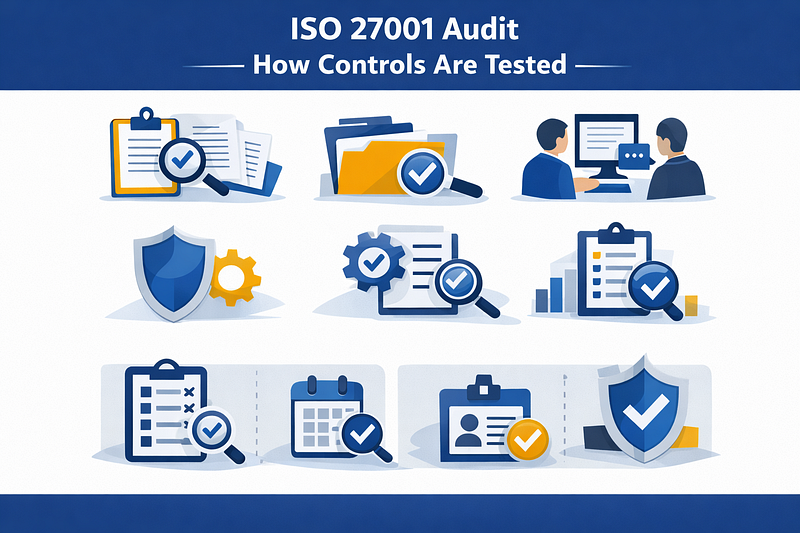
 Image by AI
Related guides:
- your guide to soc 2 audits
- the ultimate iso 27001 guide
- us data privacy compliance checklist
- ISO 27001 certification companies
- how much ISO 27001 costs
- the ISO 27001 compliance checklist
- achieving ISO 27001 certification
Key takeaways
- What Is an ISO 27001 Audit: An ISO 27001 audit is a formal assessment conducted by an accredited certification body to verify that your Information Security Management System (ISMS) meets the requirements of ISO/IEC 27001.
- ISO 27001 Controls in an Audit Context: ISO 27001 controls are defined in Annex A and selected based on your organization’s risk assessment.
- Design: Design asks whether the control is appropriate for the risk it claims to mitigate.
An ISO 27001 audit is not a paperwork exercise. It is a structured, evidence-driven examination of how your organization designs, implements, and operates information security controls in real-world conditions.
Organizations that treat the audit as a compliance checkbox often struggle, not because they lack intent, but because their controls fail under scrutiny. In contrast, organizations that understand how auditors evaluate controls approach the audit with confidence and usually pass with fewer findings.
This guide explains how ISO 27001 audits work in practice, how controls are tested, and how to prepare evidence that stands up to auditor scrutiny. It is written for organizations that want clarity, not theory; those aiming to build controls that actually work, not just look good on paper.
What Is an ISO 27001 Audit?
An ISO 27001 audit is a formal assessment conducted by an accredited certification body to verify that your Information Security Management System (ISMS) meets the requirements of ISO/IEC 27001. While many organizations assume the audit is primarily a documentation review, this is a misconception that leads to failure.
Auditors do not simply review policies and procedures. They assess whether:
- Controls exist and are appropriate for identified risks
- Controls are implemented consistently across the organization
- Controls are tested, reviewed, and improved over time
- Controls reduce real information security risk in practice
The ISO 27001 audit is risk-driven, evidence-based, and aligned with business objectives. Auditors are not looking for theoretical perfection; they seek evidence that your ISMS functions as a dynamic system rather than a static compliance artifact.
ISO 27001 Controls in an Audit Context
ISO 27001 controls are defined in Annex A and selected based on your organization’s risk assessment. The controls you implement, and the way you implement them, must be directly traceable to identified risks. This linkage is critical during an ISO 27001 audit.
During the audit, every control is evaluated across three core dimensions.
Design
Design asks whether the control is appropriate for the risk it claims to mitigate. For example, if your risk assessment identifies unauthorized access to sensitive systems, auditors will expect more than a generic access policy. They will look for controls such as role-based access, approval workflows, and periodic access reviews that clearly address the risk.
Implementation
Implementation examines whether the control is actually used in day-to-day operations. A documented process that no one follows is considered nonexistent from an auditor’s perspective. Implementation is validated through evidence, system records, and interviews.
Effectiveness
Effectiveness evaluates whether the control works consistently over time. Auditors want to see repetition, monitoring, and corrective action. A control that worked once but was never reviewed or tested again will likely fail effectiveness testing.
Auditors do not assume a control is effective simply because it exists on paper. Effectiveness must be demonstrated.
How ISO 27001 Auditors Test Controls
Documentation Review
Auditors begin by reviewing ISMS documentation to understand how your security framework is structured. This typically includes:
- Risk assessment and risk treatment plan
- Statement of Applicability (SoA)
- Security policies and procedures
- Asset inventories
- Incident response plans
- Access control policies
This step confirms that controls are clearly defined, approved by management, and aligned with identified risks. However, documentation review is only the starting point. Well-written policies cannot compensate for weak or missing operational evidence.
Auditors often use documentation to form hypotheses that they later validate through evidence and interviews. Any mismatch between documentation and reality becomes an immediate concern.
Evidence Sampling and Traceability
Once controls are understood conceptually, auditors request evidence samples to confirm implementation. Evidence is selected through sampling, not exhaustive review, but the samples must clearly demonstrate consistent control operation.
Typical evidence requests include access logs showing user provisioning and deprovisioning, change management tickets, incident records, training completion reports, and backup or restore test results. What matters most is traceability.
Auditors expect to trace evidence from policy to procedure, from procedure to execution, and from execution to recorded proof. If a control states that access reviews are conducted quarterly, auditors will expect evidence covering multiple quarters, not a single screenshot prepared just before the audit.
Traceability failures are one of the most common causes of ISO 27001 audit nonconformities.
Interviews With Control Owners
ISO 27001 audits rely heavily on interviews to validate whether controls are understood and followed by the people responsible for them. Auditors typically speak with ISMS owners, IT administrators, HR personnel, security and compliance teams, and business process owners.
These interviews are designed to test alignment between documented controls and actual behavior. If documentation states that user access is reviewed quarterly, but administrators describe ad-hoc or informal reviews, auditors will note the inconsistency.
In practice, auditors tend to trust operational staff more than documentation. When answers conflict, documentation loses credibility.
Operational Observation
In some cases, auditors directly observe controls in action. This may include watching how user access requests are processed, how incidents are escalated, how backups are monitored, or how vendor risks are reviewed.
Operational observation confirms that controls operate as part of normal business processes, not just during audit preparation. Controls that only appear during audit season are easy for experienced auditors to spot.
Common ISO 27001 Audit Tests by Control Category
Access Control Testing
Access control is one of the most frequently tested areas in an ISO 27001 audit because it directly affects confidentiality, integrity, and availability.
Auditors typically examine how role-based access is enforced, whether least privilege principles are applied, how often access reviews occur, and how promptly access is revoked when employees leave or change roles.
Auditors often request joiner-mover-leaver records, access review reports, and system access lists. Inconsistent access removal or undocumented privilege escalation is a common source of findings.
Risk Management Controls
Risk management sits at the center of the ISO 27001 audit framework. Auditors verify that risks are identified systematically, documented clearly, and reviewed regularly. They also check that risk owners are assigned, treatments are implemented, and residual risks are either mitigated or formally accepted.
An outdated risk register signals that the ISMS is no longer aligned with the organization’s reality. Even strong technical controls can be undermined by stale risk assessments.
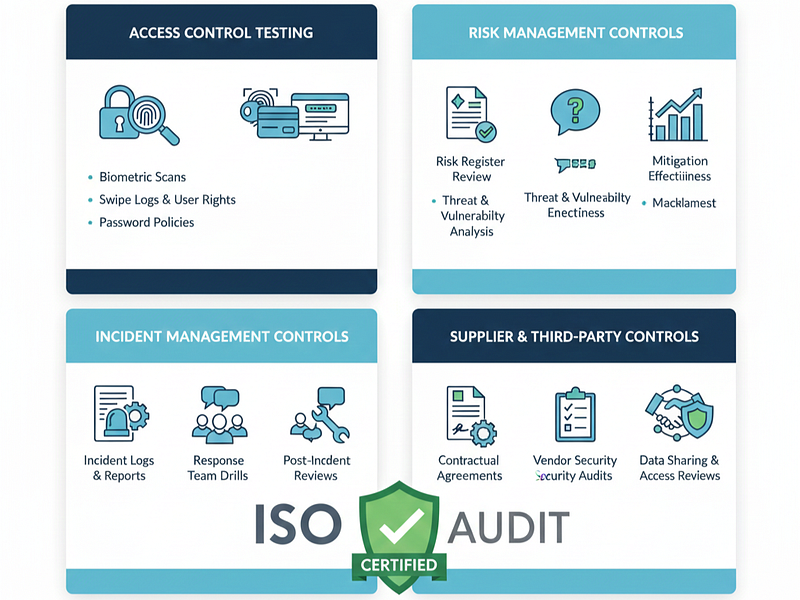 Image by AI
Incident Management Controls
Incident management controls are assessed even if no major incidents have occurred. Auditors want to see that incidents are logged consistently, response timelines are defined, root cause analysis is performed, and corrective actions are tracked to completion.
A phishing email or failed login attempt can serve as valid audit evidence if handled according to documented procedures. Auditors are less concerned about incident volume and more concerned about response discipline.
Supplier and Third-Party Controls
Supplier security is often underestimated but frequently tested during an ISO 27001 audit. Auditors examine how vendors are assessed, whether security requirements are embedded in contracts, how often suppliers are reviewed, and how critical vendors are monitored.
Organizations that cannot demonstrate visibility into third-party risk often receive findings, especially when suppliers handle sensitive data or provide critical services.
Stage 1 Vs Stage 2 ISO 27001 Audit: Control Expectations
Stage 1 Audit (Readiness Review)
The Stage 1 audit focuses on whether your ISMS is ready for certification. Auditors review the ISMS scope, risk assessment completeness, control selection rationale, and documentation maturity.
Controls do not need a long operational history at this stage, but they must be clearly defined, justified, and aligned with risk.
A successful Stage 1 audit sets the foundation for Stage 2 by identifying gaps early.
Stage 2 Audit (Certification Audit)
The Stage 2 audit is where controls are tested in depth. Auditors examine implementation evidence, historical records, control effectiveness, and continuous improvement activities. This is where most nonconformities are issued.
Controls must demonstrate consistent operation over time. One-off evidence or undocumented practices rarely pass Stage 2 scrutiny.
Internal Audits: Preparing for the External ISO 27001 Audit
An internal audit is not optional; it is a mandatory requirement under ISO 27001 and a critical preparation step for the external audit. Effective internal audits test the same controls external auditors will examine, identify gaps early, and produce corrective actions with clear owners and timelines.
Internal audit results feed directly into management review, demonstrating leadership oversight and accountability. Organizations that treat internal audits as superficial checklist exercises often struggle during certification because weaknesses surface too late.
A meaningful internal audit mirrors the mindset of a certification auditor rather than acting as a compliance formality.
Common ISO 27001 Audit Nonconformities Related to Controls
Controls Defined on Paper but Not in Practice
One of the most frequent ISO 27001 audit nonconformities occurs when controls are well documented but inconsistently applied in daily operations. Policies and procedures describe how security should function, yet real-world practices do not fully follow them. Auditors detect these gaps quickly when operational evidence fails to support what is written in the ISMS documentation.
This disconnect often appears in access management, change control, and incident handling processes, where informal shortcuts gradually replace defined workflows.
Missing, Incomplete, or Conflicting Evidence
Another common issue is evidence that is missing, incomplete, or contradictory. In many organizations, controls are performed but not consistently recorded. For example, access reviews may happen verbally or via informal messages, but without dated records, approvals, or documented outcomes, auditors cannot verify that the control operated as required.
In some cases, evidence exists but conflicts with other records, such as access logs that do not align with review reports. These inconsistencies undermine auditor confidence in the control environment.
Outdated Risk Assessments and Weak Risk Linkage
Risk assessments that are not reviewed regularly often lead to nonconformities. When business processes, systems, or threats change, but the risk register remains static, controls become disconnected from actual risk. Auditors expect to see a clear and current link between identified risks, selected controls, and implemented treatments.
An outdated risk register signals that the ISMS may not be actively managed.
Informal or Undocumented Control Testing
Many organizations rely on informal control checks rather than structured testing. While teams may “know” that a control works, auditors require documented proof. Without defined testing methods, schedules, and results, it becomes difficult to demonstrate control effectiveness over time.
Auditors interpret undocumented testing as a lack of control monitoring.
Superficial Management Review Outputs
Management reviews are often conducted, but the outputs are weak. Meeting notes may lack analysis, decisions, or action items related to control performance and risk. Auditors expect management reviews to demonstrate leadership oversight, accountability, and commitment to continuous improvement.
When management review records are shallow, auditors question the effectiveness of governance.
How to Strengthen Control Testing Before an ISO 27001 Audit
Assign Clear Ownership for Every Control
Strong control testing starts with accountability. Each ISO 27001 control should have a clearly defined owner responsible for execution, monitoring, testing, and evidence maintenance. When ownership is explicit, controls are more likely to operate consistently and improve over time.
Auditors often assess ownership indirectly through interviews, making this a critical foundation.
Define Control Frequency and Review Cycles
Controls must clearly state how often they operate and how often they are reviewed. Whether a control runs daily, monthly, quarterly, or annually, consistent frequency creates predictable evidence and sets clear auditor expectations.
Vague or undefined timing leads to inconsistent execution and audit findings.
Automate Evidence Collection Where Possible
Automation significantly strengthens control testing by reducing human error and improving evidence quality. System-generated logs, automated access reviews, and monitoring reports provide time-stamped, objective proof that auditors trust.
Automation also removes the pressure of manually gathering evidence during the audit window.
Maintain a Centralized, Audit-Ready Evidence Repository
A centralized evidence repository allows organizations to store, organize, and retrieve control evidence efficiently. When evidence is clearly labeled, traceable, and up to date, audit requests can be fulfilled quickly and accurately.
This approach minimizes the risk of submitting outdated or inconsistent records.
Test Controls Continuously, Not Just Annually
Controls should be tested on an ongoing basis rather than once a year before the audit. Continuous testing allows teams to identify weaknesses early and apply corrective actions before they escalate into nonconformities.
Auditors consistently reward organizations that demonstrate steady, repeatable control operation over time, even when minor issues are identified and resolved.
Make Control Testing Part of Daily Operations
Organizations that embed control testing into everyday workflows find that ISO 27001 audits become confirmation exercises rather than confrontations. When controls are routinely tested, evidence is always available, and staff understand their responsibilities, the audit simply validates an already mature security posture.
This is the difference between preparing for an audit and being truly audit-ready.
Conclusion
An ISO 27001 audit is ultimately a test of discipline, not documentation. Auditors want to see that your controls are risk-driven, actively managed, and continuously improved. When controls function effectively in real life, evidence naturally accumulates, and interviews align with documentation.
Organizations that understand how controls are tested and validated do not fear audits. They use the ISO 27001 audit as proof of operational maturity, resilience, and trustworthiness.
When controls work in practice, the audit stops being an obstacle and becomes a validation of how your organization protects what matters most.
Ready to Streamline Compliance?
Building a secure foundation for your startup is crucial, but navigating the complexities of achieving compliance can be a hassle, especially for a small team.
SecureSlate offers a simpler solution:
- Affordable: Expensive compliance software shouldn’t be the barrier. Our affordable plans start at just $284/month.
- Focus on Your Business, Not Paperwork: Automate tedious tasks and free up your team to focus on innovation and growth.
- Gain Confidence and Credibility: Our platform guides you through the process, ensuring you meet all essential requirements and giving you peace of mind.
FAQ
What platforms help track ISO 27001 audit progress?
Platforms that track ISO 27001 audit progress give a live view of control implementation, evidence status, and remaining gaps against the 93 Annex A controls. They replace static spreadsheets with real-time readiness.
- Dashboards show which Annex A controls are met, in progress, or failing.
- Automated evidence collection keeps status current.
- They also generate your Statement of Applicability and risk register.
Disclaimer (legal note)
SecureSlate is not a law firm, and this article does not constitute or contain legal advice or create an attorney-client relationship. When determining your obligations and compliance with respect to relevant laws and regulations, you should consult a licensed attorney.
Need compliance without the complexity?
SecureSlate automates ISO 27001, SOC 2, GDPR, HIPAA, and more. Built for growing teams. See it in action.
Find compliance gaps in 30 seconds
