 Image from pexels.com
Related guides:
Key takeaways
- What is ISO 27001 and Why Does It Matter for SaaS: ISO 27001 is the internationally recognized standard for information security management systems (ISMS), created by the International Organization for Standardization (ISO).
- Who Needs ISO 27001 Compliance in SaaS: If you’re handling sensitive data, storing customer information in the cloud, or serving enterprise clients, you need ISO 27001.
- Structure of ISO 27001: Annex A Controls and Clauses: ISO 27001 is built around the concept of an Information Security Management System (ISMS), a systematic approach to managing sensitive information.
Every SaaS business today constantly balances stringent security demands with the imperative of maintaining customer trust. If ISO 27001 compliance isn’t yet on your radar, you’re likely feeling the mounting pressure.
This guide cuts through the noise, offering a practical, SaaS-centric view of ISO 27001 compliance. We’ll provide actionable steps and real-world insights, ensuring you have precisely what you need to achieve and maintain compliance.
What is ISO 27001 and Why Does It Matter for SaaS?
ISO 27001 is the internationally recognized standard for information security management systems (ISMS), created by the International Organization for Standardization (ISO).
ISO 27001 outlines how to manage sensitive company information so it remains secure, whether it’s customer data, financial records, or intellectual property.
For SaaS businesses in 2025, ISO 27001 is more than just a badge of honor. It’s a competitive edge.
SaaS companies are prime targets for cyberattacks. You store client data in the cloud, operate across borders, and rely on third-party integrations. All of this makes your attack surface wide, and your responsibility even wider.
With ISO 27001 compliance, you’re proving to customers, investors, and regulators that you take data protection seriously.
Here’s why ISO 27001 matters now more than ever:
- Global clients expect it: Enterprise customers are increasingly demanding ISO 27001 certification from their SaaS vendors before signing contracts.
- Regulatory pressure is rising: With data privacy laws like GDPR, CCPA, and others tightening their grip, ISO 27001 provides a framework for compliance.
- It prevents breaches: The standard helps identify risks and put safeguards in place before hackers can exploit them.
- Builds customer trust: ISO 27001 is a clear signal that your business is secure, organized, and professional.
Who Needs ISO 27001 Compliance in SaaS?
If you’re handling sensitive data, storing customer information in the cloud, or serving enterprise clients, you need ISO 27001.
Especially if you are:
- A B2B SaaS with enterprise customers
- A fintech, healthtech, edtech, or govtech startup
- A global SaaS expanding into new regions
- A company preparing for funding or acquisition
- A startup aiming to shorten long procurement cycles
Even if you’re not legally required to comply, you’ll gain significant business and operational advantages by doing so.
Structure of ISO 27001: Annex A Controls and Clauses
ISO 27001 is built around the concept of an Information Security Management System (ISMS), a systematic approach to managing sensitive information.
It includes:
- Clauses 4 to 10 : These outline the mandatory requirements for establishing, implementing, maintaining, and continually improving the ISMS. Key topics include:
- Organizational context
- Leadership and commitment
- Risk assessment and treatment
- Operational planning
- Internal audits
- Continuous improvement
- Annex A: This section contains 93 security controls grouped into 4 themes (as per ISO/IEC 27001:2022 update):
- Organizational controls (e.g., policies, roles, and responsibilities)
- People controls (e.g., background checks, training)
- Physical controls (e.g., secure areas, equipment protection)
- Technological controls (e.g., malware defense, access control)
ISO 27001 Documentation You’ll Need
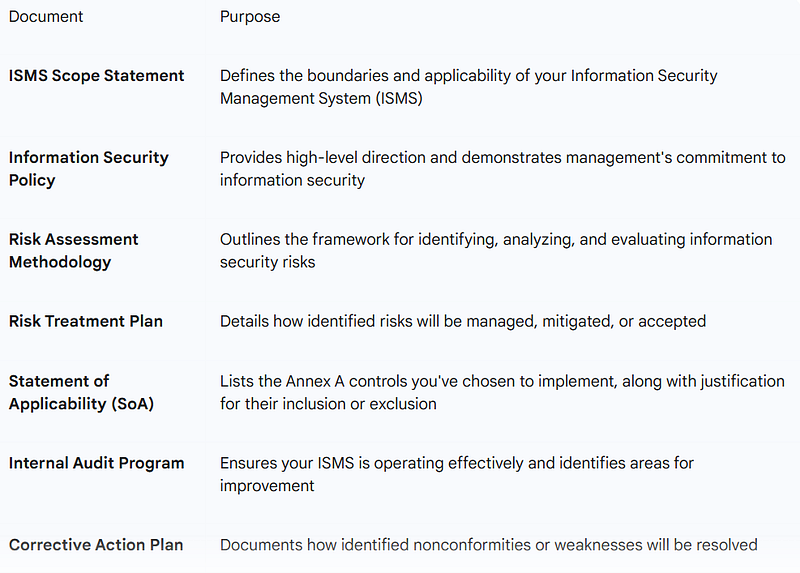
Documentation is the backbone of ISO 27001 compliance. It proves that your processes exist, are implemented, and are continuously monitored. But don’t worry. You don’t need a novel-length policy manual. You just need the right documents.
Here’s a breakdown of what your SaaS company will need:
Mandatory Documents
These are explicitly required by the standard:
Common Supporting Documents
Not explicitly required but crucial for smooth audits and practical implementation:
- Access control policy
- Acceptable use policy
- Data classification policy
- Business continuity plan
- Third-party vendor assessment template
- Incident response playbook
- Training logs and awareness programs
Step-by-Step ISO 27001 Compliance Process for SaaS
ISO 27001 compliance can seem like a heavy lift, especially for fast-moving SaaS companies, but it becomes much more manageable when approached step by step.
Define Your ISMS Scope and Context
Before anything else, you need to clearly define the scope of your Information Security Management System (ISMS).
For SaaS businesses, this typically includes your cloud platforms (like AWS, Azure, or GCP), production environments, customer data, APIs, CI/CD pipelines, and any third-party services that interact with sensitive information.
You’ll also need to identify internal and external factors that influence your ISMS , such as legal regulations, client contracts, industry standards, and key stakeholders. Include all physical and virtual locations, and don’t overlook remote teams or outsourced functions.
A poorly defined scope leads to missed risks, misaligned controls, and potential audit failure.
Conduct a Risk Assessment
Risk assessment involves identifying valuable assets like customer databases, source code, financial records, and pinpointing the potential threats and vulnerabilities that could affect them.
You can choose between a qualitative approach (using labels like high, medium, and low) or a quantitative one (assigning numerical scores to likelihood and impact). Whichever method you choose, the goal is the same: understand which risks pose the biggest threat to your business.
This assessment forms the backbone of your compliance strategy, helping you decide which controls to implement and where to focus your efforts.
Create a Risk Treatment Plan (RTP)
Your Risk Treatment Plan outlines the actions your team will take to reduce, transfer, accept, or eliminate each risk.
For example, a high-risk vulnerability might be addressed by enforcing multi-factor authentication, while a lower-priority risk could be accepted with proper documentation.
In some cases, risks may be transferred through insurance or vendor agreements, or eliminated by discontinuing a risky system altogether.
Make sure your RTP is regularly reviewed, clearly assigned to responsible owners, and tracked over time. It should be a living part of your compliance program, not a document that gathers dust.
Develop Security Policies and Procedures
Security policies are the backbone of ISO 27001 compliance. But they shouldn’t be generic or overly complicated. Instead, create policies that reflect how your SaaS team actually operates.
These documents should cover areas such as access control, password policies, incident response, secure software development, data classification, remote work, and vendor management. Use straightforward language and make sure your team understands their responsibilities.
Review and update your policies regularly, especially when your systems or processes change. Compliance isn’t just about documentation; it’s about consistent, real-world practice.
Assign Roles and Responsibilities
One of the most common reasons compliance efforts stall is a lack of ownership. ISO 27001 requires that responsibilities be clearly defined and distributed.
Start by appointing an ISMS Manager, usually someone at the executive or senior level who can drive the initiative forward. Then assign control owners across departments like IT, Engineering, HR, and Legal. These individuals are responsible for implementing and maintaining specific controls.
Also, identify internal auditors and, if applicable, a compliance or data protection officer. Clear roles ensure accountability and prevent confusion.
Implement and Monitor Controls
Security controls should directly address the risks identified earlier and align with ISO 27001 Annex A controls.
For SaaS companies, controls often include MFA across all systems, endpoint protection, regular vulnerability scanning, logging and monitoring of cloud environments, secure coding practices, and incident response processes.
Ongoing monitoring is essential. Controls aren’t “set it and forget it”, they need to be tested, validated, and continuously improved. Use automation to help with this. Integrating tools like AWS CloudTrail, Google Workspace, or Jira can streamline evidence collection and flag anomalies early.
Conduct Internal Audits and Management Reviews
Internal audits are your chance to check whether your ISMS is functioning as intended. They help uncover gaps, weaknesses, or nonconformities before your external auditor does. Aim to perform audits quarterly or biannually, depending on your size and risk profile.
In addition to audits, conduct regular management reviews to evaluate the performance of your ISMS at a strategic level. These reviews should examine KPIs, assess resource needs, consider changes in business or risk context, and identify opportunities for improvement.
Together, audits and reviews ensure your compliance program stays aligned with your security and business goals.
Top 10 Must-Have Items in Your ISO 27001 Audit Checklist PDF
Your ISO Essentials!
Prepare for External Audit and Certification
Lastly, it’s time to validate your efforts with a third-party certification audit. This process happens in two stages:
- Stage 1: The auditor reviews your documentation, including your scope, risk assessment, policies, and treatment plans.
- Stage 2: The auditor evaluates your actual implementation. This includes control walkthroughs, interviews with employees, and examination of collected evidence.
If you meet the requirements, you’ll be issued an ISO 27001 certificate demonstrating to customers, partners, and regulators that you take security seriously and follow international best practices.
How Automation Can Lighten Your ISO 27001 Compliance
If this all sounds overwhelming, you’re not alone. Many SaaS companies feel the same way when faced with the complexity of ISO 27001. That’s why a growing number of teams are turning to compliance automation tools to take the pressure off and keep everything organized.
With the right platform, automation can help you:
- Map ISO 27001 controls directly to your existing infrastructure , ensuring each control is implemented in a way that aligns with your systems.
- Automatically collect and refresh evidence , so you don’t have to chase down screenshots, logs, or spreadsheets every time an auditor comes knocking.
- Track risk treatment progress in real time , giving you instant visibility into what’s been addressed, what’s pending, and who’s responsible.
- Send smart reminders to task owners and stakeholders , keeping everyone on track with attestations, reviews, and control responsibilities.
- Generate audit-ready reports with a few clicks , cutting down on last-minute scrambles and reducing the chances of non-conformities.
Common ISO 27001 Gaps in SaaS Startups
SaaS startups often run lean; fast-paced environments, minimal overhead, and aggressive growth goals. While that’s great for innovation, it can also lead to some major compliance pitfalls.
Here are the most common ISO 27001 gaps to watch out for:
No Formal Risk Assessment
Startups SaaS tend to manage risk intuitively, not systematically. ISO 27001 requires a repeatable, documented process.
Weak Access Controls
Shared admin accounts, no MFA, and poor offboarding practices are red flags. ISO 27001 demands role-based access and account hygiene.
Lack of Security Awareness Training
Even the best technical controls can be undone by human error. Training needs to be regular, documented, and company-wide.
Missing Documentation
You can’t pass an audit without it. Verbal processes won’t cut it. You need clear, reviewable records.
No Continuous Improvement Loop
The ISO standard requires not just implementation but ongoing monitoring and improvement.
Timeline & Cost of ISO 27001 Certification in 2025
Time and money are top concerns for SaaS companies pursuing certification. Here’s what you can expect:
Timeline
- Preparation & Implementation: 3–6 months (can be faster with automation tools)
- Internal Audit & Remediation: 1 month
- External Audit : 4–6 weeks
Total: 4–8 months , depending on your size and complexity.
Cost Breakdown
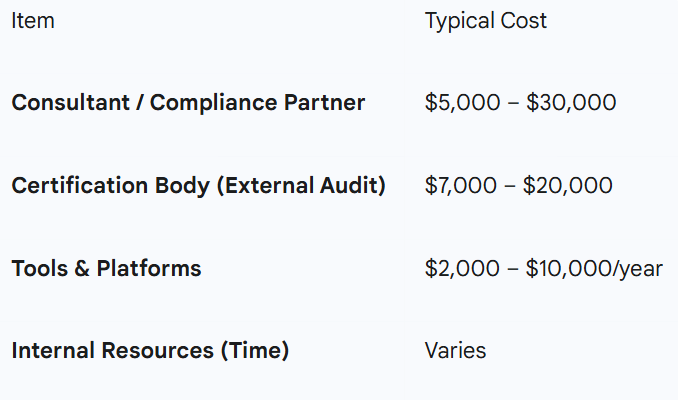
For most SaaS companies, the total cost ranges from $15,000 to $50,000 in the first year.
Best Practices for a Smooth ISO 27001 Audit
Want to ace your ISO 27001 audit the first time around? It’s not just about luck; it takes preparation, discipline, and the right approach. Let’s discuss best practices that can help you breeze through the process with confidence and ease:
Assign a Dedicated Compliance Owner
Assigning a full-time or part-time ISO lead is crucial. This individual should possess the authority to make decisions and the budget to implement necessary changes.
Having a dedicated compliance owner ensures accountability and clarity, streamlining your compliance efforts and keeping everyone on track.
Use a Centralized Documentation System
Keeping all policies, logs, and reports in one secure, auditable place is essential. Avoid the pitfalls of scattered email chains and random Google Docs, which can lead to confusion and errors.
A centralized documentation system allows for easier access, version control, and oversight, ensuring that everyone is working from the most current and accurate information.
Conduct a Mock Audit
A mock audit helps prepare your team by identifying potential gaps in compliance and boosting confidence. It’s an opportunity to practice responses, refine processes, and ensure that everyone understands their roles.
By treating the mock audit seriously, you can pinpoint weaknesses and address them before the actual audit.
Automate Where You Can
Leverage tools like SecureSlate to reduce manual tasks associated with compliance. Automation can streamline evidence collection, track control effectiveness, and maintain documentation effortlessly.
You can stay audit-ready without the last-minute scramble, allowing your team to focus on more strategic compliance initiatives with automation.
Treat It as a Cultural Shift
ISO 27001 compliance isn’t just about checkboxes; it’s about embedding security into how your team works daily. Foster a culture that prioritizes information security and compliance.
Encourage open discussions about security practices, provide regular training, and make security everyone’s responsibility. This cultural shift not only enhances compliance but also strengthens your organization’s overall security posture.
How SecureSlate Streamlines ISO 27001 Compliance for SaaS Companies
ISO 27001 compliance can be time-consuming, but SecureSlate makes it simple. Purpose-built for SaaS teams, SecureSlate automates and simplifies the entire process, from control mapping to audit readiness.
Here’s how:
- Pre-Mapped Controls : SecureSlate maps ISO 27001 controls to your cloud infrastructure (AWS, GCP, Azure) out of the box, no manual work required.
- Automated Evidence Collection : It continuously pulls evidence from your systems (GitHub, Okta, Jira, Slack, etc.), keeping your compliance always audit-ready.
- Real-Time Dashboards : Track risks, control gaps, and progress in one place. Assign tasks and monitor remediation without spreadsheets.
- Policy Templates : Use pre-built, editable templates to create compliant policies in minutes, no legalese or guesswork.
- Audit-Ready Reports : Export everything your auditor needs with a single click. Say goodbye to last-minute panic.
- Built for SaaS : Whether you’re an early-stage startup or scaling fast, SecureSlate grows with you, supporting ISO 27001, SOC 2, GDPR, and more.
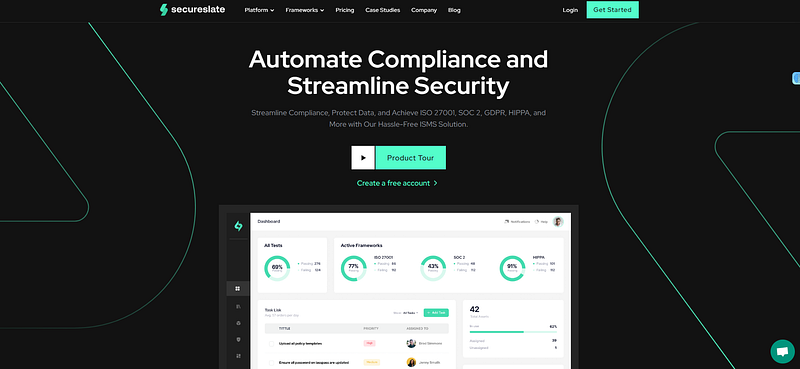
Secure your systems, earn customer trust, and fast-track ISO 27001 compliance: all in one platform, SecureSlate.
Conclusion
ISO 27001 compliance doesn’t need to be overwhelming for SaaS companies. With a clear process, dedicated owners, and smart use of automation tools like SecureSlate, you can stay compliant without derailing your product or engineering roadmap. By embedding security into your day-to-day operations, you not only earn a certificate, but you build long-term trust with your customers.
Ready to Streamline Compliance?
Building a secure foundation for your startup is crucial, but navigating the complexities of achieving compliance can be a hassle, especially for a small team.
SecureSlate offers a simpler solution:
- Affordable: Expensive compliance software shouldn’t be the barrier. Our affordable plans start at just $284/month.
- Focus on Your Business, Not Paperwork: Automate tedious tasks and free up your team to focus on innovation and growth.
- Gain Confidence and Credibility: Our platform guides you through the process, ensuring you meet all essential requirements, and giving you peace of mind.
Disclaimer (legal note)
SecureSlate is not a law firm, and this article does not constitute or contain legal advice or create an attorney-client relationship. When determining your obligations and compliance with respect to relevant laws and regulations, you should consult a licensed attorney.
Need compliance without the complexity?
SecureSlate automates ISO 27001, SOC 2, GDPR, HIPAA, and more. Built for growing teams. See it in action.
Find compliance gaps in 30 seconds