
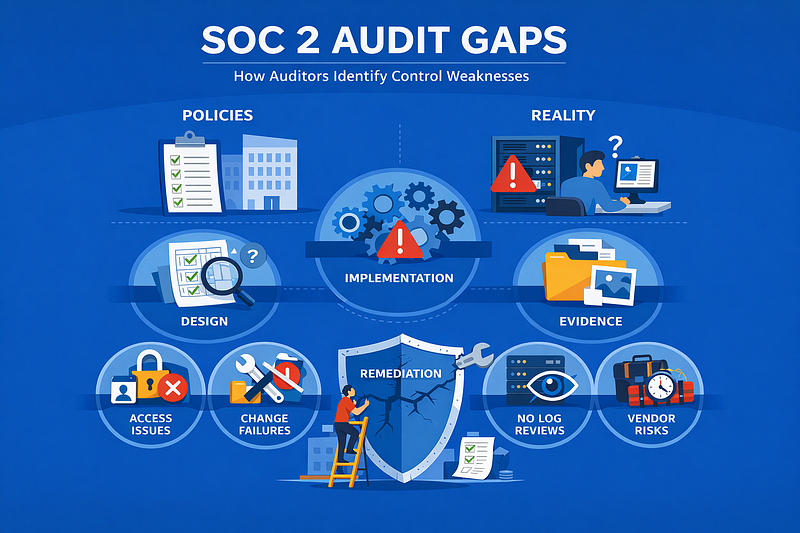
 Image by AI
Related guides:
Key takeaways
- What Are SOC 2 Audit Gaps: In the context of a SOC 2 audit, a gap is the difference between.
- Why SOC 2 Audit Gaps Matter More Than You Think: SOC 2 audit gaps don’t just slow down an audit; they create ripple effects across trust, revenue, and day-to-day operations.
- Impact on Customer Trust: Qualified or adverse SOC 2 opinions raise red flags for customers and partners.
A SOC 2 audit rarely fails because a company lacks security tools. Most failures occur because controls exist, but don’t work the way auditors expect. These disconnects are known as SOC 2 audit gaps, and they are one of the most common reasons audits stall, receive qualified opinions, or require costly remediation.
Understanding how auditors identify control weaknesses is critical if you want to pass a SOC 2 audit efficiently and avoid last-minute surprises.
This article breaks down what SOC 2 audit gaps really are, how auditors uncover them, and most importantly, how organizations can close them before they become audit findings.
What Are SOC 2 Audit Gaps?
In the context of a SOC 2 audit, a gap is the difference between:
- What your organization claims to do (policies, procedures, control descriptions)
- What actually happens in practice (evidence, system behavior, user activity)
SOC 2 auditors evaluate controls against the Trust Services Criteria (TSC) , primarily Security, and optionally Availability, Confidentiality, Processing Integrity, and Privacy. When a control fails to meet the design or operational expectations of these criteria, an audit gap is identified.
Importantly, a gap does not always mean insecurity. It often means:
- Controls are informal or undocumented
- Evidence is missing or inconsistent
- Responsibilities are unclear
- Controls are not operating consistently over time
Auditors are trained to identify these weaknesses systematically.
Why SOC 2 Audit Gaps Matter More Than You Think
SOC 2 audit gaps don’t just slow down an audit; they create ripple effects across trust, revenue, and day-to-day operations. What often starts as a “minor control issue” can quickly escalate into a business-level problem.
Impact on Customer Trust
Qualified or adverse SOC 2 opinions raise red flags for customers and partners. Buyers rely on SOC 2 reports to validate security posture, and unresolved gaps often lead to additional scrutiny or lost confidence.
Higher Costs and Longer Audits
Audit gaps increase testing, evidence requests, and remediation work. This extends audit timelines and drives up both auditor fees and internal effort.
Sales and Operational Disruption
When prospects ask for a clean SOC 2 report, gaps can stall or kill deals. At the same time, re-audits and remediation periods disrupt normal operations. Teams are pulled into reactive work, engineering resources are diverted to compliance fixes, and leadership attention shifts from growth to damage control.
How SOC 2 Auditors Identify Control Gaps
SOC 2 auditors don’t rely on automated scans or assumptions. They use a structured, evidence-driven process that evaluates how controls are designed, how they are implemented, and whether they operate consistently over time:
Reviewing Control Design
Auditors begin by examining whether controls are designed to meet SOC 2 Trust Services Criteria in a clear and enforceable way. They assess whether each control is specific enough to be tested and whether accountability is clearly defined.
Design gaps typically appear when policies are overly generic, copied from templates, or loosely mapped to SOC 2 requirements. Controls may sound reasonable on paper, but fail to explain how they actually work in practice.
A common example is stating that “access is restricted to authorized users” without defining how access is approved, reviewed, or revoked.
When controls lack clarity or ownership, auditors flag them as design weaknesses, even if the underlying intent is sound.
Evaluating Control Implementation
After reviewing the design, auditors verify whether controls are implemented exactly as documented. This involves comparing written policies with system configurations and real operational workflows.
Implementation gaps often surface when controls are only partially deployed. For example, multi-factor authentication may be required by policy but not enforced across all systems. Logging may be enabled, but logs are neither retained nor reviewed consistently. Vendor risk processes may exist on paper but are applied inconsistently in practice.
This stage is where many organizations struggle, as even small mismatches between documentation and reality can result in audit findings.
Testing Control Operating Effectiveness
In SOC 2 Type II audits, auditors focus heavily on whether controls operate consistently throughout the audit period. They review samples, test recurring activities, and look for missed executions or anomalies.
Gaps commonly appear when controls are performed irregularly or inconsistently. Access reviews may happen sporadically instead of on a defined schedule. Incident response plans may exist but are never tested. Security training may be completed by most, but not all, employees.
Even a single missed control execution can be documented as an audit gap.
Evidence: Where Most SOC 2 Audit Gaps Are Found
Evidence is the foundation of a SOC 2 audit, and also the most common place where gaps emerge. Auditors rely on evidence to verify that controls not only exist but are operating effectively throughout the audit period.
For evidence to be acceptable, it must be objective, time-stamped, and independently verifiable.
Many audit gaps arise when evidence fails to meet these standards. In some cases, evidence is incomplete or missing altogether. This includes screenshots without timestamps, policies that lack approval or review dates, or logs that cover only part of the audit window.
Other gaps occur due to inconsistency. Different systems may show conflicting configurations, manual processes may be performed differently by separate teams, or evidence may be collected informally instead of through a repeatable process. These inconsistencies make it difficult for auditors to confirm that controls operate reliably.
Gaps also appear when the evidence does not match the control being tested. Providing a written policy when auditors expect operational proof, submitting a tool screenshot instead of a documented process, or showing planned actions rather than completed ones are all common reasons evidence is rejected.
Auditors are trained to evaluate evidence strictly. If it does not directly and clearly support the specific control under review, it will not be accepted, regardless of intent or effort.
High-Risk Areas Where SOC 2 Audit Gaps Commonly Appear
Some control areas are more prone to gaps due to complexity, manual processes, or frequent change.
Access Control and User Management
Auditors closely examine how users are added, removed, and reviewed. Gaps often arise when former employees retain access, access reviews are undocumented or irregular, or shared accounts exist without justification.
Change Management
Auditors assess whether system changes are properly requested, approved, tested, and deployed. Gaps commonly appear when emergency changes lack retroactive approval, change tickets are missing, or developers have unrestricted production access.
Logging and Monitoring
Auditors expect centralized logging, defined retention periods, and evidence of regular log review. Gaps surface when logs exist but are never reviewed, alerts are ignored, or monitoring responsibilities are unclear.
Vendor Risk Management
Third-party risk is a growing focus in SOC 2 audits. Gaps often occur when vendor inventories are incomplete, risk assessments are outdated, or there is no defined process for securely offboarding vendors.
Incident Response
Auditors want proof that incident response capabilities are tested and operational. Gaps arise when incidents, even minor ones, are never documented, tabletop exercises are skipped, or response roles are unclear. A lack of incidents alone is not sufficient; auditors expect evidence of preparedness.
How Auditors Document and Classify SOC 2 Audit Gaps
Not all audit gaps carry the same weight. Auditors classify findings based on severity:
- Control Deficiency: A control is missing or poorly designed
- Significant Deficiency: A control exists but is unreliable
- Material Weakness : A failure that undermines trust criteria, objectives
Severity depends on the scope of impact, frequency of failure, likelihood of exploitation, and whether compensating controls exist. Understanding these distinctions helps teams prioritize remediation effectively.
Why Companies Miss SOC 2 Audit Gaps Before the Audit
Many organizations believe they are “audit-ready” but still fail to identify gaps early.
Common reasons include:
- Relying on policies instead of operational proof
- Treating SOC 2 as a documentation exercise
- Underestimating auditor sampling methods
- Manual evidence collection errors
- Lack of internal control of ownership
SOC 2 audits reward discipline and consistency , not just intent.
How to Proactively Identify SOC 2 Audit Gaps
The best way to avoid audit findings is to identify gaps internally before auditors do.
Perform a SOC 2 Gap Assessment
A structured gap assessment maps controls to Trust Services Criteria, evaluates both design and operation, and highlights weak or missing evidence. This mirrors auditor methodology and exposes issues early.
Test Controls Like an Auditor
Teams should ask whether they can prove each control worked for the full audit period, whether the evidence is objective and repeatable, and whether an external auditor would accept it without clarification. Internal sampling often reveals gaps before formal testing begins.
Centralize Evidence and Ownership
Disorganized evidence is a silent risk. Central repositories, consistent naming conventions, and automated evidence capture reduce confusion and audit friction. Just as importantly, every control should have a clearly assigned owner responsible for execution and evidence.
Use Automation to Reduce Human Error
Manual processes introduce variability. Automation helps enforce control execution, collect continuous evidence, and detect configuration drift. While it doesn’t remove accountability, it significantly reduces the likelihood of audit gaps.
Closing SOC 2 Audit Gaps: What Auditors Expect
When SOC 2 audit gaps are identified, auditors are not just looking for a quick fix; they are seeking evidence that the underlying issue has been thoroughly understood and fully addressed.
The first expectation is a clear root cause analysis that explains why the gap occurred, whether it was due to process failure, unclear ownership, tooling limitations, or inconsistent execution.
Auditors also expect well-defined remediation plans that outline specific corrective actions, responsible owners, and realistic timelines. Vague commitments or one-off corrections are rarely sufficient. What matters most is whether the remediation reduces the risk of the issue recurring.
Most importantly, auditors want proof that corrective actions are sustained over time. This means updated controls are operating as designed, supported by repeatable processes and reliable evidence. Controls that are fixed temporarily without improving the surrounding process often reappear as findings in future audits.
Effective remediation typically involves strengthening core processes, refining tool configurations to enforce controls automatically, improving staff training and awareness, and, when necessary, redesigning controls to better align with how the organization actually operates.
When remediation addresses both execution and accountability, audit gaps are far less likely to resurface.
Conclusion
SOC 2 audit gaps are not signs of failure; they are indicators of misalignment between intent and execution. Auditors identify control weaknesses through structured testing, evidence validation, and consistency checks.
Organizations that treat SOC 2 as an ongoing operational discipline, not a one-time audit, are far more likely to pass cleanly, reduce stress, and build lasting customer trust.
By understanding how auditors identify gaps and addressing weaknesses proactively, companies can turn SOC 2 from a compliance burden into a competitive advantage.
Ready to Streamline Compliance?
Building a secure foundation for your startup is crucial, but navigating the complexities of achieving compliance can be a hassle, especially for a small team.
SecureSlate offers a simpler solution:
- Affordable: Expensive compliance software shouldn’t be the barrier. Our affordable plans start at just $284/month.
- Focus on Your Business, Not Paperwork: Automate tedious tasks and free up your team to focus on innovation and growth.
- Gain Confidence and Credibility: Our platform guides you through the process, ensuring you meet all essential requirements and giving you peace of mind.
FAQ
What is the SOC 2 control list?
There is no fixed SOC 2 control list; controls are designed by each organization to satisfy the AICPA Trust Services Criteria. The Security (Common Criteria) category is mandatory for every report.
- Common Criteria CC1–CC9 cover governance, access, operations, and change.
- Optional categories add Availability, Confidentiality, Processing Integrity, and Privacy.
- See the full SOC 2 controls list and what auditors expect.
Disclaimer (legal note)
SecureSlate is not a law firm, and this article does not constitute or contain legal advice or create an attorney-client relationship. When determining your obligations and compliance with respect to relevant laws and regulations, you should consult a licensed attorney.
Need compliance without the complexity?
SecureSlate automates ISO 27001, SOC 2, GDPR, HIPAA, and more. Built for growing teams. See it in action.
Find compliance gaps in 30 seconds
