

Related guides:
Key takeaways
- What Are SOC 2 and ISO 27001: SOC 2, short for System and Organization Controls 2, is a cybersecurity compliance standard created by the American Institute of Certified Public Accountants (AICPA).
- What is the difference between SOC 2 and ISO 27001: While SOC 2 and ISO 27001 both aim to strengthen an organization’s information security posture, they approach the goal in very different ways.
- Origin and Governing Body: SOC 2 was developed by the American Institute of Certified Public Accountants (AICPA).
Companies constantly seek ways to assure their clients and partners that sensitive data is in safe hands. Among the many frameworks designed for this purpose, SOC 2 (System and Organization Controls 2) and ISO 27001 (International Organization for Standardization 27001) stand out as the most widely recognized benchmarks.
It’s a question we hear often: which one is right for our business?
There’s no single, simple answer to whether one of these frameworks is definitively “better” than the other. The ideal path depends heavily on an organization’s specific circumstances, including its industry, the markets it serves, its client base, and its overall security objectives.
To make an informed decision, it’s essential to understand the core distinctions and common ground between these two powerful security frameworks. Let’s explore their individual strengths and applications, helping you determine the most suitable strategy for your company’s security assurance efforts.
What Are SOC 2 and ISO 27001?
SOC 2, short for System and Organization Controls 2, is a cybersecurity compliance standard created by the American Institute of Certified Public Accountants (AICPA). It’s tailored specifically for service providers that store, process, or transmit customer data, especially cloud-based companies.
The SOC 2 framework evaluates how effectively an organization implements controls across five Trust Services Criteria (TSC):
- Security: Protection against unauthorized access
- Availability: System uptime and operational reliability
- Confidentiality: Restricting access to sensitive information
- Processing Integrity: Accurate and timely system processing
- Privacy: Protection of personal data in line with company policies
Top 10 SOC 2 Controls You Can’t Afford to Ignore!
Must-Have Security Tips!
ISO 27001, officially known as ISO/IEC 27001, is an internationally recognized standard for creating and managing an Information Security Management System (ISMS). This structured framework was developed jointly by the International Organization for Standardization (ISO) and the International Electrotechnical Commission (IEC) in 2005.
The goal of ISO 27001 is to help organizations maintain the confidentiality, integrity, and availability of their information assets. It provides a risk-based approach to managing data security, with a focus on:
- Identifying potential information security risks
- Implementing necessary security controls
- Continuously monitoring and improving the ISMS
What is the difference between SOC 2 and ISO 27001?
While SOC 2 and ISO 27001 both aim to strengthen an organization’s information security posture, they approach the goal in very different ways. Below is an overview of their key differences to help you understand which framework best suits your business needs.
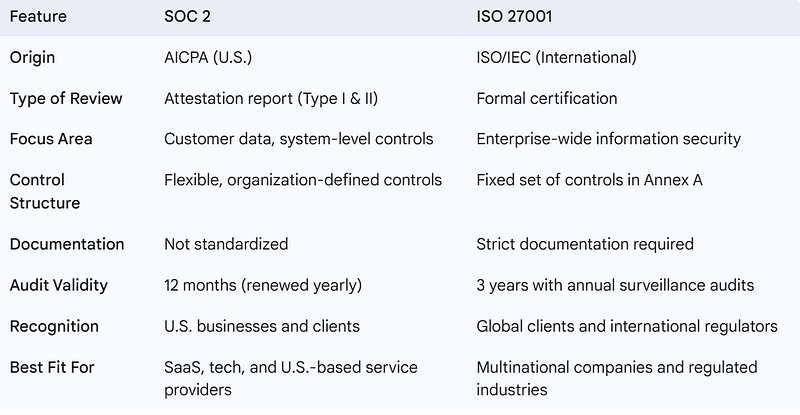
1. Origin and Governing Body
SOC 2 was developed by the American Institute of Certified Public Accountants (AICPA). It originated in the U.S. and is primarily used by companies doing business with North American clients, especially in sectors like SaaS, cloud computing, and tech services.
ISO 27001, officially called ISO/IEC 27001, is a joint creation of the International Organization for Standardization (ISO) and the International Electrotechnical Commission (IEC). It is a global standard recognized and adopted by organizations across industries and countries.
SOC 2 is region-specific and U.S.-centric, while ISO 27001 is international and universally accepted.
2. Framework Purpose and Structure
SOC 2 focuses on evaluating how a company designs and implements controls around five Trust Services Criteria: Security, Availability, Confidentiality, Processing Integrity, and Privacy. The framework is flexible, allowing organizations to create custom controls based on their unique operations as long as they align with the criteria.
ISO 27001, in contrast, is more structured. It requires organizations to establish a formal Information Security Management System (ISMS) that follows specific guidelines. This includes risk assessments, security policies, controls, and continuous improvement efforts.
SOC 2 is more adaptable and allows for customized controls, while ISO 27001 provides a formal, standardized structure for building an entire information security system.
3. Attestation vs Certification
With SOC 2, your organization undergoes an attestation process conducted by a licensed CPA (Certified Public Accountant) or auditing firm. The auditor evaluates whether your controls are effectively designed (Type I) and/or operated over time (Type II). The result is a detailed report, not a certificate.
On the other hand, ISO 27001 results in an official certification. After passing an audit by an accredited certification body, your organization receives a certificate proving that your ISMS meets international standards.
SOC 2 provides a third-party opinion (attestation), while ISO 27001 offers formal certification.
4. Audit Process and Validity
SOC 2 reports come in two forms:
- Type I : Examines the design of controls at a specific point in time.
- Type II : Reviews the operating effectiveness of controls over a period (typically 3 to 12 months).
These reports are valid for 12 months, and many clients expect updated reports annually.
ISO 27001 follows a multi-stage certification process:
- Stage 1 : Document review and readiness assessment.
- Stage 2 : Full audit of the ISMS implementation and effectiveness.
- After certification, there are annual surveillance audits, and a full recertification audit every 3 years.
SOC 2 focuses on short-term control reviews; ISO 27001 is based on a long-term, ongoing evaluation cycle.
5. Control Requirements and Flexibility
SOC 2 allows for a high degree of flexibility. Organizations choose their own controls, as long as they demonstrate alignment with the relevant Trust Services Criteria. This is useful for fast-growing tech companies or startups that may not fit a traditional mold.
ISO 27001 includes a predefined set of 93 security controls (updated in 2022) listed in Annex A. These are not optional. While organizations tailor them based on a risk assessment, they must formally address each control or explain why it’s not applicable.
SOC 2 = customizable controls.
ISO 27001 = standardized controls guided by risk.
6. Geographic and Industry Use
SOC 2 is widely accepted in the United States and is often a requirement for doing business with U.S. enterprise clients, particularly in SaaS, cloud services, and financial technology.
ISO 27001 is globally recognized and often required by multinational corporations, government agencies, and organizations in heavily regulated industries like finance, healthcare, and manufacturing.
SOC 2 is ideal for U.S. markets. ISO 27001 is preferred by international or highly regulated organizations.
7. Focus and Coverage
SOC 2 focuses on protecting customer data by verifying how specific controls meet trust criteria. It’s commonly used in vendor risk assessments and due diligence processes.
ISO 27001 is more comprehensive. It emphasizes a top-down, risk-based approach to protecting all types of organizational data, not just customer information. It includes elements like internal audits, leadership commitment, and incident response.
SOC 2 targets data handling and system-level trust. ISO 27001 covers broader information security risks across the organization.
8. Documentation Requirements
SOC 2 requires documentation, but there’s no fixed format or list of documents. The audit focuses more on evaluating whether controls are effective in practice.
ISO 27001 has strict documentation requirements. Organizations must maintain a full ISMS document suite, including policies, procedures, asset registers, risk assessments, and audit records.
SOC 2 documentation is flexible and control-specific. ISO 27001 mandates extensive, standardized documentation.
9. Maintenance and Monitoring
SOC 2 reports, especially Type II, must be renewed annually to remain current in the eyes of clients. Ongoing monitoring is recommended but not mandatory.
ISO 27001 enforces a continuous improvement model. Organizations must monitor, measure, and improve their ISMS, guided by regular internal audits, management reviews, and corrective actions. Surveillance audits help ensure the ISMS remains effective between certifications.
SOC 2 requires periodic reassessment. ISO 27001 demands continuous monitoring and improvement.
How Much Does a SOC 2 Audit Cost in 2025
Predict Your SOC 2 Audit Cost.
Which framework Do You Choose? ISO 27001 vs SOC 2?
Choosing between ISO 27001 and SOC 2 is a strategic decision that hinges on several key factors unique to your organization. While both demonstrate a strong commitment to information security, they serve different purposes and appeal to different audiences. Here’s a breakdown of how to determine which framework is the best fit for your business:
Understand Your Target Audience and Customer Requirements
- Who are your clients and what do they ask for? This is often the most direct indicator.
- Choose SOC 2 if: Your primary clients are U.S.-based businesses, especially in the technology sector (SaaS, cloud providers, data centers). Many U.S. companies specifically request a SOC 2 report (Type 2 being the most common and robust) to gain assurance about how you protect their data. It’s often a prerequisite for doing business with them.
- Choose ISO 27001 if: Your clients are global, operate in various countries, or if you deal with international partners and regulators. ISO 27001 is recognized worldwide as the benchmark for an Information Security Management System (ISMS) and is widely accepted across different industries and geographies.2
Consider Your Geographical Footprint
- Where do you operate and where are your customers located?
- Choose SOC 2 if: Your operations are predominantly based in the United States, and your services are primarily consumed by U.S. entities.
- Choose ISO 27001 if: You have a global presence, serve customers internationally, or plan to expand into markets outside of North America. ISO 27001 offers a universally understood standard for security management, facilitating international business.
How Much Does ISO 27001 Certification Cost in 2025?
Get Your ISO 27001 Cost Before You Begin
Evaluate Your Industry and Regulatory Landscape
- Are there specific industry regulations or compliance mandates you must meet?
- Choose SOC 2 if: You are a service organization that stores, processes, or transmits customer data, and your industry demands transparency around operational controls (e.g., healthcare with HIPAA, financial services with GLBA, though SOC 2 is not direct compliance for these, it supports them).
- Choose ISO 27001 if: You operate in heavily regulated industries globally (e.g., finance, government contracts, critical infrastructure) or need to demonstrate compliance with various international data protection laws (like GDPR, which is supported by ISO 27001’s comprehensive approach, although not directly certified by it). ISO 27001’s focus on a management system helps integrate and manage compliance with multiple regulations.
4. Assess Your Internal Security Maturity and Goals
- What is your current security posture, and what kind of security culture do you want to build?
- Choose SOC 2 if: You need to rapidly demonstrate specific controls related to data security, availability, or confidentiality for clients, and you’re comfortable with an auditor’s opinion on the effectiveness of those controls. It’s often seen as a client-driven compliance requirement.
- Choose ISO 27001 if: You aim to establish a holistic, risk-managed, and continuously improving information security management system (ISMS) across your entire organization. ISO 27001 requires a more formalized, top-down commitment to security as a core business process, focusing on identifying and treating risks systematically. It builds a long-term security culture.
5. Consider the Nature of the Assurance Provided
- What kind of assurance do you want to give to external parties?
- SOC 2 provides an attestation report: This is an auditor’s opinion on the design and operating effectiveness of your controls against the Trust Services Criteria. It’s a detailed, often extensive report tailored to your services.
- ISO 27001 provides a certification: This means an accredited third-party has verified that your ISMS meets the standard’s requirements. It’s a statement that you have a management system in place, rather than a detailed report on specific controls.
How to Get SOC 2 Certification and Build Strong Customer Trust
Fast Track Your Compliance Journey
Can You Use Both, ISO 27001 and SOC 2?
Yes, absolutely. In fact, many organizations pursue both SOC 2 and ISO 27001.
As noted, there’s significant overlap in the security controls and best practices required by both frameworks. Achieving one often simplifies the path to the other, making the overall compliance journey more efficient.
For companies with diverse client bases (U.S. and international) or those operating in multiple industries, holding both certifications/attestations provides comprehensive assurance and can be a significant competitive advantage.
Ultimately, the decision should align with your business strategy, client demands, and the level of security maturity you aim to achieve and demonstrate.
Conclusion
Both SOC 2 and ISO 27001 are valuable, but they serve different needs.
SOC 2 is ideal for showcasing your organization’s ability to protect customer data through trusted security controls, especially in the U.S. tech sector. ISO 27001 is a globally respected certification that confirms your entire organization takes a risk-based and systematic approach to securing information.
Whether you choose one or both, aligning your security practices with these frameworks is a smart investment in your company’s credibility, resilience, and long-term success.
Ready to Streamline Compliance?
Building a secure foundation for your startup is crucial, but navigating the complexities of achieving compliance can be a hassle, especially for small teams.
SecureSlate offers a simpler solution:
- Affordable: Expensive compliance software shouldn’t be a barrier. Our affordable plans start at just $284/month.
- Focus on Your Business, Not Paperwork: Automate tedious tasks and free up your team to focus on innovation and growth.
- Gain Confidence and Credibility: Our platform guides you through the process, ensuring you meet all essential requirements and giving you peace of mind.
Disclaimer (legal note)
SecureSlate is not a law firm, and this article does not constitute or contain legal advice or create an attorney-client relationship. When determining your obligations and compliance with respect to relevant laws and regulations, you should consult a licensed attorney.
Related guide: ISO 27001 vs. SOC 2: What is the difference? (plus overlap, timelines, and how to choose)
Need compliance without the complexity?
SecureSlate automates ISO 27001, SOC 2, GDPR, HIPAA, and more. Built for growing teams. See it in action.
Find compliance gaps in 30 seconds
