

Image from Pexels
Related guides:
- your guide to soc 2 audits
- the ultimate iso 27001 guide
- us data privacy compliance checklist
- free network security tools
Key takeaways
- What Are DAST Tools: DAST solutions (Dynamic Application Security Testing) are specialized software engines designed to communicate with a web application through its front-end or API to identify security vulnerabilities.
- The “Black Box” Philosophy: DAST operates on the Black Box Testing principle.
- DAST vs. SAST vs. IAST: Where does DAST fit: In 2026, a balanced security posture uses a “Defense in Depth” strategy.
Building a secure application in 2026 is no longer just about writing clean code; it’s about how that code survives in the wild. As architectures shift toward serverless functions, massive microservice meshes, and complex API gateways, the traditional “blueprint” of security is no longer enough. You need to see how your application reacts under fire.
This is where DAST solutions (Dynamic Application Security Testing) become the most critical component of your security stack.
In this comprehensive guide, we’ll explore what DAST is, why it’s a non-negotiable for modern enterprises, and a ranked breakdown of the best DAST solutions currently dominating the market in 2026.
Stop losing sleep over security: Learn the SecureSlate strategy top CTOs use to guarantee system integrity.
What Are DAST Tools?
DAST solutions (Dynamic Application Security Testing) are specialized software engines designed to communicate with a web application through its front-end or API to identify security vulnerabilities. Unlike static analysis (SAST), which reads code like a book, DAST interacts with the application like a user, or more accurately, like a hacker.
The “Black Box” Philosophy
DAST operates on the Black Box Testing principle. The tool has no prior knowledge of the underlying framework (be it Node.js, Python, or Go), the database type, or the server configuration. It discovers these details by sending requests and analyzing the headers, status codes, and body content of the responses.
DAST vs. SAST vs. IAST: Where does DAST fit?
In 2026, a balanced security posture uses a “Defense in Depth” strategy:
- SAST (Static): Scans source code during development. Great for finding logic errors but high on false positives.
- IAST (Interactive): Uses an agent inside the app. Accurate but difficult to deploy across polyglot microservices.
- DAST (Dynamic): Tests the fully integrated, running environment. It is the only tool that validates that your security controls (like WAFs, Firewalls, and Identity Providers) are actually working in tandem.
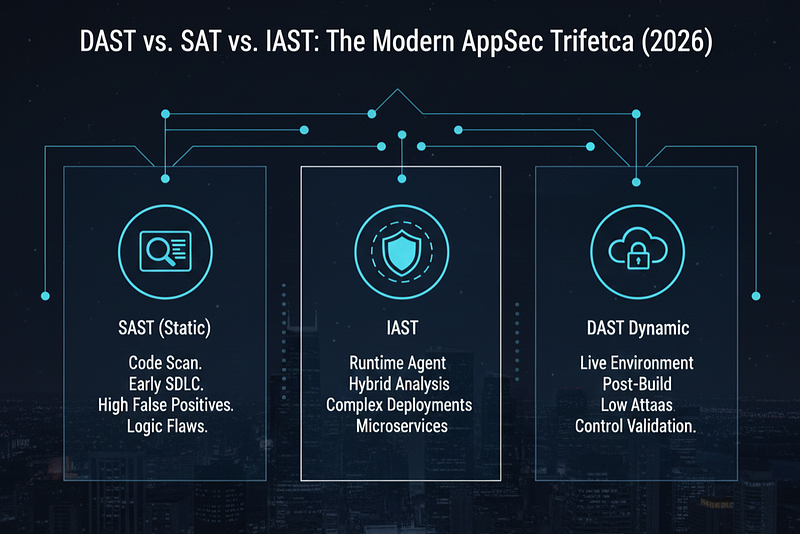 Image by AI
How DAST Works: The Lifecycle of a Scan
DAST solutions typically follow a four-stage process to identify vulnerabilities:
- Crawling (Discovery): The tool spiders through your application, finding every link, hidden form, and API endpoint to map out the entire attack surface.3
- Fuzzing (Attack Simulation): The tool sends thousands of “probes” or malicious payloads (like SQL injection strings or script tags) to these inputs.4
- Analysis: It monitors how the application responds.5 Does it crash? Does it return sensitive data? Does it execute the script?
- Reporting: It aggregates these findings, categorizes them by severity, and provides remediation steps.6
CVE-2025-55182 Alert: How to Secure Your Next.js App Before It's Too Late: Turning a crisis into a security milestone.
Core Features of Modern DAST Solutions
As we look toward 2026, the baseline for a “professional” DAST tool has shifted. Standard “crawling” is no longer enough. Here are the features that define the current leaders:
Advanced SPA and JavaScript Execution
Traditional DAST tools often failed when they encountered heavy client-side rendering (React, Angular, Vue). Modern solutions now include Headless Browser Engines (like Chromium) to fully execute JavaScript, ensuring that hidden buttons, asynchronous calls, and “Shadow DOM” elements are fully mapped and tested.
API-First Scanning (Swagger/OpenAPI/GraphQL)
With the explosion of headless architectures, the best DAST solutions can now consume a OpenAPI spec or a GraphQL schema. They don't just "guess" endpoints; they understand the required data types, query structures, and mutation logic to perform deep-tier fuzzing.
Smart Authentication Handling
The “Achilles Heel” of old DAST tools was getting stuck at a login screen. 2026’s top-tier tools utilize Session Persistence and OIDC/SAML integration to maintain authenticated states, even when challenged by Multi-Factor Authentication (MFA) or rotating tokens.
Behavioral Fuzzing
Instead of just sending a standard ' OR 1=1 -- SQL injection string, modern tools use behavioral analysis. They observe how an application handles timing, how it manages memory, and how it reacts to "out-of-band" requests (OAST), which is critical for finding "Blind" vulnerabilities.
The Benefits of Implementing DAST Solutions
Why are enterprises shifting their budgets toward dynamic testing? The benefits go beyond just “finding bugs.”
Validation of the Full Production Stack
A developer might write secure code, but a DevOps engineer might accidentally leave a staging database open or misconfigure an Nginx header. DAST solutions test the results of the entire pipeline, catching configuration errors that code-level scanners cannot detect.
Drastic Reduction in “Noise”
One of the biggest complaints in AppSec is “False Positive Fatigue.” Because DAST requires a vulnerability to be exploitable in a running state to flag it, the results are inherently more actionable. If a DAST tool says you have an XSS vulnerability, it means it successfully executed a script in your browser. There is no debating the result.
Language Agnosticism
In a 2026 enterprise, you might have 50 different microservices written in 10 different languages. Implementing 10 different SAST tools is a nightmare. A single DAST solution can scan all of them because it only cares about the HTTP/S traffic they emit.
Regulatory and Compliance Mapping
Standard frameworks like SOC 2, ISO 27001, and PCI-DSS 4.0 explicitly require regular dynamic testing. The best DAST solutions provide automated mapping, showing exactly which scan results satisfy specific compliance sub-controls. To turn that DAST evidence into audit-ready documentation and continuous compliance, platforms like SecureSlate integrate with your AppSec stack and map controls to SOC 2, ISO 27001, and HIPAA so you stay audit-ready without the spreadsheet scramble.
The 7 Best DAST Solutions for 2026
We’ve evaluated the market leaders for 2026 based on their ability to handle modern scale and their technical precision.
1. Invicti: The Enterprise Powerhouse
Invicti has dominated the market by focusing on the “Total Cost of Ownership.” By using Proof-Based Scanning , they drastically reduce the manual hours security researchers spend verifying bugs.
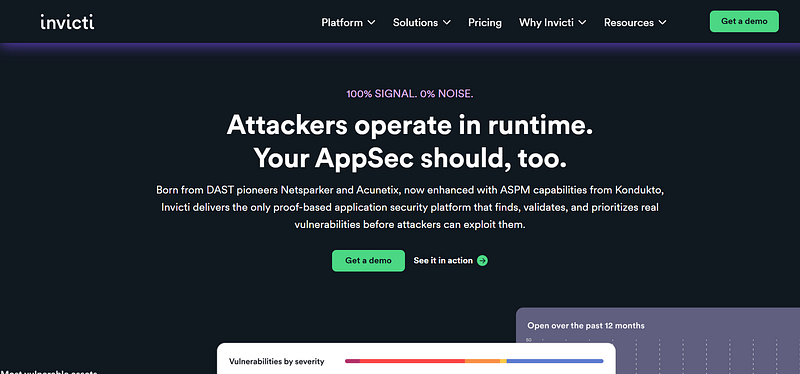
- Technical Edge: Their internal “crawler” uses a fully functional browser that can interact with complex AJAX-heavy sites as if it were a human user.
- Speed: Excellent scaling; can scan 1,000+ sites simultaneously across different global regions.
- Accuracy: Highest in the industry for “Confirmed” vulnerabilities.
2. Burp Suite Enterprise: The Researcher’s Choice
While Netsparker is for “hands-off” automation, Burp Suite is for “hands-on” depth.
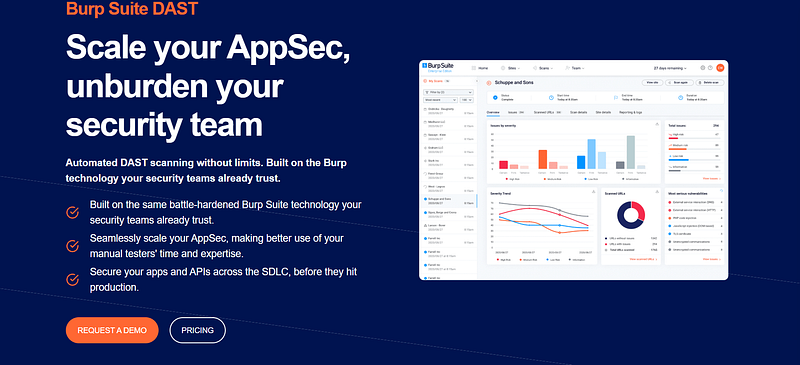
- Technical Edge: The “Burp Scanner” engine is updated weekly with the latest research from PortSwigger Labs. It is often the first tool to detect new “Zero Day” patterns.
- Speed: Moderate. It is a “thorough” scanner that probes deeply into every parameter.
- Accuracy: Elite. It provides the most detailed technical evidence for every finding, including request/response wrappers.
3. StackHawk: The DevOps Integrator
StackHawk has won over the developer community by making security testing part of the “Local Development” workflow.
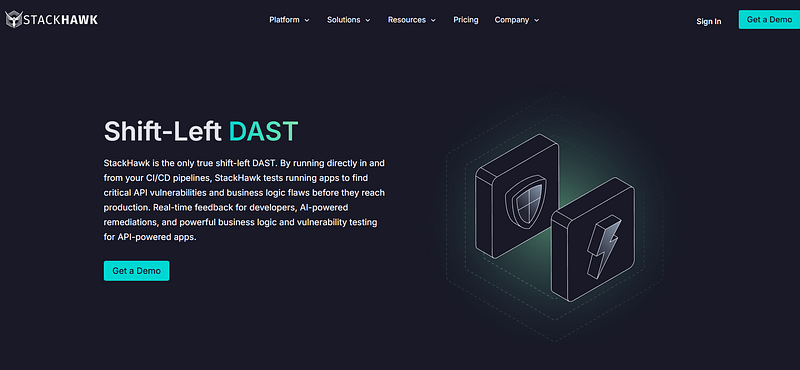
- Technical Edge: It is designed to run in a Docker container alongside your app in the CI/CD pipeline. It uses a “Configuration as Code” (stackhawk.yml) approach.
- Speed: Blazing. It is designed to run in minutes during a build process, not hours.
- Accuracy: High, specifically for REST and GraphQL APIs.
4. Rapid7 InsightAppSec: The Visibility Expert
Rapid7’s InsightAppSec is known for its “Universal Translator.”
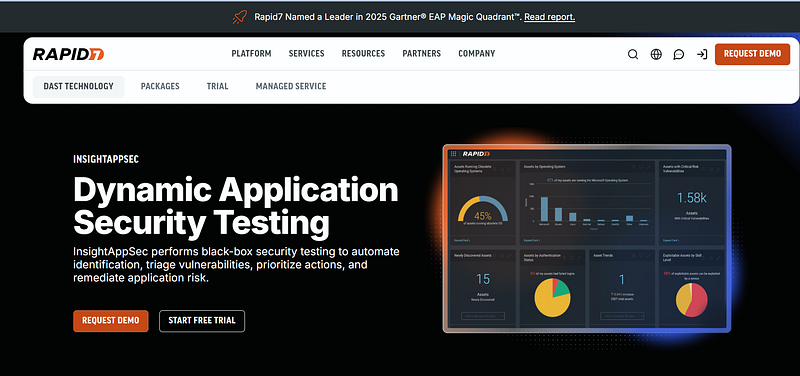
- Technical Edge: It excels at “Application Discovery.” It can scan a network range, find web servers, and automatically begin profiling them. This is vital for finding “Zombi APIs” or shadow IT.
- Speed: High.
- Accuracy: Very Strong, particularly in identifying misconfigured cloud infrastructure settings.
5. Checkmarx DAST: The Correlation King
Checkmarx provides what they call “Fusion.” It combines the results of their SAST (code) scan and DAST (runtime) scan.

- Technical Edge: If a SAST scan finds a potential SQLi in the code and the DAST scan confirms it’s exploitable, the “Fusion” engine prioritizes it as a “Critical” fix. This context is a game-changer for 2026 security teams.
- Speed: High.
- Accuracy: Enhanced by cross-referencing code-level data.
6. Veracode Dynamic Analysis: The Compliance Engine
Veracode is built for the CISO. Its reporting is the best in the business for high-level risk management.
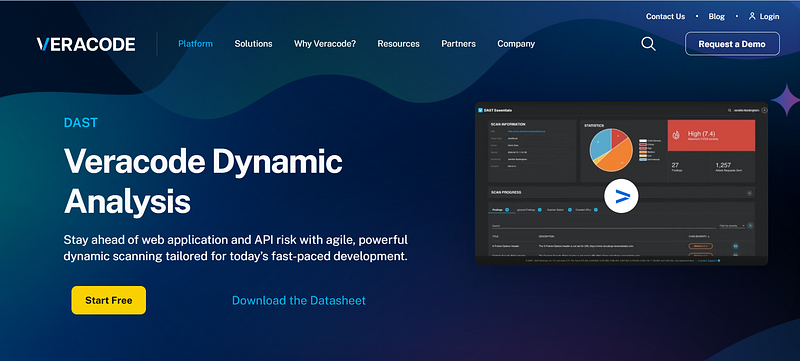
- Technical Edge: It offers “Virtual Patching” suggestions. If a DAST scan finds a hole, Veracode can provide the specific WAF (Web Application Firewall) rule to block that attack while your developers work on a permanent code fix.
- Speed: Reliable/Scheduled.
- Accuracy: Very High, with a focus on enterprise-standard vulnerabilities.
7. OWASP ZAP: The Open Source Foundation
ZAP is the world’s most widely used DAST tool. In 2026, it remains a powerhouse for teams that want to build their own internal security platforms.
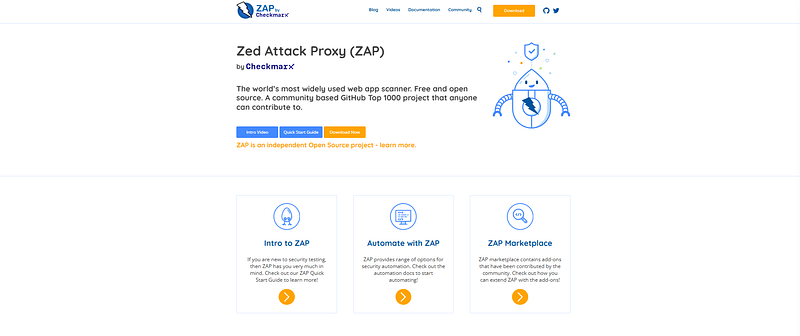
- Technical Edge: It is completely scriptable via a powerful API. You can write custom “Active Scan” rules in JavaScript or Python to test for proprietary business logic.
- Speed: Dependent on user configuration.
- Accuracy: High, provided the user knows how to tune the policies.
Comparison Table: Speed vs. Accuracy

How to Choose: A Technical Evaluation Checklist
When selecting between these DAST solutions, use the following scorecard:
- Authentication: Can it handle our specific SSO/MFA flow?
- Environment: Can it run inside our VPC, or does it require an external “punch-hole” in the firewall?
- Integration: Does it have a native plugin for our CI/CD (GitHub/GitLab/Azure DevOps)?
- API Support: Does it support our specific flavor of API (GraphQL, gRPC, Websockets)?
- False Positive Rate: Does the tool provide “Proof of Concept” (PoC) for its findings?
Conclusion
As we move through 2026, the distinction between “Testing” and “Protection” is blurring. The best DAST solutions are no longer just reporting tools; they are active participants in the Software Development Life Cycle (SDLC). They provide the evidence needed to stop insecure releases, the data needed to configure WAFs, and the peace of mind that your security controls are standing strong against an ever-evolving threat landscape.
Whether you choose the developer-friendly approach of StackHawk or the enterprise-grade verification of Invicti, the message is clear: In 2026, if you aren’t testing it dynamically, it isn’t secure. Pair your DAST tool with a compliance platform like SecureSlate to keep SOC 2, ISO 27001, and PCI-DSS evidence centralized and audit-ready.
Ready to Streamline Compliance?
Building a secure foundation for your startup is crucial, but navigating the complexities of achieving compliance can be a hassle, especially for a small team.
SecureSlate offers a simpler solution:
- Affordable: Expensive compliance software shouldn’t be the barrier. Our affordable plans start at just $284/month.
- Focus on Your Business, Not Paperwork: Automate tedious tasks and free up your team to focus on innovation and growth.
- Gain Confidence and Credibility: Our platform guides you through the process, ensuring you meet all essential requirements and giving you peace of mind.
FAQ
What are DAST solutions?
DAST (dynamic application security testing) solutions test a running application from the outside to find vulnerabilities like injection and misconfiguration. They complement static (SAST) testing.
- Scan live apps without access to source code.
- Catch runtime issues SAST misses, such as authentication flaws.
- See our list of open-source DAST tools.
Disclaimer (legal note)
SecureSlate is not a law firm, and this article does not constitute or contain legal advice or create an attorney-client relationship. When determining your obligations and compliance with respect to relevant laws and regulations, you should consult a licensed attorney.
Need compliance without the complexity?
SecureSlate automates ISO 27001, SOC 2, GDPR, HIPAA, and more. Built for growing teams. See it in action.
Find compliance gaps in 30 seconds
