
 Image by AI
Related guides:
Key takeaways
- What are WAF Rules: A Web Application Firewall (WAF) sits at the edge of your network, acting as a sophisticated gatekeeper between the public internet and your web application.
- Defining WAF Rules: WAF rules are the logic-based filters that inspect incoming HTTP/S requests.
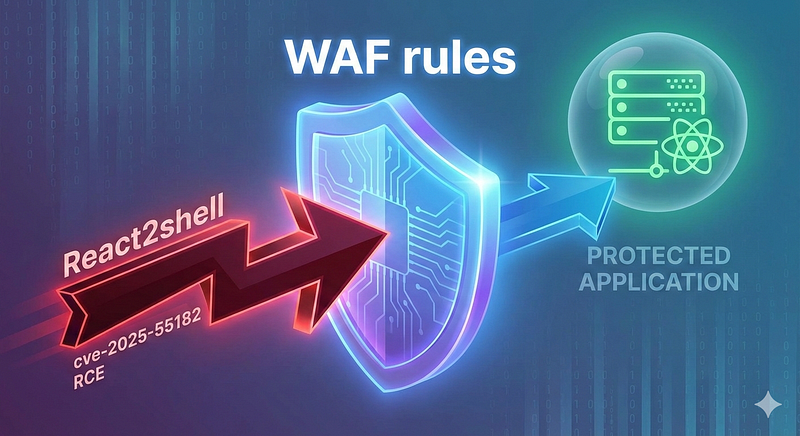
- The Strategic Importance of WAF Rules: Beyond: In a high-stakes scenario like CVE-2025–55182, WAF rules transform from general filters into critical “virtual patches.” They manage the high-risk “chaos window” that follows a zero-day disclosure.
The landscape of frontend development shifted dramatically with the introduction of React Server Components (RSC) and the Next.js App Router. While these innovations offered unprecedented performance gains by moving logic to the server, they also introduced a new class of server-side vulnerabilities.
In late 2025, the disclosure of CVE-2025–55182, nicknamed React2Shell, sent shockwaves through the industry. With a CVSS score of 10.0, this vulnerability allows unauthenticated attackers to achieve Remote Code Execution (RCE) by exploiting the way React handles data serialization.
For many organizations, the speed of exploitation outpaces the speed of deployment. And so Web Application Firewall (WAF) rules become the most critical component of a defense-in-depth strategy.
In this comprehensive guide, we will analyze the technical mechanics of the React2Shell vulnerability and provide actionable WAF configurations to protect your Next.js infrastructure.
Stop losing sleep over security: Learn the SecureSlate strategy top CTOs use to guarantee system integrity.
What are WAF Rules?
A Web Application Firewall (WAF) sits at the edge of your network, acting as a sophisticated gatekeeper between the public internet and your web application. Unlike a traditional network firewall that focuses on IP addresses and ports (Layers 3 and 4), a WAF operates at Layer 7 (the Application Layer).
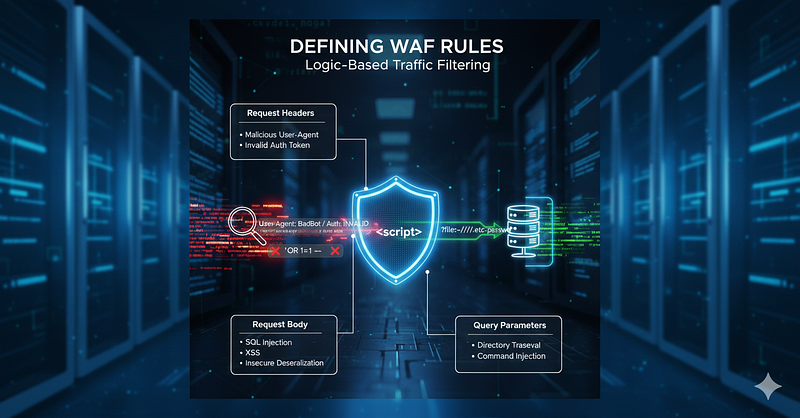 Image by AI
Defining WAF Rules
WAF rules are the logic-based filters that inspect incoming HTTP/S requests. They analyze elements such as:
- Request Headers: Checking for malicious User-Agents or unauthorized authorization tokens.
- Request Body: Scanning for patterns associated with SQL Injection (SQLi), Cross-Site Scripting (XSS), and now, insecure deserialization in React.
- Query Parameters: Identifying anomalous characters used in directory traversal or command injection.
The Strategic Importance of WAF Rules: Beyond Simple Filtering
In a high-stakes scenario like CVE-2025–55182, WAF rules transform from general filters into critical “virtual patches.” They manage the high-risk “chaos window” that follows a zero-day disclosure, providing a surgical defense when code-level fixes are not yet possible.
Closing the Window of Exposure
The primary value of WAF rules in a React/Next.js stack is Virtual Patching. Framework updates (e.g., migrating to a safe version of Next.js 15) often introduce breaking changes that require days of QA and CI/CD testing.
A WAF rule can be deployed globally in minutes, blocking CVE-2025–55182 RCE payloads at the network edge and buying engineering teams the necessary time for stable, non-emergency updates.
Operational Decoupling and Agility
WAF rules decouple security response from developer release cycles. Security teams can instantly deploy regex-based blocks for malicious headers (like next-action) and patterns (like $@), allowing developers to focus on the migration path without the existential pressure of an active production RCE.
This creates a persistent safety net, essential “Defense in Depth” should a secondary bypass for the original patch be discovered.
Legacy Systems, Continuity, and Compliance
- Legacy Protection: For older React/Next.js applications (v12 or v13) that are difficult to upgrade, custom WAF rules serve as the primary security control against automated RCE scanners.
- Business Continuity: Mitigating a CVSS 10.0 threat at the edge avoids the massive financial risk of data exfiltration and the need for emergency site-wide maintenance modes.
- Duty of Care: Logging the deployment of a WAF rule within minutes of a CVE announcement provides a clear audit trail for compliance frameworks, like SOC2 or GDPR, proving your organization is proactive.
Technical Analysis of CVE-2025–55182 (React2Shell)
To effectively defend against CVE-2025–55182, security engineers must understand exactly what is being exploited: the React Flight Protocol.
The React Flight Protocol
Next.js uses a specialized serialization format called “Flight” to stream data from Server Components to the client. This protocol allows complex JavaScript objects (including Promises and Suspense boundaries) to be sent over the wire as a stream of JSON-like chunks.
The Mechanics of the RCE
The vulnerability is rooted in Server-Side Prototype Pollution (SSPP). When a client sends a payload to a Server Action or an RSC endpoint, the server-side React runtime must “rehydrate” or deserialize that data.
- Insecure Deserialization: The vulnerability occurs because the deserializer in affected versions of React (19.x) fails to sanitize specific keys within the Flight stream.
- Prototype Hijacking: An attacker can inject properties like
__proto__,constructor, orprototypeinto the globalObjecton the server. - RCE Execution: Because Next.js and its underlying bundlers (like Webpack or Turbo) rely on certain global properties to resolve modules, an attacker who has polluted the prototype can override module-loading functions. By hijacking a function like
parcelRequireorrequireModule, the attacker can force the server to execute arbitrary shell commands.
The Role of WAF Rules in Mitigating CVE-2025–55182
WAF rules serve as the first line of defense against React2Shell by identifying the specific “malicious fingerprints” within the Flight protocol traffic.
Header-Based Inspection
Attacks targeting CVE-2025–55182 almost exclusively target the endpoints that handle Server Actions. In Next.js, these requests are identifiable by specific HTTP headers:
next-action: Contains a unique hash identifying the server function.rsc-action-id: Used in earlier or specific configurations of the App Router.
WAF Strategy: While these headers are legitimate, the presence of these headers combined with specific body patterns is a high-fidelity indicator of an RSC-based attack.
Payload Pattern Matching
The Flight protocol uses a series of prefixes to denote data types. The exploit specifically utilizes self-referential or recursive structures to trigger the prototype pollution logic. WAF rules should look for:
- Recursive prefixes: Patterns like
$1,$2, or$@appearing in unexpected density or within the context of object keys. - Pollution Keywords: Explicit strings like
"__proto__","constructor", and"prototype".
Rate Limiting and Behavioral Analysis
Because an RCE attempt often involves “probing” the server with different payloads to see which one sticks, behavioral WAF rules can detect the high-frequency POST requests to RSC endpoints that lack the typical session cookies of a real user.
Best Practices for Next.js Security Beyond WAF
While WAF rules provide an essential perimeter defense, they are “compensating controls” rather than a cure.
To definitively neutralize React2Shell and prevent similar RCE vectors, you must move deeper into the application and infrastructure layers.
Immediate Patching & Dependency Integrity
Updating your dependencies is the only way to fix the underlying deserialization flaw in the React Flight protocol. The vulnerability resides in how the server-side React runtime handles “Thenable” objects and recursive data structures.
- Verified Versions: Ensure your
package.jsonreflects Next.js 15.5.7+ or 16.0.7+ and React 19.0.3+. - The “Invisible” Dependency: Be aware that the vulnerable package,
react-server-dom-webpack, is often bundled internally by Next.js and won't appear as a direct line in yourpackage.json. You must runnpm update nextoryarn upgrade nextto ensure the internal sub-dependencies are swapped. - Mandatory Rebuild: After patching, you must regenerate your production bundles. If you simply update the library but deploy a cached build, the vulnerable code may still persist in your static assets or server-side chunks.
Implementing Egress Filtering (Network Hardening)
In a successful RCE attack, the initial payload is usually just a “loader.” The attacker’s goal is to force your server to make an outbound connection to their command-and-control (C2) server to download a full-featured binary or open a Reverse Shell.
- Default Deny Stance: Configure your AWS Security Groups or Kubernetes Network Policies to block all outbound traffic by default. Only allow specific, whitelisted destinations (e.g., your database, third-party APIs like Stripe, or internal microservices).
- Block High-Risk Ports: Specifically block outbound traffic on ports commonly used for shells (e.g., 4444, 1337) and SMB (445), which is often used for credential harvesting.
- DNS Monitoring: Attackers often use DNS exfiltration to bypass firewalls. Monitoring for a sudden spike in requests to unknown or newly registered domains can serve as an early warning system that an RCE attempt has succeeded.
Auditing & Hardening Server Actions
Every function marked with 'use server' is a public API endpoint, whether it’s explicitly documented or not. In the context of CVE-2025-55182, an attacker leverages these endpoints to inject malicious serialized data.
- Schema Validation with Zod: Do not rely on TypeScript types alone, as they disappear at runtime. Use a library like Zod or Valibot to strictly validate every argument passed into a Server Action.
- Internal Authorization: Always re-verify the user’s session and permissions inside the Server Action. Never assume that because the user can “see” the button on the UI, they are authorized to perform the action on the server.
- Use Safe-Action Wrappers: Consider using libraries like
next-safe-actionorzsa. These tools provide a standardized wrapper around Server Actions, ensuring that validation and authentication are enforced by default, reducing the risk of a developer accidentally exposing a "raw" vulnerable endpoint.
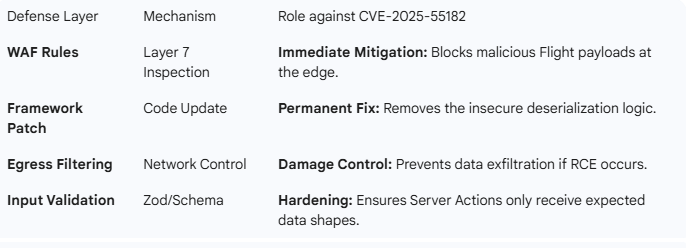
Summary Table: CVE-2025–55182 Protection Layers
Conclusion
CVE-2025–55182 is a stark reminder that as our tools become more powerful, our security strategies must become more granular. React2Shell exploits the very core of how modern applications communicate, making it a “High Impact, Low Effort” target for attackers.
By deploying robust WAF rules tailored to the React/Next.js RSC architecture, you effectively close the window of vulnerability.
However, the WAF should be viewed as a temporary “virtual patch.” True security lies in the combination of edge protection, timely dependency updates, and a fundamental understanding of the serialization protocols we use every day.
Ready to Streamline Compliance?
Building a secure foundation for your startup is crucial, but navigating the complexities of achieving compliance can be a hassle, especially for a small team.
SecureSlate offers a simpler solution:
- Affordable: Expensive compliance software shouldn’t be the barrier. Our affordable plans start at just $284/month.
- Focus on Your Business, Not Paperwork: Automate tedious tasks and free up your team to focus on innovation and growth.
- Gain Confidence and Credibility: Our platform guides you through the process, ensuring you meet all essential requirements and giving you peace of mind.
Disclaimer (legal note)
SecureSlate is not a law firm, and this article does not constitute or contain legal advice or create an attorney-client relationship. When determining your obligations and compliance with respect to relevant laws and regulations, you should consult a licensed attorney.
Need compliance without the complexity?
SecureSlate automates ISO 27001, SOC 2, GDPR, HIPAA, and more. Built for growing teams. See it in action.
Find compliance gaps in 30 seconds
