 Image from pexels.com
Related guides:
Key takeaways
- What HIPAA Requires for Training: HIPAA regulations are divided into several key areas, but the two most relevant to training are the Privacy Rule and the Security Rule.
- Top 5 HIPAA Compliance Training Requirements: Below are the top five requirements every covered entity must follow to maintain training quality and meet HIPAA expectations.
- Scope: Training Every Workforce Member: The Mandate: Who Needs HIPAA Compliance Training?
In the fast-paced world of healthcare, protecting sensitive patient data is not just an ethical duty; it is a strict legal mandate enforced by the Health Insurance Portability and Accountability Act (HIPAA). For every covered entity, from major hospital systems and small physician practices to health insurance plans, the bedrock of compliance is an effective and ongoing HIPAA compliance training program.
Failing to provide adequate HIPAA compliance training is one of the most common reasons the Office for Civil Rights (OCR) issues hefty fines. The law itself is often intentionally vague, using terms like “reasonable” and “appropriate,” which places the burden on the organization to design a robust, custom-tailored program.
This comprehensive guide breaks down the five critical, non-negotiable requirements for successful HIPAA compliance training, ensuring your organization is not only compliant but also fostering a genuine culture of patient privacy and security.
Stop losing sleep over security: Learn the SecureSlate strategy top CTOs use to guarantee system integrity.
What HIPAA Requires for Training
HIPAA regulations are divided into several key areas, but the two most relevant to training are the Privacy Rule and the Security Rule.
- Privacy Rule: Requires Covered Entities to train all members of their workforce on the policies and procedures regarding Protected Health Information (PHI), “as necessary and appropriate” for their functions.
- Security Rule: Mandates the implementation of a security awareness and training program for all members of the workforce (including management).
These two mandates form the basis for our top five requirements, serving as the essential building blocks for any effective HIPAA compliance training solution.
Top 5 HIPAA Compliance Training Requirements
Below are the top five requirements every covered entity must follow to maintain training quality and meet HIPAA expectations.
1. Scope: Training Every Workforce Member
**The Mandate: Who Needs HIPAA Compliance Training?
** A common mistake is believing HIPAA compliance training is only for clinical staff or those who directly handle patient charts. The HIPAA Privacy and Security Rules apply broadly, requiring all members of the workforce to be trained. The “workforce” includes:
- Employees: Full-time, part-time, and temporary staff.
- Volunteers and Trainees: Clinical students, interns, and volunteers.
- Other Persons: Anyone whose conduct is under the direct control of the Covered Entity, such as certain contractors or managed staff.
This means the CEO, the security guard, the volunteer in the gift shop, and the IT professional all require appropriate HIPAA compliance training.
The Implementation: Role-Based Training Customization
While everyone needs training, not everyone needs the same training. Effective HIPAA compliance training must be customized to the role, following the “minimum necessary standard” principle.
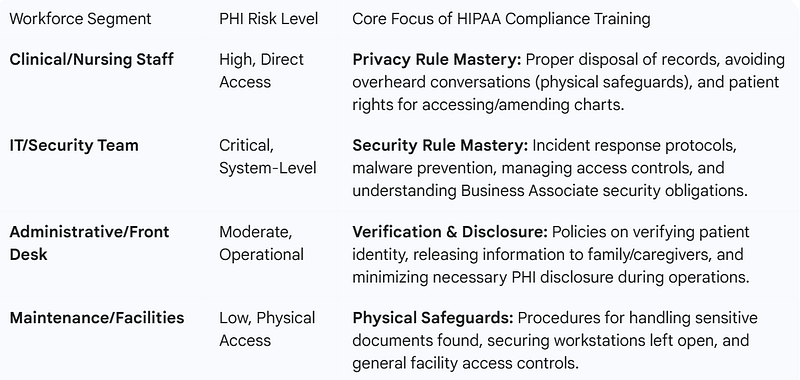
The Goal: The HIPAA compliance training must empower each employee to perform their job in a compliant manner. A generic, one-size-fits-all presentation often fails to achieve this, leaving specific risk areas and your organization vulnerable.
2. Timing: Initial, Periodic, and Trigger-Based Training
HIPAA is intentionally vague on the precise frequency of training, but it clearly defines three essential moments when HIPAA compliance training is required.
Initial Training (Onboarding)
The Privacy Rule mandates that a new workforce member must receive HIPAA compliance training “within a reasonable period of time after the person joins the covered entity’s workforce.”
Best Practice: “Reasonable period” should be interpreted as before the new hire is granted access to any Protected Health Information (PHI) or Electronic Protected Health Information (ePHI).
Giving a new employee network access before they complete their initial HIPAA compliance training is an immediate and indefensible risk.
Periodic Training (The Annual Refresher)
The term “annual training” is not explicitly written in the HIPAA statute, but it is the undisputed industry standard and a de facto requirement demonstrated by OCR enforcement actions and resolution agreements.
Why Annual HIPAA Compliance Training is Essential:
- Evolving Threats: Cyber threats (phishing, ransomware) and security tactics change monthly. HIPAA compliance training must evolve to cover the latest attack vectors.
- Staff Drift: Over time, employees naturally develop “workarounds” or forget key details. An annual refresher reinforces a culture of compliance.
- Audit Precedent: When investigating a breach, the OCR consistently cites a lack of ongoing, periodic training as a significant compliance failure.
Trigger-Based Training (Material Changes)
This is the most frequently missed requirement and a major point of failure during audits. Covered Entities must retrain their workforce, or the relevant parts of it, “when the functions of the workforce member are affected by a material change in policy or procedure.”
Examples of Material Changes Requiring Retraining:
- Implementing a new Electronic Health Record (EHR) system.
- Rolling out a new telehealth or remote work policy.
- A significant update to the organization’s Bring Your Own Device (BYOD) policy.
- An official change to HIPAA regulations (e.g., a Final Rule from the OCR).
HIPAA compliance training is a continuous, cyclical process, not a one-time event. Organizations must have a system in place to automatically track and deploy training upon these three specific triggers.
3. Content: Covering the Three Pillars of HIPAA
The content of your HIPAA compliance training must explicitly cover the three core rules that govern how PHI is handled, stored, and protected.
The Privacy Rule (PHI Handling)
This training focuses on the permissible uses and disclosures of Protected Health Information (PHI) and the rights of the patient.
Key Training Modules:
- Defining PHI: What 18 identifiers constitute PHI (name, address, medical record number, etc.) across all formats (oral, written, electronic).
- The Minimum Necessary Standard: The rule that limits PHI access to the minimum needed to perform a specific job function. This is critical for all roles.
- Treatment, Payment, and Operations (TPO): Explaining when PHI can be disclosed without patient authorization (for TPO purposes).
- Patient Rights: Training employees on a patient’s right to access, amend, and request an accounting of disclosures of their health information.
The Security Rule (ePHI Protection)
This training focuses on the administrative, physical, and technical safeguards necessary to protect Electronic Protected Health Information (ePHI). This is where the organization’s security awareness program intersects with HIPAA compliance training.
Key Training Modules (Security Awareness):
- Malware Protection: Procedures for guarding against, detecting, and reporting malicious software (antivirus, security updates).
- Secure Password Management: Training on creating, changing, and safeguarding strong passwords, and the importance of Multi-Factor Authentication (MFA).
- Login Monitoring & Reporting: Procedures for monitoring system access attempts and reporting suspicious login discrepancies.
- Workstation Security: Policies on securing unattended workstations, logging off, and managing mobile devices that access ePHI.
The Breach Notification Rule (Incident Response)
Every workforce member must be trained to recognize a potential security incident or breach and know exactly how to report it internally. Delays in reporting are a major source of increased OCR penalties.
Key Training Modules:
- Recognizing an Incident vs. a Breach: Teaching employees the difference between a simple error and a reportable event.
- Immediate Reporting Procedures: Clear, step-by-step instructions on who to notify (Privacy Officer, Security Officer, Manager) and the required internal timeline.
- The Consequences of Delay: Emphasizing that immediate reporting is crucial for containment and meeting the 60-day OCR notification deadline.
4. Documentation: Maintaining Auditable Records
The most sophisticated HIPAA compliance training program is worthless during an audit if the training cannot be proven. Documentation is not just a best practice; it is a cornerstone of the HIPAA administrative safeguards. The principle is simple: If it wasn’t documented, it wasn’t done.
What to Document and Retain
The covered entity must maintain records that demonstrate compliance with the training requirements for a minimum of six years from the date of creation or the date it was last in effect, whichever is later.
- Training Content: Copies of all training materials used (presentations, videos, handouts, online modules).
- Attendance/Completion: A record that identifies who was trained, when they were trained, and which training they received.
- Validation of Understanding: Proof that the employee understood the material (e.g., passing a quiz or signing an attestation).
Leveraging a Learning Management System (LMS)
While paper sign-in sheets can technically meet the requirement, they are administratively burdensome and prone to error. The most effective way to satisfy this documentation requirement is by using a dedicated Learning Management System (LMS) designed for HIPAA compliance training.
An LMS can automatically:
- Track the completion date and score for every employee.
- Issue traceable, downloadable certificates of completion.
- Generate instant reports for auditors showing compliance status by department or individual.
- Archive all versions of the training content for the required six-year period.
5. Sanctions: Policy Enforcement and Accountability
The training itself is a crucial preventative measure, but HIPAA also requires a mechanism to enforce the policies being taught. The Sanction Policy requirement ensures that the training has teeth.
The HIPAA Security Rule mandates that covered entities must “apply appropriate sanctions against workforce members who fail to comply with the security policies and procedures of the covered entity.”
Connecting Training to Accountability
A robust HIPAA compliance training program must clearly communicate the organization’s Sanction Policy. Employees need to know that violations, whether accidental or intentional, will result in consequences that are proportional to the severity of the violation.
Training must cover:
- Examples of Violations: Discussing PHI outside of a secure environment, sharing login credentials, clicking a malicious phishing link, or accessing records without a need-to-know.
- The Disciplinary Scale: Employees should be trained on the graduated sanction process (e.g., verbal warning for a minor violation, written warning for repeated or serious non-compliance, and termination for willful neglect or egregious breaches).
- Remedial Training: Sanctions often include mandatory, targeted remedial HIPAA compliance training to close the specific knowledge gap that led to the violation.
By tying the policies taught in HIPAA compliance training directly to a clear, enforced Sanction Policy, the organization reinforces that compliance is not optional; it is a condition of employment. This creates a genuine “culture of compliance.”
Conclusion
For covered entities, HIPAA compliance training is more than just a regulatory hurdle; it is a vital, strategic investment in patient trust and financial security. A poorly implemented or generic training program leaves the organization exposed to the greatest threat: human error.
By focusing on these HIPAA compliance training requirements, you transform compliance from a passive requirement into an active defense strategy.
Ready to Streamline Compliance?
Building a secure foundation for your startup is crucial, but navigating the complexities of achieving compliance can be a hassle, especially for a small team.
SecureSlate offers a simpler solution:
- Affordable: Expensive compliance software shouldn’t be the barrier. Our affordable plans start at just $284/month.
- Focus on Your Business, Not Paperwork: Automate tedious tasks and free up your team to focus on innovation and growth.
- Gain Confidence and Credibility: Our platform guides you through the process, ensuring you meet all essential requirements and giving you peace of mind.
Disclaimer (legal note)
SecureSlate is not a law firm, and this article does not constitute or contain legal advice or create an attorney-client relationship. When determining your obligations and compliance with respect to relevant laws and regulations, you should consult a licensed attorney.
Need compliance without the complexity?
SecureSlate automates ISO 27001, SOC 2, GDPR, HIPAA, and more. Built for growing teams. See it in action.
Find compliance gaps in 30 seconds