

Related guides:
Key takeaways
- What Is Cybersecurity Risk Management: Cybersecurity risk management is a strategic and ongoing process that helps organizations protect their digital assets.
- Why Cybersecurity Risk Management Is Essential: Cyberattacks have become more sophisticated, frequent, and damaging.
- The Cybersecurity Risk Management Process: The cybersecurity risk management process is a cyclical framework that organizations use to protect their digital assets.
Every time you see a headline about a cyberattack, you’re looking at a symptom of a much larger problem. In 2024, the average cost of a data breach soared to a record $4.88 million , a stark reminder that digital threats are not just a nuisance. This is a significant threat to financial stability and business continuity. It’s a problem that affects everyone, from global corporations to small startups.
But what if you could flip the script? Instead of being a victim, what if you could become a master of your digital destiny? This is the promise of cybersecurity risk management. It’s the strategic process of identifying, assessing, and mitigating vulnerabilities before they can be exploited.
This guide will explore what cybersecurity risk management is and why it’s crucial for modern businesses. We’ll introduce you to the top cybersecurity risk management tools that can help you automate your defenses, allowing you to focus on running your business with confidence.
What Is Cybersecurity Risk Management?
Cybersecurity risk management is a strategic and ongoing process that helps organizations protect their digital assets. It involves systematically identifying, assessing, and addressing potential threats and vulnerabilities to an organization’s information systems.
The primary goal is to minimize the potential for financial loss, reputational damage, and operational disruption caused by cyberattacks.
Why Cybersecurity Risk Management Is Essential
Cyberattacks have become more sophisticated, frequent, and damaging. From healthcare institutions to fintech startups, no sector is immune. As remote work and cloud services increase digital exposure, cybersecurity risk management is crucial in defending against a variety of modern threats:
- Data Breaches: A well-managed risk program identifies and mitigates vulnerabilities that could lead to the exposure of sensitive customer or proprietary data, safeguarding an organization’s reputation and avoiding costly fines.
- Ransomware Attacks: By assessing the likelihood of a ransomware attack and the potential impact on critical systems, organizations can implement controls like robust backups and employee training to prevent or quickly recover from these crippling incidents.
- Insider Threats: This includes threats from both malicious and negligent employees. Risk management helps establish controls and monitoring systems to detect and prevent unauthorized access or data misuse by internal parties.
- Compliance Violations: Many industries are governed by strict regulations (like GDPR and HIPAA). Cybersecurity risk management ensures that an organization’s security posture meets these requirements, helping to avoid legal penalties and financial repercussions.
Without effective risk management, even a minor vulnerability can lead to a devastating cyber incident.
The Cybersecurity Risk Management Process
The cybersecurity risk management process is a cyclical framework that organizations use to protect their digital assets. It involves four key stages:
1. Identifying Risks
The first step is to identify all potential internal and external threats that could harm the business. This includes a comprehensive look at your organization’s digital environment to discover all assets, identify potential attack vectors, and map out the entire attack surface.
Examples of risks to identify include phishing campaigns, insider threats, malware, and ransomware.
2. Analyzing Potential Impact
Once risks are identified, you must analyze them to understand their potential impact and likelihood. This stage involves determining the severity of each risk, which allows your organization to pinpoint its most significant vulnerabilities and prioritize them effectively.
The goal is to gain a clear picture of which threats pose the greatest danger to your business operations.
3. Evaluating Priority
After analyzing the risks, the next step is to evaluate them. This involves prioritizing risks based on their severity and determining which ones require immediate action.
During this phase, you also assess the effectiveness of existing security controls to understand the level of residual risk. This evaluation helps you decide which risks need to be addressed right away and which can be monitored over time.
4. Addressing Risks
In the final stage, your organization decides how to respond to the identified and evaluated risks. This can involve four strategies:
- Acceptance: Acknowledging and accepting a risk where the cost of mitigation outweighs the potential impact.
- Transfer: Shifting the risk to a third party, often through cybersecurity insurance or by outsourcing a service.
- Avoidance: Eliminating the risk entirely by ceasing the activity that causes it.
- Mitigation: Implementing controls to reduce the likelihood or impact of the risk.
For risks that are mitigated, it is crucial to implement effective controls and continuously monitor their performance to ensure ongoing protection and improvement. This is a critical step in maintaining a strong security posture.
Top Cybersecurity Risk Management Tools to Consider
Choosing the right cybersecurity risk management tool is a critical decision for any organization. These platforms are essential for identifying, assessing, and mitigating digital threats. Here’s a closer look at some of the most trusted and innovative solutions available today.
1. Microsoft Defender for Endpoint
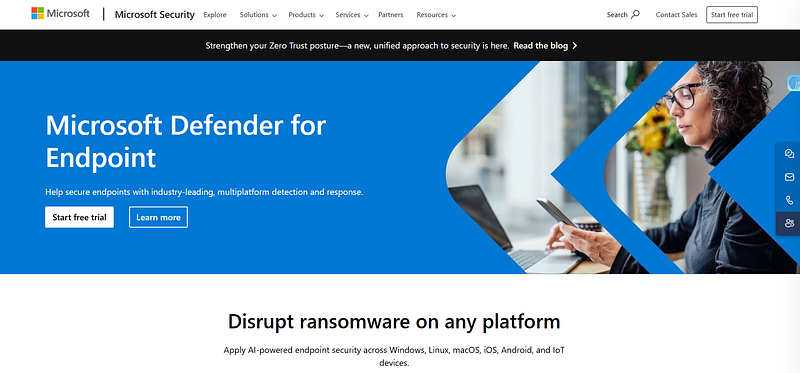
Microsoft Defender for Endpoint is a comprehensive endpoint detection and response (EDR) solution. It’s a native component of the Microsoft security ecosystem, offering advanced threat protection, automated investigations, and response capabilities for endpoints.
Features:
- Threat and vulnerability management: Continuously discovers and prioritizes software and configuration vulnerabilities on endpoints.
- Endpoint behavior analysis: Uses behavioral analytics to spot unusual activity that could indicate an attack.
- Seamless integration: As a native Microsoft product, it integrates effortlessly with Windows and other Microsoft 365 services.
Best For: Organizations already using Microsoft’s ecosystem, as it offers excellent protection and is often a cost-effective choice.
Pros: Easy to deploy and manage, cost-effective for Microsoft users, and provides strong protection for Windows devices.
Cons: Best performance is in Microsoft-heavy environments, so it may not be ideal for organizations with a diverse mix of operating systems.
2. IBM Security QRadar
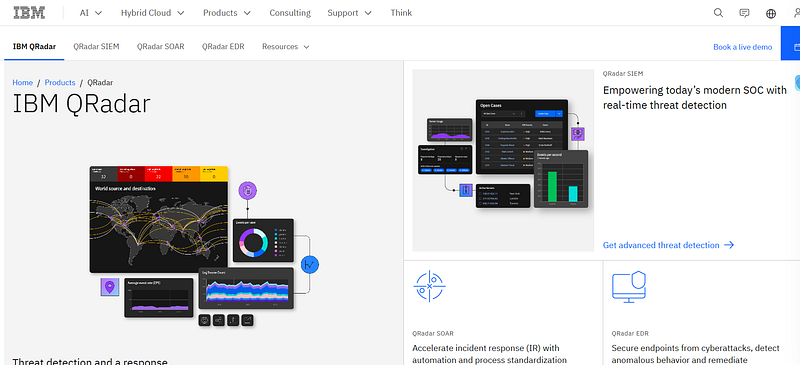
IBM QRadar is a powerful Security Information and Event Management (SIEM) solution. It gathers security data from across your network, including logs and events, to provide a centralized view of your security posture. This helps security teams quickly detect, investigate, and respond to threats.
Features:
- Real-time threat detection: Uses powerful analytics to identify known and emerging threats.
- AI-driven insights: Employs machine learning to uncover subtle anomalies and behavioral changes that might signal an attack.
- Centralized dashboard: Gives you a single pane of glass for all security-related data, making it easier to manage and respond to incidents.
Best For: Large enterprises, especially those in highly regulated industries like finance and healthcare that require robust compliance reporting and deep network visibility.
Pros: Highly scalable for massive data volumes, customizable, and provides excellent reporting.
Cons: Can be expensive and has a significant learning curve.
3. Tenable.io
Tenable.io is a cloud-based platform focused on vulnerability management. It helps organizations continuously discover and assess vulnerabilities across their entire attack surface, from on-premises servers to cloud containers.
Features:
- Continuous asset discovery: Automatically identifies and classifies all assets on your network, giving you a complete inventory.
- Risk-based prioritization: Uses a predictive scoring model to help you focus on the vulnerabilities that pose the greatest risk to your business.
- Integrated scanning: Provides both internal and external scanning capabilities to give you a full picture of your security weaknesses.
Best For: Organizations that need a proactive and continuous approach to vulnerability scanning, particularly those with dynamic, modern IT environments.
Pros: Easy to deploy and use, with a straightforward interface and regular updates.
Cons: While excellent for vulnerability management, it doesn’t offer the deep SIEM capabilities of other platforms.
4. Rapid7 InsightVM
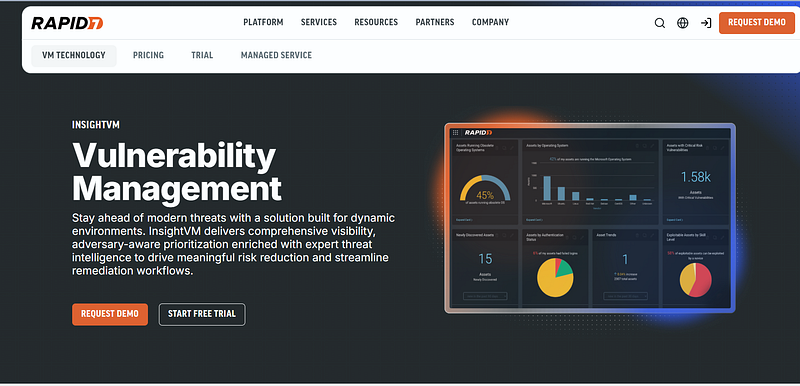
Rapid7 InsightVM is a dynamic vulnerability management solution that provides a live, real-time view of your risk landscape. Instead of relying on static scans, it continuously monitors your environment to give you an up-to-the-minute understanding of your security posture.
Features:
- Real-time vulnerability tracking: Instantly detects new vulnerabilities as they appear.
- Risk-based prioritization: Assigns a risk score to each vulnerability, helping you prioritize remediation efforts.
- Automated workflows: Integrates with other tools to automate remediation tasks and accelerate your response.
Best For: Mid-sized to large businesses with hybrid environments that need to see their risks in real-time and automate their security processes.
Pros: Interactive dashboards, automation support, and clear risk scores.
Cons: The initial setup can be complex and time-consuming.
5. Palo Alto Networks Cortex XDR
Cortex XDR is an extended detection and response (XDR) platform that unifies security data from endpoints, networks, and cloud applications. This unified approach provides deep visibility and automates threat detection and response, making it easier to handle sophisticated, multi-stage attacks.
Features:
- Behavioral analytics: Uses machine learning to identify suspicious user and network behavior.
- Unified incident response: Consolidates all threat data into a single console, streamlining investigations.
- Automated actions: Can automatically take action to contain threats and prevent further damage.
Best For: Enterprises looking for an advanced, all-in-one platform to combat complex threats.
Pros: High threat visibility across your entire network, strong automation, and seamless integration with other Palo Alto products.
Cons: Can be resource-intensive and requires significant expertise for full deployment.
6. Qualys Cloud Platform
The Qualys Cloud Platform is a comprehensive security and compliance solution delivered via the cloud. It provides a suite of integrated applications for continuous asset discovery, vulnerability management, and automated compliance tracking from a single dashboard.
Features:
- Global IT asset inventory: Creates a continuous and up-to-date inventory of all your IT assets.
- Automated patch management: Helps you automatically apply critical security patches to vulnerable systems.
- Compliance reporting: Generates reports to help you meet regulatory requirements like GDPR and HIPAA.
Best For: Companies that need continuous compliance automation and real-time security across a global or distributed IT environment.
Pros: Excellent reporting, highly scalable, and a comprehensive suite of security tools.
Cons: The platform can feel overly complex for smaller teams to navigate.
7. RSA Archer Suite
RSA Archer is a powerful Governance, Risk, and Compliance (GRC) platform. It provides a holistic view of enterprise-wide risks by connecting various risk management activities, from policy management and compliance tracking to incident response.
Features:
- Risk quantification: Helps you quantify risk in business terms, making it easier to get buy-in from senior leadership.
- Policy management: Manages and tracks your organization’s policies and controls.
- Integrated reporting: Provides a centralized view of your GRC program, streamlining audits and reporting.
Best For: Enterprises with a strong focus on GRC, and those that need to align their security efforts with business objectives and regulatory requirements.
Pros: Robust GRC framework, great integration with other business systems.
Cons: Less focused on technical vulnerability management, so it may not be the best fit if that is your primary concern.
Key Challenges in Cybersecurity Risk Management Tools
While cybersecurity risk management tools offer significant benefits, their implementation and ongoing management are not without challenges. Organizations frequently encounter several hurdles that can impact the effectiveness and ROI of their security investments.
Complexity and Configuration
Many enterprise-grade cybersecurity tools, such as IBM Security QRadar and Palo Alto Networks Cortex XDR, are highly complex. They require specialized knowledge and a deep understanding of network architecture to configure and operate correctly.
Improper or incomplete configuration can leave critical security gaps, rendering the tool ineffective. This complexity often leads to a steep learning curve for security teams, which can delay deployment and hinder the ability to realize the tool’s full potential.
High Costs
The price of top-tier cybersecurity risk management tools can be a significant barrier. This includes not only the initial licensing fees but also ongoing costs for maintenance, updates, and support.
For many organizations, the total cost of ownership (TCO) is a major concern. This includes the cost of integrating the new tool with existing systems, hiring or training specialized personnel, and the resources needed for continuous monitoring and management. While smaller organizations might opt for more affordable solutions, they may sacrifice advanced features.
False Positives and Alert Fatigue
Even the most sophisticated tools can generate a large volume of alerts, many of which are “false positives”, alerts that incorrectly identify benign activity as a threat.
This constant stream of non-critical alerts can lead to “alert fatigue” among security analysts, causing them to become desensitized and potentially miss genuine threats buried within the noise. Managing false positives requires significant time and effort to fine-tune the tool’s rules and algorithms.
Mitigating Cybersecurity Tool Challenges
To get the most out of a cybersecurity risk management tool , organizations can proactively address common challenges with strategic planning and continuous effort.
- Invest in Expertise: Provide specialized training for your security team to ensure they can properly configure and operate the tool. Smaller organizations can also partner with a managed security service provider (MSSP) to gain access to expert support without the high costs of an in-house team.
- Plan Strategically: Before purchasing a cybersecurity risk management tool, conduct a thorough needs assessment. Choose a solution that fits your specific security objectives, infrastructure, and budget to avoid unnecessary complexity and cost.
- Adopt a Phased Approach: Instead of a full-scale deployment, roll out the tool in stages. This allows your team to get familiar with its functions and fine-tune configurations in a controlled environment, reducing errors and risk.
- Maintain Continuous Improvement: Regularly monitor the tool’s performance and adjust its settings. By continuously refining detection rules and integrating new threat intelligence, you can reduce false positives and enhance the tool’s overall accuracy over time.
Conclusion
Selecting the right cybersecurity risk management tools isn’t about finding the most expensive or feature-packed platform; it’s about aligning capabilities with your organization’s specific risks and goals. Whether you’re a small business looking to strengthen endpoint security or a global enterprise managing compliance across continents, the tools above can help you stop cyberattacks cold and stay ahead of ever-evolving threats.
Ready to Streamline Compliance?
Building a secure foundation for your startup is crucial, but navigating the complexities of achieving compliance can be a hassle, especially for a small team.
SecureSlate offers a simpler solution:
- Affordable: Expensive compliance software shouldn’t be the barrier. Our affordable plans start at just $284/month.
- Focus on Your Business, Not Paperwork: Automate tedious tasks and free up your team to focus on innovation and growth.
- Gain Confidence and Credibility: Our platform guides you through the process, ensuring you meet all essential requirements, and giving you peace of mind.
Disclaimer (legal note)
SecureSlate is not a law firm, and this article does not constitute or contain legal advice or create an attorney-client relationship. When determining your obligations and compliance with respect to relevant laws and regulations, you should consult a licensed attorney.
Need compliance without the complexity?
SecureSlate automates ISO 27001, SOC 2, GDPR, HIPAA, and more. Built for growing teams. See it in action.
Find compliance gaps in 30 seconds
