
 Photo by
 Related guides:
Key takeaways
- What Are SIEM Cybersecurity Tools: SIEM cybersecurity tools are software platforms that collect, standardize, and analyze data from various systems across your network, such as firewalls, servers, endpoints, and applications.
- Why SIEM Cybersecurity Tools Are a Must-Have: Data breach isn’t a matter of “if,” but “when.” This makes real-time visibility into your IT environment non-negotiable.
- Integration: A good SIEM tool should work seamlessly with your existing technology stack.
With more rules to follow and cyberattacks happening more often, businesses know they need stronger security. That’s why 84% of organizations believe a cloud-based SIEM (Security Information and Event Management) cybersecurity tool could seriously improve their security setup.
A SIEM cybersecurity tool helps your team spot, investigate, and stop threats quickly, so they don’t turn into serious problems.
In this article, we’ll walk through the top 7 SIEM cybersecurity tools and give you tips to help you choose the best one for your company.
What Are SIEM Cybersecurity Tools?
SIEM cybersecurity tools are software platforms that collect, standardize, and analyze data from various systems across your network, such as firewalls, servers, endpoints, and applications.
These tools apply pre-configured rules and behavioral analytics to monitor for anomalies and potential threats. When suspicious activity is detected, alerts are generated for your security team to take immediate action, often before the incident escalates.
Why SIEM Cybersecurity Tools Are a Must-Have
Data breach isn’t a matter of “if,” but “when.” This makes real-time visibility into your IT environment non-negotiable. SIEM tools provide a centralized view of your security, offering advanced threat detection that is crucial for any organization.
Here’s why they matter:
- Comprehensive Threat Visibility: SIEMs track every digital trace an attacker leaves, giving you a full picture of the timeline, method, and impact of an incident.
- Faster Root Cause Analysis: They help you quickly pinpoint the source of an attack, allowing for swift remediation and preventing future risks.
- Smart Behavioral Analysis: By distinguishing between normal user activity and malicious behavior, a SIEM can detect insider threats and reduce the noise from false positives.
- Simplified Compliance: These tools make log management easy, which is essential for meeting compliance standards like SOC 2, HIPAA, and PCI-DSS.
- Stronger Reputation: A solid security posture helps you avoid costly data breaches, regulatory fines, and lasting damage to your brand’s reputation.
Common Key Features in SIEM Tools
Integration
A good SIEM tool should work seamlessly with your existing technology stack. You don’t want a security solution that creates more problems than it solves, so look for one that’s easy to integrate into your current systems without causing major disruptions.
Real-Time Monitoring
Quick detection is everything. The ability to monitor your network in real-time allows you to spot and respond to threats as they happen, not hours or days later. This is crucial for minimizing damage and downtime.
Threat Intelligence
A top-notch SIEM uses threat intelligence to identify both known and unknown attack vectors. This feature helps you stay ahead of new and emerging threats, making your security posture more proactive.
Scalability
Your business is always growing, and your security tools should be able to grow with it. Choose a solution that can handle increasing data volumes without slowing down, ensuring it remains effective as your business expands.
User and Entity Behavior Analytics (UEBA)
UEBA is a powerful tool for detecting abnormal behavior patterns. It helps you spot a threat that might not look like a traditional attack, such as an employee’s account being used in a suspicious way.
Cloud-Native Architecture
In today’s world of hybrid and remote work, a cloud-native architecture is no longer optional. It’s essential for a flexible security solution that can protect your data and systems no matter where your team is working from.
Top 7 SIEM Cybersecurity Tools in 2025
Finding the “top” SIEM tools can be subjective, as the best solution for an organization depends on its size, industry, specific security needs, and budget. However, based on recent industry reports, vendor announcements, and expert analysis, here are some of the most prominent SIEM cybersecurity tools leading the market in 2025.
1. Splunk Enterprise Security
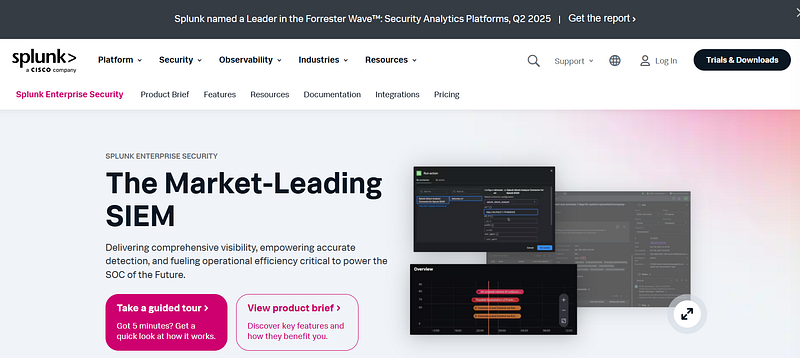
Splunk has long been considered the industry gold standard for data analysis. Its SIEM offering, Splunk Enterprise Security (ES), is a powerful platform known for its flexibility and ability to handle massive volumes of data from almost any source. It’s a highly scalable solution used by global enterprises that need deep-dive analytics and a high degree of customization.
Key Features
- Scalable Data Ingestion: Can handle petabytes of data from virtually any source.
- Search Processing Language (SPL): A powerful, proprietary language for in-depth data exploration.
- Risk-Based Alerting (RBA): Prioritizes security incidents based on a risk score, reducing alert fatigue.
- Threat Intelligence Framework: Integrates with leading threat intelligence feeds to improve detection accuracy.
Pros
- Unmatched Analytics: Its powerful search and data analysis capabilities are a benchmark in the industry.
- High Scalability: Can grow with a business of any size, from mid-market to global enterprises.
- Extensive Integrations: Boasts a vast ecosystem of third-party apps and integrations.
Cons
- High Cost: Splunk is notoriously expensive, especially for large-scale data ingestion.
- Steep Learning Curve: The platform’s complexity and the proprietary SPL language require specialized knowledge.
Best For: Large enterprises with dedicated security teams and a substantial budget that need advanced, customizable analytics.
2. Microsoft Sentinel
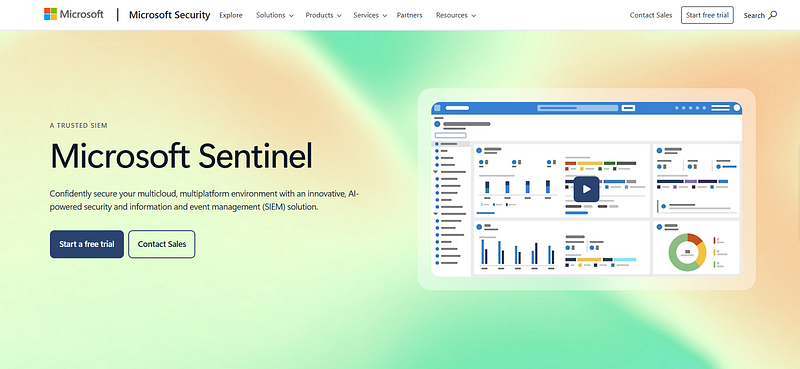
As a cloud-native SIEM built on Azure, Microsoft Sentinel offers seamless integration with other Microsoft products. It’s designed to be a modern, scalable solution that leverages AI and automation to help security teams efficiently detect and respond to threats.
Key Features
- Cloud-Native Architecture: Built on Microsoft Azure, providing inherent scalability and global availability.
- AI-Driven Analytics: Uses machine learning to correlate alerts and reduce false positives.
- Automation and SOAR: Comes with built-in SOAR capabilities, allowing for automated incident response.
- Seamless Integration: Naturally integrates with the entire Microsoft ecosystem (Azure AD, Microsoft 365, etc.).
Pros
- Cost-Effective for Microsoft Users: Organizations already using Azure or Microsoft 365 benefit from its integrated architecture and more favorable pricing.
- User-Friendly Interface: The Azure portal offers a relatively easy-to-use and intuitive interface.
- Rapid Deployment: Can be deployed and scaled up quickly without the need for on-premise hardware.
Cons
- Dependence on Azure: Its tight integration with Azure can be a drawback for multi-cloud or hybrid environments that are not primarily Microsoft-based.
- Initial Setup Complexity: While the platform is user-friendly, the initial configuration can be time-consuming for those unfamiliar with Azure.
Best For: Organizations that operate predominantly in the Microsoft cloud ecosystem and want a modern, scalable, AI-driven SIEM.
3. IBM QRadar
IBM QRadar is a mature, all-in-one SIEM platform known for its powerful correlation engine and AI-driven analytics. It’s a top choice for large enterprises and highly regulated industries that need to connect disparate events to uncover complex, multi-stage attacks.

Key Features
- Advanced Correlation Engine: Connects seemingly unrelated events to identify sophisticated attacks.
- AI and Machine Learning: Employs AI to analyze user and network behavior, spotting anomalies.
- Centralized Asset Management: Provides a single view of all assets, their vulnerabilities, and their risk profile.
- Packet Capture and Flow Analysis: Has integrated network flow capabilities for deep network visibility.
Pros
- Powerful Threat Detection: Its correlation engine is highly effective at uncovering complex threats.
- Comprehensive Platform: Offers a wide range of features from log management to network monitoring in a single solution.
- Robust Compliance Reporting: Provides out-of-the-box reports for various regulatory frameworks.
Cons
- Complex Implementation: Can be challenging and time-consuming to implement and configure.
- Resource-Intensive: Requires a significant investment in both infrastructure and maintenance.
Best For: Large enterprises and government agencies with mature security programs that need robust compliance and deep threat analysis.
4. Rapid7 InsightIDR
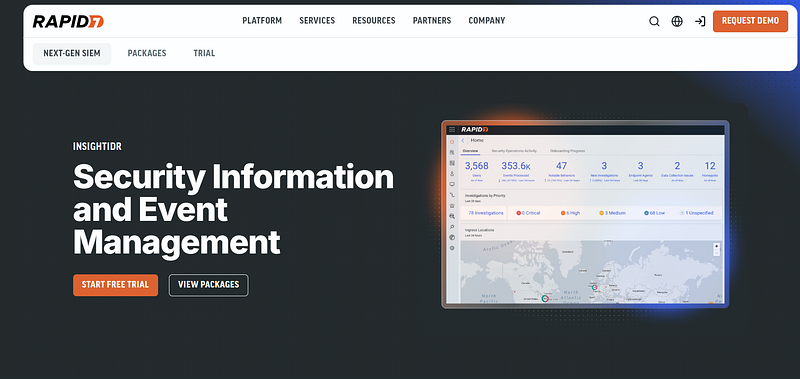
Rapid7 InsightIDR is a cloud-native SIEM solution that combines incident detection and response with advanced analytics. It’s designed for speed and efficiency, with a strong focus on detecting compromised credentials and insider threats.
Key Features
- User and Attacker Behavior Analytics (UABA): Specializes in detecting threats by baselining and analyzing user behavior.
- High-Context Timelines: Automatically builds detailed timelines of an attack, linking users, assets, and events.
- Integrated EDR: Comes with an included agent for endpoint detection and response, simplifying data collection.
- Cloud-Native & Streamlined: Designed for quick time-to-value with an intuitive interface.
Pros
- Focus on Insider Threats: Its UABA capabilities are highly effective at detecting threats from compromised accounts.
- Ease of Use: The platform is known for its user-friendly interface and simple onboarding.
- Fast Investigations: The high-context timelines significantly accelerate the incident investigation process.
Cons
- Less Customizable: It may be less flexible and customizable than more powerful, enterprise-grade SIEMs.
- Cloud-Dependent: May not be the best fit for organizations that require a full on-premise solution.
Best For: Mid-sized to large organizations with lean security teams that want to be highly efficient and are concerned with insider threats.
5. Exabeam
Exabeam is a pioneer in the UEBA space, using machine learning to create a baseline of normal behavior to detect anomalies and insider threats. Its “New-Scale SIEM” platform is built for speed and scalability, merging SIEM, UEBA, and SOAR capabilities.

Key Features
- User and Entity Behavior Analytics (UEBA): Creates a behavioral baseline to detect insider threats and advanced attacks.
- Smart Timelines: Automatically creates a chronological timeline of events for an investigation, reducing manual effort.
- Security Orchestration Automation and Response (SOAR): Provides built-in SOAR for automating response workflows.
Pros
- Unrivaled UEBA: Its behavior analytics are among the best in the industry.
- Automated Investigations: The smart timelines significantly reduce manual effort.
- Fast Deployment: Its cloud-native architecture allows for quick and easy deployment.
Cons
- Can Be a “Noise Generator”: Without proper tuning, its sensitivity can lead to a high volume of alerts.
- Cost: Can be expensive, especially for large deployments.
Best For: Organizations that prioritize the detection of insider threats and advanced, behavioral-based attacks.
6. LogRhythm
LogRhythm’s NextGen SIEM platform combines log management, network monitoring, and UEBA in a single, integrated solution. It’s a solid choice for mid-sized to large organizations that need an all-in-one platform for threat detection and incident response.

Key Features
- NextGen SIEM Platform: An integrated solution for log management, network monitoring, and UEBA.
- SmartResponse™: Automated and semi-automated incident response capabilities to take immediate action against threats.
- Advanced AI Engine: Uses a combination of machine and search analytics for risk-based threat prioritization.
- Compliance Automation: Offers a wide range of pre-built reports and dashboards for regulatory compliance.
Pros
- All-in-One Solution: Its integrated platform simplifies security operations, eliminating the need for multiple vendors.
- Flexible Deployment: Supports various deployment options, including on-premise and cloud.
Cons
- Customization Challenges: Creating new rules and customizations can be complex.
- Learning Curve: The platform has a considerable learning curve for new users.
Best For: Mid-sized to large organizations that need a single, integrated platform for all their SIEM needs.
7. SentinelOne
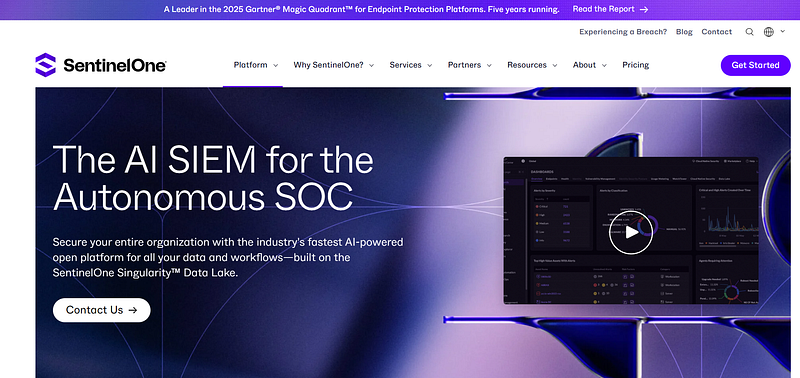
While best known for its endpoint protection, SentinelOne has expanded its platform with an AI-SIEM offering. This unified solution leverages AI to automate tasks and provides a centralized view for security operations, making it ideal for lean security teams.
Key Features
- Autonomous AI Engine: Uses a behavioral AI engine to automatically detect and prevent threats in real-time.
- Storyline™ Technology: Creates a visual narrative of an attack, connecting all related events.
- Integrated EDR, XDR, and SIEM: Provides a unified platform for endpoint, cloud, and identity security.
- Automated Remediation: Can automatically stop threats and roll back a system to a pre-infection state.
Pros
- AI-Powered Automation: Its autonomous AI engine provides rapid and effective threat prevention.
- Simplified Operations: The unified platform and automated features are excellent for organizations with limited resources.
Cons
- Maturity of SIEM Capabilities: Its full-scale SIEM capabilities are newer to the market compared to dedicated SIEM vendors.
- Pricing: Can be more expensive than some competitors for larger deployments.
Best For: Organizations of all sizes that want to move toward an autonomous security model and consolidate their EDR and SIEM platforms.
How to Select the Right SIEM Tool for Your Organization
The SIEM landscape can be overwhelming. To find the right tool for your business, you need a clear strategy. Here are the key factors to consider when making your choice:
Align with Your Security Goals
Before you begin evaluating tools, you must first define your specific security objectives. Are you primarily focused on meeting regulatory compliance mandates like HIPAA or PCI DSS? Is your main goal to detect insider threats and compromised user accounts? Or do you need a solution to provide comprehensive visibility across a complex, multi-cloud environment?
By clearly outlining what you want to achieve, you can prioritize features and functionalities that are truly necessary for your organization.
Assess Core Features and Capabilities
The best SIEM tool for you will have a feature set that directly addresses your defined security requirements. While most SIEMs offer basic log management and analysis, you should carefully compare their advanced capabilities. Look for:
- Advanced Analytics: A modern SIEM should use AI and machine learning to analyze behavior and spot anomalies that rule-based systems might miss.
- Threat Intelligence: The platform should integrate with threat intelligence feeds to enrich your data and provide context on known bad actors and attack vectors.
- Automation: Integrated SOAR (Security Orchestration, Automation, and Response) features can significantly reduce the time it takes to respond to and contain a threat.
- Compliance and Reporting: Ensure the tool can generate pre-built, audit-ready reports for any industry regulations you must adhere to.
Consider Usability and Deployment
A powerful SIEM is useless if your security team can’t use it effectively. Prioritize a solution with an intuitive user interface, clear dashboards, and visualizations that make it easy to spot trends and investigate incidents. Additionally, consider the deployment model.
A cloud-native SIEM can offer rapid deployment and seamless scalability, while an on-premise solution may be more suitable if you need to maintain full control over your data.
Be Mindful of Total Cost of Ownership (TCO)
The price tag of the software is only part of the equation. You must consider the total cost of ownership, including:
- Licensing and data volume costs: Many SIEMs charge based on data ingestion, which can lead to unpredictable and rising costs as your business grows. Look for a pricing model that is transparent and predictable.
- Implementation and maintenance: Factor in the cost of professional services for setup, as well as ongoing personnel costs for management, tuning, and monitoring.
- Training and support: Ensure the vendor provides adequate training and reliable customer support to help your team get the most out of the platform and resolve issues quickly.
Conclusion
The cybersecurity landscape is constantly evolving, and so must our defenses. As we’ve seen, the top SIEM tools for 2025 are defined by their use of AI, automation, and a cloud-first approach. They are designed to cut through the noise, reduce alert fatigue, and empower even lean security teams to tackle major threats head-on.
The decision ultimately comes down to a careful evaluation of your specific requirements. By choosing a SIEM that’s a perfect fit, you’re not just buying software, but you’re investing in your peace of mind and the long-term resilience of your business.
Ready to Streamline Compliance?
Building a secure foundation for your startup is crucial, but navigating the complexities of achieving compliance can be a hassle, especially for a small team.
SecureSlate offers a simpler solution:
- Affordable: Expensive compliance software shouldn’t be the barrier. Our affordable plans start at just $284/month.
- Focus on Your Business, Not Paperwork: Automate tedious tasks and free up your team to focus on innovation and growth.
- Gain Confidence and Credibility: Our platform guides you through the process, ensuring you meet all essential requirements, and giving you peace of mind.
Disclaimer (legal note)
SecureSlate is not a law firm, and this article does not constitute or contain legal advice or create an attorney-client relationship. When determining your obligations and compliance with respect to relevant laws and regulations, you should consult a licensed attorney.
Need compliance without the complexity?
SecureSlate automates ISO 27001, SOC 2, GDPR, HIPAA, and more. Built for growing teams. See it in action.
Find compliance gaps in 30 seconds
