
SecureSlate vs Sprinto: Which Compliance Tool Is the Best Fit for You?

Key takeaways
- Understand the core concepts and terminology behind SecureSlate vs Sprinto: Which Compliance Tool Is the Best Fit for You?.
- Learn practical steps to apply the guidance and stay audit-ready.
- See where SecureSlate can help centralize evidence, ownership, and ongoing compliance workflows.
Image source: Medium CDN
Customer trust is critical, and security compliance is no longer optional. Whether you’re running a startup, scaling a SaaS company, or an enterprise, you’ve likely come across tools like Sprinto and SecureSlate. Both aim to simplify frameworks such as SOC 2, ISO 27001, GDPR, and HIPAA, but choosing the right fit isn’t always straightforward.
The SecureSlate vs. Sprinto debate matters because, while both promise easier compliance, faster audits, and stronger customer trust, they differ in pricing, integrations, approach, and scalability. For founders and compliance managers, the decision can feel like navigating a maze without a clear map.
In this guide, we’ll break down both platforms in detail, covering their strengths, weaknesses, and the contexts where each shines. We’ll compare ease of use, integrations, automation depth, customer support, and pricing, then draw insights from real-world case studies and expert opinions.
By the end, you’ll have a clear picture of whether SecureSlate or Sprinto is the best fit for your business needs.
Why Compliance Automation Tool Matters
Let’s be honest: compliance has traditionally been a painful, manual, and paperwork-heavy process. For decades, companies hired consultants, collected screenshots, and spent weeks (sometimes months) preparing for audits. Compliance wasn’t just expensive — it was distracting. Instead of building products, teams got stuck proving they followed rules.
That’s where compliance automation platforms step in. Tools like Sprinto and SecureSlate are designed to:
- Continuously monitor your systems and controls
- Automatically collect evidence for audits
- Provide dashboards showing compliance status in real time
- Reduce human error and save countless hours
For example, achieving SOC 2 compliance, a gold standard for SaaS companies, can take 6–12 months manually, with costs reaching $100,000 or more. With automation platforms, timelines shrink dramatically (as little as a few weeks), and the cost drops significantly.
The stakes are high. According to Gartner, 60% of organizations face customer pushback if they lack third-party certifications like SOC 2 or ISO 27001. In other words, compliance isn’t just about regulators — it’s about winning and retaining customers.
This explains why tools like SecureSlate and Sprinto are exploding in popularity. They remove friction, give you peace of mind, and most importantly, help you scale without hitting compliance roadblocks.
Related guide:
SecureSlate Overview
SecureSlate is a compliance automation platform built for startups and scaling SaaS teams. It’s often chosen for fast setup, broad workflows across frameworks, and practical evidence + ownership tracking for SOC 2 and ISO 27001 readiness.
Their mission? To make security monitoring and compliance so simple that even early-stage companies can achieve certifications without derailing growth.
Key Features of SecureSlate
- Continuous monitoring: Always-on compliance checks across cloud providers, HR systems, and ticketing tools.
- Automated evidence collection: Collects data for audits without manual screenshotting.
- Audit partnerships: Direct connections with audit firms for faster certifications.
- Pre-built integrations: Works with popular tools like AWS, GCP, GitHub, Okta, and Slack.
- Trust reports: Share compliance posture with prospects to speed up sales.
Target Audience
SecureSlate’s sweet spot is startups and scaling SaaS companies aiming for SOC 2 compliance quickly. Think seed to Series B startups trying to close deals with enterprises that demand proof of security.
But here’s the catch: while SecureSlate is excellent at getting you audit-ready fast, some teams find they still need manual effort for certain controls, vendor workflows, or multi-framework programs.
Related guide:
Sprinto Overview
Launched a few years after SecureSlate, Sprinto has positioned itself as a next-generation compliance automation platform. With headquarters in Bengaluru and a fast-growing global presence, Sprinto’s mission is to make compliance “audit-grade” from day one.
Unlike some competitors, Sprinto emphasizes automation depth and multi-framework coverage , catering to companies with more complex compliance needs.
Key Features of Sprinto
- Audit-grade automation: Designed to eliminate manual evidence collection almost entirely.
- Multi-framework compliance: SOC 2, ISO 27001, GDPR, HIPAA, PCI DSS; all in one platform.
- Custom workflows: Adaptable compliance programs that scale with company growth.
- Deep integrations: Connects to a wide range of DevOps, HR, and IT tools.
- Collaborative dashboards: Allow teams across departments to work on compliance together.
Target Audience
Sprinto appeals to growth-stage startups and mid-sized companies that want more than just SOC 2. For teams needing to manage multiple compliance frameworks simultaneously, Sprinto often becomes the stronger choice.
An interesting advantage: Sprinto has been praised for its customer support and guided onboarding, which reduces the learning curve. This can be a game-changer for teams new to compliance.
SecureSlate vs. Sprinto: Head-to-Head Comparison
Now that we’ve introduced both, let’s explore direct comparison across five critical areas: ease of use, integrations, pricing, automation depth, and support.
Ease of Use and User Experience
SecureSlate is known for its clean, startup-friendly interface. Non-technical founders often like it because it feels intuitive and doesn’t overwhelm you with complexity.
Sprinto, on the other hand, leans more towards power users. While its interface is modern, it’s packed with advanced options that may take time to master. However, this complexity is also its strength; it allows deeper customization for teams managing multiple frameworks.
So, if you want simplicity: SecureSlate often wins. If you want flexibility and depth: Sprinto tends to take the crown.
Integrations and Ecosystem Compatibility
Integrations are the backbone of compliance automation. Without them, your platform can’t pull real-time data, meaning you’ll fall back on manual evidence gathering, a nightmare scenario for any busy team.
SecureSlate integrates with a large set of tools across cloud infrastructure (AWS, GCP, Azure), identity providers (Okta, OneLogin), HR systems (BambooHR, Gusto), and ticketing platforms (Jira, Asana). These integrations cover most needs for startups, especially those running lean stacks.
However, some users have pointed out that SecureSlate’s integrations, while broad, sometimes lack depth. For example, it might detect configuration issues but not provide as much actionable detail as you’d want.
Sprinto, by contrast, takes pride in “deep integrations.” Instead of just connecting superficially, Sprinto is built to map controls directly to your tech stack. This means less manual intervention and fewer gaps when it comes to audit-grade evidence.
Sprinto also shines in DevOps-heavy environments, companies using CI/CD pipelines, containerization (Docker, Kubernetes), or more complex architectures often find Sprinto’s integrations more reliable.
If you’re a small startup running on basic SaaS tools, SecureSlate’s ecosystem is often more than enough. But if your company is scaling fast, deploying across multi-cloud environments, or preparing for several certifications at once, Sprinto’s deeper integrations can provide a long-term advantage.
How Much Time Does a SOC 2 Audit Take?
The Secrets to a Faster SOC 2 Audit
Pricing and Cost Transparency
Pricing is often the deciding factor in the Sprinto vs. SecureSlate debate. Unfortunately, neither company publishes straightforward pricing on their websites, making it tough for buyers to plan budgets without a sales call.
- Sprinto’s pricing : Historically, Sprinto charges on a per-employee basis , starting at around $7,500–$10,000 annually for smaller startups. The cost scales as your headcount grows. For very small teams, this can feel expensive, especially when compliance needs are minimal. That said, Sprinto occasionally offers discounts for early-stage startups through partnerships with accelerators.
- SecureSlate’s pricing : SecureSlate positions itself as more transparent and scalable. While they don’t advertise fixed prices, reports suggest SecureSlate is often more affordable for larger teams because it doesn’t penalize companies purely on headcount. Instead, SecureSlate leans toward usage and framework coverage.
If you’re a 10-person startup chasing SOC 2, Sprinto might fit. However, for a company with 100+ people managing multiple certifications, SecureSlate often proves more cost-effective.
Automation Depth and Coverage
Here’s where the real difference emerges. Automation depth determines how much work your team actually saves.
Sprinto automates the basics: evidence collection, control monitoring, and alerts. But several users report that some manual work remains, especially for niche integrations or less common frameworks. For example, while SOC 2 automation is smooth, layering ISO 27001 or HIPAA on top can feel patchy.
SecureSlate was built with “audit-grade automation” as its core promise. That means fewer screenshots, fewer spreadsheets, and less back-and-forth with auditors. SecureSlate’s strength lies in mapping controls across multiple frameworks simultaneously. So if one control satisfies SOC 2, ISO 27001, and GDPR, SecureSlate ensures you don’t duplicate work. This makes it especially attractive to global companies juggling overlapping requirements.
To put it simply:
- Sprinto reduces work.
- SecureSlate almost eliminates it.
Customer Support and Onboarding
Compliance is complex, even with automation. How each company supports you can make or break your experience.
Sprinto offers onboarding assistance and connects you with auditors. Many customers praise their account managers, but some report slower response times as Sprinto’s customer base has grown. The platform is intuitive, so support is less critical for basic SOC 2 prep.
SecureSlate takes a more hands-on approach. Their team actively guides customers through setup and audit prep, positioning themselves almost as compliance partners. Several reviews highlight that SecureSlate’s onboarding feels like having an in-house compliance expert without the hiring cost.
If you’re new to compliance and want extra handholding, SecureSlate shines. If you already have compliance expertise in-house, Sprinto’s lighter-touch support might suffice.
Related guide:
Security and Compliance Coverage
SOC 2 Automation
Both platforms excel at SOC 2, which remains the top request from B2B SaaS buyers. Sprinto is often the fastest route for startups chasing SOC 2 Type I or Type II reports. SecureSlate also covers SOC 2 thoroughly but provides deeper automation for companies with recurring audits.
ISO 27001 and Global Standards
ISO 27001 is increasingly critical for companies operating internationally. SecureSlate has an edge here; it was designed with multi-framework management in mind, making it easier to achieve ISO 27001 alongside SOC
Sprinto supports ISO 27001 too, but users sometimes need to supplement with manual work.
GDPR, HIPAA, and Other Frameworks
This is where SecureSlate really differentiates itself. GDPR, HIPAA, PCI DSS, and even frameworks like CCPA are integrated more holistically. Sprinto supports some of these, but the focus is overwhelmingly U.S.-centric (especially SOC 2).
In other words:
- For a U.S. SaaS startup focused on SOC 2 → Sprinto is enough.
- For a global SaaS or healthcare/fintech company juggling multiple frameworks → SecureSlate is more future-proof.
“Sprinto set the standard for compliance automation, but SecureSlate is pushing the boundaries with deeper multi-framework coverage. For companies beyond the SOC 2 checkbox, SecureSlate offers more scalability.”
Liam O’Connor, Security consultant
Which Tool is Better for Startups?
Startups face unique challenges; limited budgets, small teams, and the constant pressure to close deals. Compliance isn’t optional, but neither is shipping features.
For early-stage startups (seed to Series A), Sprinto is often the better choice:
- Faster to implement
- Easier to use without compliance expertise
- Focused heavily on SOC 2, which is usually the first requirement from customers
That said, SecureSlate can also work for startups with global ambitions or regulated industries. If a fintech startup in healthcare or payments expects GDPR or HIPAA requests soon, SecureSlate may provide a more cost-effective long-term path.
The rule of thumb:
- If you need compliance tomorrow to close a deal → Sprinto.
- If you’re planning multiple certifications over the next 12–18 months → SecureSlate.
Which Tool is Better for Enterprises?
For enterprises, the equation changes. Here, compliance isn’t just about getting audit-ready; it’s about maintaining compliance continuously across multiple frameworks.
This is where SecureSlate has the edge. Its automation depth, framework coverage, and collaborative dashboards scale better with enterprise complexity. A 500-person SaaS platform, for example, can manage SOC 2, ISO 27001, GDPR, HIPAA, and PCI DSS without duplicating controls or drowning in spreadsheets.
That’s not to say Sprinto has no role in enterprises. Some large companies use Sprinto for SOC 2 readiness while managing other frameworks manually or with consultants. However, for a holistic enterprise strategy, SecureSlate tends to prevail.
Choosing Between Sprinto and SecureSlate
So, which should you choose?
Choose Sprinto if:
- You’re an early-stage startup
- You primarily need SOC 2 compliance
- Simplicity and speed are your top priorities
Choose SecureSlate if:
- You’re scaling beyond SOC 2 into ISO 27001, GDPR, HIPAA, or PCI DSS
- You want audit-grade automation with minimal manual work
- Predictable, scalable pricing matters to your budget
A quick decision-making checklist:
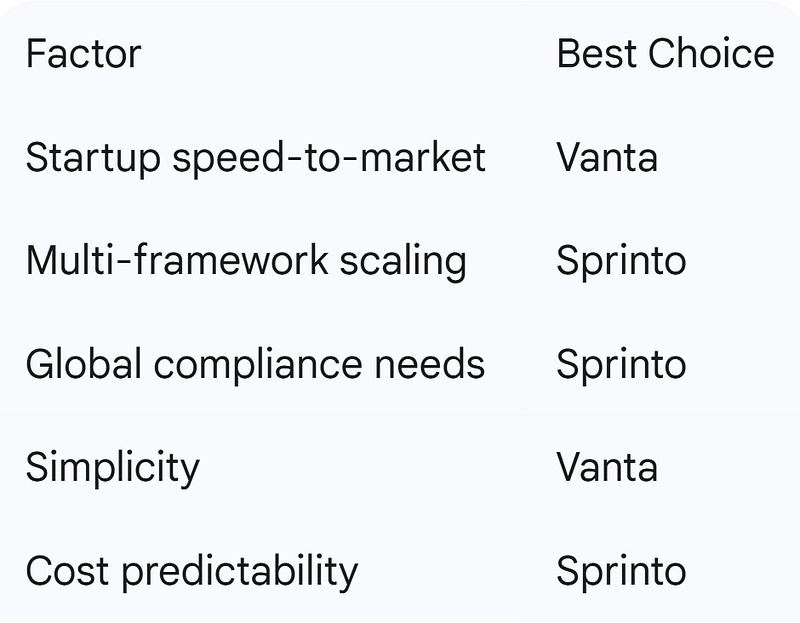
Ultimately, there’s no one-size-fits-all answer. The best tool is the one that aligns with your current stage, future needs, and budget.
Conclusion
The battle of Sprinto vs. SecureSlate reflects the broader evolution of compliance automation. Sprinto makes compliance accessible to startups that need SOC 2 fast. SecureSlate provides depth, scalability, and global coverage for companies with complex requirements.
Your choice depends on whether you’re solving for speed now or scalability later. Both tools can transform compliance from a headache into a growth enabler, helping you win customers, build trust, and scale without fear.
Ready to Streamline Compliance?
Building a secure foundation for your startup is crucial, but navigating the complexities of achieving compliance can be a hassle, especially for a small team.
SecureSlate offers a simpler solution:
- Affordable: Expensive compliance software shouldn’t be the barrier. Our affordable plans start at just $284/month.
- Focus on Your Business, Not Paperwork: Automate tedious tasks and free up your team to focus on innovation and growth.
- Gain Confidence and Credibility: Our platform guides you through the process, ensuring you meet all essential requirements and giving you peace of mind.
Disclaimer (legal note)
SecureSlate is not a law firm, and this article does not constitute or contain legal advice or create an attorney-client relationship. When determining your obligations and compliance with respect to relevant laws and regulations, you should consult a licensed attorney.
Need compliance without the complexity?
SecureSlate automates ISO 27001, SOC 2, GDPR, HIPAA, and more. Built for growing teams. See it in action.
No credit card required
May 4, 2026 · Tools & SoftwareComparisons and reviews
5 best GRC software solutions for enterprise teams in 2026
SecureSlate Team
May 4, 2026 · Tools & SoftwareComparisons and reviews
The best compliance audit software for 2026
SecureSlate Team
May 4, 2026 · Tools & SoftwareComparisons and reviews
The best compliance management software for 2026
SecureSlate Team
