
Photo: Unsplash

Related guides:
- your guide to soc 2 audits
- the ultimate iso 27001 guide
- us data privacy compliance checklist
- GDPR compliance for SaaS
- GDPR compliance for startups
- GDPR automation
Key takeaways
- The Core Benefits of GDPR Compliance Tools: Why do businesses invest in GDPR compliance tools instead of hiring more compliance staff?
- Key Features Every GDPR Tool Should Offer: Not all tools are equal.
- How to Automate Data Subject Access Requests (DSARs): Manual DSAR fulfillment is a 2026 liability: it’s slow, error-prone, and hard to prove you met GDPR timelines.
When the General Data Protection Regulation (GDPR) came into effect in May 2018, it transformed data privacy rules worldwide. Businesses in the EU, and those outside processing EU citizens’ data, faced strict obligations on collecting, storing, and using personal information.
Non-compliance isn’t just risky; it’s expensive. Regulators have issued billions of euros in fines since GDPR was enacted. Amazon was fined €746 million in 2021 , and Meta faced €1.2 billion in 2023 for GDPR violations. These staggering numbers highlight the stakes for businesses of all sizes.
The problem? GDPR compliance is complex. From managing consent to handling data subject access requests (DSARs), many organizations struggle to keep up manually.
A medium-sized company might receive dozens of DSARs monthly, each requiring precise responses within 30 days. Add data mapping, breach notifications, and audit trails on top of that, and you’re staring at an administrative nightmare.
This is where GDPR compliance tools come in. These platforms automate the hardest parts of compliance, reducing human error and ensuring businesses remain audit-ready.
The Core Benefits of GDPR Compliance Tools
Why do businesses invest in GDPR compliance tools instead of hiring more compliance staff? The answer is simple: efficiency, accuracy, and trust.
Reducing Human Error
Even well-trained staff can make mistakes when handling numerous compliance tasks. A missed DSAR deadline or mismanaged consent can lead to fines or reputational damage.
Automated tools standardize workflows and flag potential issues before they become costly errors.
Saving Time and Costs
GDPR compliance is resource-intensive. PwC reports that 92% of U.S. companies prioritize it, but many lack the bandwidth for manual management.
Automation frees teams to focus on strategic initiatives instead of chasing data across spreadsheets and emails.
Strengthening Customer Trust
Consumers care about how their data is used; 81% lose trust in brands after a breach. Tools that manage consent or provide seamless DSAR fulfillment directly strengthen customer relationships.
Staying Ahead of Regulators
GDPR guidelines evolve constantly. Compliance tools update alongside these changes, helping companies stay ahead without manual effort. Some even offer real-time monitoring of regulatory updates.
12 Free Network Security Tools Better Than Costly Software
Cut Costs, Not Security devsecopsai.today
Key Features Every GDPR Tool Should Offer
Not all tools are equal. The right platform depends on your size, industry, and risk, but strong tools share several key features:
- Data Mapping and Inventory: Automates the discovery of personal data across systems, crucial for hybrid or cloud environments.
- Consent and Preference Management: Captures, stores, and tracks consent in real time, automatically updating records across platforms.
- DSAR Automation: Simplifies submission, collection, review, and delivery of personal data within regulatory deadlines.
- Breach Response Assistance: Provides simulations, incident tracking, and reporting templates to speed up response.
- Reporting and Audit Readiness: Generates detailed audit trails for regulators or internal audits.
How to Automate Data Subject Access Requests (DSARs)
Manual DSAR fulfillment is a 2026 liability: it’s slow, error-prone, and hard to prove you met GDPR timelines. The best GDPR compliance tools automate DSAR workflows end-to-end so you can respond confidently (and consistently) at scale.
Here’s a practical DSAR automation flow used by high-performing SMEs:
- 1) Intake portal: Provide a DSAR form/portal (or email workflow) that captures request type (access, deletion, portability), identity details, and scope.
- 2) Identity verification: Verify the requester (IdP-based verification, email/phone verification, or supported KYC steps) and log the verification outcome.
- 3) Data discovery: Automatically search connected systems (CRM, support, product DBs, cloud storage) for the subject’s identifiers (email, user ID, device ID).
- 4) Review + redaction: Route results to a reviewer for exemptions, third-party data redaction, and legal hold checks.
- 5) Fulfillment: Deliver a packaged export (and/or confirm deletion) with timestamps and audit logs.
- 6) Evidence trail: Retain immutable logs for every DSAR step (who approved, what systems were queried, what was sent, and when).
When evaluating tools below, pay attention to DSAR capabilities such as connector coverage, workflow approvals, redaction support, and audit-ready logging, these determine whether DSARs become a routine workflow or a recurring fire drill.
Schrems III (2026): EU-U.S. Data Privacy Framework Updates and Cross-Border Transfers
In 2026, many buyers refer to the latest EU-U.S. data transfer changes as “Schrems III” (even when the conversation is really about ongoing updates, enforcement posture, and contract expectations around the EU-U.S. Data Privacy Framework).
If your business relies on U.S.-based subprocessors or cloud services, GDPR tools increasingly help by:
- Tracking subprocessors and data flows (what goes to the U.S., and why)
- Managing DPAs/SCCs, renewal dates, and transfer impact assessment artifacts
- Providing data residency controls (where supported) and audit-ready reporting for procurement/security reviews
This is less about “one checkbox” and more about keeping documentation and controls continuously current as guidance evolves.
Top GDPR Compliance Tools for Automation
1. SecureSlate
Unlike some of the bigger names, SecureSlate is a rising star in the GDPR compliance space. What sets it apart is its focus on accessibility for small and medium-sized enterprises (SMEs) that don’t have the budget or staff to manage sprawling compliance programs.
Key Features
- Simple DSAR portal that makes it easy for customers to submit and track requests.
- Consent and cookie management with ready-to-deploy banners and dashboards.
- Automated compliance checklists, guiding companies through each GDPR article and requirement step by step.
- Data mapping tools tailored for businesses with smaller, less complex infrastructures.
- Employee compliance training modules are embedded into the platform.
SecureSlate’s strength lies in its usability and affordability. For example, a regional e-commerce business may lack a dedicated compliance team. With SecureSlate, they can set up GDPR workflows quickly, manage customer requests, and ensure marketing practices align with regulations, all without hiring additional staff.
What makes SecureSlate relatable to many SMEs is its “compliance without complexity” philosophy. It strips away the overwhelming jargon and delivers a toolset that businesses can implement in days, not months. That accessibility helps level the playing field for smaller firms competing in data-sensitive industries.
2. OneTrust
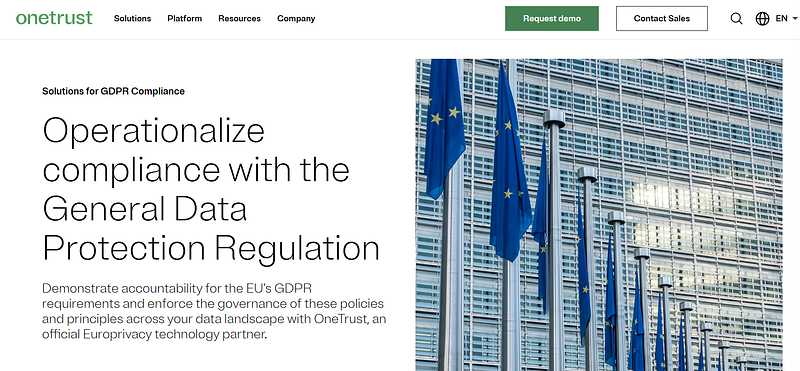
OneTrust is widely recognized as the market leader in privacy and compliance technology. In fact, Gartner consistently ranks it as a leader in the Privacy Management Magic Quadrant. Used by over 14,000 organizations worldwide , including Fortune 500 companies, it offers one of the most comprehensive GDPR compliance solutions available.
Key Features
- Automated DSAR workflows to reduce turnaround time
- Data mapping that integrates across cloud, SaaS, and on-premise systems
- Consent and preference management embedded into customer touchpoints
- Breach management tools with customizable workflows
- Integration with ISO 27001 and SOC 2 frameworks for broader compliance
OneTrust is particularly effective for enterprises managing high volumes of data requests. For example, a multinational retailer can handle DSARs across multiple regions without overwhelming local teams. Its user-friendly dashboards and reporting also make it easier for compliance officers to communicate progress with executives.
However, OneTrust can be expensive, making it less attractive to smaller businesses. That said, for enterprises that need enterprise-grade scalability and audit-readiness , it’s often the top choice.
3. Vanta
Vanta manages GDPR as one framework alongside SOC 2, ISO 27001, HIPAA, and others, rather than as a standalone project. It's built on Vanta's Agentic Trust Platform, designed for teams proving compliance across several frameworks at once.
Key Features
- Live Data Inventory: Centralizes Records of Processing Activities, connecting ROPAs and DPIAs so your GDPR posture updates as systems and vendors change.
- DPIA automation: Creates Data Protection Impact Assessments with instant risk predictions, tied to the processing activity that triggered them.
- Cross-framework evidence mapping: Reuses GDPR evidence across USDP, NIST 800-171, and HIPAA, so teams aren't duplicating audit work.
- AI-powered policy management: Drafts and updates GDPR policies with Vanta AI, then tracks employee acceptance against auditor-approved templates.
- 400+ integrations: Pulls evidence directly from the systems you already use, cutting manual audit prep.
A SaaS company managing GDPR alongside SOC 2 or ISO 27001 can reuse the same evidence across all three instead of running separate projects. According to A-LIGN, organizations using Vanta for automated compliance cut audit completion times by 50%.
Vanta's GDPR tooling centers on records, risk assessments, and evidence rather than consumer-facing DSAR or consent workflows, so high-DSAR-volume teams may want to pair it with a dedicated privacy tool.
4. TrustArc
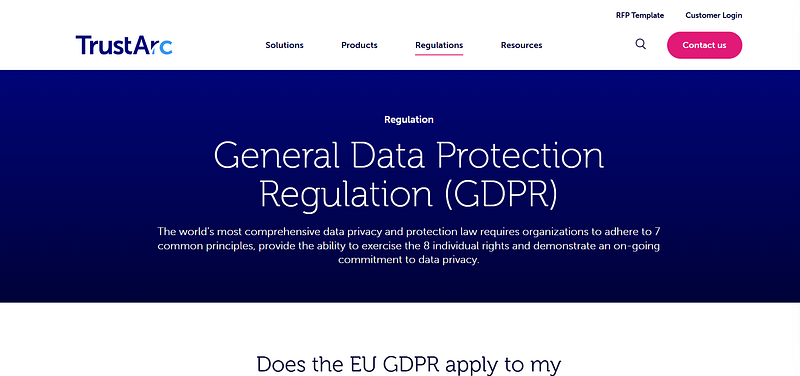
TrustArc has been a trusted name in privacy management for over two decades. Known for its flexibility and robust privacy intelligence , TrustArc helps organizations navigate GDPR, CCPA, and other global privacy regulations seamlessly.
Key Features
- Privacy assessments that identify gaps in GDPR compliance
- A centralized risk dashboard to track ongoing risks and remediation
- Consent management modules that integrate into websites and apps
- Automated audit trails and compliance reports
- Privacy training tools for employees
One of TrustArc’s strengths lies in its modular approach. Businesses can choose exactly what they need, whether it’s just consent management or a full end-to-end compliance program. This makes it an excellent fit for mid-size businesses that may not have the budget for enterprise-level tools but still need robust coverage.
SaaS company expanding into Europe might use TrustArc to ensure that data collection and processing workflows are GDPR-compliant before launching in new markets.
5. Securiti.ai
Securiti.ai is often described as the “AI-powered privacy platform” and for good reason. It combines data intelligence, automation, and machine learning to help organizations meet GDPR requirements without drowning in manual processes.
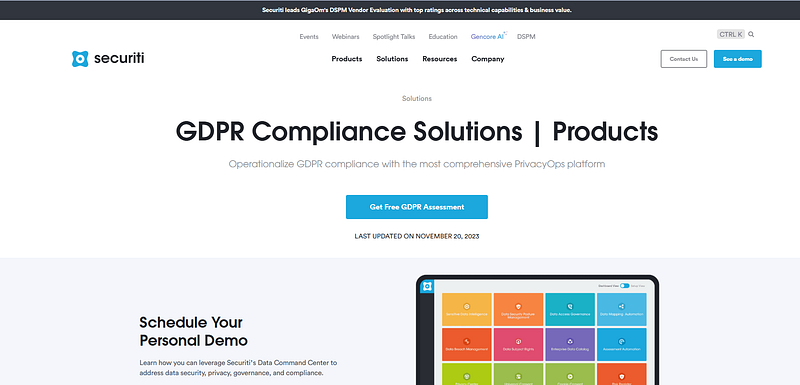
With its PrivacyOps framework , Securiti.ai is quickly becoming a go-to tool for companies handling sensitive personal data at scale.
Key Features
- Automated DSAR fulfillment: It scans across multiple systems to find an individual’s data and assembles it for delivery, cutting down hours of manual work.
- Data discovery and classification: Its AI engine continuously scans structured and unstructured data across cloud, SaaS, and on-premises systems, identifying personal data wherever it lives.
- Consent governance: Tools for managing user consent preferences and updating them in real time.
- Risk and breach management: Automated alerts and breach reporting templates to stay within the 72-hour GDPR requirement.
- Third-party risk assessments: Evaluating vendor compliance, a crucial aspect of GDPR.
Securiti.ai shines in industries with high compliance burdens , such as healthcare and finance. Imagine a hospital dealing with thousands of patient records across multiple cloud systems. Manually mapping and tracking that data would be nearly impossible. Securiti.ai automates the heavy lifting, ensuring no data falls through the cracks.
6. BigID
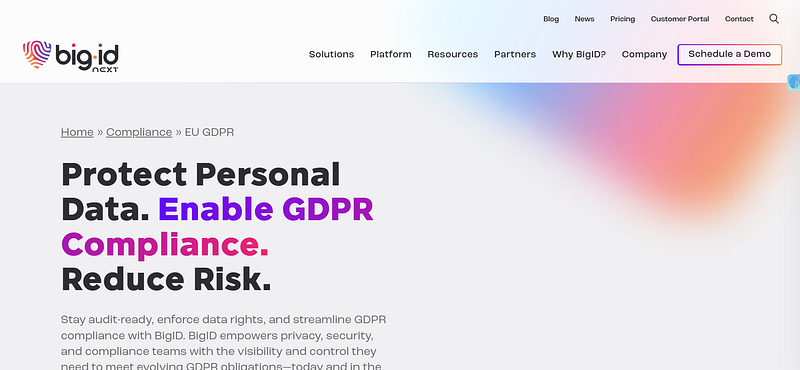
BigID is recognized for its deep data discovery and classification capabilities. It uses advanced algorithms to locate personal and sensitive data across hybrid, multi-cloud, and on-premises environments. For companies with sprawling digital infrastructures, this makes BigID invaluable.
Key Features
- Comprehensive data discovery: AI and ML-powered scanning to locate data across structured and unstructured sources.
- Identity intelligence: Linking data back to individuals to fulfill GDPR’s “right to access” and “right to erasure.”
- Policy-driven automation: Enforcing GDPR policies across systems automatically.
- Privacy impact assessments (PIAs) and data protection impact assessments (DPIAs) built into the platform.
- Third-party integrations with enterprise tools like ServiceNow, Splunk, and AWS.
BigID is particularly strong in highly regulated industries like finance and healthcare, where companies need airtight visibility into where sensitive data lives.
Global bank might use BigID to track customer data across hundreds of databases and third-party applications, ensuring GDPR compliance while also reducing cybersecurity risks.
According to Forrester, companies using BigID reported a 40% reduction in time spent on compliance tasks thanks to its automation and data intelligence. That’s a significant productivity boost that translates directly into cost savings.
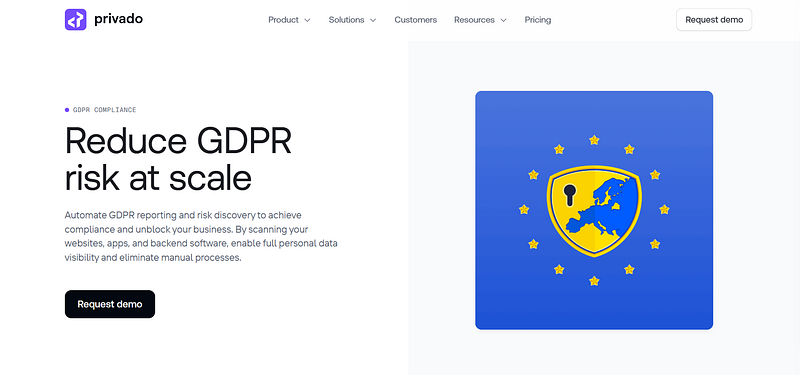
7. Privado
Privado is carving out a unique niche in the GDPR compliance market by focusing on the intersection of privacy and engineering. While many tools address compliance at the policy or operations level, Privado embeds privacy controls directly into the development lifecycle. For companies that build and ship software at scale, this is a game-changer.
Key Features
- Privacy code scanning: Privado scans source code to identify privacy risks, such as hard-coded data transfers or missing consent flows.
- Data flow mapping: Automatically generates maps that show how personal data moves through applications.
- Developer-friendly dashboards: Helps engineering teams resolve compliance issues before they hit production.
- Compliance-by-design alerts: Ensures GDPR principles are embedded during development, not after the fact.
- Regulatory coverage: Supports GDPR, CCPA, and other global privacy laws simultaneously.
Imagine a fast-growing SaaS startup with a lean compliance team. Instead of chasing developers after every product release, Privado makes compliance part of the software development pipeline. By surfacing privacy issues during coding, it prevents problems rather than just reacting to them.
8. DataGrail
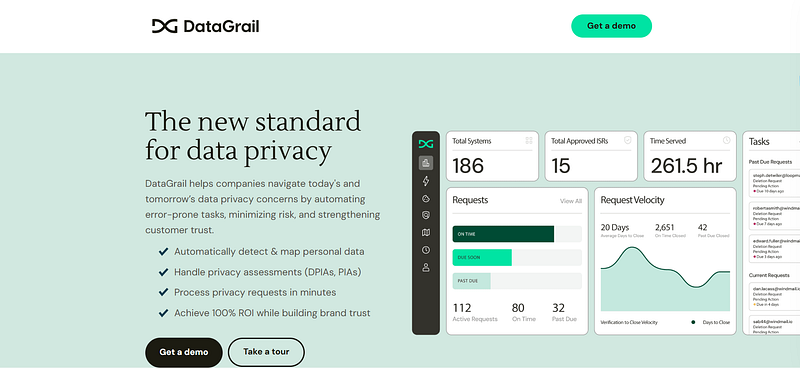
DataGrail takes a consumer-centric approach to GDPR compliance. Its strength lies in simplifying the management of data subject rights requests (DSARs) and building transparency with customers. With integrations into over 1,800 third-party systems , it’s one of the most connected platforms on the market.
Key Features
- Automated DSAR fulfillment: Streamlines requests for data access, deletion, and portability.
- Third-party system integrations: Connects with CRM, marketing, HR, and cloud systems, ensuring no data is overlooked.
- Real-time consent management: Keeps user preferences synchronized across every system.
- Audit-ready compliance reports: Demonstrates GDPR compliance at a moment’s notice.
- Customer-facing privacy portals: Gives individuals visibility and control over their data.
Consider a subscription-based streaming service. Customers frequently want to know what data is collected, or they may request deletion when canceling subscriptions. Without automation, this becomes chaotic. With DataGrail, requests are automatically routed to the right systems, fulfilled within deadlines, and logged for compliance reporting.
Beyond efficiency, DataGrail boosts consumer trust. When customers see an easy-to-use privacy portal and receive timely responses, it reinforces confidence in the brand. In competitive markets, that trust can be as valuable as compliance itself.
Comparing the 8 Tools: Which One Fits Your Business?
With so many options, how do you choose the right GDPR compliance tool? The answer depends on your business size, industry, and compliance needs.
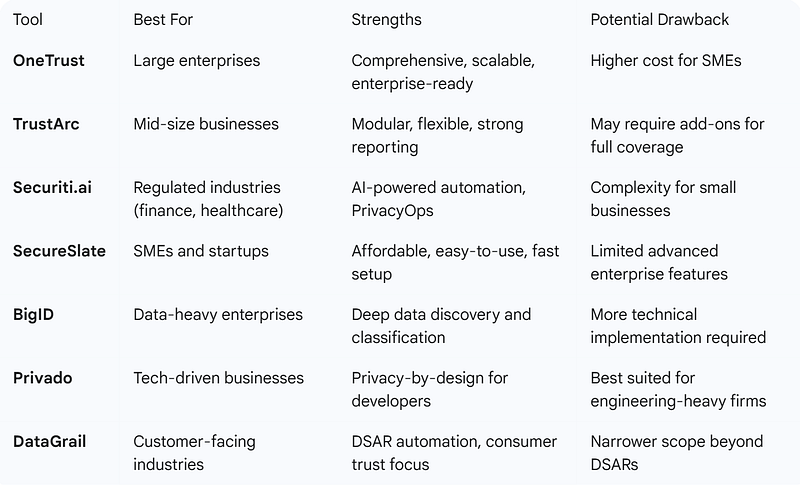
Comparison Table: GDPR Tools for Small Businesses (SME-Focused)
If you’re searching for GDPR tools for small businesses or an affordable GDPR platform, use this quick comparison to shortlist the best fit.
| Tool | Best For | DSAR Automation | Data Mapping / PII Discovery | Consent / Cookie Management | SME Affordability |
|---|---|---|---|---|---|
| SecureSlate | SMEs that want fast, guided GDPR readiness | Strong (workflow-first, audit-friendly) | Strong for SMB environments | Strong (practical, deployable) | High (SME-friendly; plans start at $284/month) |
| OneTrust | Large enterprises with complex privacy programs | Strong | Strong | Strong | Low–Medium (often priced for enterprise) |
| TrustArc | Mid-size teams wanting modular privacy tooling | Medium–Strong | Medium | Medium–Strong | Medium |
| Securiti.ai | Data-heavy orgs needing automation at scale | Strong | Strong | Medium | Medium |
| BigID | Deep discovery across sprawling environments | Medium (often paired with workflow tools) | Strong (discovery/classification) | Low–Medium | Medium–Low |
| Privado | Engineering teams embedding privacy into SDLC | Medium | Medium | Low–Medium | Medium |
| DataGrail | Teams prioritizing DSAR + integrations | Strong | Medium | Medium | Medium |
Key Takeaways
- SMEs with limited resources should look at SecureSlate first, or TrustArc for modular options.
- Enterprises handling large-scale compliance challenges should look at OneTrust, BigID, or Securiti.ai.
- Tech-first companies should consider Privado for embedding compliance into development.
- Customer-centric businesses like e-commerce or subscription services benefit most from DataGrail.
There’s no one-size-fits-all solution. The best tool is the one that aligns with both your compliance requirements and your operational realities.
Conclusion
GDPR compliance doesn’t have to be a burden. With the right tools, businesses can automate complex processes, reduce risks, and build customer trust effortlessly. Whether you’re a startup or a large enterprise, investing in GDPR compliance software ensures you stay ahead of regulations while focusing on growth.
Ready to Streamline Compliance?
Building a secure foundation for your startup is crucial, but navigating the complexities of achieving compliance can be a hassle, especially for a small team.
SecureSlate offers a simpler solution:
- Affordable: Expensive compliance software shouldn’t be the barrier. Our affordable plans start at just $284/month.
- Focus on Your Business, Not Paperwork: Automate tedious tasks and free up your team to focus on innovation and growth.
- Gain Confidence and Credibility: Our platform guides you through the process, ensuring you meet all essential requirements and giving you peace of mind.
FAQ
What is GDPR compliance software?
GDPR compliance software helps organizations meet the EU General Data Protection Regulation by mapping personal data, managing consent and data-subject requests, and maintaining audit-ready evidence. It replaces manual spreadsheets with automated workflows for the tasks GDPR requires you to prove.
- Automates records of processing activities (RoPA) and data-mapping.
- Handles data-subject access requests (DSARs), consent, and breach logging.
- Centralizes evidence so you can demonstrate compliance to regulators and customers.
What is the best GDPR compliance tool?
The best GDPR compliance tool is the one that automates data mapping, DSARs, and vendor management while fitting your team size and budget. Standalone privacy tools suit large enterprises, while platforms that combine GDPR with SOC 2 and ISO 27001 are more cost-effective for SaaS companies managing several frameworks at once.
- Look for automated RoPA, DSAR workflows, and consent management.
- Prioritize tools that reuse the same evidence across GDPR, SOC 2, and ISO 27001.
- Widely compared options include OneTrust, TrustArc, BigID, and Osano for dedicated privacy, with SecureSlate as the affordable multi-framework alternative.
- SecureSlate bundles GDPR with other frameworks from $284/month, avoiding separate single-purpose tools.
Do small businesses and SMEs need GDPR compliance software?
Yes, any business that handles the personal data of EU or UK residents must comply with GDPR regardless of size, and software makes it feasible for small teams without a dedicated privacy officer. Fines reach up to €20 million or 4% of global annual turnover.
- GDPR has no small-business exemption; it applies based on whose data you process, not headcount.
- Automation lets SMEs handle DSARs and data mapping without hiring specialists.
- Compliance also unblocks deals, since EU customers increasingly require it before signing.
What should GDPR compliance software include?
Effective GDPR compliance software should cover data mapping, lawful-basis and consent tracking, DSAR handling, vendor/processor management, and breach notification within the 72-hour deadline. Evidence collection should be continuous, not a once-a-year scramble.
- Data inventory and records of processing activities (RoPA).
- Consent and preference management plus DSAR automation.
- Data processing agreements (DPAs) and sub-processor tracking with breach-notification workflows.
Disclaimer (legal note)
SecureSlate is not a law firm, and this article does not constitute or contain legal advice or create an attorney-client relationship. When determining your obligations and compliance with respect to relevant laws and regulations, you should consult a licensed attorney.
Need compliance without the complexity?
SecureSlate automates ISO 27001, SOC 2, GDPR, HIPAA, and more. Built for growing teams. See it in action.
Find compliance gaps in 30 seconds
