
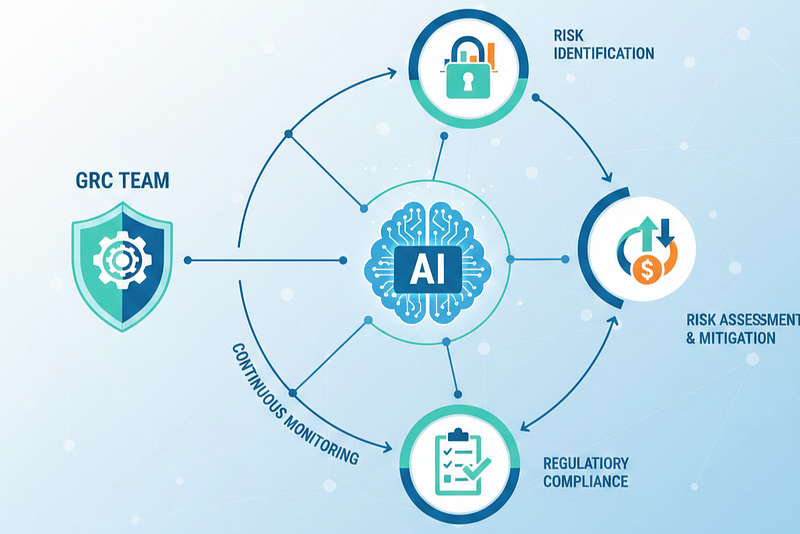
 Image by AI
Related guides:
Key takeaways
- The Current State of GRC and the Need for: Before we explore the technical implementation, we must acknowledge why the status quo is failing.
- The Regulatory Explosion: In 2024 and 2025, we have seen a record-breaking number of regulatory updates across the globe, from the EU AI Act to evolving ESG (Environmental, Social, and Governance) reporting standards.
- The Data Silo Problem: Risk data is often scattered across HR systems, financial databases, IT logs, and third-party portals.
In the modern enterprise, the Governance, Risk, and Compliance (GRC) function is undergoing a radical transformation. For decades, GRC was characterized by manual spreadsheets, periodic audits, and a “check-the-box” mentality. However, the sheer velocity of data and the complexity of global regulations have made these traditional methods obsolete.
Today, GRC teams are turning to AI to manage the overwhelming scale of modern business risks. By integrating Machine Learning (ML), Natural Language Processing (NLP), and Predictive Analytics into their workflows, organizations can move toward a “Continuous Compliance” model that identifies threats before they manifest.
The Current State of GRC and the Need for Transformation
Before we explore the technical implementation, we must acknowledge why the status quo is failing. Most GRC teams currently operate in a state of “Information Overload.”
The Regulatory Explosion
In 2024 and 2025, we have seen a record-breaking number of regulatory updates across the globe, from the EU AI Act to evolving ESG (Environmental, Social, and Governance) reporting standards.
A human compliance officer cannot possibly read, interpret, and map every single change to internal controls across a global enterprise.
The Data Silo Problem
Risk data is often scattered across HR systems, financial databases, IT logs, and third-party portals. Manual risk management relies on people manually gathering this data, which leads to “stale” risk assessments that are out of date by the time they are reviewed.
The Objective Reality of AI
Unlike humans, AI does not suffer from “audit fatigue.” It can analyze millions of data points with consistent objectivity, identifying subtle patterns of fraud or non-compliance that would be invisible to even the most seasoned auditor.
AI Technologies for GRC Teams
To implement AI effectively, GRC teams must understand the tools at their disposal. We are moving beyond simple automation into the realm of cognitive computing.
Natural Language Processing (NLP)
NLP is the “translator” between human language and machine action. For GRC, this means the ability to ingest 500-page legal documents and extract specific obligations.
NLP identifies the “who, what, and when” of a regulation, allowing for automated policy updates.
Machine Learning (ML) and Anomaly Detection
ML models thrive on historical data. By feeding an ML model three years of “clean” financial and operational data, it learns the baseline of “normal” behavior.
When a transaction occurs that deviates from this baseline, even slightly, the system flags it for review. This is the heart of modern risk management.
Generative AI (GenAI)
The newest frontier for GRC teams is GenAI. While it must be used cautiously, it is exceptionally good at drafting policy language, summarizing audit reports, and creating “Plain English” explanations of complex compliance requirements for non-expert employees.
7 Practical AI Use Cases for GRC Teams
The integration of AI into risk management isn’t about replacing human judgment; it is about providing humans with higher-quality data and more time for strategic decision-making. Here are seven practical use cases for modern GRC teams.
1. Automated Regulatory Change Management
The Challenge: Global organizations operate across a fragmented landscape of local, federal, and international laws. Manually tracking updates from bodies like the SEC, the European Commission, or the MAS involves thousands of hours of legal review. By the time a human identifies a change, the organization may already be in a period of non-compliance.
The AI Solution: Using Natural Language Processing (NLP) , “RegTech” platforms ingest real-time feeds from government portals and legal databases. The AI doesn’t just “read” the text; it classifies it by “intent.” It identifies whether a change is an amendment to an existing obligation or a brand-new mandate.
- The “Gap Analysis” Mechanic: The AI automatically compares the new regulatory text against your existing internal control framework. If a new data privacy law requires a 72-hour breach notification and your current policy says 96 hours, the AI flags this specific discrepancy.
Technical Benefit: This shifts the compliance lifecycle from a batch process (monthly reviews) to a stream process (real-time updates), reducing the “Compliance Delta” (the time between a legal change and a control update ) from months to minutes.
2. Dynamic Third-Party Risk Management (TPRM)
The Challenge: Traditional TPRM relies on “point-in-time” assessments. A vendor might look secure during an annual audit in January, but suffer a major breach or financial collapse in June. GRC teams are often the last to know, leaving the supply chain vulnerable.
The AI Solution: AI enables Continuous Monitoring by aggregating unstructured data from across the web.
- Cyber Intelligence: Scans the dark web for leaked employee credentials or database dumps belonging to your vendors.
- Sentiment & Financial Analysis: Uses NLP to analyze news reports and financial filings for “signals of distress,” such as sudden layoffs or litigation.
Risk Impact: This provides a “Risk Velocity” metric. If a critical cloud provider has a security incident, your GRC team is alerted within minutes via an automated trigger, allowing you to move data or switch to failover systems before the impact becomes catastrophic.
3. Predictive Operational Risk Modeling
The Challenge: Most risk management is lagging; it tells you what went wrong yesterday. Static risk heatmaps are often based on subjective “gut feelings” from department heads rather than hard data.
The AI Solution: Predictive Analytics and Monte Carlo Simulations transform risk into a mathematical probability. By feeding the AI historical data, such as system downtime, employee turnover rates, economic indicators, and even weather patterns, the model runs thousands of “what-if” scenarios.
- The Mechanic: The AI identifies correlations that humans might miss, such as a correlation between high employee burnout in a specific region and an increase in data entry errors that lead to financial risk.
Strategic Value: This allows leadership to practice “Proactive Capital Allocation.” Instead of setting aside funds for a disaster, you invest in the specific controls (like hiring or system upgrades) that the AI predicts will most effectively lower the “Value at Risk” (VaR).
4. 100% Audit Coverage (The End of Sampling)
The Challenge: Due to time constraints, internal auditors use statistical sampling, checking perhaps 50 out of 5,000 invoices. This leaves a 99% “blind spot” where fraud or errors can hide.
The AI Solution: AI-enabled audit tools utilize Machine Learning (ML) Anomaly Detection to process the entire population of data.
- Transaction Analysis: The AI scans 100% of general ledger entries, T&E (Travel and Expense) reports, and system access logs.
- Pattern Recognition: It looks for “Benford’s Law” deviations or unusual “time-of-day” entries (e.g., an accountant approving a massive wire transfer at 3:00 AM on a Sunday).
The Result: “Total Visibility.” The audit shifts from a “detective” control to a “deterrent” control. When employees know every transaction is being screened by AI, the rate of “accidental” non-compliance drops significantly.
5. AI-Powered Internal Policy Management
The Challenge: Most corporate policies are buried in 100-page PDFs on a dusty intranet. When employees find them too difficult to navigate, they make guesses, leading to “shadow compliance” or accidental violations.
The AI Solution: Implementing a Generative AI (GenAI) interface, often called a “Compliance Bot,” trained exclusively on your internal policy documents.
- Semantic Search: An employee can ask, “Can I accept a $200 dinner from a vendor in Singapore?” The AI cross-references the Global Anti-Bribery Policy with the regional Singapore annex and provides an instant answer.
Culture Impact: This democratizes risk management. It moves compliance out of the legal department and into the hands of the frontline staff, fostering a culture of “Compliance by Design.”
6. Automated Evidence Collection for SOC2, HIPAA, and ISO 27001
The Challenge: The “Evidence Scramble” is the most hated part of GRC. It involves dozens of people spending weeks taking screenshots of AWS configurations, Jira tickets, and HR onboarding logs to prove to auditors that controls are working.
The AI Solution: API-driven AI agents create a persistent “Evidence Data Lake.”
- Automated Verification: Instead of a human checking if “Multi-Factor Authentication is enabled for all users” once a year, the AI agent checks the configuration via API every hour.
- Timestamping & Storage: The AI automatically captures the proof, timestamps it, and maps it to the relevant SOC2 or ISO control.
Efficiency Gain: This transforms the audit from a “fire drill” into a “non-event.” When the external auditor arrives, the GRC team simply provides access to the pre-populated evidence vault, reducing audit prep time by up to 80%.
7. Fraud Detection and AML (Anti-Money Laundering)
The Challenge: Money laundering often involves “layering”, moving money through a complex web of accounts to hide its origin. Traditional rule-based systems (e.g., “flag any transfer over $10k”) are easily circumvented by “smurfing” or smaller, frequent transfers.
The AI Solution: Graph Neural Networks (GNNs). Unlike traditional databases, GNNs focus on the relationships between data points.
- The Mechanic: The AI maps the entire network of transactions. It can detect a “Cycle” (Money moving from Person A to B to C and back to A) or a “Hub and Spoke” pattern that is a hallmark of criminal activity.
Compliance Benefit: This significantly reduces “False Positives”, the bane of AML teams , while catching sophisticated “low-and-slow” fraud patterns that would never trigger a standard rule-based alarm.
Technical Roadmap for the Implementation of AI
For GRC teams ready to start, the implementation should be handled in phases to ensure data integrity and team buy-in.
Phase 1: The Data Foundation (Months 1–3)
AI is only as good as the data it consumes.
- Audit your data: Where is your risk data stored? Is it clean?
- Centralization: Move from disconnected spreadsheets to a centralized GRC platform that supports API integrations.
- Standardization: Ensure that “Risk Level High” means the same thing in the IT department as it does in the Finance department.
Phase 2: The Pilot Program (Months 4–6)
Don’t try to automate everything at once. Pick a “high-noise, low-complexity” task.
- Recommended Pilot: Third-Party Risk or Regulatory Tracking.
- Goal: Demonstrate that the AI can catch a risk that a human missed, or save a specific number of work hours.
Phase 3: Integration and “Human-in-the-Loop” (Months 7–9)
AI should augment humans, not replace them.
- Define the Workflow: The AI identifies a potential risk, but a human GRC professional must “adjudicate” it.
- Feedback Loops: When a human corrects the AI (e.g., “This isn’t actually a fraud risk”), the system learns from that correction to improve future accuracy.
Phase 4: Scaling and Governance (Months 10–12)
Once the pilot is successful, scale to other risk domains (Cyber, ESG, Finance).
- Establish an AI Ethics Committee: Monitor your own AI for bias. Ensure the models are “Explainable” (XAI) so you can tell a regulator exactly why the AI made a certain decision.
How to Automate Vendor Governance in SaaS for Zero-Stress Compliance
Govern Smarter, Not Harder
Managing the Challenges of AI in GRC
Implementing AI for risk management is not without its pitfalls. GRC teams must be prepared for three specific challenges:
1. The “Black Box” Problem
In highly regulated industries like banking or healthcare, “the AI told me so” is not an acceptable answer for a regulator.
- The Solution: Prioritize “Explainable AI.” Choose vendors that provide a clear trail of logic for every risk flag.
2. Algorithmic Bias
If your training data contains historical biases (e.g., in hiring or lending), the AI will replicate and accelerate those biases.
- The Solution: Regular “Bias Audits” of your AI models. GRC teams should treat their own AI systems as “high-risk vendors” that require constant oversight.
3. Data Privacy and Security
Sending sensitive corporate data to a public AI model (like the free version of ChatGPT) is a massive risk.
- The Solution: Use private, “Single-Tenant” AI instances. Ensure that your data is not being used to train the provider’s general model.
The Strategic ROI of AI-Enabled Risk Management
The return on investment for AI in GRC is measured in three ways:
Cost Avoidance
Avoiding a single multi-million dollar GDPR fine or a ransomware payout pays for the AI implementation ten times over.
Operational Velocity
When compliance is automated, the business can move faster. New products can be launched in new countries without waiting six months for a manual compliance review.
Strategic Focus
GRC professionals stop being “data hunters” and start being “risk strategists.” They spend their time advising the CEO on high-level strategy rather than chasing down audit logs.
Conclusion
For GRC teams, the implementation of AI is a journey, not a destination. As the technology evolves, so will the risks it manages. The organizations that thrive in the coming decade will be those that treat AI as a core member of their risk management team.
By automating the mundane, predicting the unforeseen, and providing 100% visibility into compliance, AI transforms GRC from a “necessary evil” into a powerful engine for organizational trust and resilience.
Ready to Streamline Compliance?
Building a secure foundation for your startup is crucial, but navigating the complexities of achieving compliance can be a hassle, especially for a small team.
SecureSlate offers a simpler solution:
- Affordable: Expensive compliance software shouldn’t be the barrier. Our affordable plans start at just $284/month.
- Focus on Your Business, Not Paperwork: Automate tedious tasks and free up your team to focus on innovation and growth.
- Gain Confidence and Credibility: Our platform guides you through the process, ensuring you meet all essential requirements and giving you peace of mind.
Disclaimer (legal note)
SecureSlate is not a law firm, and this article does not constitute or contain legal advice or create an attorney-client relationship. When determining your obligations and compliance with respect to relevant laws and regulations, you should consult a licensed attorney.
Need compliance without the complexity?
SecureSlate automates ISO 27001, SOC 2, GDPR, HIPAA, and more. Built for growing teams. See it in action.
Find compliance gaps in 30 seconds
