

Related guides:
Key takeaways
- Deconstructing the ISO 27001 Audit: The ISO 27001 audit is fundamentally a process of assurance and management verification.
- The Foundation: ISO/IEC 27001 and the ISMS: ISO/IEC 27001 is the international standard that specifies the requirements for establishing, implementing, maintaining, and continually improving an ISMS.
- The ISO 27001 Audit’s Objective and Scope: The core objective of an ISO 27001 audit is to provide management, partners, and customers with confidence that.
In the modern digital landscape, data is the most valuable asset, and consequently, the most targeted as well. Organizations globally invest significant resources into cybersecurity, often grappling with the fundamental question: How do we truly know our defenses are adequate?
Two primary methods frequently emerge in this discussion: the ISO 27001 audit and the penetration test.
While both are essential tools in the information security arsenal, they serve fundamentally different purposes, address different risks, and provide distinct types of assurance.
Confusing one for the other, or relying exclusively on just one, is a common pitfall that can leave significant vulnerabilities exposed.
This article will dissect the nature, scope, objectives, and outcomes of both the ISO 27001 audit and the penetration test.
By the end, you’ll see how they combine to create a robust Information Security Management System (ISMS) that meets both compliance and real-world defense needs.
Stop losing sleep over security: Learn the SecureSlate strategy top CTOs use to guarantee system integrity.
Deconstructing the ISO 27001 Audit
The ISO 27001 audit is fundamentally a process of assurance and management verification. It is not a technical hack or a vulnerability scan; it is a systematic, independent examination to determine whether an organization’s Information Security Management System (ISMS) aligns with the globally recognized standard, ISO/IEC 27001.
The Foundation: ISO/IEC 27001 and the ISMS
ISO/IEC 27001 is the international standard that specifies the requirements for establishing, implementing, maintaining, and continually improving an ISMS.
The goal of an ISMS is to manage information security risks effectively, ensuring the confidentiality, integrity, and availability (CIA) of information.
The standard mandates a risk-based approach, meaning an organization must first identify risks and then select appropriate controls from ISO/IEC 27001 (the code of practice for information security controls) to mitigate them.
The ISO 27001 Audit’s Objective and Scope
The core objective of an ISO 27001 audit is to provide management, partners, and customers with confidence that:
- The ISMS exists and operates in accordance with the requirements outlined in the ISO 27001 standard (Clauses 4 through 10).
- The organization’s security risks have been systematically identified, assessed, and mitigated using appropriate controls, as defined in the Statement of Applicability (SoA).
- The organization has established a cycle of continuous improvement (Plan-Do-Check-Act or PDCA) to ensure the ISMS remains effective over time.
The scope of an ISO 27001 audit is process-focused and comprehensive. It covers the entire ISMS across all relevant organizational and technological boundaries. This includes, but is not limited to:
- Policy and Documentation Review: Examining security policies, risk assessment methodologies, and the Statement of Applicability.
- Organizational Controls: Assessing HR security, third-party risk management, and training programs.
- Operational Procedures: Reviewing incident management, change control, and backup processes.
- Physical Security: Inspecting the physical controls protecting the scoped facilities.
ISO 27001 Audit Phases: From Stage 1 to Surveillance
A typical certification ISO 27001 audit involves two main stages conducted by an accredited certification body:
**Stage 1 Audit (Documentation Review)
** The auditor reviews the ISMS documentation (policies, scope, risk assessment, SoA) to ensure it meets the standard’s requirements on paper and is ready for the practical assessment.
**Stage 2 Audit (Main Audit)
** This is a detailed on-site (or remote) examination where the auditor interviews staff, observes processes, and samples evidence to confirm that the documented policies and controls are actually being implemented and are effective in practice.
If nonconformities are found, they must be addressed before certification is granted. Post-certification, annual surveillance audits, and a recertification audit every three years ensure ongoing compliance.
The Assurance Provided by ISO 27001 Audit
The certification obtained after a successful ISO 27001 audit provides a powerful form of managerial and systemic assurance. It confirms that the organization:
- Understands its risks.
- Has a structured, risk-based approach to security.
- Has governance and leadership committed to security.
- Is committed to continuous improvement.
So, the ISO 27001 audit confirms you are managing security risks correctly by verifying the strength of your system (the ISMS).
Deconstructing the Penetration Test
The penetration test (pentest) is a process of technical validation and defense testing. It is an authorized, simulated cyber-attack on a computer system, network, or application to evaluate the security posture of the target and identify exploitable vulnerabilities.
The Methodology: Attacker Simulation
Unlike the process-driven ISO 27001 audit, the penetration test is technical and adversarial. It operates on the principle of “prove it.”
A skilled security professional (the ethical hacker) uses the same tools, techniques, and methodologies as real attackers to find weaknesses and exploit them to gain unauthorized access to data or systems.
The Penetration Test’s Objective and Scope
The core objective of a penetration test is to:
- Identify specific, exploitable technical vulnerabilities within a defined scope (e.g., a web application, network segment, or wireless infrastructure).
- Demonstrate the impact of these vulnerabilities by successfully exploiting them (e.g., gaining access to customer databases or escalating privileges).
- Provide actionable remediation steps to fix the identified technical flaws.
The scope of a penetration test is technical and focused. It is usually limited to a specific system or network boundary, often categorized as:
- Network Penetration Testing (Internal/External): Targeting network infrastructure, firewalls, and servers.
- Web Application Penetration Testing: Focused on finding flaws (like SQL injection, XSS) in web applications.
- Wireless/Mobile Penetration Testing: Assessing the security of mobile applications or wireless networks.
- Social Engineering: Testing human factors through phishing or other manipulation techniques.
The Delivery: Black, White, and Gray Box
Penetration tests are typically categorized by the level of information provided to the tester:
- Black Box: The tester has no prior knowledge of the target system (like a real external attacker). This tests external defenses and reconnaissance capabilities.
- White Box: The tester has full knowledge, including source code, architecture diagrams, and credentials. This allows for comprehensive security control logic testing.
- Gray Box: The tester has partial knowledge (e.g., a standard user account). This simulates an insider threat or an attacker who has already gained limited access.
The Assurance Provided by a Penetration Test
A successful penetration test (one that finds no significant, exploitable flaws) provides technical assurance at a specific point in time. It confirms that the technical controls and configurations in the scoped area are robust enough to withstand current, common attack vectors.
So, the penetration test confirms your technical defenses are configured correctly by verifying the strength of your controls (the systems, applications, and networks).
ISO 27001 Audit vs. Penetration Test
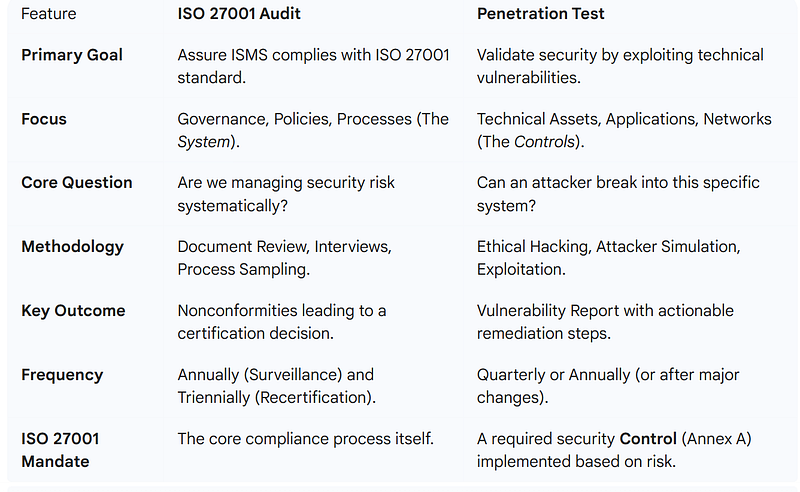
To clarify the distinct roles of these two critical activities, let’s compare them directly across key dimensions. This comparison is vital for organizations planning their security budget and strategy, helping to properly allocate resources and define expectations.
The Illusion of Security: What Each Activity Doesn’t Do
Understanding the limitations of each process is perhaps the most crucial step in achieving actual data protection. Relying on either one as a standalone solution creates a dangerous blind spot.
Limitations of the ISO 27001 Audit
A successful ISO 27001 audit does not guarantee immunity from a cyber-attack.
- It is not a technical hack: The auditor is checking for the existence and effectiveness of the vulnerability management process, not the technical security of a firewall rule configuration itself. You could pass the audit perfectly while having a critical, zero-day vulnerability if your required patch management process was documented and followed.
- It is a point-in-time snapshot of the ISMS: If an organization experiences high employee turnover or rapid technical change immediately after the audit, the ISMS could quickly degrade, even though the certification remains valid.
- Scope is key: The audit only covers the systems and processes formally included in the ISMS scope defined by the organization. Any unscheduled or shadow IT systems are outside the auditor’s review.
Limitations of the Penetration Test
A successful penetration test does not guarantee overall information security compliance.
- It is highly scope-dependent: The test only covers the specific assets defined in the scope (e.g., only one web application). It says nothing about the security of your physical controls, your security awareness training program, or your incident response process.
- It is a technical snapshot: The test finds vulnerabilities present on the day it was conducted. New vulnerabilities are discovered daily (zero-days), and a single configuration change the following week could reintroduce a critical flaw.
- It doesn’t verify management intent: A pentest may report that a system is vulnerable, but it doesn’t assess why. Was it a failure of the risk management process (an ISO 27001 requirement), or merely a configuration error? The pentest only reports the symptom, not the root cause in the ISMS.
Which One Actually Protects Your Data?
The answer to the question, “Which one actually protects your data?” is unequivocally: Both, working in concert.
Neither the ISO 27001 audit nor the penetration test can offer complete security assurance on its own. They represent the two sides of the same information security coin: Governance and Technology.
The Role of the ISO 27001 Audit (The Governance Backbone)
The ISO 27001 audit provides the structured environment necessary for effective data protection.
- It forces accountability: It ensures that policies are written, ownership is defined, and responsibilities are clear.
- It mandates risk-based decision-making: It ensures that every technical control is implemented because of an identified and assessed risk, not just on a whim.
- It institutionalizes security: By mandating the PDCA cycle, it ensures that security is a continuous, managed process that survives employee turnover and technology shifts.
The Role of the Penetration Test (The Technical Reality Check)
The penetration test provides the real-world effectiveness validation that technical controls are actually working as intended.
- It verifies the technical implementation: It checks if the controls selected by the ISMS (as defined in the Statement of Applicability) are correctly configured and robust against sophisticated attacks.
- It bridges the gap between policy and practice: A policy might state, “All systems must be patched within 48 hours.” The ISO auditor checks if the patch management process is followed. The penetration test proves the policy’s effectiveness by attempting to exploit a 49-hour-old known vulnerability.
- It identifies “unknowns”: It often uncovers configuration mistakes or zero-day issues that no simple checklist-based audit would catch.
A Practical Synergy: How They Intersect
The relationship between the two processes is cyclical and interdependent:
- Risk Assessment (ISO 27001): The organization identifies risks and determines that, say, an external-facing web application is a high-risk asset requiring robust technical controls.
- Control Selection (ISO 27001 Annex A): The organization selects Control A.14.2.8 (or similar controls related to security testing).
- Penetration Test Execution (Technical Validation): A penetration test is commissioned as the specific mechanism to execute the control. The pentest identifies that the application is vulnerable to SQL injection.
- Nonconformity/Incident (Action): The SQL injection vulnerability is fixed.
- Review and Improvement (ISO 27001 PDCA): The organization reviews the findings of the penetration test and asks: Why did this vulnerability exist? Was it a failure in the development process (A.14)? A failure in code review? The ISMS is then updated to prevent this type of vulnerability from recurring, making the overall system stronger for the next ISO 27001 audit.
In this perfect scenario, the ISO 27001 audit ensures the organization has a plan, and the penetration test provides the crucial evidence that the plan is technically sound.
Strategic Recommendations for Holistic Data Protection
For organizations committed to achieving both compliance and resilient security, here are key strategic recommendations:
Embed the Pentest into the ISMS
Do not view the penetration test as a standalone project. ISO 27001 requires the organization to conduct security testing based on the results of the risk assessment.
The pentest should be formally documented as a critical control and reviewed annually during the ISO 27001 audit. This ensures the activity is tracked, funded, and its findings are formally treated within the ISMS framework.
Define a Clear, Risk-Based Scope
The scope of the ISO 27001 audit must align with the most critical business functions. Simultaneously, the scope of the penetration test must align with the highest-risk technical assets identified within that ISMS scope.
This unified approach prevents critical infrastructure from being audited (process-wise) without being tested (technically) or vice-versa.
Treat Pentest Findings as Major Nonconformities (Internally)
While the ISO 27001 auditor might not write a nonconformity specifically because of a single pentest finding, the organization should treat critical pentest findings as though they are nonconformities against the ISMS.
Failure to patch a critical system, for example, is a direct failure of the documented vulnerability management process (A.12.6.1), which will be scrutinized in the next ISO 27001 audit.
Focus on the Root Cause, Not Just the Fix
After a penetration test, it’s easy to focus only on patching the discovered vulnerabilities. An ISO 27001-minded organization will go further:
- Determine Root Cause: Was it a lack of training? Poor configuration management? Flawed change control?
- Corrective Action: Implement changes to the process (the ISMS) to prevent the flaw from being introduced again. This is a core requirement of the PDCA cycle validated by the ISO 27001 audit.
Conclusion
The question, “ISO 27001 Audit vs. Penetration Test: Which One Protects Your Data?” simplifies a complex security reality. The truth is that the two activities are not competitors but complementary forces.
The ISO 27001 audit provides the framework, governance, and assurance that your organization is managing its information security risks in a structured, internationally recognized, and continually improving manner. It verifies that you are doing the right things.
The penetration test provides the technical validation, resilience check, and adversarial evidence that your specific controls are effective against real-world threats. It verifies that you are doing things right.
True data protection and resilience are achieved when an organization successfully integrates the findings of its penetration test into its ISO 27001 ISMS, using the results to drive the next cycle of improvement. This synergy ensures that security is not just a checkbox compliance exercise but a living, breathing defense system, ready for both the auditor’s scrutiny and the attacker’s probes.
Ready to Streamline Compliance?
Building a secure foundation for your startup is crucial, but navigating the complexities of achieving compliance can be a hassle, especially for a small team.
SecureSlate offers a simpler solution:
- Affordable: Expensive compliance software shouldn’t be the barrier. Our affordable plans start at just $284/month.
- Focus on Your Business, Not Paperwork: Automate tedious tasks and free up your team to focus on innovation and growth.
- Gain Confidence and Credibility: Our platform guides you through the process, ensuring you meet all essential requirements and giving you peace of mind.
Disclaimer (legal note)
SecureSlate is not a law firm, and this article does not constitute or contain legal advice or create an attorney-client relationship. When determining your obligations and compliance with respect to relevant laws and regulations, you should consult a licensed attorney.
Need compliance without the complexity?
SecureSlate automates ISO 27001, SOC 2, GDPR, HIPAA, and more. Built for growing teams. See it in action.
Find compliance gaps in 30 seconds
