
 Image by AI
Related guides:
Key takeaways
- The Core Architecture: Risk Management in ISO: The 2022 update to the ISO 27001 standard introduced a pivotal shift in how organizations conceptualize security.
- The Risk Management Lifecycle: To satisfy Clause 6.1 , your process must follow a structured lifecycle.
- What to Do: Executing a High-Quality Assessment: A technically sound risk assessment is the fundamental difference between a “paper-thin” security posture and a truly hardened organization.
In the global cybersecurity landscape, ISO 27001 risk management serves as the central nervous system of an Information Security Management System (ISMS). Without a rigorous risk process, security becomes a series of disjointed, reactive measures. For organizations pursuing certification, the risk assessment and treatment cycle is the most heavily scrutinized area during an audit.
To achieve compliance and improve resilience, you must move beyond a simple checklist.
This guide provides an in-depth analysis of the technical requirements, essential documentation, and specific evidence that auditors demand to see.
The Core Architecture: Risk Management in ISO 27001:2022
The 2022 update to the ISO 27001 standard introduced a pivotal shift in how organizations conceptualize security. While the 2013 version was often interpreted through a rigid, asset-centric lens, the 2022 revision emphasizes a process-oriented framework. This evolution recognizes that modern threats often target processes, services, and cloud-based ecosystems rather than just physical hardware.
However, flexibility does not mean a lack of rigor. The core requirement under Clause 6.1 remains stringent: your risk management must be a consistent, valid, and comparable process. This means that if two different people within your organization assess the same risk, they should ideally arrive at a similar conclusion using your documented methodology.
The Risk Management Lifecycle
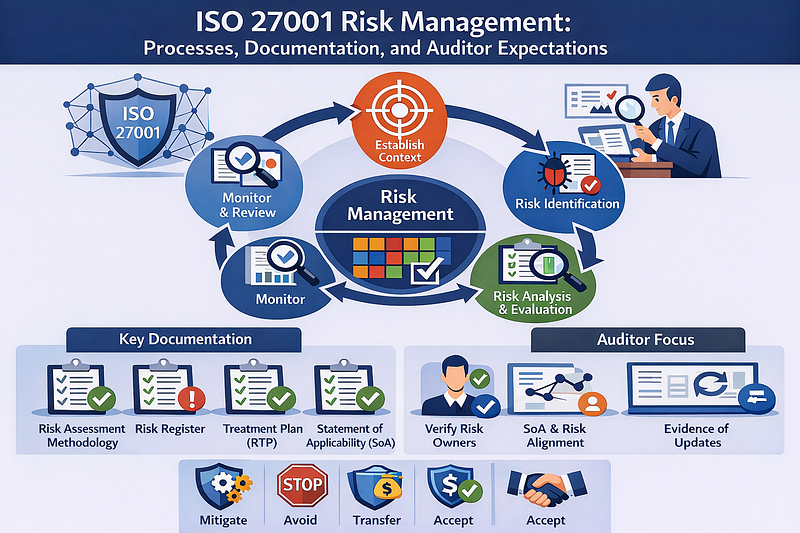
To satisfy Clause 6.1 , your process must follow a structured lifecycle:
- Establish Context: Defining the scope of the ISMS and your organization’s “risk appetite”, the level of risk you are willing to accept to achieve your objectives.
- Risk Identification: Determining how the loss of confidentiality, integrity, or availability (CIA) of information could affect the business.
- Risk Analysis & Evaluation: Assigning values to the likelihood of a threat occurring and the resulting impact.
- Risk Treatment: Selecting and implementing the appropriate controls to bring the risk within acceptable levels.
- Monitoring & Review: Continually assessing if the risk environment has changed due to new technologies, business shifts, or emerging threats.
What to Do: Executing a High-Quality Assessment
A technically sound risk assessment is the fundamental difference between a “paper-thin” security posture and a truly hardened organization. Within the framework of ISO 27001 risk management , the assessment process must be repeatable and defensible. If your methodology is vague, the results will be inconsistent, rendering your security investments arbitrary.
Step 1: Establish a Quantitative or Qualitative Methodology
Before identifying specific threats, you must document the “rules of the game.” Auditors look for a formal methodology that eliminates individual subjectivity and ensures that different assessors would reach similar conclusions.
- Impact Scales: You must define what specific scores mean in a business context. A “4” (Major) cannot be a feeling; it must be tied to tangible thresholds. For example:
- Financial: Loss exceeding $100,000.
- Regulatory: A breach involving 10,000+ GDPR-protected records.
- Operational: Downtime of critical services exceeding 4 hours.
- Likelihood Scales: Define the frequency of occurrence for each level. A “3” (Moderate) might be defined as a threat likely to occur once per year based on historical data or industry threat intelligence.
- The Risk Matrix: Use a standardized matrix (e.g., a 5x5 grid) to calculate the total score. This provides a visual and mathematical representation of your risk landscape.
The standard formula for determining the severity of a risk is:
Risk Score = Probability x Impact
Step 2: Risk Identification
While the ISO 27001:2022 update allows for more flexible threat-based assessments, most high-maturity organizations maintain an asset-based approach as their foundation. This ensures no “dark corners” of the infrastructure are missed.
- Primary Assets: Focus on the “crown jewels”: the information itself and the core business processes. This includes intellectual property, customer PII (Personally Identifiable Information), and proprietary algorithms.
- Supporting Assets: Identify the underlying infrastructure that handles the primary assets. This includes virtual machines, SaaS platforms, physical server rooms, API gateways, and even the “human assets” (privileged administrators).
- Threat & Vulnerability Mapping: For each asset, identify relevant threats.
- External: State-sponsored actors, DDoS attacks, or supply chain compromises.
- Internal: Malicious insiders, but also “non-malicious” threats like accidental data deletion or social engineering.
- Environmental: Power failures or regional natural disasters affecting data centers.
Step 3: Risk Analysis and Evaluation
Once identified, you must analyze the risk by considering the effectiveness of existing controls. This results in your “Inherent Risk.” You then compare this calculated score against your Risk Acceptance Criteria.
Evaluation is the decision-making gate: if a risk is scored at 12, but your organization’s acceptance threshold is 10, that risk must be prioritized for treatment. This objective threshold prevents “cherry-picking” security issues and forces management to acknowledge gaps that exceed the company’s risk appetite.
Step 4: The Four Pillars of Risk Treatment
For every risk that falls into the “unacceptable” category, ISO 27001 risk management protocols require you to select one of the following four treatment options:
- Mitigation (Treat): This is the most common path. It involves applying technical or organizational controls to reduce the likelihood or impact. Examples include implementing Multi-Factor Authentication (MFA) to mitigate credential theft or deploying end-to-end encryption to reduce the impact of a data leak.
- Avoidance (Terminate): If the risk is too high and the cost of mitigation is prohibitive, you may choose to stop the activity entirely. For instance, an organization might decide to stop storing credit card data locally and instead use a third-party payment processor to eliminate that specific risk vector.
- Transfer (Share): This involves shifting the risk to another party. The most common examples are purchasing cyber insurance or outsourcing the management of complex infrastructure to a specialized, secure cloud provider. Note: You transfer the burden , but the organization often remains legally accountable.
- Acceptance (Tolerate): In some cases, the cost of fixing a problem is higher than the potential loss. If a risk is accepted, it must be formally documented, justified, and, most importantly, signed off by “Top Management.” Auditors will pay close attention to the justification for any “High” or “Medium” risks that were simply accepted.
What to Document: Building the Evidence Trail
In the world of ISO 27001 risk management , there is a common saying: “If it isn’t documented, it didn’t happen.” Documentation is the only way to prove to auditors that your risk process is not just a theoretical exercise, but a functional part of your business operations. The standard is explicit about “retained documented information,” and missing even one of these core artifacts can lead to a major non-conformity.
The Risk Assessment Methodology
This is your foundational policy document. It serves as the “source of truth” that ensures consistency across the organization. Auditors will review this document to ensure it aligns with the actual practices they observe in your risk register. It must explicitly detail:
- Scoring Criteria: Clear definitions for impact and likelihood.
- The Risk Matrix: The mathematical grid used to calculate risk levels.
- Roles and Responsibilities: Specifically defining who identifies risks, who validates them, and who has the authority to approve the results.
- Risk Acceptance Thresholds: A documented statement of what level of risk the company is willing to tolerate.
The Risk Register (Risk Assessment Report)
The Risk Register is a dynamic, living database that captures the current state of your security posture. For a robust ISO 27001 risk management framework, every entry in your register should be granular enough to stand alone. At a minimum, it must record:
- Unique ID and Description: A clear identifier (e.g., R-101) and a narrative describing the threat/vulnerability pair.
- The Risk Owner: This must be an individual (by role or name) who has the accountability and budget to manage the risk. Auditors often verify this by interviewing the listed owner.
- Inherent Risk Score: The risk level before any controls are considered.
- Selected Treatment Option: One of the four pillars (Mitigate, Avoid, Transfer, or Accept).
The Risk Treatment Plan (RTP)
While the Risk Register identifies what the risks are, the RTP acts as your tactical roadmap for how you will secure them. It bridges the gap between identifying a problem and implementing a solution. A high-quality RTP includes:
- Specific Control Mapping: Which Annex A control (e.g., A.8.15 Logging) is being implemented?
- Implementation Timelines: Concrete deadlines (e.g., “To be completed by Q4 2026”).
- Resource Allocation: Assigned personnel or departments responsible for the execution.
- Residual Risk Score: This is critical. It shows the projected risk level after the controls are active. Auditors look for this to ensure your plan is actually effective at bringing the risk below your acceptance threshold.
The Statement of Applicability (SoA)
The SoA is arguably the most vital document in an ISO 27001 audit. It serves as a comprehensive “inventory of security” that links your risk assessment directly to the 93 controls found in Annex A.
An auditor will use the SoA as their primary checklist during the audit. It must clearly state:
- Applicability: Is the control relevant to your organization?
- Implementation Status: Is it currently “In Place,” “Planned,” or “Not Applicable”?
- Justification: You must justify why a control is included (usually by linking it to a specific risk in your register) or, more importantly, why it is excluded (e.g., “A.7.4 Physical security monitoring is excluded because the organization is 100% remote with no physical offices”).
- Evidence Cross-Reference: A pointer to the policy, procedure, or technical evidence that proves the control is functioning.
What Auditors Check: How to Pass the scrutiny
During Stage 1 and Stage 2 audits, auditors will perform a “vertical deep dive” into your risk process. They are looking for a logical thread that connects a business threat to a technical control.
Verification of Risk Owners
An auditor will frequently interview a Risk Owner listed in your register. If the Risk Owner is unaware of the risks assigned to them or doesn’t understand the mitigation steps, the auditor may issue a non-conformity for Clause 5.1 (Leadership and Commitment).
Consistency Between the SoA and the Risk Register
The SoA must be a mirror of your Risk Treatment Plan. If you have a risk regarding “Unauthorized Physical Access,” the auditor will check if Annex A 7.2 (Physical Entry) is marked as “Applicable” in your SoA. If there is a mismatch, it suggests your risk process is fragmented.
Residual Risk Acceptance
Auditors check for a formal sign-off. Even if a risk is mitigated, some level of “Residual Risk” always remains. Top Management must formally accept this residual risk. Evidence of this is usually found in Management Review Meeting minutes.
Technical Validity
Modern auditors are increasingly technical. If you identify “Ransomware” as a high risk but your treatment plan doesn’t include Annex A 8.13 (Information Backup) or 8.7 (Protection against malware) , they will challenge the validity of your assessment.
The “Feedback Loop”
Auditors look for evidence that the risk assessment is updated following major changes (e.g., moving from on-premise to AWS) or after a security incident. A risk assessment that hasn’t changed in three years is a major red flag.
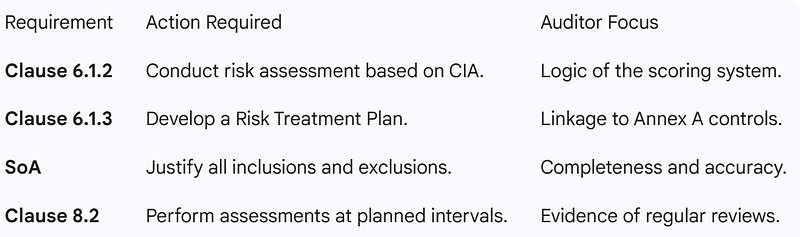
ISO 27001 Risk Management Requirements
Conclusion
ISO 27001 risk management is the bridge between business objectives and technical reality. By following a structured methodology, maintaining rigorous documentation, and ensuring your auditors can see a clear “thread” from risk identification to control implementation, you not only pass your audit but truly secure your organization.
Ready to Streamline Compliance?
Building a secure foundation for your startup is crucial, but navigating the complexities of achieving compliance can be a hassle, especially for a small team.
SecureSlate offers a simpler solution:
- Affordable: Expensive compliance software shouldn’t be the barrier. Our affordable plans start at just $284/month.
- Focus on Your Business, Not Paperwork: Automate tedious tasks and free up your team to focus on innovation and growth.
- Gain Confidence and Credibility: Our platform guides you through the process, ensuring you meet all essential requirements and giving you peace of mind.
Disclaimer (legal note)
SecureSlate is not a law firm, and this article does not constitute or contain legal advice or create an attorney-client relationship. When determining your obligations and compliance with respect to relevant laws and regulations, you should consult a licensed attorney.
Need compliance without the complexity?
SecureSlate automates ISO 27001, SOC 2, GDPR, HIPAA, and more. Built for growing teams. See it in action.
Find compliance gaps in 30 seconds
