
Photo by Jakub Żerdzicki on Unsplash (Unsplash License).

Related guides:
Key takeaways
- What are SAST Solutions: Static Application Security Testing (SAST) is a “white-box” testing methodology that analyzes an application’s source code, bytecode, or binaries without execution.
- How Modern SAST Works: Technical Mechanics: Modern SAST solutions go far beyond simple regex-based pattern matching.
- The Core Engines: Lexical Analysis: Converting raw code into tokens to understand syntax.
As we move into 2026, the paradigm of software development has shifted. We are no longer just writing code; we are orchestrating AI-driven development workflows. With the volume of code being produced by “agentic” coding assistants, the risk of technical and security debt has reached a critical point.
In this environment, SAST solutions (Static Application Security Testing) have evolved from passive scanners into active, real-time security partners.
This guide examines the top SAST solutions for 2026, prioritizing the balance between developer velocity and enterprise-grade accuracy.
Stop losing sleep over security: Learn the SecureSlate strategy top CTOs use to guarantee system integrity.
What are SAST Solutions?
Static Application Security Testing (SAST) is a “white-box” testing methodology that analyzes an application’s source code, bytecode, or binaries without execution. By now, SAST has been rebranded as a core pillar of Application Security Posture Management (ASPM).
The primary goal of SAST solutions is to identify security flaws, such as injection vulnerabilities, insecure cryptographic implementations, and logic errors, early in the Software Development Life Cycle (SDLC).
The 7 Best DAST Solutions for 2026: Ranked by Speed and Accuracy: Dynamic testing to pair with your SAST stack.
How Modern SAST Works: Technical Mechanics
Modern SAST solutions go far beyond simple regex-based pattern matching. To maintain accuracy at 2026 scales, they utilize complex graph-based models.
The Core Engines
- Lexical Analysis: Converting raw code into tokens to understand syntax.
- Abstract Syntax Trees (AST): Building a hierarchical representation of code to understand relationships between elements.
- Control Flow Graphs (CFG): Mapping every possible execution path through the application.
Taint Analysis and Data Flow
The most critical technical component is Taint Analysis. This involves tracking untrusted user input (the Source) as it traverses the application to a sensitive operation (the Sink).
The complexity of these checks is often modeled as a graph traversal problem. For an application with n nodes and e edges in its flow graph, the analysis must resolve:

The “Reachability” Revolution
A defining feature of 2026 tools is Reachability Analysis. Legacy tools often flagged “vulnerable code” that was physically impossible for a user to trigger. Modern SAST correlates code analysis with runtime telemetry to ensure that security teams only spend time on exploitable paths.
Key Features to Look for in 2026
When evaluating SAST solutions, look beyond simple bug-finding. Demand these 2026-standard features:
- Reachability Analysis: The ability to determine if a vulnerability in a library is actually accessible via the application’s code paths.
- Agentic Remediation: AI agents that don’t just find a bug but generate, test, and propose a pull request for the fix.
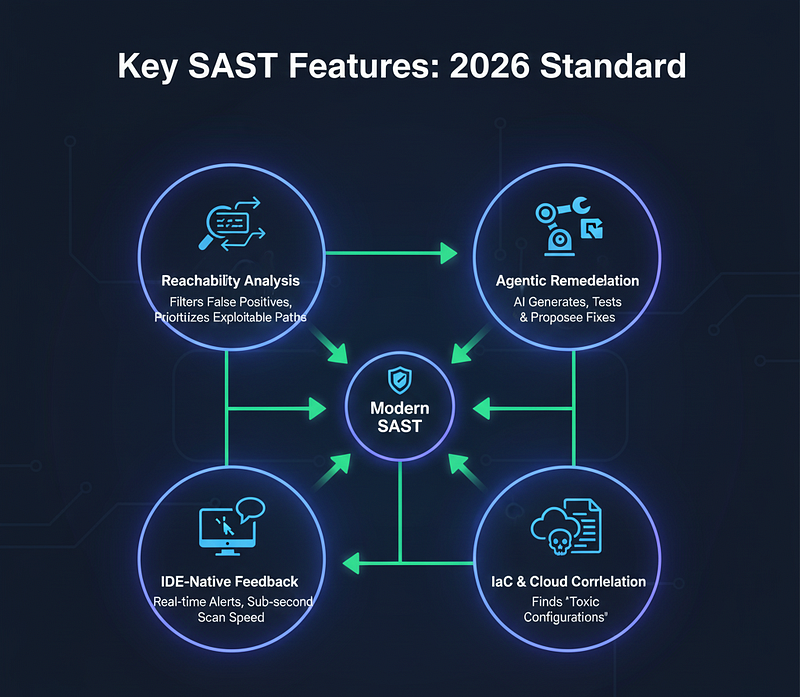 Image by AI
- IDE-Native Feedback: Scanning that happens “at the keystroke,” providing sub-second feedback within VS Code or JetBrains.
- Infrastructure-as-Code (IaC) Correlation: Analyzing the application code and the cloud configuration simultaneously to find “toxic combinations.”
- VEX (Vulnerability Exploitability eXchange) Support: In 2026, high-performing AppSec teams reduce noise by publishing exploitability status (for example, not affected / fixed / under investigation) via VEX formats such as CycloneDX VEX or CSAF. Even if your SAST tool doesn’t generate VEX itself, prioritize tooling that can ingest SBOM/VEX context or export findings cleanly so you can operationalize reachability and suppress non-exploitable alerts.
The 7 Best SAST Solutions for 2026
In 2026, the market for SAST solutions is no longer a competition of who can find the most bugs, but who can integrate most seamlessly into an AI-accelerated development pipeline.
Below is an in-depth analysis of the top industry leaders, detailing the specialized technologies that define their 2026 offerings.
1. SecureSlate: The Compliance-Integrated Scanning Platform
SecureSlate bridges application security scanning and audit readiness, ideal for teams that need SAST, DAST, and cloud vulnerability findings tied directly to SOC 2, ISO 27001, and HIPAA controls instead of living in a separate AppSec silo.
- Best For: Startups and growing teams that need vulnerability scanning plus compliance evidence in one workspace, not a standalone SAST-only tool.
- 2026 Innovation: Unified vulnerability scanning across code, cloud, and applications (SAST, DAST, CSPM) with findings prioritized and mapped to compliance controls automatically.
- Key Advantage: Scan results feed directly into CC7.1-ready workflows: identify, assign, remediate, and retain evidence without exporting to spreadsheets.
- Compliance “Why” (SOC 2 CC7.1): Built for teams where SAST is part of a broader compliance program; scan results, remediation status, and audit evidence live in one platform. See vulnerability scanning capabilities.
2. Aikido Security: The Unified Developer Scanner
Aikido Security (often searched as “Aikodo”) consolidates SAST, SCA, secrets detection, IaC, and container scanning into one developer-first platform, built for teams that want fast PR feedback and AI-driven noise reduction without stitching together five separate AppSec tools.
- Best For: Engineering-led startups and scale-ups that want an all-in-one code-to-cloud scanner with low setup overhead.
- 2026 Innovation: AutoTriage + AutoFix. Aikido uses reachability context and AI triage to deprioritize non-exploitable findings, then generates reviewable pull requests to remediate confirmed issues across code, dependencies, and infrastructure.
- Key Advantage: Unified scanning surface (SAST + SCA + secrets + IaC + containers) with IDE, CI/CD, and PR-native feedback, so developers see prioritized issues where they already work.
- Compliance “Why” (SOC 2 CC7.1): Supports CC7.1 technical vulnerability management with continuous scan evidence and remediation trails; pairs well with a GRC workspace when you also need policies, access reviews, and full audit packaging. See Connecting SecureSlate & Aikido.
3. Snyk: The Developer Choice
Snyk has solidified its position as the market leader in developer adoption by treating security as a feature of the software, not a hurdle. Its DeepCode AI engine is specifically trained on curated, security-specific datasets rather than general-purpose code, allowing it to provide high-precision scans in seconds.
- Best For: Fast-moving DevOps and cloud-native teams who require security to move at the speed of their IDE.
- 2026 Innovation: Agentic Fixes. Snyk’s 2026 platform utilizes autonomous agents that not only identify flaws but also perform “reachability triage” to ensure developers only see exploitable vulnerabilities.
- Key Advantage: Near-zero developer friction. With its “as-you-type” scanning, it offers high-fidelity “Auto-fix” suggestions that have an 80%+ accuracy rate, drastically reducing the time spent in the triage phase.
- Compliance “Why” (SOC 2 CC7.1): Helps satisfy CC7.1 vulnerability identification and remediation expectations by continuously identifying code-level weaknesses, creating tickets/PRs, and producing an auditable trail of findings and fixes.
4. Checkmarx One: The Enterprise Powerhouse
Checkmarx provides a unified Application Security Posture Management (ASPM) platform that scales across millions of lines of code. In 2026, their “Fusion” engine is the crown jewel, correlating SAST findings with DAST (Dynamic) and runtime signals to provide a multidimensional view of risk.
- Best For: Global enterprises with complex compliance requirements and massive, heterogeneous codebases.
- 2026 Innovation: AI Query Builder. Checkmarx allows security teams to use natural language to generate custom security queries, making it easier to hunt for company-specific logic flaws without deep knowledge of proprietary query languages.
- Key Advantage: Unmatched language support (over 80 frameworks) and the ability to scan uncompiled code, catching vulnerabilities before the build stage.
- Compliance “Why” (SOC 2 CC7.1): Strong fit for CC7.1 programs that need centralized vulnerability management across many repos, plus evidence that issues are tracked, prioritized, and remediated over time.
5. GitHub Advanced Security (CodeQL)
For teams living in GitHub, CodeQL is the “frictionless” choice. It treats code as a searchable database, allowing security researchers to model vulnerabilities as data flow queries that can be executed across thousands of repositories simultaneously.
- Best For: Engineering organizations that have consolidated their entire SDLC within the GitHub/Azure ecosystem.
- 2026 Innovation: Copilot Autofix Integration. In 2026, CodeQL alerts are automatically fed into Copilot, which generates a verified patch. Telemetry shows this remediates SQL injections up to 12x faster than manual intervention.
- Key Advantage: Native integration: vulnerabilities appear as inline comments on Pull Requests, ensuring security is part of the standard peer-review process.
- Compliance “Why” (SOC 2 CC7.1): Ideal when your CC7.1 evidence needs to live where engineering work happens: PR annotations, review history, and merge records become your audit trail for vulnerability remediation.
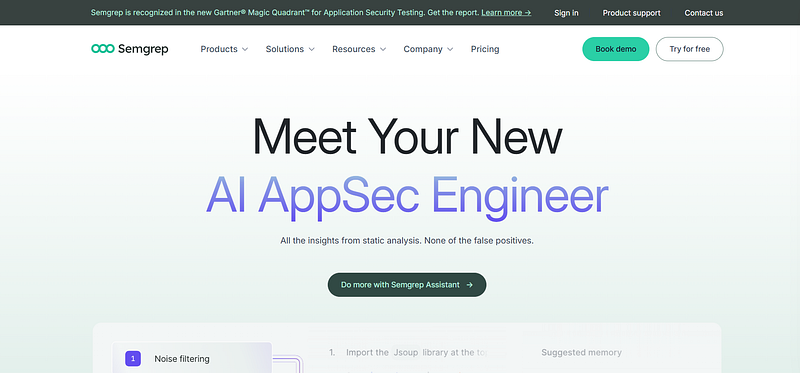
6. Semgrep: The Speed Specialist
Semgrep disrupted the legacy market by replacing complex proprietary engines with a lightweight, YAML-based rule system. It is the favorite for “Security Champions” who want to write and deploy custom guardrails in minutes.
- Best For: High-velocity, modern tech stacks that prioritize customization and CI/CD scan speed.
- 2026 Innovation: Semgrep Assistant AI Triage. In 2026, Semgrep uses LLMs to filter out nearly 60% of SAST noise by analyzing code context and historical triage decisions, ensuring only “True Positives” reach the developer.
- Key Advantage: An extremely fast engine that supports Inter-file Analysis , allowing it to trace complex data flows across multiple files without the heavy performance overhead of traditional tools.
- Compliance “Why” (SOC 2 CC7.1): Supports CC7.1 by enabling repeatable, policy-driven detection in CI/CD (and fast remediation loops), which auditors often want to see for ongoing vulnerability management.
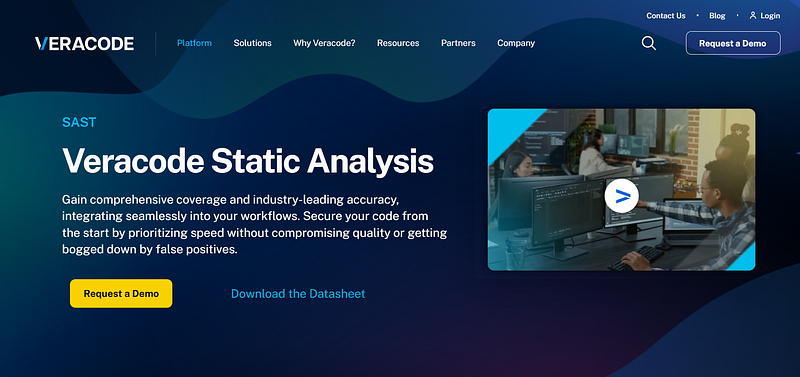
7. Veracode: The Risk & Compliance Leader
Veracode is the pioneer of cloud-native SAST and remains the gold standard for organizations that need a “Central Source of Truth” for risk. Their 2026 platform, Veracode Fix , leverages two decades of proprietary research to provide AI-generated remediation.
- Best For: Heavily regulated industries (Finance, Healthcare, Defense) that require a rigorous audit trail and “zero-trust” security.
- 2026 Innovation: Binary Static Analysis. Veracode remains a leader in scanning compiled binaries, a critical feature for 2026 enterprises that rely on third-party “black box” software where source code is unavailable.
- Key Advantage: High-confidence remediation that satisfies the most stringent global audit requirements (like SOC2 and ISO 27001) while maintaining a false-positive rate of less than 1%.
- Compliance “Why” (SOC 2 CC7.1): Built for environments where CC7.1 requires strong governance and defensible evidence: clear reporting, consistent workflows, and documentation-friendly outputs.
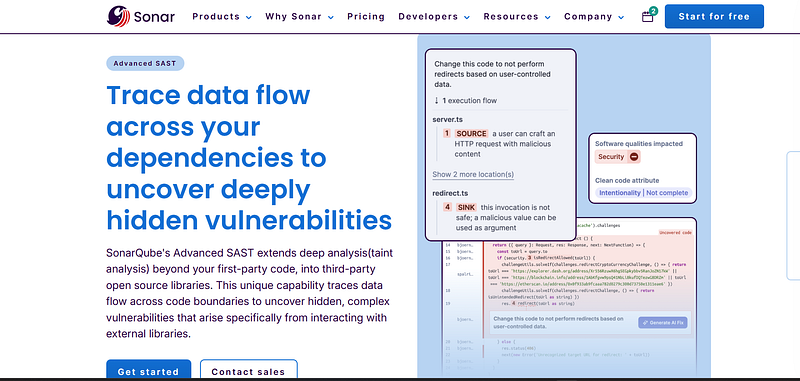
8. SonarQube: The Quality-Security Hybrid
Sonar views security as an essential pillar of Clean Code. In 2026, SonarQube has moved beyond simple “quality gates” to an integrated experience where security flaws, bugs, and technical debt are handled in a single unified workflow.
- Best For: Large engineering teams focused on long-term code maintainability and “Clean as You Code” methodologies.
- 2026 Innovation: Deep Security Hotspot Analysis. Sonar identifies code patterns that are technically valid but “security-sensitive,” guiding developers to review logic that might be exploited, even if it doesn’t trigger a standard CVE rule.
- Key Advantage: The “Clean as You Code” workflow ensures that developers are only held accountable for the security of the new code they write, preventing the overwhelm of a 10-year-old security backlog.
- Compliance “Why” (SOC 2 CC7.1): Helps operationalize CC7.1 by enforcing quality/security gates on new code and producing a consistent record that security issues are reviewed and addressed continuously.
9. Fortify (by OpenText): The Depth Veteran
Fortify remains the “special forces” tool for deep analysis, especially in environments with a mix of cutting-edge microservices and legacy mainframe code. Its Aviator AI has modernized the tool for the 2026 landscape.
- Best For: Large-scale organizations with significant legacy footprints (COBOL, Java 6/7) that modern tools often ignore.
- 2026 Innovation: Application Security Aviator. This AI-driven auditor provides contextual explanations of vulnerabilities in layman’s terms, helping junior developers understand complex architectural flaws in legacy codebases.
- Key Advantage: Robust On-Premises and Air-Gapped deployment options, making it the preferred choice for government and high-security sectors that cannot use cloud-based scanning.
- Compliance “Why” (SOC 2 CC7.1): A practical choice when CC7.1 must cover legacy and restricted environments, enabling vulnerability identification where SaaS-first scanners can’t operate.
Comparison Table: 2026 SAST Solutions
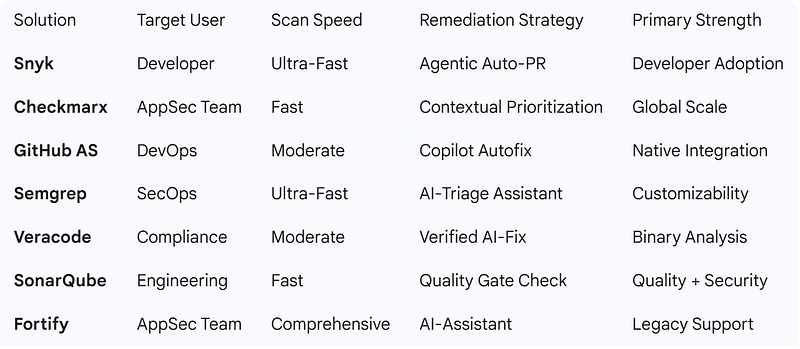
| Tool | Key Strength | AI Remediation Capability | Best For |
|---|---|---|---|
| SecureSlate | SAST + compliance evidence in one workspace | Medium (prioritized triage + remediation tracking) | Teams pairing code scans with SOC 2 / ISO 27001 audits |
| Aikido Security | Unified SAST + SCA + secrets + IaC + containers | Strong (AutoTriage + AutoFix PRs) | Engineering teams wanting one developer security platform |
| Snyk | Developer-first speed + reachability-style triage | Strong (AI-assisted fixes / autofix workflows) | High-velocity cloud teams |
| Checkmarx One | Enterprise scale + multidimensional risk correlation | Strong (query assistance + remediation workflows) | Large orgs with complex codebases |
| GitHub Advanced Security (CodeQL) | Native PR workflow + powerful dataflow queries | Strong (Copilot Autofix in GitHub flow) | GitHub/Azure-native engineering orgs |
| Semgrep | Fast, customizable rules + CI/CD friendliness | Medium–Strong (AI triage reducing noise) | Teams that want custom guardrails fast |
| Veracode | Governance + audit-grade reporting | Strong (AI-assisted remediation with mature workflows) | Regulated industries needing evidence |
| SonarQube | “Clean as You Code” quality + security hotspots | Medium (guidance + workflow-driven fixes) | Large teams optimizing long-term maintainability |
| Fortify (OpenText) | Deep legacy analysis + air-gapped support | Medium (contextual assistance) | Gov/high-security + legacy-heavy estates |
SAST Tools with the Lowest False Positive Rates (and the Least Alert Fatigue)
In 2026, the most common reason teams switch SAST vendors is alert fatigue. The “lowest false positive rate” usually comes from two things: (1) better dataflow accuracy, and (2) better exploitability context (reachability + VEX-style status so teams can suppress what’s not exploitable).
Here’s how the leaders typically reduce noise:
- SecureSlate: Combines SAST, DAST, and CSPM findings with compliance workflows so teams prioritize exploitable issues and suppress noise with audit-ready status tracking.
- Aikido Security: Uses AutoTriage with reachability and environment context to deprioritize non-exploitable alerts before they hit developers.
- Veracode: Often preferred when teams want high-confidence findings and reporting rigor, especially for regulated programs where chasing false positives is expensive.
- GitHub Advanced Security (CodeQL): High signal when the org uses mature query packs and runs findings directly in the PR workflow; less context switching, easier verification.
- Snyk: Reduces noise via reachability-oriented triage and developer-first workflows designed to keep only exploitable items front-and-center.
- Semgrep: Very low “noise” when teams invest in rule tuning + AI triage, especially for company-specific patterns.
If alert fatigue is your #1 pain point, shortlist tools that support:
- Reachability analysis / exploitability context
- Rule tuning and suppression with governance
- VEX-aware workflows (CycloneDX VEX / CSAF) so security can formally record “not affected” and avoid recurring re-triage
The Benefits of Modern SAST Solutions
The value proposition of SAST solutions has shifted from “finding bugs” to “enabling secure velocity.” Implementing a modern SAST platform isn’t just a security choice; it’s a financial and operational imperative.
Cost Efficiency: The “Rule of 100x”
The “Shift-Left” approach drastically reduces remediation costs.
- In-IDE Fix (~$100): Real-time alerts allow developers to patch flaws in minutes without context switching or redeployment.
- Post-Production Fix ($1M+): Breaches involve forensics, legal fees, and fines. Industry data shows production fixes are 30x to 100x more expensive than those addressed during coding.
Continuous Compliance & Audit Readiness
Modern SAST provides 24/7 enforcement by mapping scans to frameworks like SOC 2, ISO 27001, and HIPAA.
For SOC 2 specifically, SAST is a direct lever for Criterion CC7.1 because it helps define system boundaries for scanning coverage and enforces a continuous vulnerability management workflow (identify → prioritize → remediate → verify → retain evidence). When engineering and legal align on this, SAST stops being “extra security tooling” and becomes part of the compliance operating system.
- Automated Mapping: Real-time “Compliance Health” reports replace the yearly audit scramble.
- Modern Guardrails: Pre-configured rules for 2026 standards protect against SSRF and insecure AI-generated code.
- Immutable Logs: Every remediation is logged, providing a “Paper Trail of Care” for legal requirements.
To centralize SAST and other security evidence for SOC 2, ISO 27001, and HIPAA audits, SecureSlate automates control mapping and evidence collection so your AppSec and compliance teams stay audit-ready without manual spreadsheets.
Precision: Reachability Analysis
2026-era tools have solved “alert fatigue” through deep contextual triage.
- Taint Analysis: Tools trace user input to see if it can actually reach a sensitive “sink.”
- Noise Reduction: By correlating analysis with the Control Flow Graph (CFG) , tools filter out “dead code” vulnerabilities, reducing alert volume by 60–80%. Developers focus only on the exploitable “Top 5%.”
Educational Growth: Security as a Skill
SAST acts as an automated training engine, bridging the gap between security and engineering.
- Real-Time Pedagogy: Inline “Before vs. After” examples and interactive tutorials turn every alert into a learning moment.
- Muscle Memory: Constant feedback reduces the overall Vulnerability Injection Rate and counteracts insecure AI “hallucinations” with verified, secure patches.
Conclusion
Selecting the right SAST solutions in 2026 is about finding the sweet spot between Speed (not breaking the CI/CD), Accuracy (low false positives), and Control (the ability to enforce policy).
If you are a high-velocity startup, SecureSlate, Aikido Security, Snyk, or Semgrep will likely provide the best ROI, especially when you need scan findings tied to compliance evidence. If you are a global bank with 10,000+ developers, the governance and depth of Checkmarx or Veracode are indispensable. SecureSlate turns SAST and vulnerability scan results into audit-ready SOC 2, ISO 27001, and HIPAA evidence without manual spreadsheet work.
Ready to Streamline Compliance?
Building a secure foundation for your startup is crucial, but navigating the complexities of achieving compliance can be a hassle, especially for a small team.
SecureSlate offers a simpler solution:
- Affordable: Expensive compliance software shouldn’t be the barrier. Our affordable plans start at just $284/month.
- Focus on Your Business, Not Paperwork: Automate tedious tasks and free up your team to focus on innovation and growth.
- Gain Confidence and Credibility: Our platform guides you through the process, ensuring you meet all essential requirements and giving you peace of mind.
Disclaimer (legal note)
SecureSlate is not a law firm, and this article does not constitute or contain legal advice or create an attorney-client relationship. When determining your obligations and compliance with respect to relevant laws and regulations, you should consult a licensed attorney.
Need compliance without the complexity?
SecureSlate automates ISO 27001, SOC 2, GDPR, HIPAA, and more. Built for growing teams. See it in action.
Find compliance gaps in 30 seconds
