

Related guides:
- your guide to soc 2 audits
- the ultimate iso 27001 guide
- us data privacy compliance checklist
- HIPAA-compliant scheduling software
- HIPAA disaster recovery planning
- HITRUST vs HIPAA
- PCI DSS and HIPAA compliance
Key takeaways
- What Is HIPAA-Compliant Billing Software: HIPAA-compliant billing software is a digital platform designed to manage medical billing processes while strictly protecting PHI under HIPAA’s Privacy and Security Rules.
- Why HIPAA-Compliant Billing Software Is Essential: Healthcare revenue cycles generate enormous amounts of PHI.
- Evaluation Framework Used for Ranking the Software: Each solution below is assessed using a consistent set of factors.
Financial expectations in healthcare are more demanding than ever. Clinics and hospitals are pressured to enhance billing accuracy, safeguard confidential information, and expedite payment cycles, all while payer rules become increasingly complex each year.
Billing teams face tighter margins and higher workloads, yet they must still deliver precise claim submissions without risking compliance gaps that could lead to penalties or revenue disruptions.
This is why healthcare organizations are moving toward HIPAA-compliant billing software. These solutions reduce coding errors, protect sensitive data, and help providers maintain predictable cash flow in an environment where financial stability has a direct impact on the quality of care delivered.
This guide examines the top 7 HIPAA-compliant billing software solutions delivering measurable improvements in accuracy, protection, and reimbursement speed.
Stop losing sleep over security: Learn the SecureSlate strategy top CTOs use to guarantee system integrity.
What Is HIPAA-Compliant Billing Software?
HIPAA-compliant billing software is a digital platform designed to manage medical billing processes while strictly protecting PHI under HIPAA’s Privacy and Security Rules. Unlike generic billing systems, these platforms include multiple protective layers that safeguard patient data across every revenue cycle stage, from charge capture and coding to claim submission and payment posting.
To qualify as HIPAA-compliant, a billing system must demonstrate:
- AES-256 encryption for stored data and TLS 1.2+ encryption for transmitted data
- Multi-factor authentication and strict identity verification
- Access restrictions based on user role and job function
- Continuous log monitoring for unauthorized access
- Automatic logoff to prevent exposure at unattended workstations
- Disaster recovery systems with redundant backups
- Secure hosting environments , typically SOC 2 Type II, HITRUST, or equivalent
These protections reduce exposure to cyberattacks, internal misuse, and accidental disclosure, some of the most common causes of HIPAA violations.
Why HIPAA-Compliant Billing Software Is Essential
Healthcare revenue cycles generate enormous amounts of PHI. Every patient encounter, procedure, diagnosis, and insurance verification involves sensitive data that must be protected. HIPAA-compliant billing software is essential because it guards this information while simultaneously improving financial outcomes.
Consider the following realities:
- Healthcare breaches have climbed over 55% since 2020 , driven largely by gaps in billing and administrative systems.
- The average cost of a healthcare data breach surpassed $11 million in 2024 , making healthcare the most expensive industry for breaches.
- Roughly 25% of all medical claims contain an error , according to AARP, frequently resulting from manual processes.
- Up to 40% of denials are preventable , yet many practices lack the technology to detect inaccuracies before submission.
When PHI is compromised or claims are mishandled, organizations lose far more than revenue. They risk, like investigations, fines, lawsuits, increased insurance premiums, and damaged reputation
HIPAA-compliant billing software minimizes these risks and replaces guesswork with structured, secure, reliable workflows. The result is faster reimbursement, fewer denials, and greater financial predictability.
Evaluation Framework Used for Ranking the Software
Each solution below is assessed using a consistent set of factors:
- Compliance architecture: encryption, logs, identity management
- Revenue cycle performance: clean claim rates, denial reduction
- Automation depth: coding support, scrubbing, charge capture
- Integration capability: EHR compatibility, API options
- Usability: workflow speed, learning curve
- Scalability: suitable practice size and specialty alignment
This framework ensures that each solution selected has proven value beyond general marketing claims.\
Top 7 HIPAA-Compliant Billing Software Solutions
1. AdvancedMD
AdvancedMD offers a comprehensive, cloud-based billing environment designed for organizations that want deeper automation and detailed financial analytics. It is engineered to process high claim volumes while maintaining strict HIPAA security controls. With its modular structure, practices can expand from basic billing to full clinical and patient-engagement ecosystems without switching platforms.

Key Features
- Automated charge capture that reduces manual data entry
- Sophisticated denial management with trend analysis
- Secure document management for PHI and insurance records
- Real-time claim validation against payer-specific rules
- Performance dashboards displaying KPIs such as AR aging and clean-claim rates
- Integration with AdvancedMD’s EHR or external EHR systems
Best For
Mid-size clinics and multi-specialty practices need a more advanced set of billing automation tools and scalable workflows.
Notable Strengths
With strong tools for detecting coding inconsistencies, many organizations using AdvancedMD achieve faster payments and fewer rejections. Its modular structure ensures smooth system expansion as teams grow.
2. DrChrono
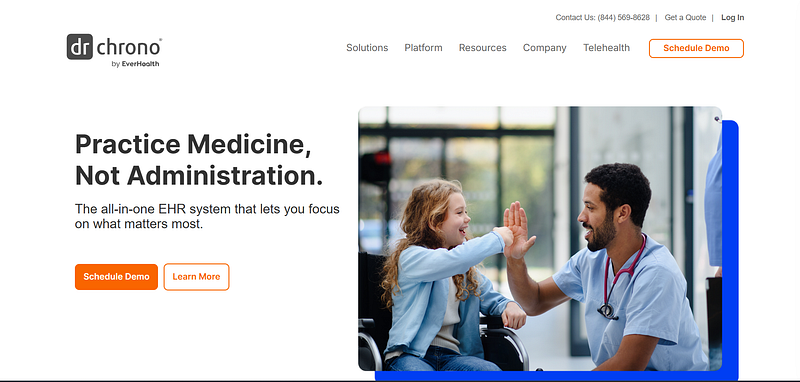
DrChrono differentiates itself through mobility and modern workflow design. Many practices appreciate its ability to handle billing tasks from iPads, giving providers and billing teams secure access to essential information during patient visits. This flexibility makes it a popular choice for fast-paced care environments and hybrid-care models.
Key Features
- Mobile charge capture directly within patient encounters
- Secure mobile encryption and identity controls
- Integrated clinical documentation, scheduling, and billing
- Real-time claim tracking with status updates
- Automated payer rule application that reduces errors
- Integrated payment tools for streamlined collections
Best For
Mobile-first practices, hybrid care clinics, home-visit care models, and teams wanting mobile accessibility without compromising HIPAA requirements.
Notable Strengths
Secure mobile functionality sets DrChrono apart, giving providers real-time access to billing tasks during patient encounters.
3. AthenaCollector (athenahealth)
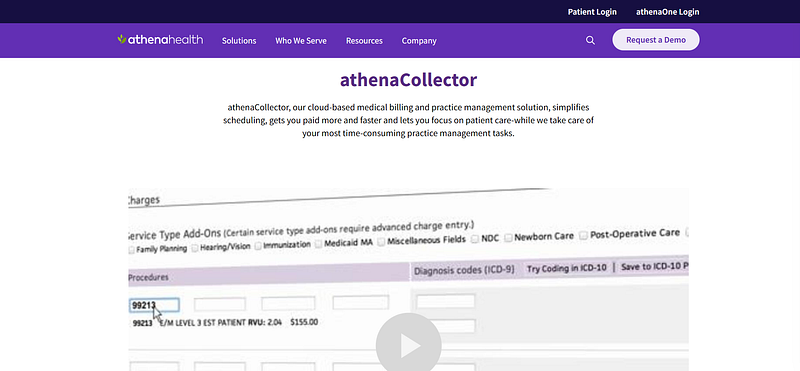
AthenaCollector is a powerful, cloud-based billing engine built on one of the largest network datasets in the healthcare industry. The platform analyzes millions of claims across its national network, giving users access to real-time payer insights that improve financial performance.
Key Features
- Dynamic claim edits based on national payer behavior
- An intelligent rule engine that updates continuously
- Performance analytics that benchmark outcomes against similar organizations
- Automated claim routing and payment posting
- Secure storage, encrypted communications, and detailed audit controls
- Integrated patient financial tools
Best For
Practices focused on efficiency, data-backed decisions, and consistent revenue growth.
Notable Strengths
AthenaCollector improves operational decision-making using live analytics, helping organizations adapt quickly to payer rule changes.
4. PracticeSuite
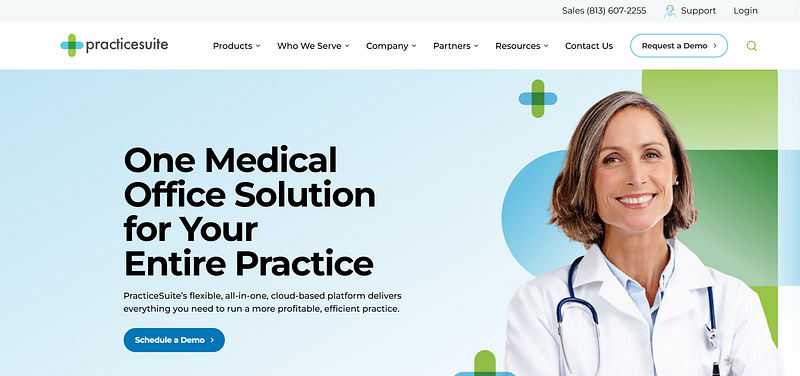
PracticeSuite is a HIPAA-compliant, all-in-one practice management and medical billing software designed to streamline operations for small to mid-sized practices and independent billing companies. It is a flexible, web-based platform that integrates EHR, practice management, and RCM tools, prioritizing maximizing collections and minimizing administrative burden.
Key Features
- Integrated EHR and Practice Management
- Comprehensive Claim Scrubbing to minimize denials
- Automated Clearinghouse Services for secure claim submission
- Secure Patient Portal for payments and scheduling
- Optional Dedicated RCM Services with guaranteed performance
- Detailed Financial Reporting and Analytics
Best For
Small to mid-sized medical practices, independent physician offices, specialty clinics, and third-party medical billing companie.
Notable Strengths
PracticeSuite is strong in its robust integration and flexibility, offering a scalable platform for practices managing their own billing or for third-party billing companies.
5. CareCloud
CareCloud provides a visually modern, intuitive billing ecosystem built for multi-location practices and growing medical groups. Its interface offers real-time visibility into financial performance, enabling administrative leaders to track revenue trends and spot bottlenecks before they escalate.
Key Features
- Modern, responsive interface for faster navigation
- Automated billing workflows with prioritized claims queues
- Secure PHI handling across locations and user profiles
- Integrated patient payments and online billing
- Custom reporting tools that monitor financial health
- Centralized control for multi-site operations
Best For
Multi-location practices and growing medical groups that need centralized billing oversight without sacrificing efficiency.
Notable Strengths
Its visual layout reduces training time and helps keep billing cycles predictable even during busy seasons.
6. NextGen Healthcare
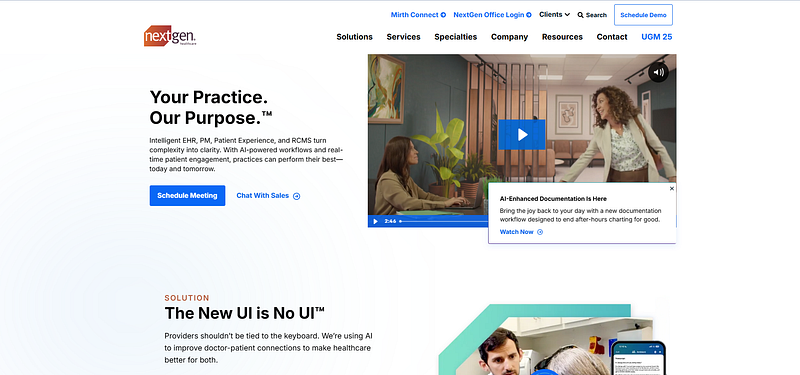
NextGen Healthcare is built with specialty practices in mind. Its billing ecosystem supports complex coding structures for fields such as cardiology, orthopedics, behavioral health, ophthalmology, and more. The platform blends precision billing with strong compliance controls, helping clinicians maintain high documentation and coding accuracy.
Key Features
- Specialty-specific coding support, templates, and billing rules
- Encrypted PHI storage with continuous monitoring
- Comprehensive audit trails for secure traceability
- Integrated EHR + billing for seamless documentation flow
- Automated claim edits based on specialty requirements
- Payment posting with advanced reconciliation tools
Best For
Specialty groups requiring deep coding detail and tailored billing workflows, especially those handling complex procedures or multi-step treatment plans.
Notable Strengths
Specialty practices report significantly fewer errors due to NextGen’s tailored coding logic.
7. CollaborateMD
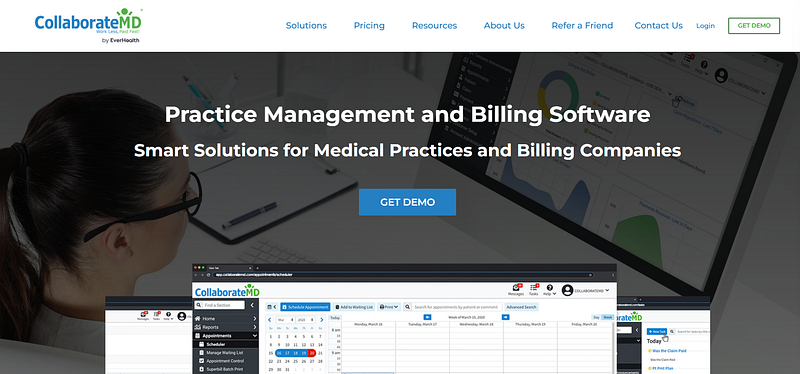
CollaborateMD is designed for speed and operational simplicity. Practices with high daily patient volume appreciate how quickly the system processes claims, verifies coverage, and posts payments. Its HIPAA-secure environment ensures sensitive information remains protected even in fast-paced conditions.
Key Features
- Fast claim processing with near-instant clearinghouse connections
- Real-time eligibility verification
- Accurate audit trails and secure data routing
- Automated payment posting
- Streamlined interface optimized for billing teams
- Detailed AR reports with payment trend visibility
Best For
High-volume clinics, primary care groups, urgent care centers, and practices requiring rapid financial turnaround.
Notable Strengths
Its speed and accuracy provide relief to teams managing heavy patient loads.
How to Choose the Right HIPAA-Compliant Billing Software
Choosing HIPAA-compliant billing software impacts cash flow, efficiency, and patient data security. A structured approach avoids systems that look good on paper but fail in real-world workflows.
Identify Core Needs
- Billing Challenges: Clarify where your current process fails (e.g., high denial rates, slow reimbursements, heavy manual work). This establishes baseline feature requirements.
- Automation Needs: Determine the necessary level of automation. Smaller clinics need strong claim scrubbing, while larger groups benefit from deeper RCM automation to reduce data entry and ensure coding accuracy. Match automation to workflow to avoid overspending.
Technical and Vendor Evaluation
- Integration Requirements: The system must work seamlessly with your current EHR and essential tools to prevent duplicate work and errors. Confirm smooth connectivity and support for future growth or specialty needs.
- Verify Compliance: A credible vendor supplies clear documentation: a Business Associate Agreement (BAA) , encryption methods, access controls, and audit processes. Proceed cautiously if a vendor cannot clearly explain their Protected Health Information (PHI) protection measures.
- Pricing Model: Understand the full financial picture: per-provider, per-claim, or subscription tiers. Review all costs, including setup, training, clearinghouse fees, and contract terms, to ensure transparency.
Workflow Alignment
- Usability and Training: Assess if the interface is intuitive and how long training will take. Difficult-to-use software harms staff efficiency and revenue performance. Check the quality of vendor support.
- Realistic Demo: Request a demonstration that reflects your daily workflow (charge entry, scrubbing, eligibility, posting, reporting) instead of a high-level presentation. This reveals if the system truly aligns with your operational needs.
Conclusion
The transition to HIPAA-compliant billing software is now essential for healthcare organizations that focus on protecting PHI and strengthening financial performance. These systems streamline billing, lower denial rates, and support steady cash flow despite rising administrative pressures and shifting payer demands.
As the healthcare landscape changes, organizations that adopt secure and intelligent billing technology will be better equipped to stay compliant, improve reimbursement outcomes, and support stronger patient experiences. The right software becomes a core driver of a stable, financially healthy practice.
Ready to Streamline Compliance?
Building a secure foundation for your startup is crucial, but navigating the complexities of achieving compliance can be a hassle, especially for a small team.
SecureSlate offers a simpler solution:
- Affordable: Expensive compliance software shouldn’t be the barrier. Our affordable plans start at just $284/month.
- Focus on Your Business, Not Paperwork: Automate tedious tasks and free up your team to focus on innovation and growth.
- Gain Confidence and Credibility: Our platform guides you through the process, ensuring you meet all essential requirements, and giving you peace of mind.
FAQ
What is HIPAA-compliant invoicing and billing software?
HIPAA-compliant billing software processes patient invoices while safeguarding PHI through encryption, access controls, and a signed BAA. Ordinary invoicing tools are not compliant by default.
- The vendor must sign a Business Associate Agreement.
- PHI on invoices must be encrypted and access-controlled.
- Audit logs must record who accessed billing records.
- Widely used HIPAA-compliant billing options include Kareo/Tebra, AdvancedMD, athenahealth, and CureMD; all will sign a BAA.
Disclaimer (legal note)
SecureSlate is not a law firm, and this article does not constitute or contain legal advice or create an attorney-client relationship. When determining your obligations and compliance with respect to relevant laws and regulations, you should consult a licensed attorney.
Need compliance without the complexity?
SecureSlate automates ISO 27001, SOC 2, GDPR, HIPAA, and more. Built for growing teams. See it in action.
Find compliance gaps in 30 seconds
