
Related guides:
Key takeaways
- Why AI Risks Are Now a Compliance Problem: Historically, compliance programs focused on systems, processes, and people.
- Data Protection and Privacy Risks in AI Systems: One of the most immediate AI risks is uncontrolled data exposure.
- Shadow AI and the Breakdown of Compliance Oversight: From a regulatory compliance perspective, shadow AI is dangerous because it bypasses governance entirely.
This article reframes AI risks through a regulatory compliance management lens. It explains the most critical AI risks businesses face today and shows how structured governance, documentation, and security controls, core to modern compliance programs, can reduce exposure and improve audit readiness.
Why AI Risks Are Now a Compliance Problem
Historically, compliance programs focused on systems, processes, and people. AI disrupts all three at once.
AI systems process large volumes of data, often across jurisdictions. They generate outputs that influence decisions. They learn from historical information that may contain bias or regulated data. And they are frequently introduced informally, outside established governance processes.
This makes AI risks particularly dangerous for compliance teams. A single AI tool used incorrectly can trigger violations of GDPR, ISO 27001, SOC 2, HIPAA, or internal risk policies, without any malicious intent.
From a compliance perspective, AI risks matter because they:
- Reduce visibility into how decisions are made
- Complicate data protection and privacy obligations
- Introduce undocumented third-party dependencies
- Challenge auditability and evidence collection
- Create accountability gaps
So, managing AI risks is becoming a core requirement of regulatory compliance management.
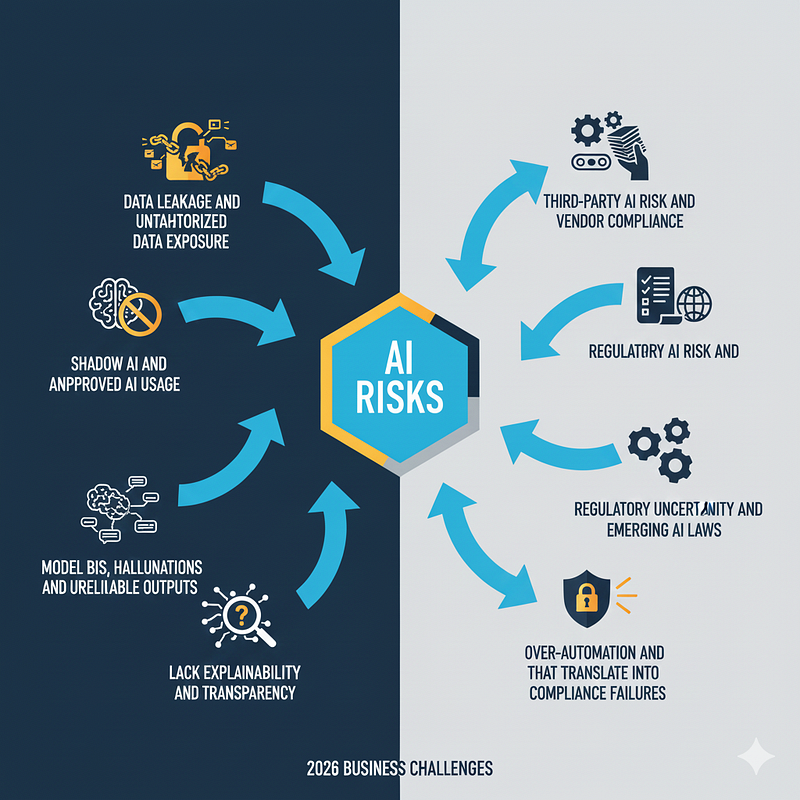
Top AI Risks Businesses Face
1. Data Protection and Privacy Risks in AI Systems
One of the most immediate AI risks is uncontrolled data exposure. AI tools depend on data, and in regulated organizations, that data often includes personal information, financial records, customer communications, or proprietary business intelligence.
The compliance issue arises when sensitive data is entered into AI systems without clear controls over storage, retention, or reuse. Many AI platforms log prompts, retain interaction histories, or use submitted data to improve models. Without a formal assessment, this creates silent compliance violations.
From a regulatory standpoint, this directly affects data minimization, purpose limitation, and confidentiality requirements. Regulators do not care whether a breach occurred intentionally or accidentally; the obligation to protect data remains the same.
2. Shadow AI and the Breakdown of Compliance Oversight
From a regulatory compliance perspective, shadow AI is dangerous because it bypasses governance entirely. There is no risk assessment, no vendor due diligence, no audit trail, and no policy enforcement. This makes it impossible to demonstrate compliance during an audit.
AI risks increase dramatically when organizations cannot answer basic questions such as:
- Which AI tools are being used?
- What data is shared with them?
- Who approved their use?
- What controls are in place?
3. Unreliable AI Outputs and Compliance Accountability
Another major category of AI risks involves the accuracy and reliability of AI-generated outputs. AI systems can hallucinate facts, misinterpret context, or generate biased recommendations, often without signaling uncertainty.
In regulated environments, this becomes a compliance issue when AI outputs influence decisions related to hiring, access control, financial reporting, customer communications, or risk assessments. If an AI system provides incorrect guidance and a business acts on it, the organization, not the model, is accountable.
Regulatory frameworks consistently emphasize accountability. Organizations must be able to justify decisions, explain outcomes, and demonstrate reasonable controls. Blind reliance on AI undermines all three.
4. Explainability, Auditability, and the AI Black Box Problem
Explainability is becoming a central compliance concern. Many AI systems cannot clearly explain how they arrive at a particular output. This lack of transparency conflicts directly with regulatory expectations.
Auditors and regulators expect organizations to demonstrate:
- How decisions are made
- What inputs are used
- Who is responsible
- What controls are in place
If an organization cannot explain how an AI system influenced a decision, compliance becomes difficult to defend.
This does not mean businesses must avoid advanced AI models altogether. It means they must document AI use cases carefully, define their scope, and maintain records that support auditability.
5. Third-Party AI Risk and Vendor Compliance
Most organizations rely on third-party AI services. These vendors introduce compliance obligations that are often underestimated.
AI vendors may process regulated data, rely on opaque training datasets, or change their models without notice. If something goes wrong, regulators will still hold the organization accountable for vendor failures.
This makes third-party AI risk a compliance issue, not just a procurement concern.
6. Regulatory Uncertainty and Emerging AI Laws
One of the most challenging AI risks is regulatory uncertainty. AI-specific regulations are evolving rapidly, and many organizations are unsure how current compliance obligations apply to AI-driven processes.
While the regulatory landscape continues to develop, existing frameworks already provide clear guidance. Data protection laws, information security standards, and risk management frameworks all apply to AI, even if AI is not mentioned explicitly.
The compliance mistake organizations make is waiting for AI-specific regulations before acting. In reality, regulators expect businesses to apply existing principles to new technologies proactively.
7. Security Threats That Translate Into Compliance Failures
AI systems introduce new security vulnerabilities, such as prompt injection, data poisoning, and unauthorized model access. While these may sound technical, their consequences are compliance-related.
A compromised AI system can expose regulated data, generate misleading outputs, or disrupt critical processes. Each outcome creates compliance risk, audit findings, and potential regulatory action.
Strong security controls remain the backbone of compliance management. Access control, monitoring, incident response, and change management all apply to AI systems just as they do to traditional infrastructure.
8. Over-Automation and Loss of Compliance Control
Automation is attractive, especially in compliance-heavy environments. AI promises faster assessments, automated reporting, and reduced manual effort. But over-automation introduces risk when it removes human accountability.
Compliance frameworks consistently emphasize oversight, review, and responsibility. Fully autonomous AI systems undermine these principles.
Effective compliance management ensures that automation enhances consistency without eliminating control. AI should streamline processes, not obscure ownership or decision-making.
Managing the Top AI Risk Through Regulatory Compliance
Regulatory compliance provides the structure needed to control AI responsibly. Existing frameworks already contain what AI governance requires; organizations simply need to apply them deliberately.
Establish Formal AI Ownership
Compliance starts with accountability. Every AI system must have a clearly defined owner responsible for risk, controls, and regulatory alignment. Without ownership, there is no enforceable compliance.
This mirrors existing requirements in ISO 27001, SOC 2, and GDPR, where accountability is non-negotiable.
Treat AI as a Regulated System
AI tools should not be treated as productivity add-ons. They must be governed like any other regulated system that processes data or influences decisions.
This means documenting AI use cases, defining acceptable usage, and formally assessing risk before deployment. When AI is brought under existing compliance processes, shadow AI disappears and visibility improves.
Map AI Usage to Regulatory Controls
AI does not exist outside regulation. Data protection laws, security standards, and audit frameworks already apply.
By mapping AI usage to existing controls (such as access management, data classification, vendor risk management, and incident response), organizations reduce AI risks without creating parallel compliance programs.
Auditors do not expect perfection. They expect evidence of control.
Enforce Human Oversight and Explainability
One of the fastest ways AI risks turn into compliance failures is when organizations rely on AI outputs without oversight.
Regulatory frameworks consistently require organizations to explain decisions and demonstrate reasonable safeguards. Human review, documented approvals, and defined escalation paths ensure AI remains compliant, even when outputs are imperfect.
AI may assist decisions, but accountability must remain human.
Extend Vendor Compliance to AI Providers
Most AI systems rely on third parties. Compliance does not stop at the contract boundary.
AI vendors must be assessed for data protection, security posture, and regulatory alignment. If a vendor cannot demonstrate compliance support, the risk transfers directly to the organization.
Strong vendor governance turns third-party AI risk into a manageable compliance obligation.
Maintain Continuous Monitoring and Evidence
Compliance is not a one-time activity. AI usage evolves, models change, and regulations mature.
Ongoing monitoring, regular reviews, and documented evidence ensure that AI risks remain controlled over time. This is what auditors look for, not just policies, but proof of execution.
Conclusion
AI risks are not just technical challenges; they are governance challenges, accountability challenges, and compliance challenges.
Organizations that treat AI as an unmanaged productivity tool will struggle with audits, regulatory scrutiny, and risk exposure. Those that integrate AI into their compliance management programs will be better positioned to scale safely.
Strong compliance does not slow down AI adoption. It enables it.
By aligning AI usage with security controls, documentation, and regulatory expectations, businesses can reduce AI risks while building trust with regulators, customers, and stakeholders.
If AI is shaping the future of business, compliance will shape whether that future is sustainable.
Disclaimer (legal note)
SecureSlate is not a law firm, and this article does not constitute or contain legal advice or create an attorney-client relationship. When determining your obligations and compliance with respect to relevant laws and regulations, you should consult a licensed attorney.
Need compliance without the complexity?
SecureSlate automates ISO 27001, SOC 2, GDPR, HIPAA, and more. Built for growing teams. See it in action.
Find compliance gaps in 30 seconds
