
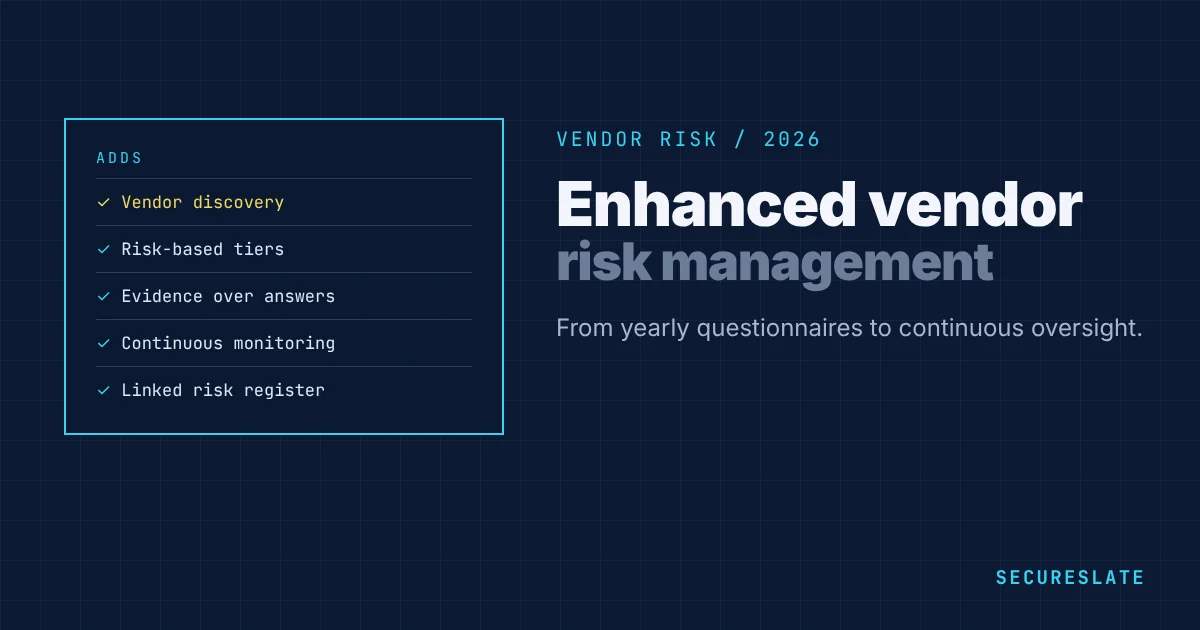
Enhanced vendor risk management (VRM) replaces the old model of yearly, checkbox questionnaires with continuous, risk-based oversight of third parties. Companies now rely on dozens or hundreds of SaaS tools, cloud providers and service firms, and many of the largest breaches in recent years started at a vendor. At the same time, customers, auditors and regulations such as SOC 2, ISO 27001, DORA and NIS 2 expect evidence that vendors are monitored, not just approved once. This guide explains what an enhanced VRM program looks like, its key capabilities and how to move from a basic process to continuous oversight.
Related guides: Vendor tiering model · Due diligence software · TPRM vs VRM vs ERM · State of third-party risk management
Key takeaways
- Traditional VRM relies on annual questionnaires; enhanced VRM adds tiering, evidence, continuous monitoring and lifecycle workflows.
- Start with a complete inventory fed by procurement, finance and SSO data.
- Use automation to send assessments, read documents and track expiry dates.
- Link vendor findings to your risk register and contracts.
- Measure program health with coverage, timeliness and issue closure metrics.
Why traditional VRM falls short
| Traditional approach | Problem |
|---|---|
| Same questionnaire for every vendor | Wastes time on low-risk vendors; shallow on critical ones |
| Yearly reviews only | Misses breaches and changes between reviews |
| Self-reported answers | Accepts claims without evidence |
| Spreadsheets and email | Hard to track, easy to lose |
| Procurement-only process | Misses vendors signed up outside procurement |
| No link to risk register | Leadership never sees vendor risk |
Capabilities of enhanced VRM
| Capability | What it adds |
|---|---|
| Vendor discovery | Finds vendors through SSO, finance and procurement data |
| Risk-based tiering | Matches review depth to data, access and criticality |
| Evidence-based assessment | SOC 2 reports, ISO certificates, pen test summaries, not just answers |
| Automated workflows | Sends questionnaires, chases responses and routes approvals |
| Document intelligence | Extracts key facts and exceptions from reports |
| Continuous monitoring | Alerts on breaches, certificate expiry and security posture changes |
| Contract controls | Tracks security clauses, DPAs, BAAs and renewal dates |
| Issue management | Logs findings, remediation plans and deadlines |
| Fourth-party visibility | Records critical vendors' key subprocessors |
| Offboarding | Confirms access removal and data return or deletion |
| Reporting | Dashboards for leadership and auditors |
The enhanced VRM lifecycle
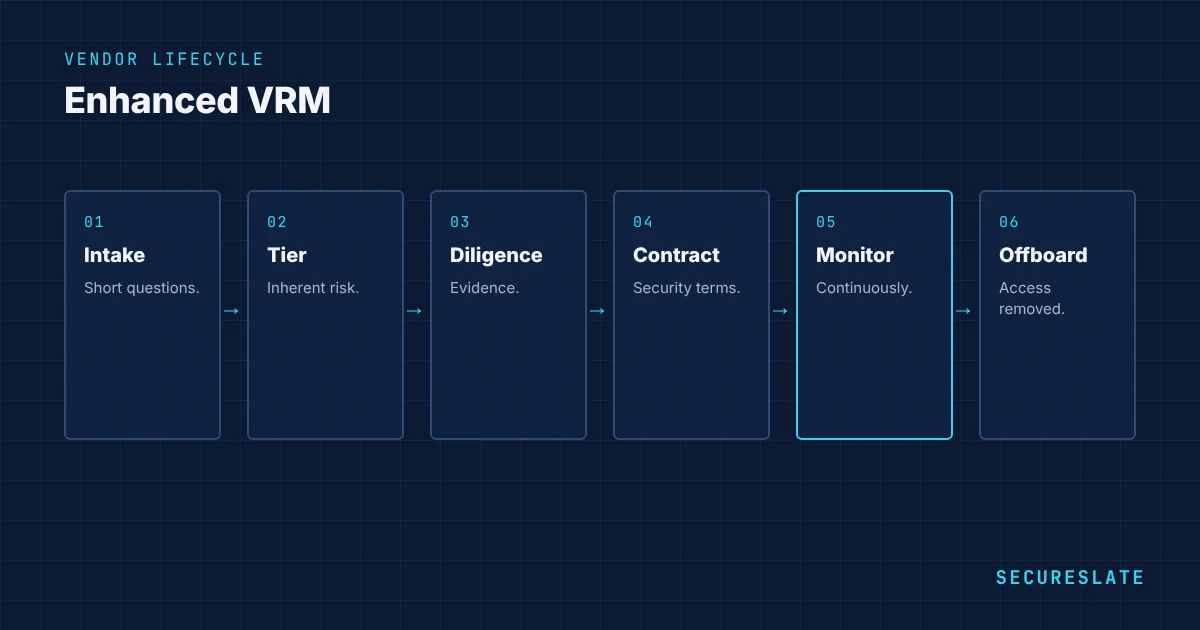
- Intake: business owner requests a vendor and answers short intake questions.
- Tiering: inherent risk score sets the tier.
- Due diligence: assessments and evidence by tier; security, legal and privacy review.
- Contracting: security terms, DPA or BAA, breach notification and audit rights.
- Onboarding: least-privilege access, SSO and MFA, data minimization.
- Monitoring: continuous alerts and scheduled reassessments.
- Issue management: findings tracked to closure or accepted with approval.
- Offboarding: access removed, data returned or deleted, records kept.
Program maturity
| Level | Characteristics |
|---|---|
| Basic | Spreadsheet inventory, questionnaires for some vendors, no tiering |
| Defined | Tiering, standard assessments, contract templates |
| Managed | Evidence-based reviews, workflows, issue tracking, regular reporting |
| Enhanced | Continuous monitoring, automated discovery, document intelligence, integration with the risk register |
| Optimized | Concentration and fourth-party risk analysis, predictive signals, tight integration with procurement |
Metrics
| Metric | Target |
|---|---|
| Vendors in inventory with a tier | 100% |
| Critical vendors with current assessment | 100% |
| Overdue reassessments | Zero |
| Open high-risk findings past due date | Zero |
| Average days to complete due diligence | Decreasing |
| Vendors discovered outside procurement | Decreasing over time |
Regulatory drivers
| Regulation or framework | Vendor oversight expectation |
|---|---|
| SOC 2 | CC9.2 assess and manage vendor and business partner risk |
| ISO 27001:2022 | Annex A 5.19 to 5.23 supplier relationships and cloud services |
| DORA | ICT third-party risk management, register of information, contract requirements |
| NIS 2 | Supply chain security measures |
| GDPR | Article 28 processor due diligence and contracts |
| HIPAA | Business associate agreements and oversight |
Getting started
- Pull vendor lists from finance, SSO and procurement into one inventory.
- Agree tiering criteria and tier every vendor.
- Collect evidence from critical vendors first.
- Update contract templates with security terms.
- Turn on monitoring for critical and high vendors.
- Connect vendor risks to the risk register and report quarterly.
Example: enhanced VRM in practice
A 120-person SaaS company used to email a 200-question spreadsheet to every vendor once a year. Responses were slow, few people read them and two critical vendors were never reviewed because they were signed up on a corporate card. After moving to an enhanced approach, the company pulled vendors from its SSO and finance systems and found 40 tools it had not tracked. It tiered every vendor in a week: eight critical, 22 high, the rest medium or low. Critical vendors now provide SOC 2 Type 2 reports that the security lead reads for exceptions and complementary user entity controls, high vendors complete a short questionnaire, and low vendors get a basic check. Monitoring alerts the team when a certificate expires or a vendor reports a breach. Reviews take less total time than before, and the company can show auditors and customers exactly how each vendor was assessed.
Reading vendor evidence well
| Evidence | What to check |
|---|---|
| SOC 2 Type 2 report | Period dates, services in scope, auditor opinion, exceptions, subservice organizations, complementary user entity controls |
| ISO 27001 certificate | Accredited certification body, scope statement, validity dates |
| Penetration test summary | Date, scope, provider, whether critical and high findings were fixed |
| Questionnaire answers | Consistency with reports; evidence for key claims such as MFA and encryption |
| Insurance certificate | Cyber coverage, limits and expiry |
| Subprocessor list | Where your data goes next and in which countries |
Contract clauses that support oversight
- Security requirements aligned with your policies
- Breach notification within a defined time, such as 72 hours or less
- Right to receive audit reports each year
- Approval or notice for new subprocessors
- Data location and transfer terms
- Return and deletion of data at the end of the contract
- Cooperation with incident investigations
- Termination rights for serious security failures
Common mistakes when upgrading VRM
- Buying a tool before agreeing tiering criteria and ownership
- Turning on monitoring alerts without someone to review them
- Collecting reports but not recording conclusions
- Leaving offboarding out, so former vendors keep access
How SecureSlate helps
SecureSlate vendor risk management delivers enhanced VRM for small and mid-size companies. Discover and inventory vendors, tier them automatically, send assessments, collect and track SOC 2 reports and certificates, log findings and schedule reassessments. Vendor risks feed the risk register, and evidence maps to SOC 2, ISO 27001, DORA and GDPR, at a price designed for growing teams.
FAQ
What is enhanced vendor risk management?
A modern approach to vendor oversight that combines tiering, evidence-based assessments, automation and continuous monitoring across the vendor lifecycle.
How is enhanced VRM different from traditional VRM?
Traditional VRM relies on periodic questionnaires. Enhanced VRM adds continuous monitoring, evidence, workflows and integration with risk management.
Do small companies need enhanced VRM?
Small companies benefit from the core elements, such as tiering, evidence for critical vendors and alerts, which compliance platforms provide without large teams.
What should we monitor continuously?
Breach news, certificate and report expiry, security posture signals and changes in vendor scope or ownership.
How does VRM support SOC 2?
SOC 2 CC9.2 requires assessing and managing vendor risk. A documented VRM program provides the evidence auditors test.
Who should own vendor risk management?
Usually security or compliance owns the process, with procurement handling contracts and business owners accountable for each vendor relationship.
What is continuous vendor monitoring?
Ongoing tracking of signals such as breaches, certificate expiry, security ratings and ownership changes between scheduled reviews.
How many vendors does a typical SMB have?
Even small companies often use dozens of SaaS tools and service providers. Discovery through SSO and finance data usually finds more vendors than teams expect.
Disclaimer (legal note)
SecureSlate is not a law firm, and this article does not constitute or contain legal advice or create an attorney-client relationship. When determining your obligations and compliance with respect to relevant laws and regulations, you should consult a licensed attorney.
Need compliance without the complexity?
SecureSlate automates ISO 27001, SOC 2, GDPR, HIPAA, and more. Built for growing teams. See it in action.
Find compliance gaps in 30 seconds