
The all-in-one Comp AI alternative
Key takeaways
- SecureSlate delivers 17+ security and compliance modules in one platform (incident response, dark web monitoring, phishing simulation, and more) without stacking point tools on top of a baseline GRC product.
- Published pricing starts at $2,688/year for one framework; Comp AI typically quotes around $8,500/year on demo, with less transparency on what is included.
- Both platforms cover core compliance automation; SecureSlate pulls ahead on operational depth, vendor risk, training workflows, and continuous security monitoring after certification.
- Teams evaluating Comp AI alternatives should compare total platform cost over three years, including add-on security tools you would otherwise buy separately.
SecureSlate is built for SMBs that want to run compliance and real security operations in one workspace. Comp AI can accelerate a first audit sprint, but many teams outgrow a compliance-only toolset when they need vendor risk, incident response, phishing simulation, and continuous monitoring in the same place. SecureSlate covers that full stack without stitching together multiple products.
Related guides:
- Why cheaper code isn't always cheap: build vs buy for compliance platforms
- Beyond SOC 2: Exploring Alternative Compliance Frameworks for Your Needs
- Top 7 SOC 2 compliance software to take the pain out of audits
Quick verdict
- Choose SecureSlate if you want all-in-one security and compliance, with published pricing, 17+ built-in modules, and operational workflows that keep you audit-ready after certification.
- Choose Comp AI if you only need a narrow compliance sprint and plan to run advanced security workflows in separate tools.
- For most SMB teams, SecureSlate delivers 3.5× lower platform cost on day one and significantly broader coverage without add-on tool sprawl.
SecureSlate vs Comp AI
If you are evaluating Comp AI alternatives, the decision usually comes down to three things: what is actually included in the platform, what you will pay over time, and how much work stays on your team after the first audit. The right compliance automation platform should help you maintain compliance with less manual effort, especially when you are pursuing frameworks like SOC 2, ISO 27001, HIPAA, and GDPR.
Top differences at a glance
- Platform breadth: SecureSlate includes incident response automation, dark web monitoring, phishing simulation, DAST, and SaaS spend management, modules Comp AI does not offer natively.
- Operational readiness: Teams connect policy, evidence, remediation, and monitoring workflows in one workspace instead of hopping between point tools.
- Cost clarity: SecureSlate publishes annual pricing; Comp AI typically requires a demo quote before you know your total platform cost.
- Post-certification value: SecureSlate is designed for continuous compliance, with automated evidence collection, control health monitoring, and Data Room workflows that reduce prep time for every audit cycle.
Comparison Table
Discover how SecureSlate stacks up against Comp AI across the security and compliance workflows teams evaluate most.
| Feature | SecureSlate | Comp AI |
|---|---|---|
| Pricing model (annual, one framework) | $2,688 (Save 72%) | $8,500 |
| Continuous monitoring (control health) | ✅ | ✅ |
| Control Management | ✅ | ❌ |
| Auditing | ✅ | ✅ |
| Access reviews (user access) | ✅ | ✅ |
| Risk Scoring | ✅ | ✅ |
| Trust Center | ✅ | ✅ |
| Vendor Risk Management | ✅ | ✅ |
| Policy Management and Templates | ✅ | ✅ |
| Employee Training Modules | ✅ | ❌ |
| Questionnaire Automation | ✅ | ✅ |
| Data Governance | ✅ | ❌ |
| Cloud Gap Analytics | ✅ | ❌ |
| AI-driven Automation | ✅ | ✅ |
| Anomaly Detection | ✅ | ❌ |
| Vulnerability Assessment | ✅ | ✅ |
| Security Awareness Training | ✅ | ✅ |
| Data Security Posture Management | ✅ | ✅ |
| AI-driven Vulnerability Detection | ✅ | ✅ |
| Data Room | ✅ | ❌ |
| Incident Response Automation | ✅ | ❌ |
| DAST | ✅ | ❌ |
| Dark Web Monitoring | ✅ | ❌ |
| Phishing Simulation | ✅ | ❌ |
| SSL Monitoring | ✅ | ❌ |
| DMARC Monitoring | ✅ | ❌ |
| Code Review Agent | ✅ | ✅ |
| SaaS Spend Management | ✅ | ❌ |
| Cloud Asset Discovery and Management | ✅ | ❌ |
| Data Detection and Response | ✅ | ❌ |
| Data Exfiltration Prevention | ✅ | ❌ |
| Human Firewall | ✅ | ❌ |
Pricing note: Estimates are directional and may vary by team size, implementation scope, contract terms, and add-ons.
Where SecureSlate pulls ahead
Comp AI covers baseline compliance automation well. Where teams typically feel the gap is after certification, when security operations, vendor reviews, and continuous monitoring need to run in the same system as your controls and evidence.
| Workflow | SecureSlate | Comp AI |
|---|---|---|
| Centralized audit evidence (Data Room) | ✅ Built-in | ❌ Not included |
| Incident response tied to compliance controls | ✅ Built-in | ❌ Requires external tooling |
| Phishing simulation + security awareness training | ✅ Built-in | ❌ Requires external tooling |
| Dark web + SSL + DMARC monitoring | ✅ Built-in | ❌ Requires external tooling |
| Vendor risk assessments with tiered scoring | ✅ Built-in | ✅ Baseline coverage |
| Published annual pricing (no demo required) | ✅ $2,688/yr | ❌ Quote on demo (~$8,500/yr) |
Replacing even two or three of those external tools with SecureSlate's built-in modules often closes the cost gap, and reduces the operational overhead of managing separate vendors, logins, and evidence exports.
Negative points about Comp AI
Teams evaluating Comp AI should weigh these commonly reported drawbacks alongside its open-source positioning and first-audit speed. Points below are drawn from published buyer reviews (including G2), independent comparisons, GitHub issue reports, and community feedback. Validate every claim during your own procurement process.
Pricing and transparency
- Sales-gated pricing. Comp AI typically routes pricing through a demo or sales call rather than publishing a full list price on trycomp.ai, making budget planning harder before you enter procurement.
- Higher typical platform cost. Directional estimates put Comp AI around $8,500/year for a single framework versus SecureSlate's published $2,688/year Starter rate.
- Add-on tool sprawl. Missing built-in modules (Data Room, incident response, phishing simulation, dark web monitoring, and more) often push teams toward separate point tools after certification.
Platform and feature gaps
- Compliance-first core. Comp AI lacks native employee training modules, data governance, cloud gap analytics, anomaly detection, and many operational security workflows that scaling teams expect in one GRC platform.
- No operational security modules. Incident response automation, DAST, dark web monitoring, phishing simulation, SSL/DMARC monitoring, SaaS spend management, and cloud asset discovery are not included natively.
- No centralized Data Room. Audit evidence is harder to package and export compared with platforms that include a dedicated audit workspace.
Scalability and maturity
- Younger platform. Comp AI launched in early 2025 with a smaller customer base than category leaders. Buyers report gaps when adding multiple frameworks, vendors, and enterprise customer reviews.
- Thinner auditor familiarity. Independent reviewers note that many CPA firms have far more experience with Vanta- or Drata-driven audits than Comp AI exports.
- Integration depth questions. Marketing claims of 580+ integrations exceed what some independent reviews verify in public documentation. Confirm your exact stack before buying.
AI automation reliability
- Setup friction and product rough edges. Buyers report onboarding complexity, occasional bugs, and workflows that need manual tweaking before they feel solid.
- Browser AI glitches. Published user reviews note that automated browser-based evidence collection can fail intermittently and may require support intervention.
- Human review still required. Comp AI's terms do not guarantee AI recommendation accuracy. Teams should expect to validate AI-generated policies and evidence outputs.
Self-hosting and open-source complexity
- Self-hosting is not turnkey. A widely discussed GitHub issue documents missing Docker documentation, inconsistent environment variables, and orchestration gaps that make self-hosting unnecessarily difficult for most teams.
- AGPL obligations. The open-source core is AGPLv3-licensed; teams planning to fork or embed the platform for external customers should involve legal review.
Trust and community concerns
- Low public review volume. Trustpilot lists Comp AI at 3.2/5 with limited review volume; the platform has not publicly replied to negative feedback there.
- Community marketing backlash. A Trustpilot reviewer cited "questionable behaviour" including subreddit-related promotional tactics and declined to trust the platform for SOC 2. Community moderators have also reported disputes involving Comp AI-associated accounts in compliance forums such as r/ISO27001.
What G2 reviewers say
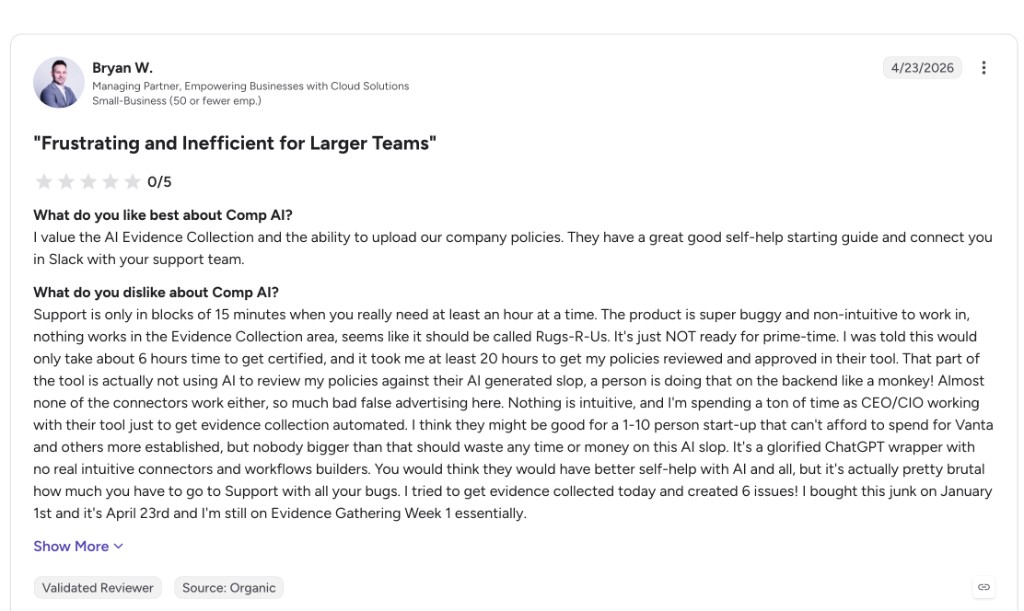
A verified G2 reviewer (Managing Partner, small business, April 2026) rated Comp AI 0/5 and titled the review “Frustrating and Inefficient for Larger Teams.” They valued AI evidence collection and policy uploads, but called out 15-minute support blocks, buggy evidence collection, unreliable connectors, and timelines far longer than the promised ~6-hour certification path:
Key themes from this and similar G2 feedback:
- Support bandwidth is too thin for complex compliance workflows; 15-minute blocks are insufficient when evidence collection and policy review need sustained help.
- Evidence collection is unreliable: reviewers report broken automations, repeated bugs, and weeks stuck on early onboarding tasks.
- Policy review is slower than promised: sales timelines of ~6 hours diverge sharply from 20+ hours of manual policy approval work.
- Connectors often fail to deliver: marketing claims about broad integrations do not match day-to-day connector reliability for many buyers.
- Not enterprise-ready: teams beyond very small startups report the UX, workflows, and stability are not mature enough for larger programs.
Source: G2: Comp AI reviews. Individual experiences vary; verify during your own evaluation.
Buyer takeaway: Independently verify pricing, integration coverage, auditor familiarity with Comp AI exports, and the total cost of any external tools you will need to cover platform gaps, regardless of which compliance platform you choose.
Note: Community allegations and single-review complaints are not legal findings. This section summarizes publicly reported concerns for evaluation purposes.
Which platform is a better fit?
Choose SecureSlate if your team needs
- One management platform for security and compliance: compliance management, risk, vendor workflows, and security operations.
- Deeper built-in modules for awareness training, incident response automation, and external monitoring, without buying separate point tools.
- A workflow that connects controls, automates evidence collection, and tracks remediation for ongoing audit readiness.
- Predictable pricing and better value for SMB teams that need broad coverage without tool sprawl.
Choose Comp AI if your team needs
- A compliance-first sprint focused on a single framework with minimal operational scope.
- A narrower toolset where incident response, phishing simulation, and external monitoring can remain in separate tools.
Features teams value in SecureSlate
Integrations and workflow flexibility
SecureSlate integrates across cloud, identity, HR, and ticketing systems so teams can automate evidence collection and reduce manual follow-ups.
- 200+ integrations
- 20+ categories of connected tools
- Explore integrations on the homepage: SecureSlate features
Policy and control management
Pre-built templates and guided workflows help teams move from policy drafting to implemented controls faster.
- Time savings: typically 20–40 hours in policy preparation cycles
- Supports multi-framework control mapping for scaling teams
Onboarding and offboarding governance
Automated onboarding and offboarding workflows reduce access drift and improve control hygiene across core systems.
- 15+ supported process templates
- Faster transitions with standardized approvals and evidence trails
User access control and governance
SecureSlate helps SMB teams manage user access with role-based controls and clearer approval workflows across critical systems.
- Centralized access visibility for audit and compliance checks
- Supports least-privilege practices during onboarding and offboarding
- See platform overview: Access and governance features
Vulnerability scanners and security monitoring
SecureSlate includes vulnerability scanning workflows so teams can identify, prioritize, and track remediation from one workspace.
- Built-in vulnerability assessment capabilities for continuous visibility
- Faster triage with prioritized findings linked to compliance workflows
- See related capabilities: Security monitoring features
Vendor risk management
SecureSlate helps security and compliance teams evaluate vendors, track risk posture, and prioritize remediation.
- Risk evaluation time reduced by up to 40%
- Risk tiers supported: high, medium, and low
- See related capabilities: Vendor risk features
Risk assessments and compliance frameworks
As programs mature, teams want one place to run risk assessments, manage evidence, and map controls across compliance frameworks. SecureSlate is built for multi-framework programs where you need consistent audit readiness without adding more automation tools for each new standard.
Data Room for audit readiness
SecureSlate Data Room centralizes evidence so teams can prepare faster and reduce audit scramble.
- Audit preparation time saved: 25+ hours (typical internal estimate)
Get started with SecureSlate
See how SecureSlate compares in your environment. Connect your stack, map your controls, and explore built-in security modules in one workspace.
Frequently asked questions
Is SecureSlate a true Comp AI alternative?
Yes, for teams that want compliance plus broader security workflows in one platform. SecureSlate covers baseline GRC automation and adds operational modules Comp AI does not include natively, such as incident response automation, phishing simulation, and dark web monitoring.
How does SecureSlate pricing compare to Comp AI?
SecureSlate publishes $2,688/year for Starter (one framework). Comp AI's typical annual platform cost is around $8,500. When comparing total cost, factor in any separate security tools you would need to cover gaps in monitoring, training, and incident response.
How hard is it to switch from Comp AI?
Most teams start by mapping existing controls and policies, then migrating evidence workflows in phases. A structured rollout helps avoid disruption.
Can we keep our current frameworks and evidence?
Yes. Most teams retain existing framework goals and import or reconnect evidence sources through integrations and workflow mapping.
Which platform is better for SMB compliance programs?
SMBs expecting to add more frameworks, vendors, and security workflows typically prefer broader all-in-one coverage. SecureSlate is designed for teams that want to stay audit-ready continuously, not just pass a first audit and then rebuild their stack.
Related guides:
- Case Study: How a Tech Service Provider Simplified ISO 27001 and GDPR Compliance with SecureSlate
- Why cheaper code isn't always cheap: build vs buy for compliance platforms
- Beyond SOC 2: Exploring Alternative Compliance Frameworks for Your Needs
Disclaimer (legal note)
SecureSlate is not a law firm, and this article does not constitute or contain legal advice or create an attorney-client relationship. When determining your obligations and compliance with respect to relevant laws and regulations, you should consult a licensed attorney.
Need compliance without the complexity?
SecureSlate automates ISO 27001, SOC 2, GDPR, HIPAA, and more. Built for growing teams. See it in action.
Find compliance gaps in 30 seconds
