
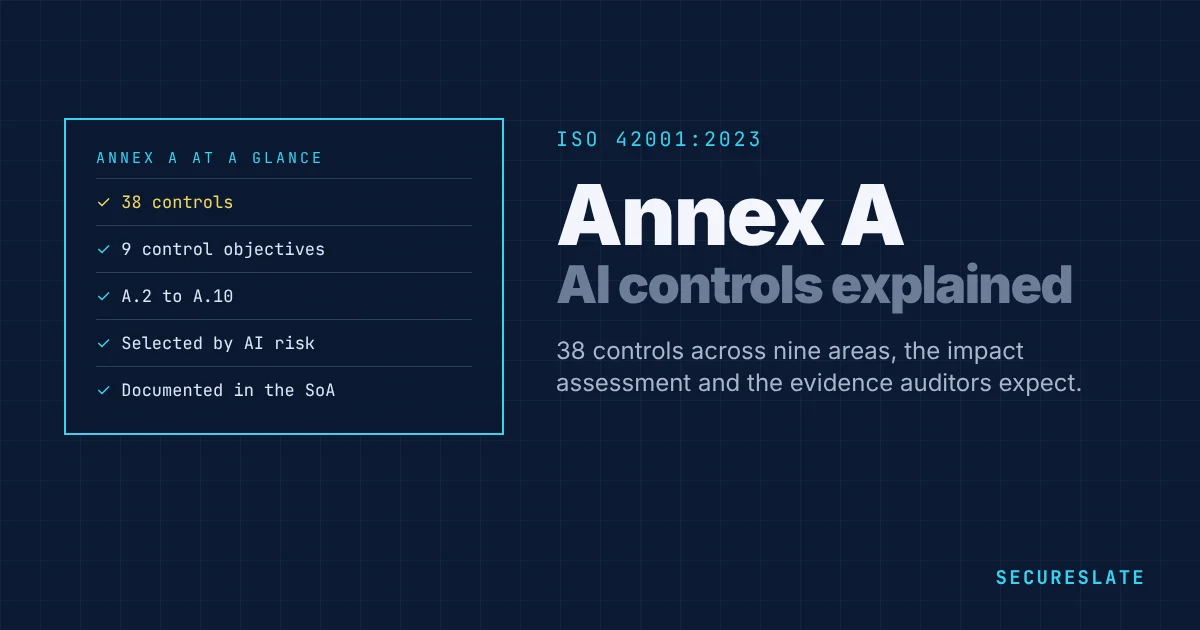
ISO/IEC 42001:2023 includes Annex A, a control set for AI-specific risks across the lifecycle (data, development, deployment, monitoring, transparency, and supplier AI).
Related: Main requirements · Collection
Key takeaways
- Annex A is selected based on AI risk, not implemented blindly.
- Your SoA documents applicable controls and exclusions.
- Controls align with themes also found in ISO 27001; reuse evidence where possible.
- Other annexes (B–D) provide implementation guidance and sector notes.
Annex structure
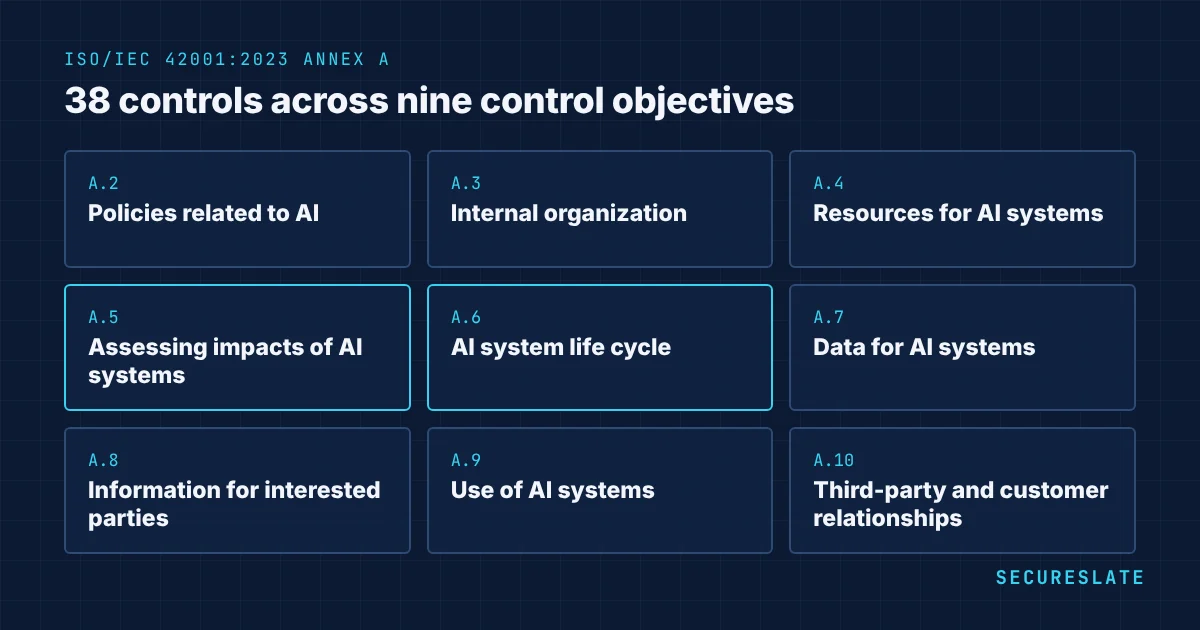
Annex A contains 38 controls grouped into nine control objectives (A.2 to A.10). In summary, they cover:
- AI policies and roles
- Data for AI systems
- Model development and validation
- Deployment and monitoring
- Transparency and communication
- Third-party and customer AI relationships
Exact control IDs should be tracked in your compliance tool against owners and tests.
The nine Annex A control areas
| Area | Title | What it covers |
|---|---|---|
| A.2 | Policies related to AI | An AI policy, how it fits with other policies, and regular review |
| A.3 | Internal organization | Roles and responsibilities for AI, and a way to report concerns about AI systems |
| A.4 | Resources for AI systems | Documenting the data, tools, computing resources and people each AI system needs |
| A.5 | Assessing impacts of AI systems | A process for AI system impact assessments on individuals, groups and society, and keeping records of them |
| A.6 | AI system life cycle | Objectives for responsible development, and controls across requirements, design, verification and validation, deployment, operation and monitoring, and technical documentation |
| A.7 | Data for AI systems | Data acquisition, quality, provenance and preparation |
| A.8 | Information for interested parties | Documentation for users, external reporting, communication of incidents and information for other parties |
| A.9 | Use of AI systems | Processes and objectives for responsible use, and use according to intended purpose |
| A.10 | Third-party and customer relationships | Allocating responsibilities, managing suppliers, and meeting customer needs |
How Annex A relates to the other annexes
- Annex B gives implementation guidance for each Annex A control, similar to how ISO 27002 supports ISO 27001.
- Annex C lists potential organizational objectives and risk sources for AI, such as fairness, transparency, safety and robustness. Use it when running your AI risk assessment.
- Annex D explains how the management system applies across different domains and sectors.
Only the clauses and Annex A are certified against. Annexes B to D are informative.
Where ISO 42001 overlaps with ISO 27001
If you already hold ISO 27001, you can reuse a large part of your management system: document control, internal audit, management review, competence and awareness, supplier management and incident handling. The AI-specific work is mainly the AI system inventory, the impact assessment process, lifecycle controls for model development and monitoring, data quality and provenance, and transparency to users.
Evidence by control area
| Area | Typical evidence |
|---|---|
| A.2 Policies | Approved AI policy, review records, links to related policies |
| A.3 Internal organization | Role descriptions, RACI for AI systems, a channel for reporting AI concerns |
| A.4 Resources | Records of data, tools, compute and staff for each AI system |
| A.5 Impact assessments | Completed AI system impact assessments with sign-off and review dates |
| A.6 Life cycle | Requirements, design records, test and validation results, deployment approvals, monitoring dashboards, technical documentation |
| A.7 Data | Data sources, quality checks, provenance and lineage records, preparation steps |
| A.8 Information for interested parties | User documentation, model cards, incident communication procedures |
| A.9 Use | Approved use cases, intended purpose statements, usage monitoring |
| A.10 Third parties | Supplier due diligence, contracts allocating responsibilities, customer commitments |
What an AI system impact assessment includes
The impact assessment is one of the most distinctive parts of ISO 42001. For each AI system, it usually records:
- The system and its purpose: what it does, who uses it and who it affects
- Foreseeable uses and misuses: including uses outside the intended purpose
- Potential impacts: on individuals, groups and society, such as unfair outcomes, privacy, safety, or loss of access to services
- Severity and likelihood of each impact
- Existing and planned measures: human oversight, testing, transparency, limits on use
- Decision and sign-off: whether the residual impact is acceptable, who approved it and when it will be reviewed
Repeat the assessment when the system, its data or its use changes significantly.
Statement of Applicability
The SoA links each control to:
- Applicable (yes/no) and justification
- Implementation status
- Related policies and evidence locations
Evidence examples
- Model cards and risk assessments
- Dataset lineage and quality checks
- Production monitoring dashboards
- Human oversight procedures for high-risk automation
- Vendor AI due diligence records
Common mistakes with ISO 42001 controls
- Treating Annex A as a checklist. Controls should follow from your AI risk and impact assessments, with a clear reason for each one you apply or exclude.
- Leaving out AI you buy. Third-party models, AI features in SaaS tools and AI APIs all belong in the inventory and fall under A.10.
- No evidence of monitoring. Many teams document development well but cannot show how models are monitored for drift, errors or misuse once in production.
- Impact assessments done once. They should be reviewed when the system, its data or its users change.
- Unclear ownership between teams. Data science, engineering, product and legal each own parts of the controls. Write down who owns which.
Implementation tips
- Start with the inventory. You cannot select controls until you know which AI systems you build, buy and use.
- Run impact assessments early. They drive which lifecycle and transparency controls matter most.
- Reuse ISO 27001 evidence for overlapping controls instead of creating new documents.
- Keep the SoA alive. Update it whenever you add or retire an AI system.
- Assign an owner per control area, usually split between engineering, data, legal and product.
FAQ
How many controls are in ISO 42001 Annex A?
There are 38 controls grouped into nine control objectives, numbered A.2 to A.10.
Do we have to implement every Annex A control?
No. You select controls based on your AI risk assessment and impact assessment, and justify any exclusions in your Statement of Applicability.
Is ISO 42001 required by the EU AI Act?
No. ISO 42001 is voluntary. However, it gives a structured management system that can help organizations organize the governance, risk management and documentation the EU AI Act expects from providers and deployers.
How does ISO 42001 Annex A differ from ISO 27001 Annex A?
ISO 27001 Annex A has 93 information security controls. ISO 42001 Annex A has 38 controls focused on AI, such as impact assessments, the AI system life cycle, data quality and provenance, and transparency to users. Organizations that hold both can share evidence where the topics overlap, such as supplier management and roles.
Who should own ISO 42001 controls?
Split ownership by area: leadership for the AI policy, engineering and data science for the life cycle and data controls, product for user information and intended use, legal for impact assessments and external reporting, and procurement or security for third-party AI.
What evidence do auditors sample for the AI life cycle controls?
Expect requests for requirements and design records for an AI system, test and validation results before release, the approval to deploy, and monitoring records from production. Auditors usually pick one or two AI systems and follow them from design to operation, so keep that trail complete for every system in scope.
Disclaimer (legal note)
Control interpretation follows your certification body. Informational only.
Need compliance without the complexity?
SecureSlate automates ISO 27001, SOC 2, GDPR, HIPAA, and more. Built for growing teams. See it in action.
Find compliance gaps in 30 seconds
