
 Photo by
 Related guides:
- your guide to soc 2 audits
- the ultimate iso 27001 guide
- us data privacy compliance checklist
- how much ISO 27001 costs
- how ISO 27001 controls are audited
- the ISO 27001 compliance checklist
- achieving ISO 27001 certification
Key takeaways
- Why Get ISO 27001 Certification: ISO 27001 certification is a strategic move, not just a compliance checkbox, demonstrating serious commitment to information security.
- Enhanced Data Protection: It forces you to identify assets, assess risks, and implement controls, drastically reducing chances of data breaches, ransomware, or internal leaks.
- Regulatory and Legal Compliance: ISO 27001 principles align with global privacy regulations like GDPR, HIPAA, and NIS2.
ISO/IEC 27001 stands out as the most trusted standard for managing information security risks in cybersecurity. Whether you’re a startup protecting user data or a large enterprise managing sensitive assets, ISO 27001 certification shows clients, regulators, and partners that you take security seriously.
In this guide, we’ll explore why ISO 27001 certification matters, top ISO 27001 certification companies, and get expert advice on selecting the right certification partner to fit your goals.
Why Get ISO 27001 Certification?
ISO 27001 certification is a strategic move, not just a compliance checkbox, demonstrating serious commitment to information security. Thousands of businesses invest in it for key benefits:
Enhanced Data Protection
It forces you to identify assets, assess risks, and implement controls, drastically reducing chances of data breaches, ransomware, or internal leaks.
Regulatory and Legal Compliance
ISO 27001 principles align with global privacy regulations like GDPR, HIPAA, and NIS2. Certification shows commitment to data protection, lowering legal risk.
7 Best HIPAA Compliance Software for 2025
Avoid Penalties with Top-Rated HIPAA Compliance Tools
Competitive Advantage
It acts as a trust signal for clients, partners, and investors. This sets you apart in procurement, especially in tech, finance, healthcare, and legal sectors.
Operational Efficiency
The standard’s structured approach improves documentation, reduces security incidents, and strengthens risk management.
Top 10 Global ISO 27001 Certification Companies
Securing your information assets with ISO 27001 involves partnering with the right experts. Understanding the roles of certification companies(who audit and certify your ISMS) and accreditation bodies (who validate the competence of certification firms) is essential.
To simplify your search for a reputable provider, we present a curated list of the top 10 global certification companies and their overseeing accreditation bodies.
For assured credibility and international recognition, always confirm that your chosen certification body holds valid accreditation from a recognized national accreditation authority.
The world’s leading ISO 27001 certification companies are distinguished by their extensive auditing expertise, global reach, and comprehensive portfolio of information security standards.
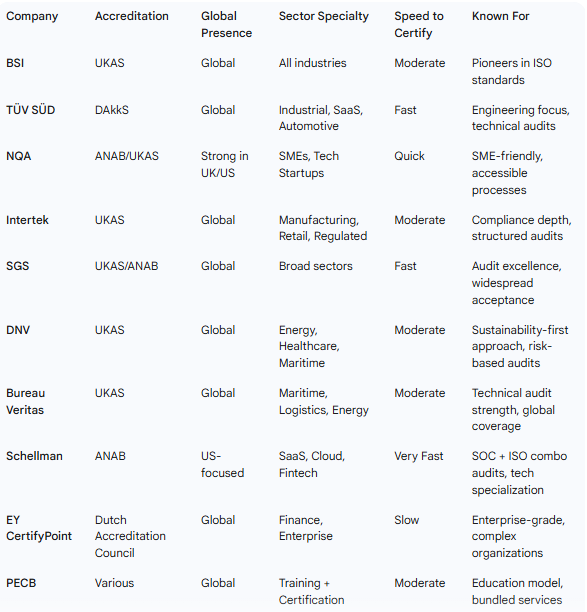
Here’s an expanded, moderate-length description for each of the top ISO 27001 Certification Companies and Accreditation Bodies:
Best ISO 27001 Certification Bodies by Region (EMEA, North America, APAC)
ISO 27001 is a global standard, but auditor availability, accreditation norms, and industry depth vary by region. If you’re searching for an ISO 27001 certification body in EMEA, North America, or APAC, here are reliable starting points:
- EMEA (UK & Europe): BSI (UKAS), NQA (UKAS), SGS (UKAS), Bureau Veritas (UKAS), TÜV SÜD (DAkkS)
- North America (US/Canada): A-LIGN (ANAB/UKAS), Schellman (ANAB), NQA (ANAB), SGS (ANAB), Intertek (ANAB/region-dependent)
- APAC (Asia-Pacific): SGS, Bureau Veritas, DNV, Intertek, and TÜV SÜD (availability varies by country; confirm local accreditation coverage)
If you’re using an automation platform like SecureSlate, prioritize auditors marked Automation-Friendly below; these tend to be more comfortable validating control evidence that’s centralized in a platform (instead of scattered across spreadsheets and email threads).
1. A-LIGN
A-LIGN is a leading compliance audit firm that helps organizations start and grow their compliance programs across SOC 2, ISO 27001, CMMC, and ISO 42001 frameworks. For ISO 27001, A-LIGN is accredited by both ANAB (US) and UKAS (UK), a dual accreditation that reassures buyers and procurement teams validating auditor credibility on either side of the Atlantic. Rather than covering one standard, A-LIGN performs the audit directly across multiple frameworks under a single provider relationship.
Automation-Friendly: Yes, A-LIGN partners with leading compliance automation providers and lets clients keep working in their preferred platform, so teams organizing evidence in a tool like SecureSlate can present centralized controls without a forced tool change.
Choosing A-LIGN means partnering with an accredited firm built around a single, consolidated provider relationship that reduces audit fatigue and duplicate evidence collection, a strong fit for companies looking to start and grow their compliance program beyond a single certification.
Pros:
- Dual ANAB- and UKAS-Accredited: Registry-verifiable accreditation from both the US and UK national bodies gives A-LIGN’s ISO 27001 certificates broad international acceptance.
- Single Provider, Every Framework: A-LIGN delivers SOC 2, ISO 27001, CMMC, HITRUST, and ISO 42001 under a single provider, reducing audit fatigue and duplicate evidence collection versus managing separate vendors.
- Deep SOC 2 Specialization: SOC 2 audit is A-LIGN’s most established service line, making it a natural fit for tech companies pairing ISO 27001 with SOC 2 Type II.
- Among the First Accredited ISO 42001 Bodies: AI companies can certify against ISO 42001 alongside an existing ISO 27001 or SOC 2 program with the same firm.
Cons:
- Premium Pricing: A-LIGN’s pricing reflects a consolidated audit model; buyers should compare total program cost, not per-audit cost.
- Performs the Audit Directly Rather Than Self-Serve Software: A-LIGN is the accredited firm that issues the certification itself, not a subscription platform you operate on your own.
2. BSI (British Standards Institution)
As one of the foundational creators of ISO standards, BSI holds a preeminent position in the certification world. BSI’s ISO 27001 certifications are typically issued under UKAS accreditation, which is a strong trust signal for buyers evaluating auditor credibility. Their audits are known for rigor, ensuring comprehensive adherence to information security best practices.
Automation-Friendly: Yes, BSI regularly audits modern SaaS and cloud environments; teams using platforms like SecureSlate can streamline evidence collection and present controls more cleanly.
Opting for BSI means choosing a globally recognized and highly respected certifier, making them a top contender for organizations seeking a gold-standard certification.
Pros:
- UKAS-Accredited and Globally Trusted: Their accreditation from the UK Accreditation Service (UKAS) underscores their commitment to the highest standards, making their certifications widely accepted worldwide.
- Decades of Experience Across Industries: BSI brings unparalleled experience, having worked with diverse organizations across virtually every sector, which translates into a deep understanding of varied operational contexts.
- Deep Documentation and Training Support: They provide extensive resources, including detailed guidance and training programs, to help organizations prepare for and maintain their ISO 27001 certification.
- Ideal for Large Enterprises: Their robust processes and global footprint make them perfectly suited for complex, multinational corporations requiring comprehensive and consistent certification across their operations.
Cons:
- May be Overkill for Startups or SMBs: The depth and formality of BSI’s processes might be more extensive than necessary for smaller, less complex organizations.
- Pricing is on the Higher End: Reflecting their premium service and global standing, BSI’s certification costs are generally at the higher end of the spectrum.
3. TÜV SÜD
TÜV SÜD is a highly respected European certification body with a strong reputation for technical audits and an engineering-oriented approach. Their ISO 27001 certifications are commonly issued under DAkkS accreditation (Germany’s national accreditation body), which supports international credibility. While rooted in Germany, their global expansion makes them a compelling choice for companies operating with intricate systems or a multi-country presence.
Automation-Friendly: Sometimes, strong fit for technical teams; bring clean, centralized evidence (for example, from SecureSlate) to speed up audit walkthroughs.
Pros:
- Highly Technical and Thorough Auditors: TÜV SÜD’s auditors are distinguished by their strong technical backgrounds, leading to meticulous and in-depth assessments of your ISMS.
- DAkkS-Accredited (Germany’s Top Accreditation Body): Accreditation from DAkkS, Germany’s national accreditation body, signifies their adherence to rigorous quality and impartiality standards, reinforcing global trust.
- Fast Audit Timelines: Despite their thoroughness, TÜV SÜD is often praised for efficient audit scheduling and turnaround times, helping organizations achieve certification promptly.
- Strong Presence in Key Sectors: They possess a particularly strong foothold and specialized knowledge in the manufacturing, automotive, and IT sectors, making them ideal for companies in these industries.
- Offers Integrated Certifications: Beyond ISO 27001, TÜV SÜD frequently offers integrated audits for other crucial standards like ISO 9001 (Quality Management) and ISO 14001 (Environmental Management), streamlining the certification process for multi-standard compliance.
Cons:
- May be Too Formal for Small or Non-Technical Startups: Their structured and technical approach might feel less flexible or overly formal for agile small businesses or those without an engineering focus.
- Documentation Requirements Can Feel Rigid: Organizations may find TÜV SÜD’s requirements for documentation to be quite stringent and prescriptive, demanding meticulous preparation.
4. NQA (National Quality Assurance)
NQA has emerged as a favored choice among small and mid-sized businesses, particularly within the UK and North America. NQA is commonly UKAS-accredited in the UK and ANAB-accredited in the United States, which helps buyers and procurement teams validate auditor legitimacy quickly. Their approach is known for transparency in pricing and a process that’s often more business-friendly than some larger, more traditional certifiers.
Automation-Friendly: Yes, a strong option for cloud/software teams that want an auditor comfortable reviewing evidence generated and organized in platforms like SecureSlate.
Pros:
- UKAS- and ANAB-Accredited: Holding accreditation from both UKAS (UK) and ANAB (US) ensures broad international acceptance and adherence to high-quality standards.
- Strong in Cloud, Software, and Services: NQA has developed particular expertise and a strong client base within the dynamic cloud, software development, and services industries, understanding their unique security challenges.
- Faster Onboarding and Certification: They are known for an efficient onboarding process and typically quicker certification timelines, which is beneficial for businesses with urgent compliance needs.
- Offers Helpful Readiness Assessments and Templates: NQA often provides valuable pre-audit support, including readiness assessments and practical templates, to help organizations prepare effectively.
- Cost-Effective for Small Teams: Their pricing structure and streamlined processes make them a more budget-friendly option, especially for smaller organizations or those with limited resources.
Cons:
- May Lack Depth in Highly Regulated Industries: While competent, NQA might not possess the specialized, in-depth experience required by organizations operating in exceptionally complex or highly regulated sectors.
- Smaller Global Footprint Compared to SGS or BSI: While growing, their international presence is not as extensive as some of the larger global players, which could be a consideration for multinational corporations.
How Much Does ISO 27001 Certification Cost in 2025?
Get Your ISO 27001 Cost Before You Begin
5. Intertek
Intertek stands as a global powerhouse in testing, inspection, and certification (TIC) services. Intertek operates accredited certification programs in many countries (often via national accreditation bodies such as ANAB in North America, depending on entity and scope). Always confirm the exact accreditation mark shown on your certificate and proposal. Their ISO 27001 audit process is highly structured and emphasizes thorough documentation, making Intertek a strong fit for regulated environments.
Automation-Friendly: Sometimes, documentation-heavy audits benefit from having evidence mapped and searchable (for example, in SecureSlate), but expect formal walkthroughs.
Pros:
- Trusted by Fortune 500 Companies: Their extensive client list includes major global corporations, attesting to their reliability and the high regard in which their certifications are held.
- Offers Full-Service Certification Across Many ISO Standards: Intertek provides a comprehensive suite of certification services for numerous ISO standards, enabling organizations to manage multiple certifications with a single provider.
- Strong Focus on Compliance and Risk: Their auditing methodology heavily emphasizes regulatory compliance and robust risk management, aligning well with organizations that face complex compliance landscapes.
- Available Worldwide: With a vast network of offices and laboratories globally, Intertek offers consistent service delivery across different geographical regions.
Cons:
- Less Suited for Fast-Moving SaaS or Startups: The highly structured and documentation-heavy nature of their audits might be less agile or flexible for rapidly evolving SaaS companies or lean startups.
- Can Feel Bureaucratic for Smaller Firms: Smaller organizations might perceive Intertek’s processes as somewhat bureaucratic or overly formal, potentially leading to a less personalized experience.
6. SGS (Société Générale de Surveillance)
SGS is one of the world’s foremost inspection, verification, testing, and certification companies. SGS commonly issues ISO 27001 certifications under UKAS and/or ANAB accreditation (depending on region and legal entity), a meaningful trust signal for enterprise procurement. With operations in 100+ countries, SGS is popular among multinationals that need globally recognized certificates.
Automation-Friendly: Sometimes, great for scaled programs; if you’re using SecureSlate, align control mappings and evidence early to reduce back-and-forth.
Pros:
- UKAS- and ANAB-Accredited: Holding dual accreditation from UKAS (UK) and ANAB (US) signifies their commitment to international quality standards and ensures broad acceptance of their certifications.
- Lightning-Fast Certification in Some Cases: While not guaranteed for all audits, SGS is sometimes noted for their efficiency and ability to expedite the certification process for well-prepared organizations.
- Widely Accepted Worldwide: Due to their extensive global network and long-standing reputation, an SGS certification is highly recognized and respected across international markets.
- Known for Process Discipline: SGS’s auditors are celebrated for their methodical and disciplined approach, ensuring a thorough and consistent audit experience.
Cons:
- Limited Hand-Holding for First-Timers: Organizations new to ISO 27001 or certification processes might find SGS’s approach less hands-on or supportive, assuming a certain level of preparedness.
- May Feel Transactional if You’re Looking for Consultative Support: If an organization desires a more collaborative or consultative relationship with their certifier, SGS’s streamlined, process-driven approach might feel more like a transactional service.
7. DNV (Det Norske Veritas)
DNV is a highly respected certifier, noted for its sustainability focus and risk-based auditing model. DNV operates accredited ISO 27001 certification programs across regions (accreditation varies by country/office; confirm the national accreditation body on your engagement). While historically prominent in maritime and energy, DNV has expanded into tech, healthcare, and manufacturing. Their audits are often strategic and risk-focused.
Automation-Friendly: Yes, risk-based audits pair well with centralized evidence and continuous control monitoring from platforms like SecureSlate.
Pros:
- Sustainability-First Approach: DNV integrates sustainability principles into its auditing philosophy, appealing to organizations with a strong commitment to environmental and social governance.
- Excellent for Regulated Sectors: Their deep understanding of risk and compliance makes them an ideal partner for businesses operating in highly regulated industries.
- Strong ISO Integration: DNV excels at offering integrated management system certifications, allowing organizations to combine audits for ISO 27001, ISO 9001 (Quality), ISO 22301 (Business Continuity), and other standards efficiently.
- Global Presence with Nordic Precision: Their worldwide reach, combined with a reputation for meticulousness and high standards often associated with Nordic approaches, ensures consistent quality.
Cons:
- Not the Cheapest: DNV’s specialized expertise and comprehensive approach typically come with a higher price tag compared to some other certifiers.
- Their Risk-Based Audit Model May Not Appeal to All Organizations: While beneficial for many, organizations seeking a more prescriptive or checklist-driven audit might find DNV’s strategic, risk-focused methodology less straightforward.
8. Bureau Veritas
Bureau Veritas, with its origins in France, brings a formidable legacy of technical audit strength to the certification arena. Bureau Veritas commonly operates under UKAS accreditation for ISO certifications in the UK (and other national accreditation bodies elsewhere), which helps establish trust for global buyers. They serve logistics, energy, construction, maritime, and increasingly SaaS and enterprise IT.
Automation-Friendly: Sometimes, works well when your policies, risk register, and evidence are already organized (for example, in SecureSlate).
Pros:
- UKAS-Accredited: Their accreditation by UKAS ensures international recognition and confidence in their certification services.
- Covers 140+ Countries: With an extensive global footprint, Bureau Veritas can provide consistent certification services to multinational organizations across a wide range of territories.
- Technical and Procedural Audit Depth: Their auditors possess strong technical knowledge and meticulously review an organization’s processes and controls, ensuring robust compliance.
- Consistent Certification Timelines: Organizations often report predictable and consistent timelines for the audit and certification process, aiding in planning.
Cons:
- Heavier Documentation Burden: Similar to some other large certifiers, Bureau Veritas may have more extensive documentation requirements, which can demand considerable preparation from the client.
- Their Style May Not Suit Informal or Agile Startups: The formal and structured audit approach might feel less adaptable or comfortable for very informal or rapidly agile startup environments.
9. Schellman
Schellman is rapidly gaining prominence in the US market, particularly favored by SaaS and cloud-first companies. Schellman is ANAB-accredited for ISO 27001, which is a strong authority signal for North American buyers. They specialize in ISO 27001, SOC 2, FedRAMP, and PCI, and they’re well-known for combo audits that streamline multi-framework compliance.
Automation-Friendly: Yes, an excellent fit for teams already using tools like SecureSlate who want an auditor comfortable with modern, systemized evidence collection.
Pros:
- ANAB-Accredited: Their accreditation by ANAB (ANSI National Accreditation Board) ensures their certifications are recognized and trusted within North America and internationally.
- Ideal for Fast-Growing SaaS and Tech Startups: Schellman’s deep understanding of cloud environments and agile development methodologies makes them a perfect fit for dynamic tech companies.
- Offers ISO + SOC 2 Combo Audits: This is a major benefit, allowing companies to achieve multiple critical compliance certifications efficiently through a single audit process.
- Deep Cloud Security Experience: Their auditors possess specialized expertise in cloud security challenges and best practices, crucial for modern tech businesses.
- One of the Fastest ISO Certifiers: Schellman is often cited for its efficiency and relatively quick turnaround times in delivering ISO 27001 certifications.
Cons:
- US-Focused, with Limited Offices Outside North America: While they serve global clients, their physical presence and primary focus remain strong in the North American market, which might be a consideration for truly global companies seeking local support elsewhere.
- Premium Pricing: Reflecting their specialized expertise and efficient services for the tech sector, Schellman’s pricing is generally at the higher end of the spectrum.
10. EY CertifyPoint
EY CertifyPoint operates as a specialized ISO certification division under Ernst & Young, serving large enterprises. Their ISO 27001 certifications are commonly issued under RvA (Dutch Accreditation Council) accreditation, which supports international recognition. Their client roster often includes multinational financial institutions and major cloud vendors, reflecting strength in highly regulated environments.
Automation-Friendly: Sometimes, strong for complex environments; align SecureSlate control mappings and evidence packs to keep audit cycles tight.
Pros:
- Ideal for Highly Regulated and Complex Firms: Their extensive experience with large-scale, intricate, and heavily regulated organizations makes them an excellent fit for similar businesses.
- Dutch-Accredited and Internationally Accepted: Holding accreditation from the Dutch Accreditation Council (RvA) ensures their certifications are robust and widely recognized globally.
- Tailored Audit Process for Large Enterprises: They are adept at customizing their audit methodologies to accommodate the unique structures, systems, and requirements of very large organizations.
- Strong Focus on Quality and Depth: Their audits are characterized by a meticulous focus on quality assurance and a deep dive into an organization’s information security posture.
Cons:
- Slower Certification Timelines: Given the complexity of their typical clientele and their thorough approach, certification timelines with EY CertifyPoint can sometimes be longer.
- Expensive for Smaller Companies: Their services are designed and priced for large enterprises, making them prohibitively expensive for small and medium-sized businesses.
- More Suitable for Fortune 500-Type Clients: Their operational model and pricing are predominantly aligned with the needs and budgets of very large corporations.
Choosing Your ISO 27001 Certifier: Key Factors
Choosing the right ISO 27001 certification company is vital. Consider these factors:
- Accreditation Status: Ensure the certifier is accredited by a reputable body (e.g., UKAS, ANAB). Look for their accreditation mark.
- ISO 27001 Expertise: Choose a certifier with a proven track record in ISO 27001 audits , ideally in your size and industry (e.g., cloud security for tech).
- Reputation & Reviews: Research their industry reputation and read testimonials or feedback from other companies.
- Industry Expertise & Scope: Confirm auditors understand your sector (e.g., healthcare, finance) and relevant regulations (e.g., HIPAA, PCI-DSS) alongside ISO 27001.
- Pricing: Request detailed quotes. Compare total costs and pricing structures (fixed fee vs. daily rates), ensuring transparency based on IAF guidelines.
What About Automated Platform, SecureSlate?
Certifying directly with a body can be time-consuming. That’s where automated compliance platforms like SecureSlate come in. While SecureSlate doesn’t issue certificates themselves, they prepare your organization for a successful audit through:
- Gap analysis
- Automated control mapping
- Policy libraries
- Risk assessment templates
- Audit readiness dashboards
Why it matters : You’ll save time, reduce cost, and avoid surprises during your audit. Many companies pair SecureSlate with a certifier like A-LIGN, BSI, or Schellman to streamline the process.
Conclusion
ISO 27001 certification is a strategic investment in trust, security, and operational resilience. But that investment only pays off when paired with the right certification partner.
Whether you’re a lean startup aiming for fast-track compliance or a global enterprise managing complex risks, the companies featured in this guide offer credible, accredited pathways to certification. From multi-framework firms like A-LIGN and industry giants like BSI and SGS to tech-focused players like Schellman, there’s a certifier that fits your scale, sector, and budget.
The key is to match your organization’s needs; speed, support, sector knowledge, with the right level of auditing rigor and global recognition. And if you’re new to the process, platforms like SecureSlate can smooth the road ahead by making your audit prep faster, easier, and audit-ready.
Choose wisely, get certified confidently, and prove to the world that your information security is anything but an afterthought.
Ready to Streamline Compliance?
Building a secure foundation for your startup is crucial, but navigating the complexities of achieving compliance can be a hassle, especially for small teams.
SecureSlate offers a simpler solution:
- Affordable: Expensive compliance software shouldn’t be a barrier. Our affordable plans start at just $284/month.
- Focus on Your Business, Not Paperwork: Automate tedious tasks and free up your team to focus on innovation and growth.
- Gain Confidence and Credibility: Our platform guides you through the process, ensuring you meet all essential requirements and giving you peace of mind.
FAQ
What are ISO 27001 certification companies?
ISO 27001 certification companies are accredited certification bodies (registrars) that audit an organization's information security management system (ISMS) and issue the ISO/IEC 27001 certificate. They are distinct from consultants who help you prepare for the audit.
- Accredited bodies include BSI, Schellman, A-LIGN, Bureau Veritas, and TÜV.
- Only bodies accredited by a recognized authority (e.g., UKAS, ANAB) can issue valid certificates.
- Certification involves a two-stage audit followed by annual surveillance audits.
How do you become an ISO 27001 certified company?
To become ISO 27001 certified, you build an ISMS, implement the Annex A controls relevant to your risks, then pass a Stage 1 and Stage 2 audit from an accredited certification body. Preparation typically takes three to twelve months.
- ISO/IEC 27001:2022 defines 93 Annex A controls across four themes: organizational, people, physical, and technological.
- You document a Statement of Applicability and run a full risk assessment.
- Compliance automation can shorten preparation by collecting evidence and tracking control implementation, see our compliance automation platforms guide.
What is an accredited ISO 27001 certification body?
An accredited ISO 27001 certification body is a registrar whose competence has been verified by a national accreditation authority, making the certificates it issues internationally recognized. A certificate from a non-accredited body may not be accepted by customers.
- Accreditation authorities include UKAS (UK), ANAB (US), and other IAF members.
- Accredited certificates carry the accreditation mark alongside the certification body's logo.
- Always confirm accreditation before engaging a certification company.
Disclaimer (legal note)
SecureSlate is not a law firm, and this article does not constitute or contain legal advice or create an attorney-client relationship. When determining your obligations and compliance with respect to relevant laws and regulations, you should consult a licensed attorney.
Need compliance without the complexity?
SecureSlate automates ISO 27001, SOC 2, GDPR, HIPAA, and more. Built for growing teams. See it in action.
Find compliance gaps in 30 seconds
