
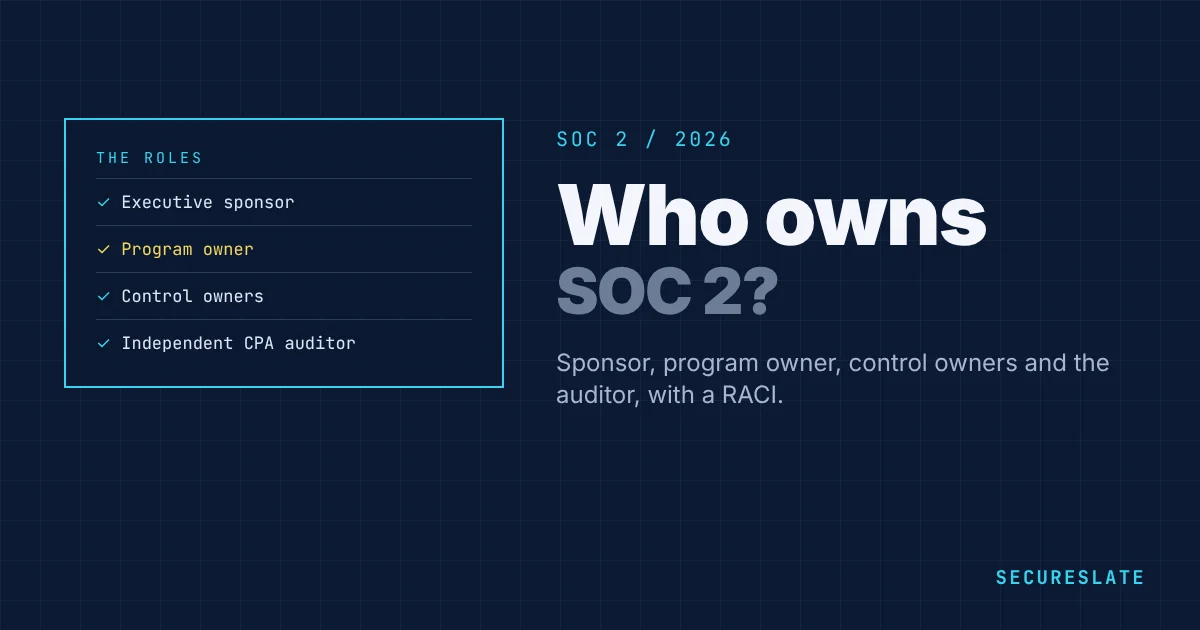
When prospects ask “who is responsible for SOC 2?” they are really asking whether accountability is clear, or whether compliance lives in one overwhelmed person’s inbox.
Related: SOC 2 project plan · Collection
Key takeaways
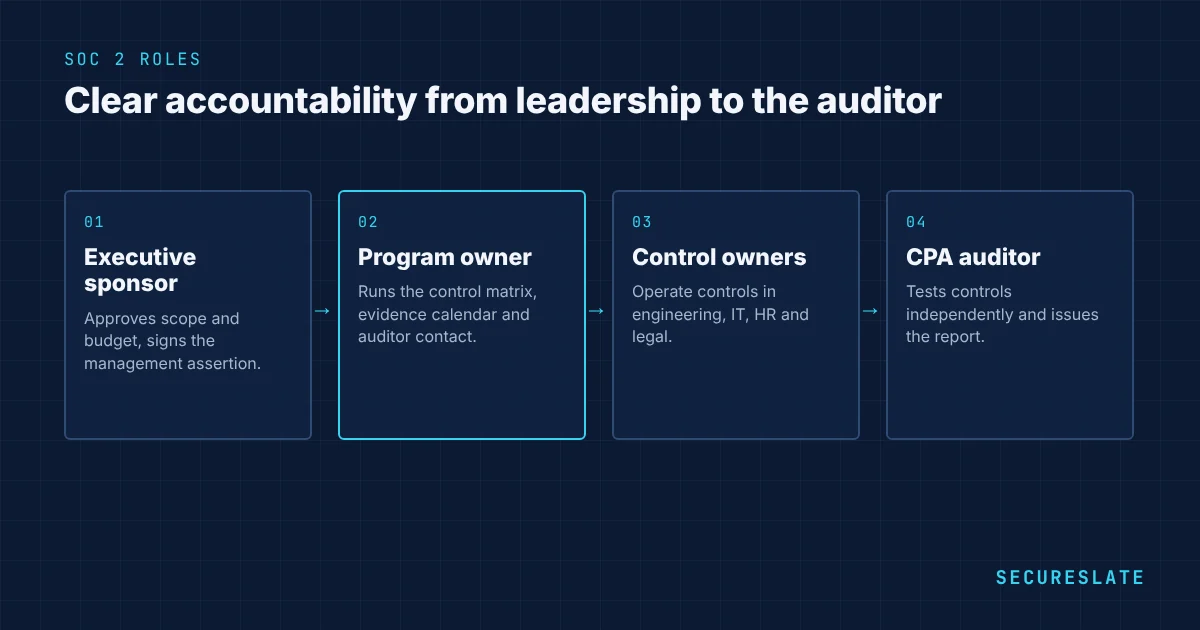
- Executive sponsorship sets priority and resources.
- A program owner coordinates scope, evidence, and auditor requests.
- Control owners in Engineering, IT, HR, and Legal operate specific controls.
- The CPA firm performs independent attestation; they do not run your program.
Executive sponsor
Typically CTO, CISO, COO, or CEO. The sponsor approves scope, budget (tools + audit fees), and escalation when remediation blocks release timelines.
Program owner (day-to-day)
Often a compliance manager, security lead, or first GRC hire. Responsibilities:
- Maintain control matrix and evidence calendar
- Run readiness and gap tracking
- Interface with the SOC 2 auditor
Control owners across the business
| Domain | Examples |
|---|---|
| Engineering | Change management, SDLC, production access |
| IT / Security | MFA, logging, vulnerability management |
| People Ops | Background checks, termination, training |
| Legal / Sales | Customer commitments, DPAs, subprocessor lists |
External auditor (independent)
Auditors test and opine; they are not responsible for implementing fixes. Keep roles separate to preserve independence.
SOC 2 RACI for common controls
R = responsible (does the work), A = accountable (signs off), C = consulted, I = informed.
| Activity | Executive sponsor | Program owner | Engineering | IT / Security | People Ops |
|---|---|---|---|---|---|
| Approve scope and budget | A | R | C | C | I |
| Information security policies | A | R | C | C | C |
| Risk assessment | A | R | C | C | I |
| Access reviews | I | A | R | R | I |
| Change management | I | C | A, R | C | I |
| Vulnerability management | I | C | R | A, R | I |
| Onboarding and offboarding | I | C | I | R | A, R |
| Security awareness training | I | A | I | C | R |
| Vendor management | I | A, R | C | R | I |
| Incident response | A | C | R | R | I |
| Auditor coordination | I | A, R | C | C | C |
How responsibility changes with company size
Up to 20 people. The CTO or a co-founder is often both sponsor and program owner. One or two engineers own most technical controls, and an operations person covers HR controls. A compliance automation platform and an outside advisor fill the gaps.
20 to 50 people. A dedicated program owner appears, often a first security or compliance hire. Control ownership spreads across engineering, IT, people operations and finance. Leadership reviews progress monthly.
50 people and more. A security or GRC team runs the program, with formal control owners in each department and quarterly reporting to the leadership team or board.
What auditors ask about roles
Auditors want to see that responsibility is defined and working. Expect questions such as:
- Who is responsible for information security, and how is that documented?
- How does leadership oversee the security program? Show us meeting records.
- Who performs access reviews, and who approves the results?
- How are new control owners trained when people change roles?
Document roles in your information security policy or an organizational chart, and keep minutes of leadership security reviews as evidence.
Setting up SOC 2 ownership in one week
- Day 1: name the sponsor and program owner. Write both names into your information security policy.
- Day 2: list your controls. Start from your control matrix or the controls in your compliance platform.
- Day 3: assign one owner per control. Choose the person who already does the work. Add a backup for critical controls such as offboarding, access reviews and incident response.
- Day 4: brief the owners. Spend 20 minutes with each owner explaining what the control is, how often it runs and what evidence the auditor will want.
- Day 5: set the calendar. Put recurring tasks, such as quarterly access reviews and annual policy reviews, into owners' calendars or your platform's reminders.
Keeping ownership current
People change roles and leave. Review the owner list every quarter and whenever someone with control ownership changes jobs. Make "hand over compliance responsibilities" a step in your offboarding checklist, so controls never become orphaned between audits.
Evidence that shows ownership works
Auditors look for proof, not just a list of names. Useful evidence includes the approved policy that names security roles, minutes of leadership reviews of the security program, completed access reviews signed off by the right owner, and tickets showing that the named person actually performed recurring tasks during the audit period.
The program owner's year
A program owner's work follows a predictable rhythm once the first audit is done:
| When | Program owner tasks |
|---|---|
| Every week | Track open gaps and evidence requests, answer control owner questions |
| Every month | Check evidence is current, review new vendors and system changes |
| Every quarter | Run access reviews with owners, report status to the executive sponsor |
| Every year | Lead the risk assessment and policy review, plan the next audit, refresh training |
| Audit period | Coordinate the auditor, schedule interviews, deliver evidence and track findings |
Writing this calendar down makes the role easier to hand over and shows auditors that oversight is continuous.
Responsibilities outside your company
Some controls sit with your vendors. If you host on a major cloud provider, physical data center security is the provider's responsibility, covered by its own SOC 2 report. Your auditor will treat the provider as a subservice organization. You remain responsible for reviewing that report each year and for operating the complementary controls it lists, such as managing your own users and configuring encryption.
Common mistakes
- One person owns every control and becomes a single point of failure
- Roles are defined on paper but owners do not know what they are responsible for
- No backup owner for critical controls such as offboarding and access reviews
- Treating the auditor as a consultant who will tell you what to fix
- Leadership involvement only at kickoff and when the report arrives
SecureSlate
Assign owners and automate evidence in one workspace: Get started
FAQ
Who is ultimately accountable for SOC 2?
Management is. The SOC 2 report includes a management assertion, signed by the company's leadership, that describes the system and states that controls were suitably designed and, for Type 2, operating effectively.
Can the auditor help us fix controls?
Auditors can explain what they expect, but to stay independent they cannot design or run your controls. Use internal staff, a compliance platform or a separate advisor for remediation.
Do we need to hire a compliance manager for SOC 2?
Not always. Many companies under 30 people succeed with a technical leader as program owner, a compliance automation platform and occasional outside help. A dedicated hire becomes worthwhile as frameworks and customer reviews grow.
Is the CTO responsible for SOC 2?
Often, in startups. The CTO commonly acts as executive sponsor and sometimes as program owner. As the company grows, day-to-day ownership usually moves to a security or compliance lead while the CTO stays accountable for engineering controls.
What happens to SOC 2 responsibilities when the program owner leaves?
The executive sponsor should name an interim owner straight away and hand over the control matrix, evidence calendar, auditor contacts and open findings. A written handover note and access to the compliance platform prevent missed reviews during the gap, which auditors would otherwise report as control exceptions.
Disclaimer (legal note)
Organizational charts vary. Informational only.
Need compliance without the complexity?
SecureSlate automates ISO 27001, SOC 2, GDPR, HIPAA, and more. Built for growing teams. See it in action.
Find compliance gaps in 30 seconds
