
The benefits of achieving CMMC certification start with a simple fact: for many defense contracts, you cannot win or keep the work without it. The Cybersecurity Maturity Model Certification (CMMC) program, set out in 32 CFR part 170 and enforced through DFARS contract clauses, requires contractors to show they protect Federal Contract Information (FCI) and Controlled Unclassified Information (CUI). CMMC requirements started appearing in solicitations on November 10, 2025, with third-party Level 2 assessments phasing in from November 10, 2026. Beyond eligibility, a well-run CMMC program brings real business and security benefits. This guide covers seven of them and how to get there.
Related guides: What is CMMC? · CMMC assessment types · Best CMMC compliance software
Key takeaways
- CMMC status is becoming a condition of contract award for DoD work involving FCI or CUI.
- Certification gives you a competitive edge with primes and agencies while many competitors are still preparing.
- The 110 NIST SP 800-171 requirements behind Level 2 reduce real cyber risk, not just paperwork.
- A documented program lowers False Claims Act and contract risk from inaccurate self-attestations.
- Work done for CMMC carries over to other frameworks such as NIST CSF, ISO 27001 and SOC 2.
CMMC in brief
CMMC has three levels:
| Level | Applies to | Requirements | Assessment |
|---|---|---|---|
| Level 1 | FCI only | 15 basic safeguarding requirements from FAR 52.204-21 | Annual self-assessment and affirmation |
| Level 2 | CUI | 110 requirements from NIST SP 800-171 Rev 2 | Self-assessment or C3PAO assessment every three years, with annual affirmation |
| Level 3 | Higher-priority CUI | Level 2 plus 24 requirements from NIST SP 800-172 | DCMA DIBCAC assessment every three years |
The contract tells you which level and assessment type you need. Results are recorded in the Supplier Performance Risk System (SPRS), and a senior official must affirm continued compliance each year.
The 7 practical benefits
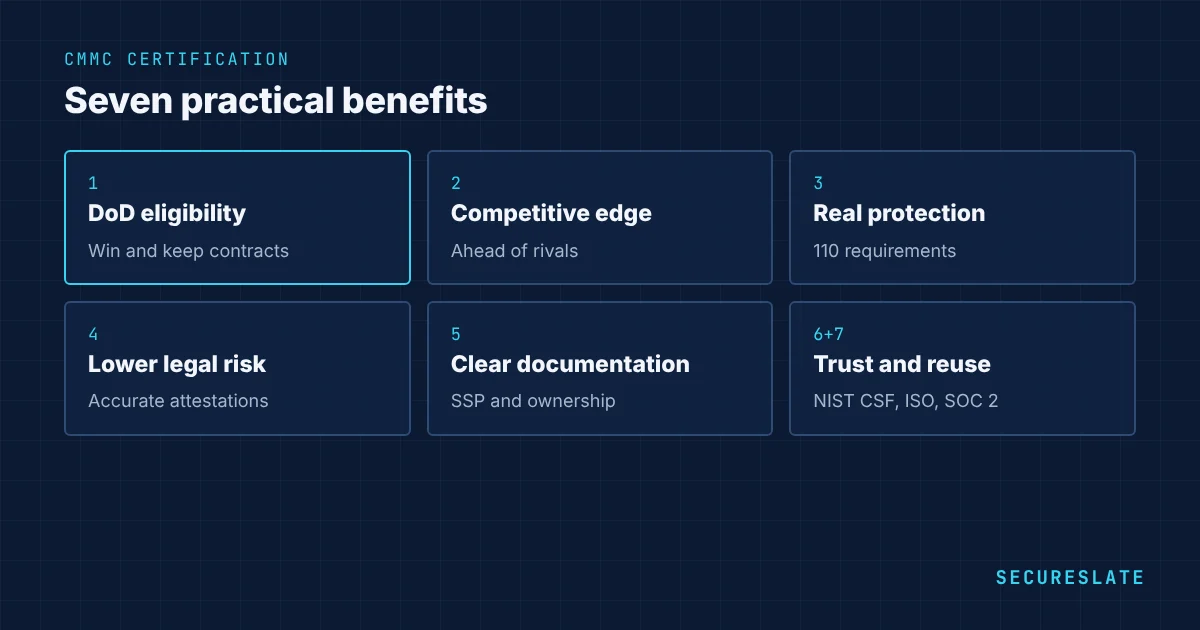
1. Eligibility for DoD contracts
This is the core benefit. When a solicitation requires a CMMC status, contractors without it cannot be awarded the contract. Primes must also flow down requirements to subcontractors that handle FCI or CUI, so certification protects your place in supply chains, not just direct awards.
2. A competitive advantage while others catch up
Many small and mid-size defense suppliers are still working through NIST SP 800-171. Having a final Level 2 status early makes you a lower-risk choice for primes building teams for upcoming bids, and lets you bid on work that competitors cannot.
3. Stronger protection against real attacks
The Level 2 requirements cover multifactor authentication, access control, audit logging, configuration management, incident response, media protection and more. Defense contractors are frequent targets of espionage and ransomware. Meeting these requirements makes successful attacks less likely and limits their impact.
4. Lower legal and contract risk
Since DFARS 252.204-7012 and 7019, contractors have self-attested to NIST SP 800-171. The Department of Justice has pursued False Claims Act cases against contractors that misrepresented their cybersecurity. A verified assessment and a documented program reduce the chance of inaccurate claims and give you records to stand on.
5. Clear documentation and accountability
Preparing for CMMC produces a System Security Plan (SSP), a defined CUI boundary, asset inventory, policies and procedures. These make onboarding, audits and incident response easier and show exactly who owns which control.
6. Better customer and partner trust
Primes, agencies and even commercial customers see CMMC status as a signal of security maturity. It shortens supplier security reviews and supports your reputation as a reliable partner.
7. A head start on other frameworks
NIST SP 800-171 controls map closely to NIST SP 800-53, NIST CSF and large parts of ISO 27001 and SOC 2. If you sell commercially as well, much of your CMMC work can be reused to meet those customer requirements.
What it takes to get certified
- Confirm the level. Check current and upcoming contracts for the required CMMC level and assessment type.
- Scope the environment. Identify where FCI and CUI are stored, processed and transmitted. Consider an enclave to shrink scope.
- Assess gaps. Score yourself against the 110 requirements using the DoD assessment methodology and post the score in SPRS.
- Write the SSP. Describe how each requirement is met in your environment.
- Remediate. Close gaps, prioritizing higher-weighted requirements.
- Prepare evidence. Collect artifacts, interview-ready staff and test results.
- Assess and affirm. Complete the self-assessment or C3PAO assessment, then affirm in SPRS. Plan for annual affirmations and reassessment every three years.
Common obstacles
- Unclear CUI scope that pulls the whole company into the assessment
- Cost and time for small suppliers without security staff
- Cloud services that do not meet FedRAMP Moderate or equivalent requirements for CUI
- POA&M limits. Conditional Level 2 status requires a minimum score of 88 out of 110, only certain requirements can be on a POA&M, and items must close within 180 days
- Evidence gaps where controls exist but are not documented
The CMMC rollout timeline
| Phase | Start date | What changes |
|---|---|---|
| Phase 1 | November 10, 2025 | Level 1 and Level 2 self-assessments required in applicable solicitations |
| Phase 2 | November 10, 2026 | Level 2 C3PAO certification required where applicable |
| Phase 3 | November 10, 2027 | Level 3 DIBCAC assessments required where applicable |
| Phase 4 | November 10, 2028 | Full implementation across applicable contracts |
Contracting officers can include higher requirements earlier at their discretion. Because C3PAO assessment capacity is limited, contractors that need Level 2 certification should plan their assessment well before the contracts they are targeting are released.
How to make the business case internally
Leadership often sees CMMC as a cost. Frame it around revenue and risk instead:
- Revenue at risk. Add up current and pipeline DoD contracts and subcontracts involving FCI or CUI. That revenue depends on CMMC status.
- New opportunities. List upcoming bids that require CMMC and estimate their value.
- Cost of a breach. Include incident response, downtime, contract penalties and reputational damage.
- Legal exposure. Explain the risk of inaccurate self-attestations under the False Claims Act.
- Reuse. Show how the same controls support commercial customer requirements.
- Cost reduction options. Scoping CUI into an enclave, using compliant cloud services and automating evidence can cut the effort substantially.
Measuring the benefits after certification
| Benefit | How to measure |
|---|---|
| Contract eligibility | Number and value of bids you can now submit |
| Competitive position | Teaming invitations from primes and win rate |
| Security improvement | Incidents, MFA coverage, patch timeliness |
| Audit readiness | Hours spent preparing for annual affirmation |
| Reuse | Commercial security reviews closed using CMMC evidence |
How SecureSlate helps
SecureSlate helps small and mid-size defense suppliers prepare for CMMC Level 1 and Level 2. It maps controls to NIST SP 800-171, tracks your SPRS score, helps you build the SSP and POA&M, and continuously checks cloud, identity and device controls so evidence is ready for assessors. Multi-framework mapping lets you reuse the same work for SOC 2 or ISO 27001 if you also sell commercially, at a price built for smaller contractors.
FAQ
Is CMMC certification mandatory?
It is required when a DoD contract includes the CMMC clause and specifies a level. Requirements are phasing into contracts from November 10, 2025, with full implementation by November 2028.
What is the biggest benefit of CMMC certification?
Eligibility for DoD contracts and subcontracts that involve FCI or CUI. Without the required status, you cannot be awarded those contracts.
How long does CMMC certification take?
It depends on your starting point. Companies already close to NIST SP 800-171 compliance may be ready in a few months. Others need a year or more of remediation.
Does CMMC help with commercial customers?
Indirectly. The controls overlap heavily with NIST CSF, ISO 27001 and SOC 2, so the work makes it easier to meet commercial security requirements.
How long is a CMMC certification valid?
Level 2 and Level 3 statuses last three years, with annual affirmations. Level 1 requires a self-assessment and affirmation every year.
What happens if my CMMC status lapses?
If you fail to affirm annually or let your status expire, you may become ineligible for new awards that require CMMC, and contracting officers can consider the lapse when making decisions on existing work.
Disclaimer (legal note)
This article is general information, not legal or contracting advice. Contract requirements vary by solicitation and program office.
Need compliance without the complexity?
SecureSlate automates ISO 27001, SOC 2, GDPR, HIPAA, and more. Built for growing teams. See it in action.
Find compliance gaps in 30 seconds