
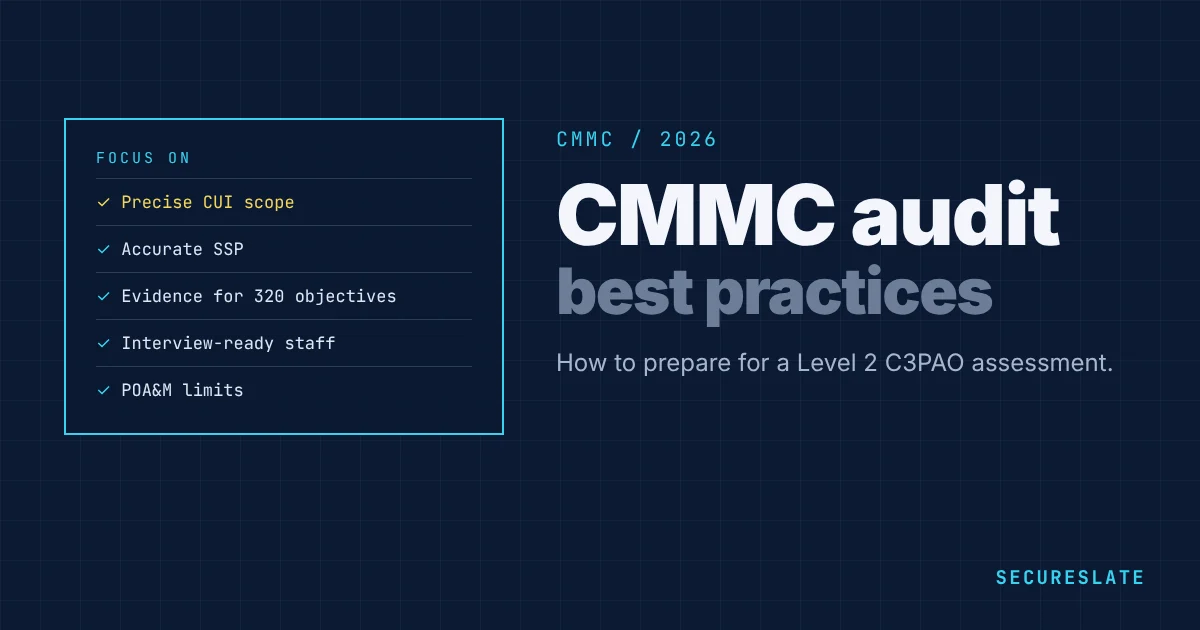
CMMC audit best practices help defense contractors pass their assessment the first time instead of paying for delays and follow-up work. A CMMC "audit" is formally called an assessment. For Level 2 certification it is performed by a Certified Third-Party Assessment Organization (C3PAO) authorized by the Cyber AB, using the CMMC Assessment Process and the assessment objectives in NIST SP 800-171A. Level 1 and some Level 2 contracts allow self-assessment instead, and Level 3 is assessed by the Defense Contract Management Agency's DIBCAC. This guide covers how assessments work and the practices that make them go smoothly.
Related guides: CMMC assessment types · How to implement an effective CMMC program · What is CMMC?
Key takeaways
- Assessors check each of the 110 Level 2 requirements against 320 assessment objectives using three methods: examine, interview and test.
- A precise CUI scope is the most important factor in cost and success.
- The System Security Plan (SSP) must match reality. Assessors compare what it says to what they see.
- Every objective needs evidence that shows the control is implemented, not just written down.
- A conditional status is possible with a score of at least 88 and an allowed POA&M, but open items must close within 180 days.
How a CMMC Level 2 assessment works
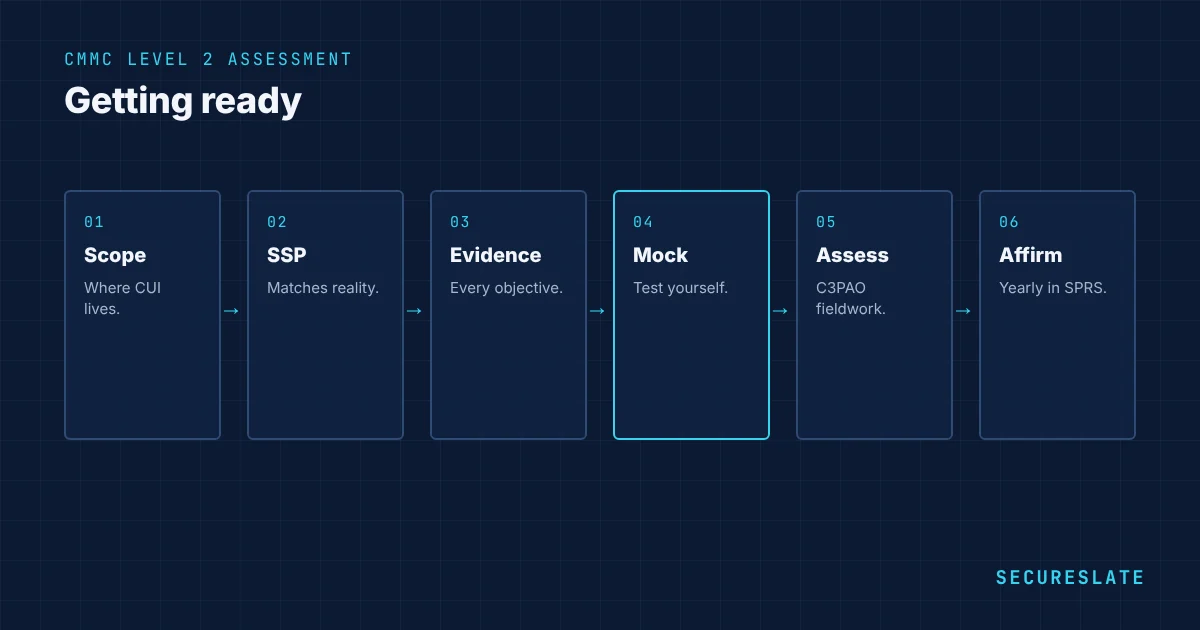
A C3PAO assessment usually follows four phases:
- Plan and prepare. The C3PAO and the organization seeking certification (OSC) agree on scope, schedule, assessment team and logistics. The C3PAO reviews the SSP and other documents for readiness.
- Conduct the assessment. The team examines documents and records, interviews staff and tests systems for each assessment objective. Each requirement is scored MET, NOT MET or NOT APPLICABLE.
- Report results. The C3PAO uploads results to the CMMC eMASS system, and your status appears in SPRS.
- Close out POA&M items. If you received a conditional status, a closeout assessment confirms that open items were fixed within 180 days.
After a final status, a senior official affirms compliance in SPRS, and the affirmation repeats every year. Certification lasts three years.
Best practice 1: Get the scope right
Scope drives everything: how many systems, people and locations the assessors examine. Identify every asset that stores, processes or transmits CUI, plus security protection assets, contractor risk managed assets and specialized assets as defined in the CMMC scoping guidance. Draw a network diagram and data flow diagram that shows how CUI moves.
Many companies reduce scope by putting CUI into a dedicated enclave, such as a separate cloud tenant or virtual desktop environment, rather than bringing the whole corporate network in scope. Whatever you choose, make sure the boundary is enforced technically, not just on paper.
Best practice 2: Write an SSP that matches reality
The SSP should describe, for each requirement, how it is implemented in your environment: which tools, settings, people and procedures. Avoid copying generic text. Assessors read the SSP before fieldwork and then check whether your systems and staff behave as described. Inconsistencies are a common cause of NOT MET findings.
Keep the SSP current. Update it when you change tools, providers or architecture, and record the version and approval date.
Best practice 3: Map evidence to every objective
NIST SP 800-171A breaks the 110 requirements into 320 assessment objectives. Assessors need evidence for each one. Build an evidence matrix that lists every objective and the artifacts that prove it, such as:
- Configuration screenshots or exports from identity, endpoint and cloud consoles
- Policies and procedures with approval dates
- Logs showing audit events are captured and reviewed
- Access review records and account lists
- Training completion reports
- Incident response test results
- Asset inventory and baseline configurations
Evidence should cover a meaningful period, not only the day before the assessment. Continuous monitoring makes this far easier.
Best practice 4: Prepare people for interviews
Interviews confirm that staff know and follow the procedures. Identify who owns each control family and walk them through the questions assessors are likely to ask: how do you grant access, how do you know a device is patched, what do you do if you suspect an incident? People should answer honestly and show how they do the work, not recite policy text.
Best practice 5: Test before the assessors do
Run an internal mock assessment using the same objectives and methods. Try to log in without MFA, check whether removable media is blocked, confirm that audit logs are retained, and verify that FIPS-validated cryptography protects CUI where required. Fix what fails and record the fix.
Best practice 6: Use POA&Ms carefully
The CMMC rule allows a conditional Level 2 status if your score is at least 88 out of 110 and the open requirements are eligible for a POA&M. Requirements worth more than one point generally cannot be on a POA&M, with limited exceptions, and the security assessment requirement for SSPs must be met. Every POA&M item must be closed and verified within 180 days, or the conditional status expires. Treat the POA&M as a short safety net, not a plan to finish compliance later.
Best practice 7: Manage your cloud and service providers
If a cloud service provider stores or processes CUI, it must meet FedRAMP Moderate or equivalent requirements. External service providers such as managed security providers may also come into scope. Collect their documentation, customer responsibility matrices and contracts before the assessment, and be ready to explain which requirements they meet on your behalf.
Common reasons for NOT MET findings
| Area | Typical finding |
|---|---|
| Multifactor authentication | MFA missing for some privileged or remote access |
| Audit logging | Logs collected but not reviewed, or retention too short |
| Configuration management | No documented baselines or change tracking |
| Encryption | Cryptography not FIPS validated where CUI is protected |
| Incident response | Plan exists but has never been tested |
| Media protection | Removable media not controlled or sanitization not documented |
| Documentation | SSP does not match implemented controls |
Assessment readiness checklist
- CUI scope, asset inventory and diagrams complete and current
- SSP approved and consistent with the environment
- Evidence matrix covering all 320 objectives
- SPRS score posted and accurate
- Policies and procedures approved and communicated
- Staff briefed for interviews
- Mock assessment done and gaps fixed
- Cloud and service provider documentation collected
- Point of contact and logistics agreed with the C3PAO
What happens on assessment day
Most C3PAO assessments start with an opening meeting where the lead assessor confirms scope, schedule, points of contact and how evidence will be shared. Assessors then work through control families, usually in blocks: they review documents in the morning, interview owners and watch demonstrations in the afternoon, and test settings directly in consoles. Expect requests such as "show me how a new engineer gets access to the CUI file share" or "pull the audit log for yesterday and show me failed logins." A daily wrap-up call covers open questions and any requirement trending toward NOT MET, which gives you a chance to provide more evidence before the final review.
Keep a small, dedicated team available throughout: the program owner as coordinator, an IT or cloud administrator who can show configurations live, and someone who can retrieve HR and training records. Track every evidence request in a shared list with status, owner and the artifact provided so nothing is lost.
Evidence quality: good versus weak
| Requirement area | Weak evidence | Strong evidence |
|---|---|---|
| MFA | A policy saying MFA is required | Identity provider export showing MFA enforced for all in-scope users and admins, plus a live login demo |
| Audit logging | A screenshot of a logging dashboard | Log retention settings, a sample of reviewed alerts and the review procedure with dated sign-offs |
| Access reviews | An email asking managers to check access | Completed review records with reviewer decisions and tickets for removed access |
| Training | A slide deck | Completion report for every in-scope user with dates |
| Incident response | A plan document | The plan plus results and lessons from a tabletop exercise |
How SecureSlate helps
SecureSlate helps small and mid-size defense contractors get ready for CMMC assessments. It maps controls to NIST SP 800-171, tracks your score, supports the SSP and POA&M, and continuously checks identity, cloud and device controls so evidence covers the whole period. Audit management gives assessors organized evidence, and access reviews and the device agent produce the records assessors ask for most.
FAQ
How long does a CMMC Level 2 assessment take?
Fieldwork commonly lasts about one to two weeks depending on scope, plus planning before and reporting after. Smaller, well-scoped environments take less time.
Who can perform a CMMC Level 2 certification assessment?
A C3PAO authorized by the Cyber AB, with assessment team members certified as CMMC assessors.
Can I fail a CMMC assessment?
If your score is below 88, or open items are not eligible for a POA&M, you will not receive a conditional status and will need to remediate and be reassessed.
What is the difference between a CMMC audit and a self-assessment?
A self-assessment is performed by your own organization and affirmed by a senior official. A certification assessment is performed by an independent C3PAO.
How often are CMMC assessments required?
Level 2 and Level 3 assessments are every three years, with annual affirmations in SPRS. Level 1 requires annual self-assessment.
Can we fix gaps during the assessment?
Small documentation issues can sometimes be clarified with additional evidence during the assessment, but assessors judge the state they observe. Plan to fix technical gaps before fieldwork begins.
Disclaimer (legal note)
This article is for general information only and is not legal, regulatory, or professional advice. Requirements vary by framework, industry, and jurisdiction. Consult qualified advisors for your specific obligations.
Need compliance without the complexity?
SecureSlate automates ISO 27001, SOC 2, GDPR, HIPAA, and more. Built for growing teams. See it in action.
Find compliance gaps in 30 seconds