
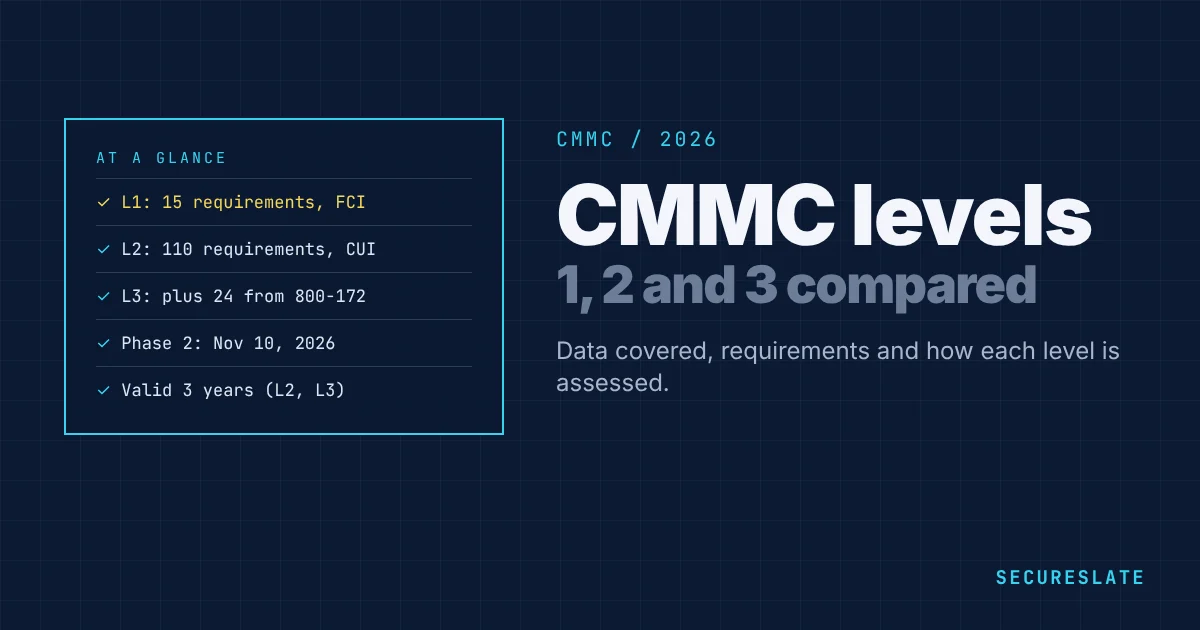
The CMMC levels set how much cybersecurity a defense contractor must show before it can win Department of Defense (DoD) contracts. CMMC 2.0 has three levels. Level 1 protects Federal Contract Information (FCI), Level 2 protects Controlled Unclassified Information (CUI), and Level 3 adds enhanced protections against advanced threats for the most sensitive programs. This guide compares the three levels, explains how each is assessed, and shows how to work out which level you need.
Related guides: CMMC Level 1 requirements · CMMC Level 2 requirements · CMMC Level 3 requirements · CMMC certification cost
Key takeaways
- Level 1: 15 basic requirements for FCI, with an annual self-assessment.
- Level 2: the 110 requirements of NIST SP 800-171 Rev 2 for CUI, assessed by self-assessment or a C3PAO every three years, depending on the contract.
- Level 3: Level 2 plus 24 requirements from NIST SP 800-172, assessed by the government's DIBCAC.
- CMMC is being phased into contracts. Phase 2, which brings Level 2 third-party certification into contracts, begins on November 10, 2026.
CMMC levels compared
| Level 1 (Foundational) | Level 2 (Advanced) | Level 3 (Expert) | |
|---|---|---|---|
| Data protected | Federal Contract Information (FCI) | Controlled Unclassified Information (CUI) | CUI in the highest-priority programs |
| Requirements | 15, from FAR 52.204-21 | 110, from NIST SP 800-171 Rev 2 | 110 plus 24 selected from NIST SP 800-172 |
| Assessment | Annual self-assessment | Self-assessment or C3PAO certification every 3 years, as the contract specifies | DIBCAC assessment every 3 years, after a Level 2 C3PAO certification |
| Affirmation | Annual, by a senior official | Annual, by a senior official | Annual, by a senior official |
| POA&M allowed | No | Yes, limited, closed within 180 days | Yes, limited, closed within 180 days |
| Results reported in | SPRS | SPRS, and CMMC eMASS for C3PAO results | CMMC eMASS |
| Typical organizations | Most contractors that handle only FCI | Contractors and subcontractors that handle CUI | A small number of contractors on critical programs |
CMMC Level 1
Level 1 covers basic safeguarding of FCI, information provided by or generated for the government under a contract that is not intended for public release. The 15 requirements cover essentials such as limiting system access to authorized users, authenticating users, sanitizing media before disposal, physically controlling access, monitoring visitors, protecting system boundaries, patching flaws and running anti-malware. Organizations self-assess every year, must meet every requirement with no open POA&M items, and a senior official affirms compliance in the Supplier Performance Risk System (SPRS).
CMMC Level 2
Level 2 applies when you handle CUI. It requires all 110 security requirements in NIST SP 800-171 Rev 2, across 14 families such as access control, audit and accountability, configuration management, incident response and system and communications protection. The contract states whether you need a self-assessment or a certification assessment by a CMMC Third-Party Assessment Organization (C3PAO). Most contracts involving CUI are expected to require C3PAO assessment.
Scoring uses the DoD assessment methodology, with a maximum score of 110. You can achieve conditional status with a minimum score of 80% (88 of 110) and certain lower-weighted requirements in a POA&M, but those items must be closed within 180 days. Some requirements can never be placed on a POA&M.
CMMC Level 3
Level 3 is for CUI in the most sensitive programs, where the risk from advanced persistent threats is highest. An organization must first hold a final Level 2 C3PAO certification for the same scope, then implement 24 additional requirements from NIST SP 800-172, such as threat hunting, enhanced incident response and security operations. The Defense Contract Management Agency's DIBCAC performs the assessment.
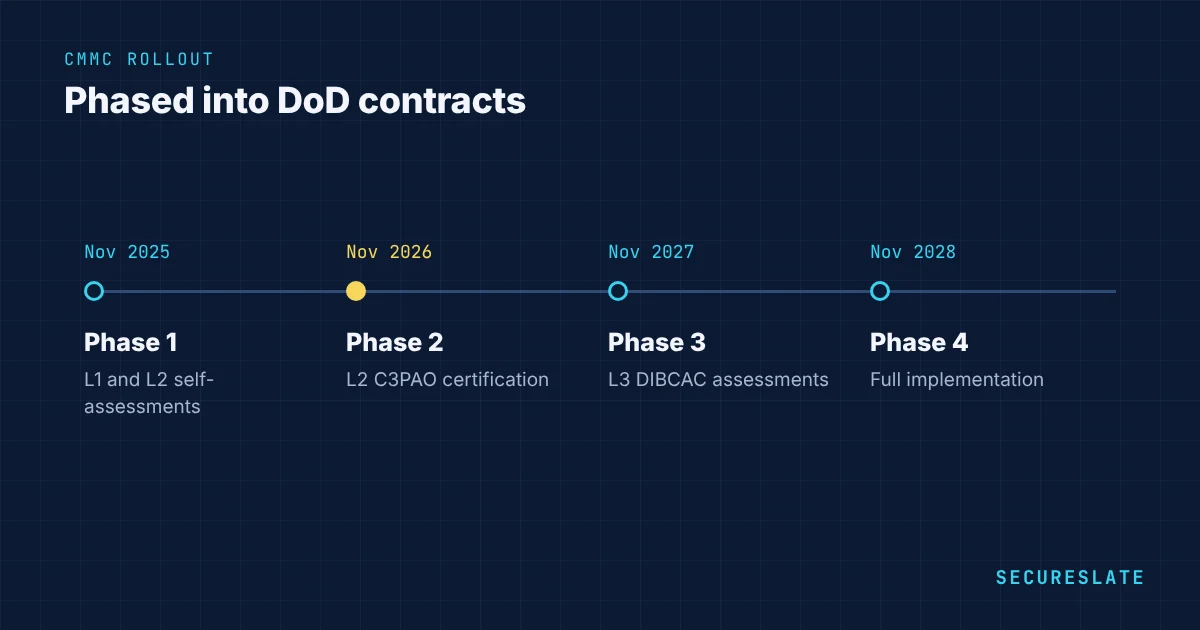
The CMMC rollout timeline
| Phase | Start date | What it means |
|---|---|---|
| Phase 1 | November 10, 2025 | Level 1 and Level 2 self-assessments required in applicable new solicitations |
| Phase 2 | November 10, 2026 | Level 2 C3PAO certification required in applicable solicitations |
| Phase 3 | November 10, 2027 | Level 3 DIBCAC assessments added |
| Phase 4 | November 10, 2028 | Full implementation across applicable contracts |
DoD may include higher requirements earlier at its discretion, so check each solicitation.
How to determine your CMMC level
- Check your contracts and solicitations for the DFARS 252.204-7021 clause and the CMMC level stated.
- Identify the data you handle. FCI only usually means Level 1. Any CUI usually means Level 2.
- Ask your prime contractor. Primes must flow CMMC requirements down to subcontractors that handle FCI or CUI.
- Map where the data lives to set your assessment scope. Keeping CUI in a well-defined enclave reduces scope and cost.
How to prepare for a CMMC Level 2 assessment
- Define your CUI scope. Find every system, person and location that stores, processes or transmits CUI, plus security protection assets such as your identity provider and logging tools.
- Run a gap assessment against the 110 NIST SP 800-171 requirements and calculate your current SPRS score.
- Write your System Security Plan (SSP). It must describe how each requirement is met in your environment.
- Close gaps, starting with high-value requirements such as MFA, encryption with FIPS-validated modules, logging, incident response and configuration management.
- Collect evidence for each requirement: screenshots, configurations, logs, policies and records.
- Run a mock assessment or a readiness review before booking a C3PAO.
- Book a C3PAO early. Demand for assessors grows as each phase starts.
Common reasons organizations fall short
- CUI spread across too many systems, making the scope large and expensive
- An SSP that describes intended controls rather than how things actually work
- Cloud services used for CUI that do not meet FedRAMP Moderate or equivalent requirements
- Missing FIPS-validated encryption where CUI is protected by cryptography
- Weak evidence for operational controls such as log review, access reviews and incident response testing
- Subcontractors not prepared, even though primes must flow requirements down
CMMC and other frameworks
CMMC Level 2 is built on NIST SP 800-171, which itself is derived from NIST SP 800-53. If you already hold SOC 2 or ISO 27001, many controls overlap, though CMMC is more prescriptive about specifics such as FIPS-validated cryptography and documented scoping. See how CMMC relates to NIST in our guide to CMMC vs NIST 800-171.
Reducing CMMC scope with an enclave
Many small contractors keep CUI in a separate enclave, such as a dedicated cloud environment or a segmented set of systems used only for defense work, instead of across the whole company. A smaller scope means fewer systems to secure, fewer people to train and a cheaper assessment. The enclave must still meet all Level 2 requirements, and cloud services that store CUI must meet FedRAMP Moderate or equivalent security requirements.
How SecureSlate helps
SecureSlate includes CMMC Level 1 and Level 2 with NIST SP 800-171 mappings, SPRS score tracking, POA&M management, policy templates and evidence collection, so small defense suppliers can prepare for self-assessment or C3PAO certification without a large compliance team.
FAQ
How many CMMC levels are there?
Three in CMMC 2.0: Level 1 (Foundational), Level 2 (Advanced) and Level 3 (Expert). The earlier CMMC 1.0 model had five.
Which CMMC level do most contractors need?
Contractors handling only FCI need Level 1. Those handling CUI, a large share of the defense industrial base, need Level 2.
Can a company self-assess for CMMC Level 2?
Only if the contract allows it. Many contracts involving CUI require a C3PAO certification assessment instead.
How long is a CMMC certification valid?
Level 2 and Level 3 assessments are valid for three years, with annual affirmations. Level 1 self-assessments are repeated every year.
What happens if we do not meet our CMMC level?
You will not be eligible for contract awards that require that level, and false affirmations can create legal liability.
What is an SPRS score?
A score from the DoD assessment methodology, recorded in the Supplier Performance Risk System. The maximum is 110, and points are deducted for each unmet NIST SP 800-171 requirement.
Do subcontractors need CMMC?
Yes. Prime contractors must flow CMMC requirements down to subcontractors that process, store or transmit FCI or CUI, at the level that matches the information they handle.
Is CMMC the same as NIST SP 800-171?
No. NIST SP 800-171 sets the security requirements for protecting CUI. CMMC is the DoD program that verifies contractors actually meet them, through self-assessments and third-party assessments.
Disclaimer (legal note)
This article is for general information only and is not legal, regulatory, or professional advice. Requirements vary by framework, industry, and jurisdiction. Consult qualified advisors for your specific obligations.
Need compliance without the complexity?
SecureSlate automates ISO 27001, SOC 2, GDPR, HIPAA, and more. Built for growing teams. See it in action.
Find compliance gaps in 30 seconds