
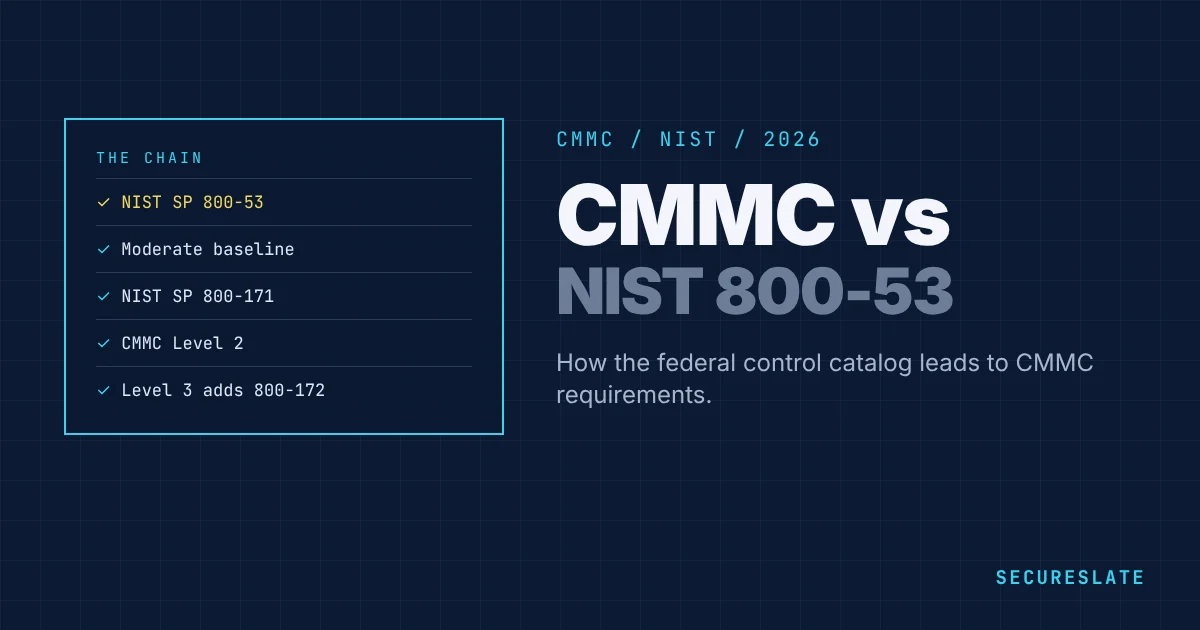
CMMC vs NIST 800-53 confuses many government contractors because the two are closely related but used in different places. NIST SP 800-53 is a large catalog of security and privacy controls for federal information systems and the base for FISMA and FedRAMP. CMMC is the DoD program that verifies defense contractors protect Federal Contract Information (FCI) and Controlled Unclassified Information (CUI) using NIST SP 800-171 and, at Level 3, NIST SP 800-172. Those two documents were derived from NIST SP 800-53. This guide explains the relationship, the differences and how to map them if you need both.
Related guides: CMMC vs FedRAMP · What is CMMC? · NIST 800-53 guide · CMMC and DFARS 7012
Key takeaways
- NIST SP 800-53 Rev 5 is a catalog of more than 1,000 controls and enhancements in 20 families, used for federal systems.
- NIST SP 800-171 Rev 2 contains 110 requirements in 14 families, tailored from the 800-53 Moderate baseline for nonfederal systems. CMMC Level 2 uses it.
- CMMC Level 3 adds 24 requirements from NIST SP 800-172, which also traces back to 800-53.
- 800-53 is a control catalog you tailor. CMMC is a certification program with fixed requirements, scoring and assessments.
- If you already meet the 800-53 Moderate baseline, you likely meet most CMMC Level 2 requirements, but you still need CMMC-specific documentation and assessment.
What is NIST SP 800-53?
NIST Special Publication 800-53, "Security and Privacy Controls for Information Systems and Organizations," is the main control catalog used across the US federal government. Revision 5, released in 2020, made the controls outcome-based and usable by any organization, and merged privacy controls into the catalog. Baselines for Low, Moderate and High impact systems are published separately in NIST SP 800-53B. Federal agencies use 800-53 under FISMA and the NIST Risk Management Framework, and FedRAMP builds its cloud baselines from it.
The 20 control families include Access Control (AC), Audit and Accountability (AU), Configuration Management (CM), Contingency Planning (CP), Identification and Authentication (IA), Incident Response (IR), Risk Assessment (RA), System and Communications Protection (SC), Supply Chain Risk Management (SR) and others.
What is CMMC?
The Cybersecurity Maturity Model Certification program (32 CFR part 170) applies to DoD contractors and subcontractors. It has three levels:
| Level | Requirements | Source |
|---|---|---|
| Level 1 | 15 | FAR 52.204-21 basic safeguarding |
| Level 2 | 110 | NIST SP 800-171 Rev 2 |
| Level 3 | 110 plus 24 | NIST SP 800-171 Rev 2 plus selected NIST SP 800-172 requirements |
CMMC adds assessment rules, scoring, POA&M limits, affirmations and the role of C3PAOs and DIBCAC on top of these requirements.
How they connect
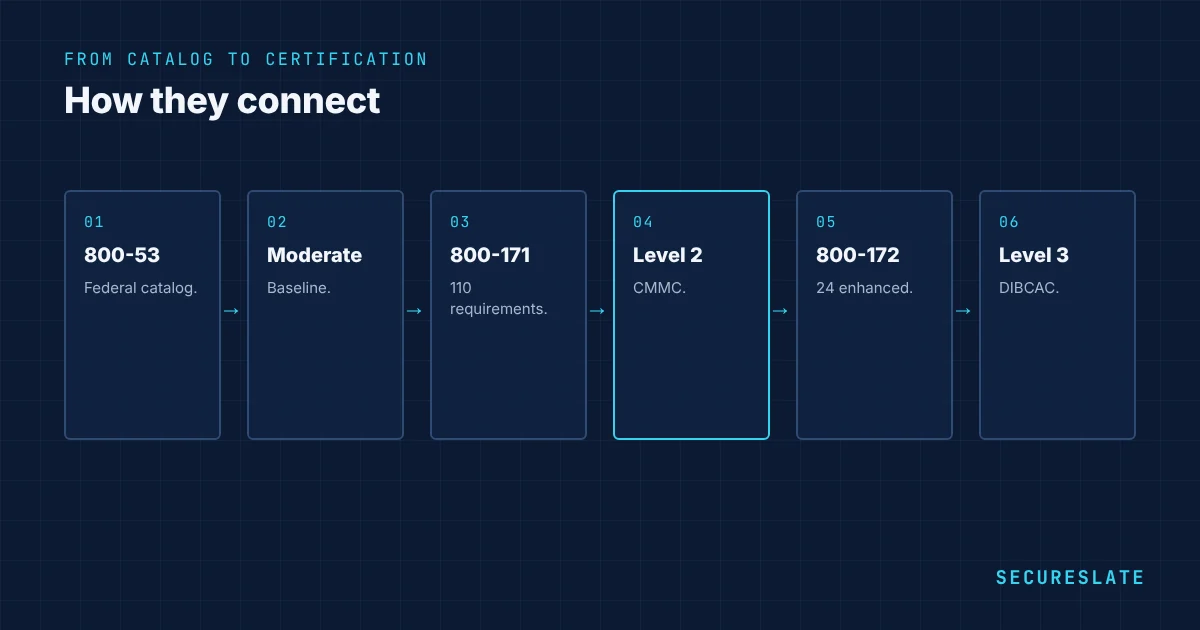
NIST created SP 800-171 to protect CUI when it sits in contractor systems, which are not federal systems and should not have to adopt the full 800-53 catalog. NIST started from the 800-53 Moderate baseline, removed controls that were purely federal, assumed to be already in place in most organizations, or not related to confidentiality of CUI, and rewrote the rest as 110 requirements. Each 800-171 requirement includes a mapping back to the 800-53 controls it came from.
NIST SP 800-172 provides enhanced requirements for CUI associated with critical programs and high value assets, aimed at advanced persistent threats. CMMC Level 3 selects 24 of them.
Note that NIST published 800-171 Revision 3 in May 2024, with 97 requirements in 17 families that align even more closely with 800-53 Rev 5. The CMMC rule currently references Revision 2, so contractors should assess against Rev 2 for CMMC until DoD says otherwise.
Key differences
| Aspect | NIST SP 800-53 | CMMC |
|---|---|---|
| Type | Control catalog and guidance | Certification program with contract requirements |
| Intended for | Federal information systems, and any organization voluntarily | DoD contractors handling FCI or CUI |
| Size | 1,000+ controls and enhancements, tailored by baseline | 15, 110 or 134 fixed requirements |
| Flexibility | Organizations select and tailor controls by risk | Requirements are fixed for each level |
| Families | 20, including privacy and supply chain | 14 families at Level 2 |
| Assessment | Agency assessment under RMF, or 3PAO for FedRAMP | Self-assessment, C3PAO or DIBCAC |
| Scoring | Risk-based authorization decision | DoD assessment methodology, scores from minus 203 to 110 |
| Required by | FISMA, OMB policy, FedRAMP | DFARS clauses and 32 CFR part 170 |
Mapping examples
| NIST SP 800-171 requirement | Topic | Related 800-53 controls |
|---|---|---|
| 3.1.1 | Limit system access to authorized users | AC-2, AC-3, AC-17 |
| 3.3.1 | Create and retain audit logs | AU-2, AU-3, AU-6, AU-11, AU-12 |
| 3.4.1 | Baseline configurations and inventories | CM-2, CM-6, CM-8 |
| 3.5.3 | Multifactor authentication | IA-2 enhancements |
| 3.6.1 | Incident handling capability | IR-2, IR-4, IR-5, IR-6, IR-7 |
| 3.13.11 | FIPS-validated cryptography for CUI | SC-13 |
Use the official NIST mapping tables when you build your own crosswalk, since the exact mappings appear in the publication's appendix.
When you need both
- Cloud providers that serve federal agencies (FedRAMP, based on 800-53) and store CUI for defense contractors.
- Contractors with federal system work that operate systems on behalf of an agency, which brings 800-53, as well as internal systems handling CUI, which brings CMMC.
- Organizations standardizing on 800-53 as an internal control framework while needing CMMC certification for DoD contracts.
In these cases, implement controls to the 800-53 baseline your federal work needs, then use the mapping to produce CMMC documentation, scoring and evidence for the CUI scope.
Common mistakes
- Assuming an 800-53 based ATO or FedRAMP authorization automatically gives you a CMMC status.
- Using 800-171 Revision 3 numbering for a CMMC assessment that still uses Revision 2.
- Ignoring the 320 assessment objectives in NIST SP 800-171A, which define how CMMC assessors test each requirement.
- Treating 800-53 privacy controls as CMMC requirements. They are not part of CMMC Level 2.
Families compared
| NIST SP 800-171 Rev 2 family (CMMC Level 2) | Matching NIST SP 800-53 family |
|---|---|
| Access Control (3.1) | AC |
| Awareness and Training (3.2) | AT |
| Audit and Accountability (3.3) | AU |
| Configuration Management (3.4) | CM |
| Identification and Authentication (3.5) | IA |
| Incident Response (3.6) | IR |
| Maintenance (3.7) | MA |
| Media Protection (3.8) | MP |
| Personnel Security (3.9) | PS |
| Physical Protection (3.10) | PE |
| Risk Assessment (3.11) | RA |
| Security Assessment (3.12) | CA |
| System and Communications Protection (3.13) | SC |
| System and Information Integrity (3.14) | SI |
800-53 families with no direct 800-171 Rev 2 family include Contingency Planning, Planning, Program Management, PII Processing and Transparency, System and Services Acquisition, and Supply Chain Risk Management. Some of their content appears in 800-171 Rev 3, which added planning, system and services acquisition and supply chain risk management families.
How to build a crosswalk
- Start from the NIST SP 800-171 Rev 2 requirement list and its appendix mapping to 800-53.
- For each 800-171 requirement, list the 800-53 controls you already implement and test.
- Note differences in parameters, such as password rules or log retention periods, and use the stricter value.
- Mark which evidence supports both frameworks so it is collected once.
- Keep CMMC-only items, such as SPRS scoring and the affirmation process, as separate tasks.
How SecureSlate helps
SecureSlate lets smaller contractors manage NIST SP 800-171 for CMMC alongside other frameworks. Multi-framework mapping links controls across NIST standards, continuous monitoring checks cloud, identity and device settings, and audit management organizes evidence for assessors, without the cost of an enterprise GRC suite.
FAQ
Is CMMC based on NIST 800-53?
Indirectly. CMMC Level 2 uses NIST SP 800-171, whose requirements were derived from the NIST SP 800-53 Moderate baseline. Level 3 adds requirements from NIST SP 800-172, which also traces to 800-53.
Does NIST 800-53 compliance mean CMMC compliance?
Not automatically. You may meet most of the technical requirements, but CMMC needs its own SSP, scoring, scope and assessment.
How many controls are in NIST 800-53 vs CMMC Level 2?
NIST SP 800-53 Rev 5 has more than 1,000 controls and enhancements, with the Moderate baseline using several hundred. CMMC Level 2 has 110 requirements.
Which revision of NIST 800-171 does CMMC use?
The CMMC rule references NIST SP 800-171 Revision 2. Revision 3 was published in 2024 but has not replaced Revision 2 for CMMC assessments.
Who uses NIST 800-53?
Federal agencies, FedRAMP cloud providers, contractors operating federal systems and private organizations that choose it as a control framework.
Is NIST 800-171 a subset of NIST 800-53?
Effectively yes. The 800-171 requirements were tailored from the 800-53 Moderate baseline for nonfederal systems, so each maps back to one or more 800-53 controls.
Disclaimer (legal note)
Mappings and scopes vary. Use official NIST publications and assessor guidance for authoritative control applicability.
Need compliance without the complexity?
SecureSlate automates ISO 27001, SOC 2, GDPR, HIPAA, and more. Built for growing teams. See it in action.
Find compliance gaps in 30 seconds