
A speak-up culture is what turns whistleblowing policies from compliance theater into early warning. Security and compliance leaders are often asked to "build culture", but culture follows systems: visible leadership, safe channels, and consistent follow-through.
This playbook connects behavioral expectations to operational controls you can measure.
This guide covers:
- Signals that culture is broken (and how to read metrics)
- Leadership and manager accountability
- Communications cadence and training
- Linking culture initiatives to whistleblowing software
Related guides:
- Whistleblower retaliation prevention program
- Internal reporting for remote and hybrid teams
- Whistleblowing programs for fintech and financial services
- Whistleblowing investigation workflow and case management
Key takeaways
- Culture metrics matter. Track reporting rates alongside retaliation complaints and exit interviews.
- Managers make or break speak-up programs. Train them first.
- Closing the loop publicly (within confidentiality limits) builds trust.
- Zero reports isn't always healthy. Benchmark against industry and headcount.
- Software reduces friction. Hard-to-find channels signal performative compliance.
Culture vs channel: both required
| Element | Culture | Channel |
|---|---|---|
| Goal | Trust and psychological safety | Reliable intake and case handling |
| Owned by | CEO + HR + Compliance | Compliance / Legal + IT |
| Measured by | Surveys, exit themes, manager feedback | Volume, time-to-triage, closure rates |
| Failure mode | "Values poster" only | Unused web form |
Leadership behaviors that increase reporting
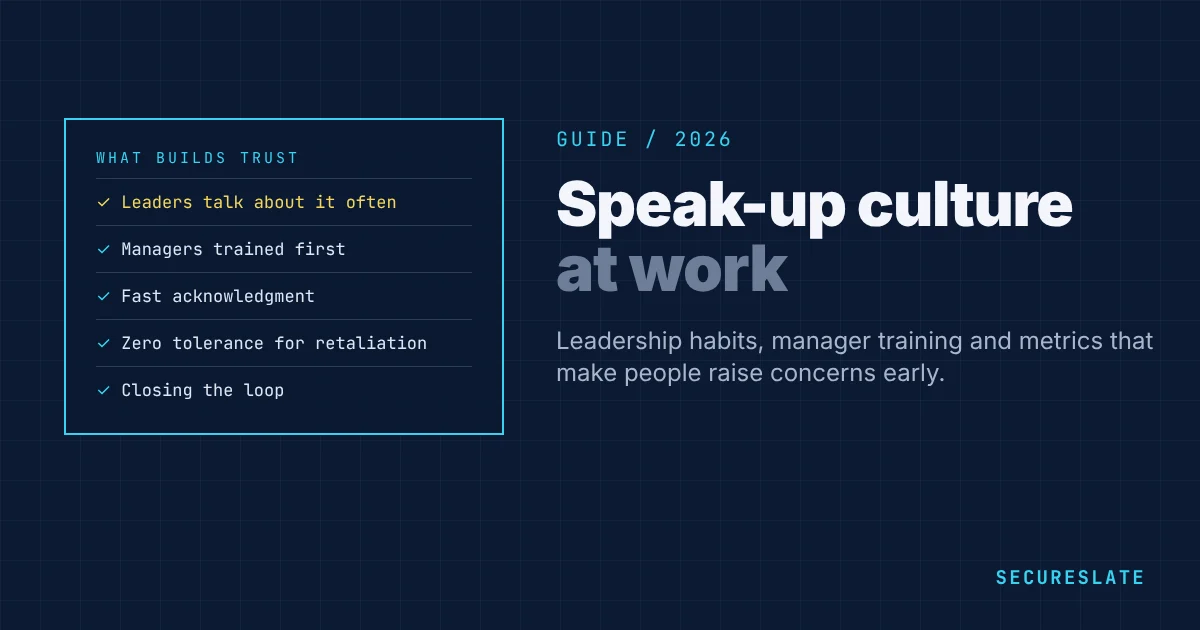
- Executives reference speak-up in all-hands, not only during scandals
- Non-retaliation stories (appropriate anonymized examples) shared by HR
- Fast acknowledgment when issues surface. Slow response kills future reports
- Zero tolerance for retaliation, enforced visibly
12-month speak-up culture playbook
| Quarter | Initiative | Success metric |
|---|---|---|
| Q1 | Launch policy + SecureSlate channel + manager training | 100% manager completion |
| Q2 | Pulse survey on psychological safety | Baseline score |
| Q3 | Tabletop investigation + communications drill | SLA met in exercise |
| Q4 | Leadership program review + improvements | Documented actions |
Pair culture work with SecureSlate Whistleblowing module metrics so the board sees operational proof, not slogans.
Why a speak-up culture matters
Employees often see problems first: a security shortcut, a falsified record, harassment, or a supplier cutting corners. When they feel safe to raise concerns early, the organization can fix issues while they are small. When they do not, problems surface later through customers, regulators, the press or a lawsuit.
A speak-up culture also supports compliance. The EU Whistleblowing Directive requires internal reporting channels for organizations with 50 or more workers in EU member states, and frameworks such as SOC 2 and ISO 27001 expect a way for staff to report concerns and security events. A channel only works if people trust it.
Signs your culture is not working
- Very few reports, or none at all, from a company with dozens of employees
- Issues come to light through exit interviews or social media instead of internal channels
- Employees say they reported something but nothing happened
- Reports arrive only anonymously and never through managers
- Managers react defensively when concerns are raised in meetings
- Engagement surveys show low trust in leadership or fear of consequences
Train managers first
Most concerns are raised informally with a direct manager before any formal channel is used. How that manager responds decides whether the employee speaks up again. Give every manager short, practical training that covers:
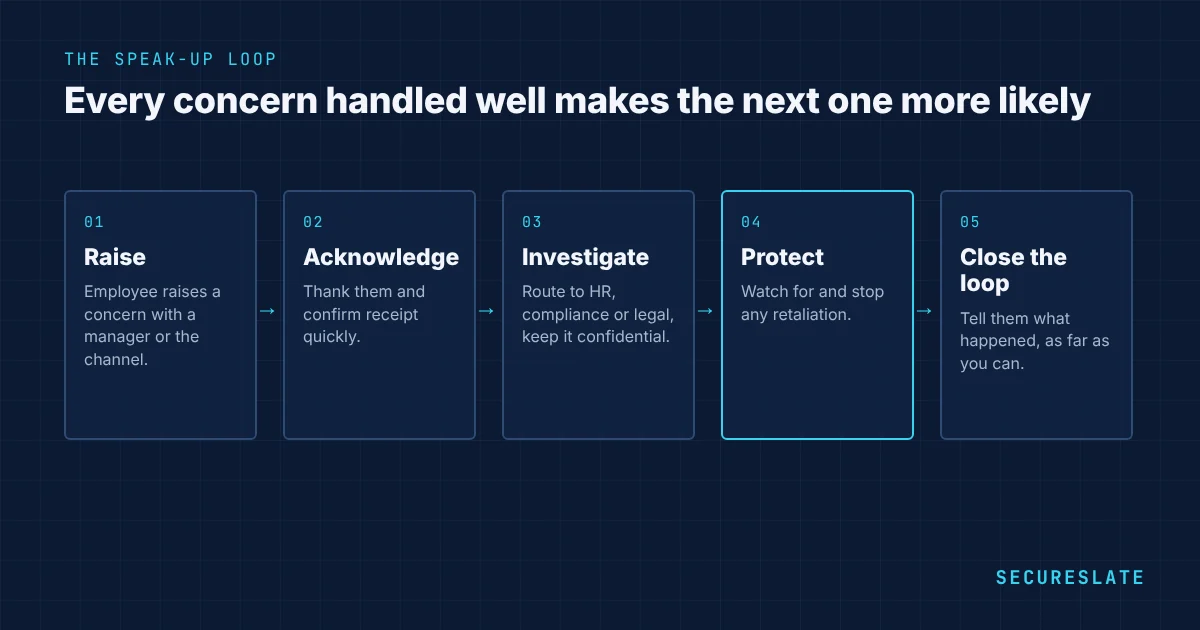
- Listen and thank. Thank the person for raising the concern, even if it turns out to be unfounded.
- Do not investigate alone. Know when to pass the concern to HR, compliance or legal.
- Protect confidentiality. Share details only with people who need to know.
- Prevent retaliation. Watch for exclusion, changed assignments or poor reviews after someone speaks up.
- Close the loop. Tell the person, as far as confidentiality allows, what happened as a result.
Role-play exercises work better than slides. Ten minutes of practice responding to a difficult concern teaches more than an hour of policy reading.
Metrics to track
| Metric | What it tells you |
|---|---|
| Reports per 100 employees per year | Whether people use the channels at all |
| Share of named versus anonymous reports | How much people trust that they will not face retaliation |
| Time to acknowledge and time to close | Whether the organization takes reports seriously |
| Substantiation rate | Whether reports are meaningful, and whether investigations are thorough |
| Retaliation complaints | Whether protections work in practice |
| Survey score on feeling safe to speak up | The underlying level of trust |
Rising report numbers are usually a good sign at first: they show people trust the process. Review the metrics with leadership at least quarterly.
Operationalize culture with SecureSlate
Culture programs fail when reporting is hard. SecureSlate makes speak-up operational.
SecureSlate's Whistleblowing module helps compliance, HR, and legal teams operationalize speak-up programs without stitching together email, spreadsheets, and third-party hotlines:
- Employee-friendly Whistleblowing intake accessible from any device
- Training + attestation tracking tied to speak-up policy
- Case SLAs so leadership can monitor responsiveness
- Dashboards for quarterly culture and compliance reviews
- Demo to see how channels fit your employee journey
Because whistleblowing sits inside SecureSlate's broader GRC platform, you can connect reports to risk registers, policy attestations, training records, and audit evidence, so investigations produce proof, not just notes.
Get started for free: Create your SecureSlate account
Prefer a walkthrough? Book a demo to see the Whistleblowing module with your frameworks and workflows.
FAQ: speak-up culture
Will launching a channel increase complaints?
Volume may rise initially. That often means visibility improved, not that misconduct increased.
Who should communicate the program?
CEO or senior leader for launch; managers reinforce locally; compliance owns content accuracy.
How does SecureSlate support culture?
It lowers reporting friction and gives leaders metrics to prove the program works.
What is a speak-up culture?
It is a workplace where employees feel safe and encouraged to raise concerns about misconduct, safety, security or ethics, and trust that their concern will be handled fairly and without retaliation.
How do you measure a speak-up culture?
Combine channel data, such as report volume, anonymous share and response times, with survey questions about whether employees feel safe to raise concerns and believe action will follow. Retaliation case counts and exit interview themes add useful context.
Is a speak-up policy the same as a whistleblowing policy?
They overlap. A whistleblowing policy covers formal reports of serious wrongdoing and the legal protections that apply. A speak-up policy is usually broader and encourages raising any concern early, through managers or formal channels.
What should a manager do when an employee raises a concern?
Listen without interrupting, thank the person, avoid promising an outcome you cannot guarantee, and pass the concern to HR, compliance or legal if it may involve misconduct. Afterwards, check in with the employee and watch for any signs of retaliation from colleagues.
How long does it take to build a speak-up culture?
Expect at least a year of consistent effort. Trust grows as employees see concerns handled fairly and quickly, and as leaders talk about speaking up regularly, not only after a scandal.
Disclaimer (legal note)
SecureSlate is not a law firm, and this article does not constitute or contain legal advice or create an attorney-client relationship. When determining your obligations and compliance with respect to relevant laws and regulations, you should consult a licensed attorney.
Need compliance without the complexity?
SecureSlate automates ISO 27001, SOC 2, GDPR, HIPAA, and more. Built for growing teams. See it in action.
Find compliance gaps in 30 seconds
