
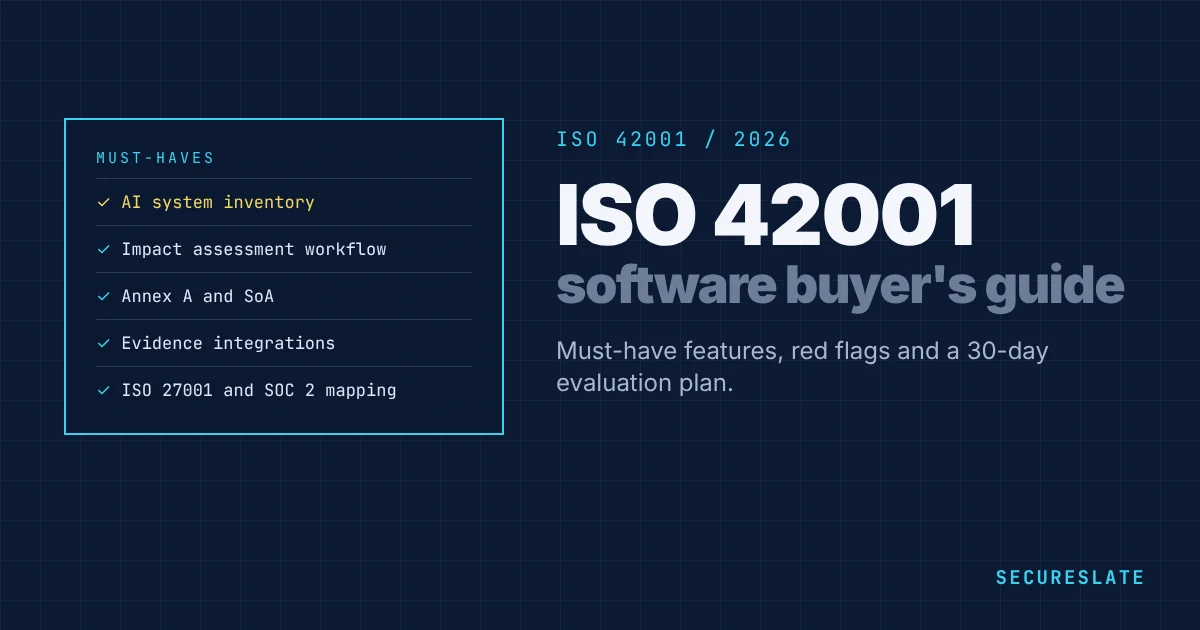
The right ISO 42001 compliance software connects AI governance controls to evidence from engineering, security, and HR systems, reducing manual work across certification and surveillance cycles.
Related: 7 best compliance software for SaaS · Collection
Key takeaways
- Prefer platforms with ISO 42001 control libraries and SoA workflows, not generic checklists only.
- Validate integrations (cloud, IdP, Git, ticketing, HR).
- If you run ISO 27001 / SOC 2, demand cross-framework mapping.
- Run a pilot exporting auditor-ready evidence.
Evaluation criteria
| Criterion | Why it matters |
|---|---|
| AIMS / Annex A mapping | Tracks AI-specific controls |
| Model & vendor inventory | Scope and third-party AI risk |
| Evidence automation | Type 2 and surveillance efficiency |
| Risk workflows | Links risks to controls and owners |
| Auditor collaboration | Secure sharing, request tracking |
Questions to ask vendors
- How do you support ISO 42001:2023 Annex A out of the box?
- Can we map EU AI Act obligations alongside 42001?
- How is AI agent governance represented?
- What is continuous vs point-in-time testing?
- How do you price at our stage (startup vs enterprise)?
What ISO 42001 software needs to do
ISO/IEC 42001:2023 is the standard for an AI management system (AIMS). Like ISO 27001, it combines management clauses (context, leadership, planning, support, operation, performance evaluation and improvement) with an Annex A control set, here 38 controls focused on AI. Good software should support the whole system, not only the control list:
- AI system inventory: every AI system you build, buy or use, with its owner, purpose and risk level
- AI risk assessment and AI system impact assessment: the standard expects you to assess risks to the organization and the potential impact of AI systems on individuals and society
- Statement of Applicability: all Annex A controls with applicability, justification and status
- Policies and roles: an AI policy, defined responsibilities and evidence that staff understand them
- Lifecycle evidence: data quality checks, testing and validation, deployment approvals and monitoring records
- Supplier management: due diligence on third-party models and AI services
- Internal audit and management review: planning, findings and corrective actions
Must-have versus nice-to-have
| Must-have | Nice-to-have |
|---|---|
| ISO 42001 clauses and Annex A control library | AI-assisted policy drafting |
| AI system inventory linked to risks and controls | Model cards generated from your repository |
| Impact assessment workflow | Automatic mapping to the EU AI Act |
| Evidence collection from cloud, code and ticketing tools | Built-in AI red-teaming |
| Mapping to ISO 27001 and SOC 2 if you already run them | Public trust center for AI practices |
| Auditor access and evidence export | Board reporting dashboards |
If you already hold ISO 27001, cross-framework mapping is the feature that saves the most time. Many ISO 42001 management clauses mirror ISO 27001, so one internal audit, one management review and one document control process can serve both.
Red flags when evaluating vendors
- The ISO 42001 module is only a checklist of control names, with no impact assessment or AI inventory
- No clear answer on how evidence from your engineering tools reaches the platform
- Pricing that charges again for controls you already cover under ISO 27001
- No customers who have completed an ISO 42001 certification audit using the product
- Vague claims of "AI compliance" without naming the standard or the clauses covered
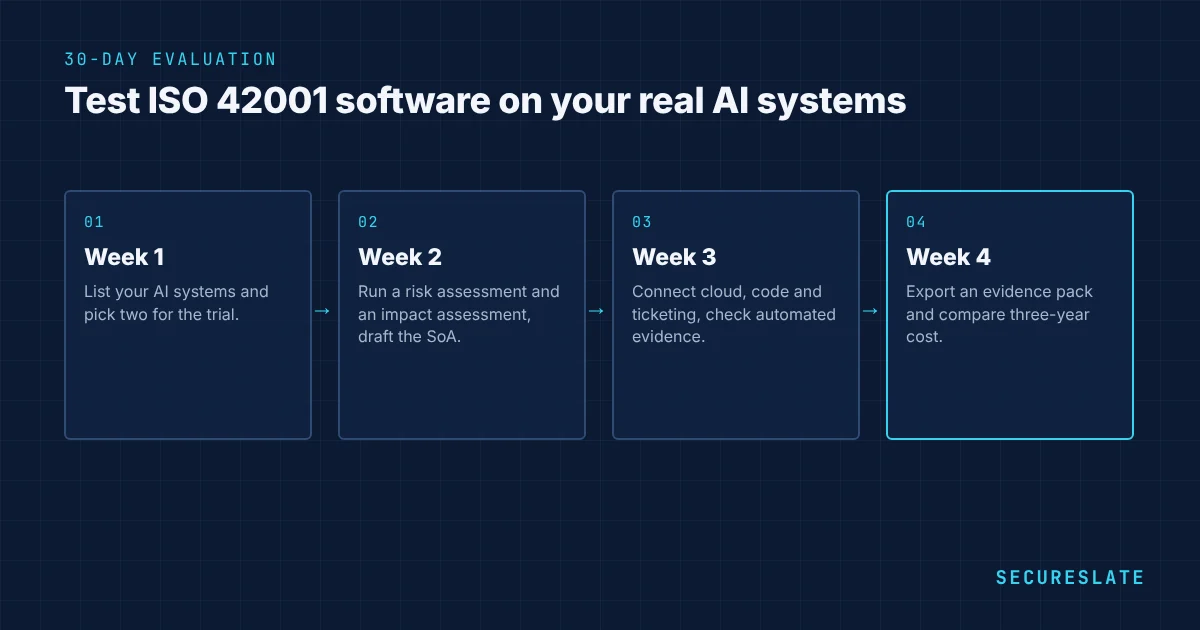
A 30-day evaluation plan
- Week 1: list your AI systems and pick two to use in the trial, ideally one you build and one you buy.
- Week 2: load them into each shortlisted platform, run a risk assessment and an impact assessment, and draft your SoA.
- Week 3: connect your cloud, code repository and ticketing tools and check what evidence arrives automatically.
- Week 4: export an evidence pack for a few controls, show it to your certification body or an advisor, and compare total cost over three years.
Pick the platform your team actually used during the trial, not the one with the best demo.
Spreadsheets versus a platform
Small teams sometimes start ISO 42001 with spreadsheets and shared documents. That can work for a first gap assessment, but it gets harder as the program grows.
| Spreadsheets and documents | Compliance platform | |
|---|---|---|
| Cost | Free to start | Subscription |
| AI system inventory | Manual list, easily out of date | Linked to owners, risks, controls and evidence |
| Evidence | Screenshots and files collected by hand | Collected from connected systems on a schedule |
| Multiple frameworks | Separate trackers per standard | One control set mapped to ISO 42001, ISO 27001, SOC 2 and others |
| Audit | Evidence assembled before each audit | Auditor access to organized, dated evidence |
| Best for | One or two AI systems, first year only | Several AI systems or more than one framework |
Who will use the software
ISO 42001 touches more teams than most security standards, so check that the software works for each of them:
- Compliance or GRC lead: runs the program, the SoA, internal audits and management reviews
- Engineering and data science: record model development, testing, validation and monitoring evidence
- Product: owns intended use, user information and transparency
- Legal and privacy: reviews impact assessments, contracts and regulatory obligations such as the EU AI Act
- Procurement and security: assess third-party AI suppliers
- Leadership: approves the AI policy, risk acceptance and management review outcomes
If engineers have to leave their usual tools to log evidence, they will stop doing it. Prefer integrations with the code repository, ticketing and cloud tools your teams already use.
Budgeting for ISO 42001
Plan for three cost areas: the software, the certification audit by an accredited certification body, and internal time. Ask each vendor whether ISO 42001 counts as an extra framework on your plan or is included, and whether controls you already cover under ISO 27001 are charged again. SecureSlate publishes its plans, with Starter at $2,688 a year for one framework, so you can compare before a sales call. See pricing.
SecureSlate
SecureSlate supports multi-framework programs including ISO 42001, ISO 27001, and SOC 2 with shared evidence.
See how SecureSlate's ISO 42001 compliance software pairs the platform with a dedicated compliance lead.
FAQ
Do I need software to get ISO 42001 certified?
No. The standard does not require any tool. Software saves time on inventories, assessments, evidence and audits, especially if you also run ISO 27001 or SOC 2.
Can one platform handle ISO 42001 and ISO 27001 together?
Yes, and it is usually the most efficient approach. The management clauses overlap heavily, and many controls such as access, supplier management and incident handling can share evidence.
How long does ISO 42001 certification take?
Organizations that already run ISO 27001 often need three to six months. Starting from scratch, six to twelve months is more typical, depending on how many AI systems are in scope.
What should an ISO 42001 trial prove?
By the end of a trial you should have at least two AI systems in the inventory, a completed impact assessment, a draft Statement of Applicability and a sample evidence export. If the platform cannot get you there in a few weeks, it will not get easier after you sign.
Disclaimer (legal note)
Vendor selection is situational. SecureSlate is our product. Validate claims in evaluation.
Need compliance without the complexity?
SecureSlate automates ISO 27001, SOC 2, GDPR, HIPAA, and more. Built for growing teams. See it in action.
Find compliance gaps in 30 seconds
