
Short answer: To prepare for a compliance audit, confirm the scope and criteria with your auditor, check that policies are approved and current, verify that each control has an owner and recent evidence, run a readiness review to find and fix gaps, brief the people who will be interviewed, and organize evidence so every request can be answered quickly.
Related guides: How to prepare for a SOC 2 audit · Audit evidence requests · Audit readiness checklist
Key takeaways
- Preparation has six areas: scope, policies, controls, evidence, people and logistics. Weakness in any one slows the audit.
- Agree scope and the audit period in writing before collecting anything. Most wasted effort comes from preparing the wrong things.
- Auditors test whether you do what your policies say. Align the two before fieldwork, in whichever direction is honest.
- Find your own gaps first with a readiness review, while there is still time to fix them.
- The audit does not end with the closing meeting. Remediation and the next cycle start there.
What is a compliance audit, and what will the auditor check?
A compliance audit is an independent examination of whether your organization meets a defined set of requirements, based on evidence. The requirements may come from a standard such as ISO 27001, attestation criteria such as SOC 2, a regulation such as HIPAA or GDPR, or a contract.
Whatever the framework, the auditor is trying to answer three questions about each requirement:
- Is there a control? A documented policy, process or technical measure that addresses the requirement.
- Is it designed properly? If it works as described, would it meet the requirement?
- Did it operate? Is there evidence it worked, consistently, during the period under review?
The format of the audit varies, and that changes how you prepare.
| Audit type | Who performs it | What you receive | Preparation emphasis |
|---|---|---|---|
| SOC 2 Type 1 or Type 2 | Licensed CPA firm | Attestation report | System description, control design and, for Type 2, evidence across the whole period |
| ISO 27001 certification | Accredited certification body | Certificate after a two-stage audit | Management system documents, risk assessment, Statement of Applicability, internal audit and management review |
| HIPAA assessment or regulator review | Independent assessor, or the regulator in an investigation | Assessment report, or regulator findings | Risk analysis, safeguards, business associate agreements, training and incident records |
| PCI DSS assessment | Qualified Security Assessor, or self-assessment where permitted | Report on Compliance or Self-Assessment Questionnaire | Cardholder data environment scope and requirement-by-requirement evidence |
| Customer or contractual audit | The customer or a firm it appoints | Findings letter | The specific contract clauses and security schedule |
HIPAA has no official certification. A HIPAA "audit" is usually either a voluntary third-party assessment or a review by the HHS Office for Civil Rights.
What should a compliance audit checklist cover?
A complete checklist covers six areas, and each should be confirmed before fieldwork begins.
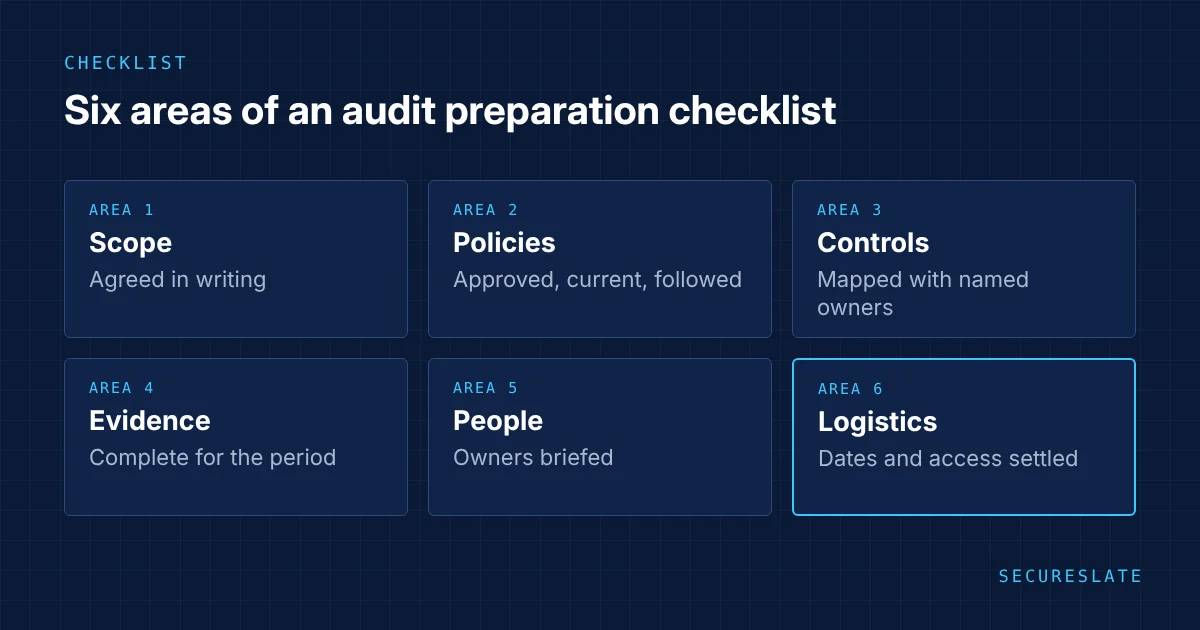
| Area | What "ready" looks like |
|---|---|
| Scope | Framework, criteria, entities, systems, locations and period agreed in writing with the auditor |
| Policies | Approved, dated, reviewed within the last year, acknowledged by staff and consistent with practice |
| Controls | Every requirement mapped to a control with a named owner |
| Evidence | Current, complete, labeled by control and covering the whole audit period |
| People | Control owners briefed, a single audit coordinator named, executives aware |
| Logistics | Dates, auditor access, request list process and communication channel settled |
The sections below turn each area into checklist items.
Checklist part 1: Have you defined scope and chosen the auditor?
Scope is ready when you and the auditor would give the same answer about what is being audited. Work through these items first:
- Confirm the framework and version, and for SOC 2 the Trust Services Criteria categories in scope.
- Define the audit period or the point-in-time date.
- List in-scope products, legal entities, offices, cloud accounts and environments.
- List key vendors and subprocessors that support in-scope systems, and how each is covered.
- Draw or update the system and data flow diagrams.
- Record justified exclusions, such as the ISO 27001 Statement of Applicability.
- Select the auditor, check their accreditation or licence for the framework, and sign the engagement letter. See how to choose an information security auditor.
- Agree the timeline, the request list format and how evidence will be shared.
Checklist part 2: Are policies and controls in place and owned?
Policies and controls are ready when each requirement has a written rule, a working control and a person responsible for it.
- Map every requirement in the framework to at least one control. Note any that do not apply and why.
- Assign a named owner to each control.
- Check that each policy is approved by management, dated and reviewed within your stated review cycle.
- Confirm that staff have acknowledged the policies that apply to them.
- Read each policy against practice. Where the policy promises something you do not do, either change the practice or correct the policy through proper approval.
- Confirm that the risk assessment is current and that treatment plans have owners and dates.
- Check completion of security awareness training for everyone in scope.
- Confirm that scheduled activities took place in the period: access reviews, vulnerability scans, penetration test, backup restore test, incident response exercise, vendor reviews.
- For ISO 27001, confirm the internal audit and management review are complete and documented, as required by clauses 9.2 and 9.3 of ISO 27001.
- Review open findings from the last audit and record what was done about each.
Checklist part 3: What evidence should you gather before the audit?
Gather evidence that shows each control operating during the audit period, organized by control so that any request can be answered without a search. The list an auditor sends, often called a request list or PBC list, will look broadly like this.
| Control area | Typical evidence |
|---|---|
| Governance | Policies with approval records, organization chart, roles and responsibilities, management meeting minutes |
| Risk management | Risk assessment, risk register, treatment plans |
| Human resources | Lists of joiners and leavers in the period, background check records where applicable, signed confidentiality terms, training completion |
| Access control | User lists for key systems, access request approvals, leaver access removal records, access review records, MFA settings |
| Change management | List of production changes in the period, with review, testing and approval for sampled changes |
| Operations | Backup configuration and restore test, monitoring and alert records, capacity or availability reports |
| Vulnerability management | Scan reports, penetration test report, remediation tickets |
| Incident response | Incident response plan, incident log, post-incident reviews, exercise record |
| Vendor management | Vendor inventory, due diligence records, contracts with security and privacy terms |
| Endpoint and network | Device inventory, encryption and patch status, firewall or security group configuration |
| Privacy, where in scope | Records of processing, privacy notices, data subject request log, data processing agreements |
Three rules keep evidence usable:
- Provide populations, not just samples. The auditor selects samples from complete lists, so export full lists from the source system and show how they were generated.
- Show dates and sources. Screenshots should include the system name, date and time. System exports are preferable.
- Cover the whole period. Evidence only from the last month does not support a twelve-month report.
How far ahead should you start preparing?
Start early enough to fix what you find. The sequence below is typical for a small or mid-sized company with controls already in place. In our experience, a first audit needs considerably more lead time, because controls must be implemented and, for period-based audits, must operate for the whole period first.
| Phase | Actions |
|---|---|
| About three months before fieldwork | Confirm scope and auditor, sign the engagement, name the audit coordinator, run a readiness review against every requirement |
| About two months before | Remediate gaps, update and approve policies, complete overdue reviews, training and tests |
| About one month before | Collect and organize evidence, export populations, brief control owners, confirm dates and access |
| Final two weeks | Dry run of likely interview questions, check that nothing has lapsed, confirm the walkthrough schedule |
| Fieldwork | Answer requests promptly, track every item, hold short daily check-ins with the auditor |
| After fieldwork | Review the draft report for factual accuracy, agree remediation plans, schedule the next cycle |
What should you do during and after the audit?
During the audit, give accurate, direct answers quickly and keep one person in charge of all communication. After it, treat findings as work to be planned, not as a verdict.
During fieldwork
- Route all requests through the audit coordinator and log each one with an owner and status.
- Answer the question asked. Extra material creates extra questions.
- Have control owners explain their own processes in walkthroughs, and let them say "I will confirm and come back to you" rather than guess.
- If a control failed during the period, say so and show what you did about it. Auditors respond better to a known, corrected lapse than to one they discover.
- Never create or backdate evidence. It is dishonest, it can end the engagement, and auditors are practised at spotting it.
- Raise disagreements about a finding early, with evidence, before the draft report.
After fieldwork
- Check the draft report for factual errors in the system description, scope and findings.
- For each exception or nonconformity, record the root cause, the fix, an owner and a date. Our guide to SOC 2 audit exceptions explains how exceptions appear in a report.
- Provide a management response where the report format allows one.
- Put next year's control activities on a calendar now, so preparation becomes routine.
How SecureSlate helps
SecureSlate helps you prepare for and manage audits. It does not perform audits or issue certifications, and you remain free to choose your auditor.
- Multi-framework control mapping: built-in frameworks including SOC 2, ISO 27001, HIPAA, HITRUST, GDPR, PCI DSS and NIST CSF, with controls mapped across them so one piece of evidence serves several audits. Other requirements can be set up as a custom framework.
- Agentless, read-only cloud integrations and a device agent: collect configuration and endpoint evidence without screenshots.
- Access reviews and vendor risk management: produce the review and due diligence records auditors request.
- Risk management: keep the risk register and treatment plans current.
- Audit management: track requests, link evidence to controls and give the auditor organized access.
- Trust center: share the resulting report or certificate with customers in a controlled way.
Start a free trial to see which checklist items you already cover.
FAQ
How long does it take to prepare for a compliance audit?
It depends on the framework and how mature your controls are. A company with controls already operating can often prepare in two to three months. A first audit takes longer, because controls must be designed, implemented and, for period-based audits, run for the full observation period.
What documents do auditors ask for first?
Usually the scope or system description, the policy set, the risk assessment, an organization chart, the asset or system inventory, and lists of employees, vendors and changes for the period. Sample-based requests follow from those lists.
What happens if the auditor finds a gap?
The result depends on the framework. In SOC 2 it appears as an exception and may affect the auditor's opinion if serious. In ISO 27001 it is raised as a nonconformity that needs corrective action, and a major one must be resolved before certification. In all cases you document the cause and the fix.
Can we fix issues during the audit?
You can fix them going forward, and you should. A fix does not change the fact that a control failed earlier in the period, so the lapse may still be reported for period-based audits. Prompt correction is still viewed more favorably than inaction.
Should we do a readiness assessment before the real audit?
Yes, especially for a first audit or a new framework. A readiness assessment, whether done internally or by an outside firm, finds gaps while there is still time to remediate and makes fieldwork shorter.
Disclaimer (legal note)
This article is for general information only and is not legal, regulatory, or professional advice. Requirements vary by framework, industry, and jurisdiction. Consult qualified advisors for your specific obligations.
Need compliance without the complexity?
SecureSlate automates ISO 27001, SOC 2, GDPR, HIPAA, and more. Built for growing teams. See it in action.
Find compliance gaps in 30 seconds