
Short answer: Integrating whistleblowing with GRC means connecting what reports reveal to your risk register, controls, policies and audit evidence, while keeping the reports themselves and the reporter's identity in a restricted case system. Only de-identified outcomes, such as a new risk, a control gap or a remediation task, should flow into the wider GRC platform.
Related guides: How to implement a whistleblowing policy · ISO 27001 whistleblowing controls and evidence · Board oversight of whistleblowing
Key takeaways
- Integration is about outcomes, not raw reports: risks, control failures, policy changes and training needs move into GRC, while case files stay restricted.
- A standalone hotline with no link to GRC tends to leave systemic issues unaddressed and creates evidence gaps at audit time.
- Choose an integration model that matches your size and existing contracts: native, connected through an API, or a documented manual handoff.
- Protect identity by design: separate roles, minimal fields in shared records and logged access, in line with confidentiality duties such as Article 16 of the EU Whistleblowing Directive.
- Auditors want to see that the channel exists, works and leads to action, so keep evidence of each step.
What does integrating whistleblowing with GRC mean?
It means treating your speak-up channel as one source of risk and control information inside your governance, risk and compliance program, rather than as a separate ethics tool nobody else sees. A report about expense fraud, a bypassed access control or a vendor paying bribes is evidence that a control or policy may not be working.
In a disconnected setup, the case is closed and the lesson stays in the case file. In an integrated setup, the case handler raises a de-identified finding that becomes a risk entry, a control exception or a remediation task with an owner and a due date. The investigation stays confidential. The improvement becomes part of the program.
Why connect whistleblowing to your GRC program?
Because the same root causes show up in reports, audits, incidents and risk assessments, and you only see the pattern when they live in one place. In our experience, the main benefits fall into four areas.
- Systemic fixes. Repeated reports about the same process point to a design flaw. Linking them to a control makes the flaw visible to control owners.
- Fewer duplicate processes. One access review, one policy attestation cycle and one evidence store, instead of separate ones for the hotline.
- Cleaner audits. SOC 2, ISO 27001 and similar audits ask for evidence that reporting channels exist and that issues are addressed. Integrated records make that easier to show.
- Better board reporting. Audit committees can see speak-up trends next to risk and control status, rather than in a separate pack.
Which integration model fits your team?
Most teams fit one of four models, depending on whether they already have a hotline contract and how much case volume they expect.
| Model | How it works | Best for | Watch out for |
|---|---|---|---|
| Native | Intake and case management sit in the same platform as GRC, with strict role separation | Smaller and mid-sized teams starting fresh | Role design must keep case data restricted |
| API connected | A dedicated hotline tool sends de-identified outcomes to the GRC platform | Teams with an existing hotline contract | Field mapping, so no identifying data crosses over |
| Manual handoff | Case handlers enter findings into GRC under a documented procedure | Low report volumes | Steps get skipped without a checklist and owner |
| Disconnected | Hotline and GRC never meet | Nobody | Systemic issues and evidence gaps |
There is no single right answer. What matters is that the handoff is defined, owned and evidenced. If you use an external hotline provider, treat it as a critical vendor and assess how it stores, encrypts and grants access to case data.
What should flow from a report into GRC?
Only the outcome that the wider program needs to act on, and nothing that identifies the reporter or unnecessarily names the people involved. The flow below shows a typical path from intake to a closed improvement.
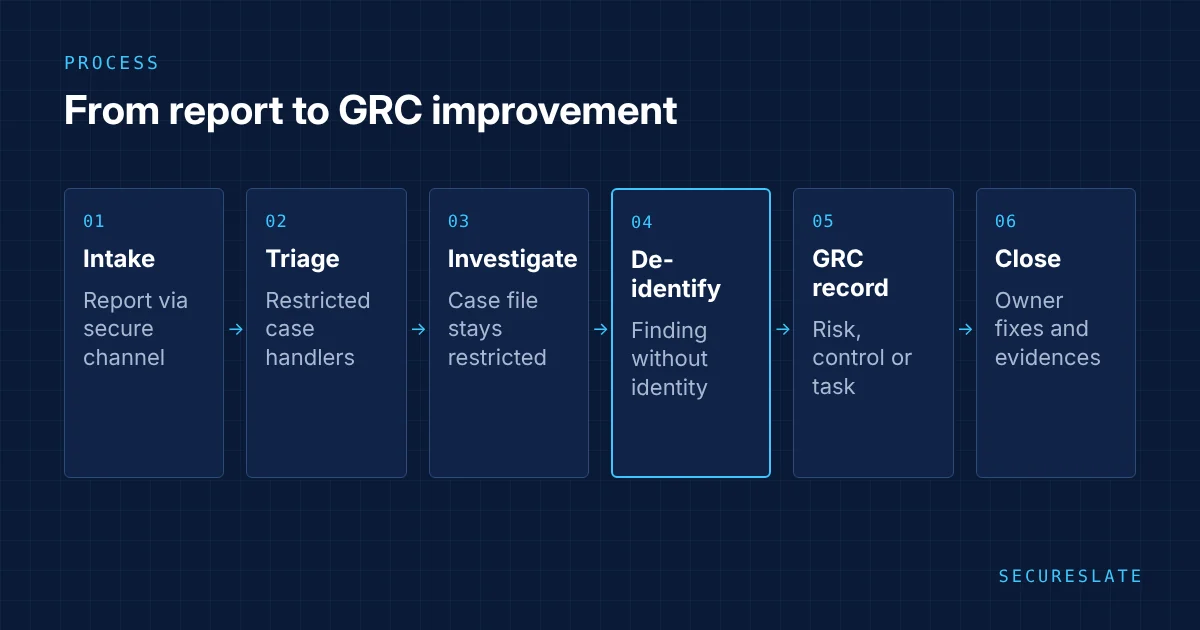
The table shows common report outcomes and where each should land in GRC.
| Report outcome | GRC record created | Example |
|---|---|---|
| A control did not operate | Control exception plus remediation task | Shared admin account used to bypass approval |
| A new or underrated risk | Risk register entry or rating change | Repeated concerns about a high-risk market |
| A policy gap or unclear rule | Policy update and re-attestation | Gifts policy silent on a common situation |
| A vendor issue | Vendor risk reassessment | Supplier reported for data handling failures |
| A training need | Training assignment and completion record | Managers unsure how to respond to concerns |
| A security event | Incident record in your incident process | Report of leaked credentials |
Keep the case reference in the GRC record so authorized handlers can trace the link, but keep the case content in the restricted system. A good risk management workflow then handles ownership, treatment and review.
How do you keep reporter identity out of GRC?
Design the integration so identity never needs to cross over. Under the EU Whistleblowing Directive, Article 16 requires that a reporter's identity is not disclosed beyond authorized staff without explicit consent, subject to narrow legal exceptions, and Article 17 requires that personal data manifestly not relevant to a report is not collected or is deleted without undue delay. GDPR principles such as data minimization (Article 5(1)(c)) point the same way.
| Control | What it looks like |
|---|---|
| Role separation | Case handlers have access to case files; GRC admins and control owners do not |
| Minimal fields | Shared records hold category, finding and owner, never reporter details |
| Generalized wording | "Approval control bypassed in finance" rather than names or dates that point to a person |
| Access logging | Every view of case data is logged and reviewed |
| Periodic access reviews | Confirm only current handlers can open the case system |
| Retention rules | Case data deleted on schedule; GRC records keep only what audits need |
Small teams need extra care: even a de-identified finding can point to the reporter if few people could have known the facts. When in doubt, delay or generalize the GRC entry.
How to integrate whistleblowing with GRC in seven steps
- Agree ownership. Name who runs the channel, who handles cases and who owns the handoff into GRC. Record it in the whistleblowing policy.
- Choose the integration model. Native, API connected or manual handoff, based on your tooling and volume.
- Define the handoff fields. Agree the minimum data that crosses over: case reference, category, finding, affected control or risk, owner and due date.
- Map controls. Link speak-up controls to your frameworks, for example ISO 27001 Annex A 6.8 on information security event reporting and the SOC 2 CC2.2 point of focus on separate communication lines.
- Set access rules. Configure role separation and add the case system to your regular access reviews.
- Test with sample cases. Run test reports end to end and confirm that no identifying data reaches GRC records.
- Report and review. Give the audit committee periodic de-identified metrics and review the process yearly.
What evidence do auditors expect?
Auditors expect proof that the channel exists, that people know about it and that reports lead to action. Integration makes this simpler because the evidence sits next to the controls it supports.
| Framework | Relevant requirement | Typical evidence |
|---|---|---|
| SOC 2 | Trust Services Criteria CC2.2, point of focus on separate communication lines | Policy, channel description, awareness communications, sample case handling |
| ISO 27001 | Annex A 6.8, information security event reporting (ISO 27001) | Reporting procedure, event records, follow-up actions |
| EU Whistleblowing Directive | Article 9 channel and timing rules, Article 18 record keeping | Acknowledgment within seven days, feedback within three months, case records |
| US-listed companies | SEC Rule 10A-3 audit committee complaint procedures | Audit committee approved procedure, reporting to the committee |
For a deeper view of framework mapping, see our compliance automation platform guide.
How SecureSlate helps
SecureSlate is a compliance automation platform. It helps you connect the outcomes of your whistleblowing program to the rest of your GRC work:
- Risk management records risks raised by reports, with owners, treatment plans and review dates.
- Multi-framework control mapping links speak-up controls to built-in frameworks such as SOC 2, ISO 27001 and GDPR, so one set of evidence supports several audits.
- Custom frameworks and controls let you model national whistleblowing laws or internal speak-up standards as a custom framework.
- Access reviews help confirm that only authorized handlers can reach systems holding case data.
- Vendor risk management covers due diligence on an external hotline or case management provider.
- Audit management keeps policies, evidence and auditor requests in one place.
SecureSlate does not perform audits or issue certifications. Start a free trial to see how it fits your program.
FAQ
Should whistleblowing reports be stored in the GRC platform?
The full case file should sit in a restricted case system or a strictly separated area with handler-only access. The GRC platform should hold de-identified outcomes such as risks, control exceptions and tasks.
Can a whistleblowing report become a security incident?
Yes. If a report describes a security event, such as leaked credentials or unauthorized access, route it into your incident response process while keeping the reporter's identity with the case handlers.
Who should own the integration?
Usually the compliance or GRC lead owns the handoff process, with legal or HR owning case handling. The audit committee or board oversees the program as a whole.
Do small companies need to integrate whistleblowing with GRC?
They benefit most from a simple, documented manual handoff. Low volume means a checklist and a named owner are often enough, provided identity protection is designed in.
How should speak-up metrics be reported to the board?
Use de-identified, aggregated metrics such as volume by category, time to acknowledge and close, and actions taken. Avoid details that could identify reporters or subjects.
Disclaimer (legal note)
This article is for general information only and is not legal, regulatory, or professional advice. Requirements vary by framework, industry, and jurisdiction. Consult qualified advisors for your specific obligations.
Need compliance without the complexity?
SecureSlate automates ISO 27001, SOC 2, GDPR, HIPAA, and more. Built for growing teams. See it in action.
Find compliance gaps in 30 seconds