Image from pexels.com
Related guides:
Key takeaways
- What SIEM Solutions Do Best: Security Information and Event Management (SIEM) tools remain one of the most established and trusted technologies in cybersecurity.
- Benefits of SIEM Solutions: Organizations continue to invest in SIEM because of its wide-ranging benefits, particularly in environments that require visibility and accountability.
- Challenges and Limitations of SIEM: Despite its importance, SIEM comes with significant challenges.
The stakes have never been higher. Cybercrime is projected to cost the world $10.5 trillion annually by 2025 (Cybersecurity Ventures). Businesses across every sector are asking the same urgent question:
Which cybersecurity approach will protect us best: SIEM Solutions, SOAR, or XDR?
While each technology plays a unique role, they are often misunderstood or used interchangeably. To make the right choice, organizations must examine how these solutions complement or compete with each other, and where they might fall short.
SIEM Solutions: The Cornerstone of Security Monitoring
What SIEM Solutions Do Best
Security Information and Event Management (SIEM) tools remain one of the most established and trusted technologies in cybersecurity. At their core, SIEM solutions act as the central nervous system of security monitoring , gathering log data from across an organization’s IT infrastructure.
This includes data from servers, applications, endpoints, firewalls, and intrusion detection systems. By aggregating and correlating this information, SIEM helps detect patterns that may indicate suspicious or malicious activity.
For example, a failed login attempt may seem harmless in isolation. But if SIEM correlates hundreds of failed attempts across different accounts within a short time frame, it can flag a potential brute-force attack.
Similarly, SIEM provides analysts with a consolidated dashboard to investigate anomalies, helping reduce the time spent combing through fragmented data.
The value of SIEM extends beyond real-time monitoring. These platforms serve as a historical archive , enabling security teams to reconstruct the timeline of an attack long after the initial breach. This makes them indispensable for incident investigations, audits, and compliance reporting.
In regulated industries such as healthcare and finance, where standards like HIPAA, PCI DSS, or GDPR demand meticulous record-keeping, SIEM plays a critical role in meeting those requirements.
Benefits of SIEM Solutions
Organizations continue to invest in SIEM because of its wide-ranging benefits, particularly in environments that require visibility and accountability:
- Comprehensive visibility: SIEM provides a single pane of glass for monitoring security events across the entire enterprise, making it easier to spot anomalies that would otherwise go unnoticed.
- Compliance support: By maintaining detailed logs and reports, SIEM simplifies the process of proving compliance with regulations such as HIPAA, PCI DSS, SOX, or GDPR.
- Forensic analysis: When a breach occurs, SIEM enables analysts to reconstruct attack timelines, identifying how attackers gained access, what systems were compromised, and what data was exfiltrated.
- Customizable alerts: With flexible rule engines, SIEM can be tailored to flag suspicious activity relevant to an organization’s unique environment.
These features make SIEM a cornerstone technology, particularly for large organizations with complex infrastructures and heavy regulatory obligations.
Challenges and Limitations of SIEM
Despite its importance, SIEM comes with significant challenges. Deployment and maintenance are resource-intensive, often requiring dedicated teams to manage rules, fine-tune alerts, and ensure integrations remain functional. Licensing costs can also be steep, making SIEM a heavy financial commitment.
One of the biggest concerns, however, is alert fatigue. SIEM platforms are notorious for generating a flood of alerts, many of which turn out to be false positives.
According to the Ponemon Institute, nearly 70% of SIEM alerts go unreviewed due to the overwhelming workload placed on analysts. This not only wastes valuable time but can also cause teams to miss genuine threats hidden in the noise.
Moreover, SIEM solutions are inherently reactive. They excel at detecting suspicious activity and recording it, but they lack the ability to respond quickly without being paired with other technologies.
For this reason, many organizations began to complement SIEM with SOAR platforms, which add the missing automation and response layer.
SOAR: Adding Automation to Security Operations
How SOAR Extends Beyond SIEM
While SIEM solutions are great at identifying suspicious patterns, they stop short of providing a rapid response. That’s where Security Orchestration, Automation, and Response (SOAR) platforms enter the picture. SOAR was designed to address one of SIEM’s biggest shortcomings: the slow, manual nature of incident response.
SOAR integrates with SIEM and other security tools, turning raw detection data into actionable workflows. For instance, when SIEM flags a suspicious login, SOAR can automatically trigger a playbook that locks the affected account, notifies the user, and escalates the case to analysts. Instead of waiting hours or even days for human intervention, SOAR executes containment measures within minutes.
This makes SOAR invaluable for organizations where speed and consistency are critical. The platform doesn’t just automate repetitive tasks but also standardizes how incidents are handled across teams, reducing the likelihood of errors or delays.
Benefits of SOAR in Security Operations
The adoption of SOAR has been driven by its ability to reduce the burden on overwhelmed security teams. Some of its most impactful benefits include:
- Automated responses: Routine threats such as phishing, malware alerts, or brute-force attempts can be neutralized automatically.
- Standardized playbooks: Incident response becomes consistent, predictable, and auditable thanks to predefined workflows.
- Seamless integration: SOAR connects with SIEM, Endpoint Detection and Response (EDR) solutions, and even ticketing systems, creating an end-to-end response loop.
- Reduced response times: Some organizations report an 80% reduction in mean time to respond (MTTR) after implementing SOAR.
For businesses struggling with a shortage of skilled security professionals, SOAR acts as a force multiplier , enabling smaller teams to handle a larger volume of incidents with greater efficiency.
Challenges and Limitations of SOAR Platforms
Despite its advantages, SOAR is not a silver bullet. Its effectiveness depends heavily on how well playbooks are defined and maintained. Without robust workflows and integrations, automation can misfireleading to either missed detections or inappropriate responses.
Additionally, the setup and customization process can be time-consuming and requires a team with both technical and operational expertise. Smaller organizations without a mature Security Operations Center (SOC) may find SOAR overkill or too resource-heavy.
XDR: The Next Generation Security Approach
What Makes XDR Different from SIEM and SOAR
Extended Detection and Response (XDR) represents the latest evolution in cybersecurity technology. Unlike SIEM and SOAR, which are often assembled from multiple vendors and require significant integration, XDR is typically delivered as a unified, out-of-the-box platform.
The strength of XDR lies in its ability to connect the dots across multiple layers of the IT environment ; endpoints, networks, cloud workloads, and email systems. Instead of piecing together separate alerts, XDR uses advanced analytics and AI to correlate signals into a single, high-confidence incident.
For example, XDR might detect a phishing email, link it to a suspicious file downloaded on an endpoint, and correlate it with unusual outbound network traffic. Where SIEM might present three separate alerts and SOAR would need to run a playbook, XDR delivers a single, actionable threat case in real time.
Benefits of XDR
XDR’s rise in popularity is driven by several key benefits:
- Cross-layer detection: It monitors endpoints, networks, cloud workloads, and email together, offering broader coverage than siloed tools.
- AI-driven analytics: Machine learning reduces false positives by correlating and prioritizing only the most relevant threats.
- Built-in automation: Response capabilities are integrated, enabling rapid containment of threats without requiring complex playbooks.
- Ease of deployment: Compared to SIEM, which often takes months to configure, XDR platforms can be deployed quickly with fewer resources.
This makes XDR particularly attractive for mid-sized organizations that need strong protection but lack the manpower to manage complex SIEM or SOAR environments.
Challenges and Limitations in Adopting XDR
However, XDR is not without trade-offs. One of its biggest criticisms is vendor lock-in. Many XDR platforms are tied to a single vendor’s ecosystem (e.g., Palo Alto Networks, CrowdStrike, Microsoft). Organizations that prefer a multi-vendor strategy may find themselves constrained.
Another limitation is that XDR, while powerful in detection and response, does not yet provide the compliance depth and long-term log retention of traditional SIEM systems. For industries that require detailed auditing and reporting, SIEM may still be necessary.
In essence, XDR shines as an agile, real-time defense platform, but may fall short in highly regulated or heavily customized environments.
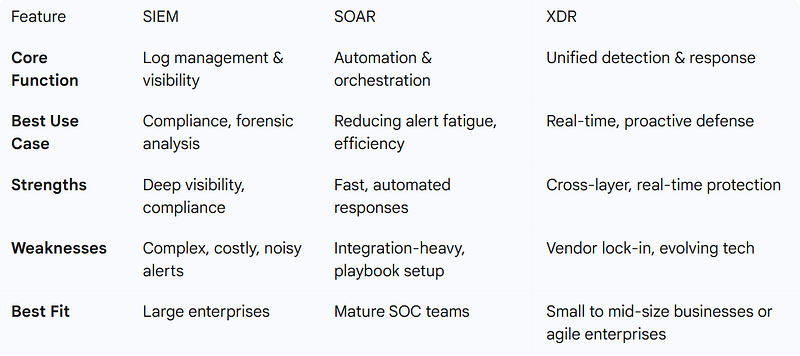
Head-to-Head: SIEM vs. SOAR vs. XDR
Use Cases Across Industries
SIEM in Financial Services
Banks rely heavily on SIEM Solutions for fraud detection and compliance audits. However, the high volume of alerts often requires additional SOAR integration.
SOAR in Enterprise IT Security
Large enterprises use SOAR to scale operations. Automated playbooks allow teams to handle thousands of alerts daily without human bottlenecks.
XDR in Cloud-Native Organizations
Tech startups with lean security teams favor XDR for its plug-and-play simplicity. XDR is particularly effective in hybrid cloud environments.
Which One Actually Protects You Best?
The truth is, no single solution holds the crown. Instead, effectiveness depends on organizational context:
- If compliance and forensic visibility are priorities → SIEM is indispensable.
- If you’re drowning in alerts and need efficiency → SOAR is your lifeline.
- If speed and unified protection are critical → XDR is your best bet.
Many mature enterprises actually deploy all three in tandem, using SIEM for visibility, SOAR for orchestration, and XDR for real-time protection. A layered approach often yields the strongest defense.
As John Oltsik, Senior Principal Analyst at ESG , once said:
“Security is not about buying a silver bullet; it’s about creating a layered ecosystem where tools complement each other.”
Conclusion
Cyber threats are not slowing down. Attackers are getting smarter, faster, and more sophisticated every year. SIEM, SOAR, and XDR each bring unique strengths to the fight: visibility, automation, and unified response.
The best protection lies not in choosing one over the others but in aligning the right solution with your organization’s maturity, resources, and goals. For some, that means adopting XDR as a standalone. For others, it means combining SIEM, SOAR, and XDR into a cohesive ecosystem.
The cyber battlefield is evolving. The question isn’t whether you’ll be attacked; it’s whether you’ll be ready when it happens.
Ready to Streamline Compliance?
Building a secure foundation for your startup is crucial, but navigating the complexities of achieving compliance can be a hassle, especially for a small team.
SecureSlate offers a simpler solution:
- Affordable: Expensive compliance software shouldn’t be the barrier. Our affordable plans start at just $284/month.
- Focus on Your Business, Not Paperwork: Automate tedious tasks and free up your team to focus on innovation and growth.
- Gain Confidence and Credibility: Our platform guides you through the process, ensuring you meet all essential requirements, and giving you peace of mind.
Disclaimer (legal note)
SecureSlate is not a law firm, and this article does not constitute or contain legal advice or create an attorney-client relationship. When determining your obligations and compliance with respect to relevant laws and regulations, you should consult a licensed attorney.
Need compliance without the complexity?
SecureSlate automates ISO 27001, SOC 2, GDPR, HIPAA, and more. Built for growing teams. See it in action.
Find compliance gaps in 30 seconds