
Short answer: GRC stands for governance, risk and compliance. It is the coordinated way a company sets direction and accountability (governance), identifies and manages what could go wrong (risk), and proves it meets laws, contracts and standards (compliance). Done well, the three share one set of owners, controls and evidence instead of running as separate projects.
Related guides: GRC controls · What is GRC engineering · Risk management software
Key takeaways
- Governance decides who is accountable and what the rules are. Risk decides what matters most. Compliance proves the rules are followed.
- GRC is a capability, not a product. Software helps, but policies, owners and decisions come first.
- Most security frameworks, including SOC 2, ISO 27001 and HIPAA, already require all three parts, so a GRC program is often the fastest route to an audit.
- A small company can start with a risk register, a policy set, named control owners and an evidence calendar.
- The biggest gain comes from mapping one control to many frameworks so work is done once.
What does GRC mean?
GRC means managing governance, risk and compliance as one connected system rather than three separate functions.
The term is widely associated with OCEG, a nonprofit that publishes GRC guidance. OCEG defines GRC as the capability, or integrated collection of capabilities, that enables an organization to reliably achieve objectives, address uncertainty and act with integrity. In plain terms: hit your goals, handle the unexpected and keep your promises.
Each letter answers a different question:
| Part | Question it answers | Typical owner | What it produces |
|---|---|---|---|
| Governance | Who decides, and by what rules? | Leadership, board, security lead | Policies, roles, oversight meetings, metrics |
| Risk | What could go wrong, and how bad would it be? | Risk or security owner with business leads | Risk register, risk assessments, treatment plans |
| Compliance | Can we prove we meet our obligations? | Compliance lead with control owners | Controls, evidence, audit reports, questionnaire answers |
In cybersecurity, GRC usually focuses on information security and privacy obligations. In larger enterprises it can also cover financial controls, ethics, health and safety and operational resilience.
How do governance, risk and compliance work together?
Governance sets the direction, risk management decides where to focus, and compliance checks and proves that the agreed controls actually run.
A simple example shows the loop. Leadership approves an information security policy that requires access to production data to be limited and reviewed (governance). A risk assessment finds that former contractors keeping access to a customer database is a high risk (risk). The company adds a control: access is removed within one business day of offboarding and reviewed every quarter, with records kept (compliance). The quarterly review finds two stale accounts. That result goes back to leadership, which decides whether the control needs changing. The loop starts again.
When the three parts are run separately, the same problems repeat:
- Policies are written for an audit and never linked to real risks.
- The risk register is updated once a year and does not drive any decisions.
- Compliance teams collect evidence for each framework from scratch, often asking engineers for the same screenshots several times.
Integration fixes this by giving every control a link to the policy that requires it, the risks it reduces and the frameworks it satisfies.
What are the components of a GRC program?
A working GRC program has six building blocks: policies, a risk register, a control library, evidence, third-party risk and reporting.
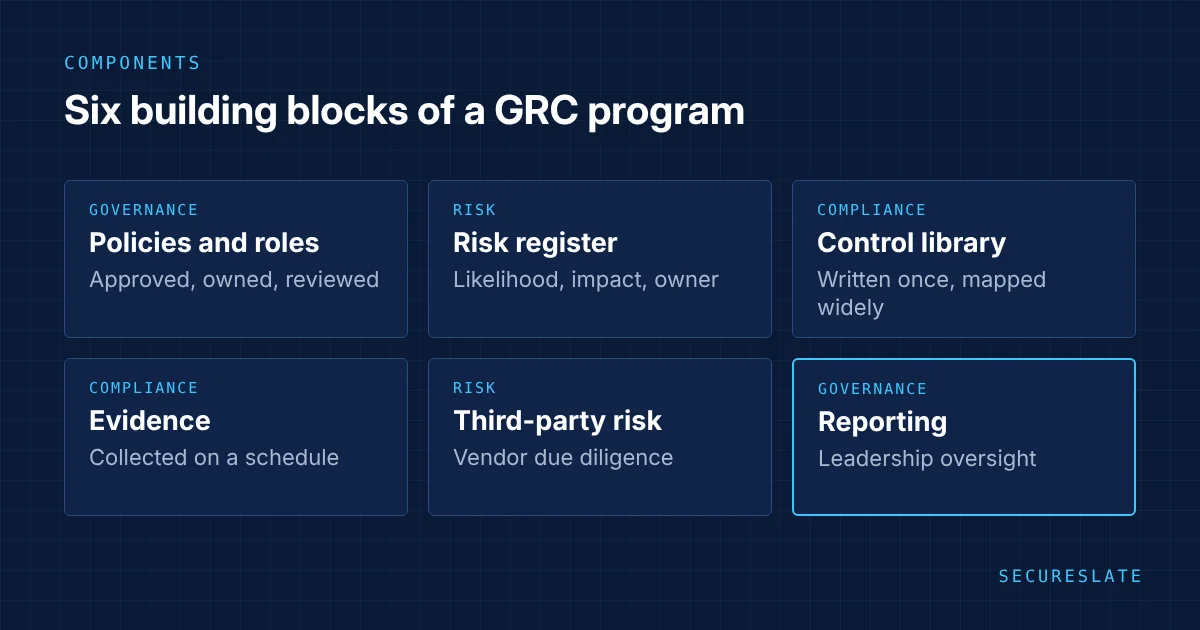
- Policies and roles. A short set of approved policies, such as information security, access control, incident response and vendor management, each with an owner and a review date.
- Risk register. A list of risks with likelihood, impact, owner, treatment decision and review date. For a method, see our guide to cybersecurity risk assessment.
- Control library. The safeguards you operate, written once and mapped to every framework and contract that needs them.
- Evidence. Records that prove controls run, such as access review sign-offs, training completion, backup tests and configuration exports. Evidence should be collected on a schedule, not just before an audit.
- Third-party risk. Due diligence and monitoring for vendors that handle your data or support critical services.
- Reporting and oversight. Regular reporting to leadership on risk status, control failures, open findings and upcoming audits, with decisions recorded.
Small teams do not need a separate department for each block. They need a named owner for each and a regular rhythm for review.
How do security frameworks fit into GRC?
Frameworks define what good looks like, and GRC is the operating system that lets you meet several frameworks with one program.
Most well-known frameworks already expect governance, risk and compliance activity, which is why they map so well to a single program:
| Framework | Governance expectation | Risk expectation | Compliance output |
|---|---|---|---|
| ISO/IEC 27001 | Leadership commitment, policy and roles | Information security risk assessment and treatment | Certificate from an accredited certification body |
| SOC 2 (Trust Services Criteria) | Control environment and oversight criteria | Risk assessment criteria | Attestation report from a CPA firm |
| HIPAA Security Rule | Assigned security responsibility and workforce policies | Risk analysis and risk management | Documented safeguards and records |
| NIST CSF 2.0 | A dedicated Govern function | Identify function and risk strategy | Profiles and improvement plans |
| GDPR | Accountability of the controller | Risk-based security and data protection impact assessments | Records of processing and documented measures |
The overlap is large. An access review, for example, supports SOC 2, ISO 27001 and HIPAA at the same time. A GRC program captures that once and reuses it. If you are choosing between the two most common security frameworks, our comparison of ISO 27001 vs SOC 2 explains the differences.
Why does GRC matter for smaller companies?
For a small or mid-sized company, GRC is less about bureaucracy and more about closing deals and avoiding avoidable incidents.
In our experience, the first push usually comes from customers. An enterprise or healthcare buyer sends a security questionnaire or asks for a SOC 2 report, and the company realizes it has no single place that holds its policies, risks and evidence. Without a GRC approach, each request becomes a scramble.
Other reasons tend to follow:
- Regulation. HealthTech companies handling protected health information have HIPAA obligations. Companies serving EU residents have GDPR obligations. These require documented risk analysis and safeguards, not just good intentions.
- Multiple frameworks. Many growing companies end up with SOC 2, then ISO 27001, then a customer-specific framework. Without shared controls, effort multiplies.
- Better decisions. A maintained risk register helps leadership decide where to spend limited security budget.
- Due diligence. Investors and acquirers increasingly review security and compliance posture.
How do you build a GRC program?
Start small: agree on scope and owners, assess risk, then adopt the controls and evidence routines that address your biggest risks and obligations.
- List your obligations. Write down the laws, contracts and frameworks that apply, such as HIPAA, GDPR, customer security addenda and SOC 2.
- Define scope. Decide which products, systems, data and teams are in scope. Keep it tight for a first audit.
- Assign governance. Name an executive sponsor and a program owner. Set a monthly or quarterly review meeting.
- Run a risk assessment. Identify assets and threats, rate likelihood and impact, and choose a treatment for each risk: reduce, transfer, avoid or accept.
- Write core policies. Keep them short and true to how you actually work. Get them approved and acknowledged by staff.
- Build the control library. Choose controls that address your risks and map each one to every framework it satisfies.
- Automate evidence where you can. Connect cloud, identity and device sources so evidence refreshes on its own.
- Review and report. Track control failures, overdue tasks and risk changes, and report them to leadership on a schedule.
Our guide to getting started with GRC automation covers the tooling side of these steps.
Do you need GRC software?
You can run early GRC in spreadsheets, but most teams outgrow them once they face more than one framework or a Type 2 audit period.
| Spreadsheets and shared drives | GRC platform | |
|---|---|---|
| Cost to start | Low | Subscription |
| Evidence collection | Manual screenshots and exports | Integrations collect much of it automatically |
| Multiple frameworks | Copy and maintain separate trackers | One control mapped to many frameworks |
| Ownership and reminders | Depends on individual follow-up | Assigned tasks with due dates |
| Audit handoff | Folders shared by link | Organized evidence linked to controls |
| Best fit | One framework, very small scope | Several frameworks, recurring audits, growing team |
When you evaluate tools, look at the frameworks supported out of the box, the depth of cloud and identity integrations, how risks link to controls, vendor risk features, and how evidence is shared with auditors. Our guide on how to choose a GRC platform lists more evaluation questions.
How SecureSlate helps
SecureSlate is a compliance automation platform for SMBs, with a focus on HealthTech. It brings the building blocks of GRC into one place:
- Multi-framework control mapping with built-in frameworks including SOC 2, ISO 27001, HIPAA, HITRUST, GDPR, PCI DSS and NIST CSF, plus custom frameworks and controls for anything else.
- Risk management to maintain a risk register and link risks to controls.
- Agentless, read-only cloud integrations and a device agent for continuous evidence.
- Access reviews and vendor risk management for the controls auditors test most often.
- Audit management, a trust center and security questionnaire automation to share your posture with customers.
SecureSlate does not perform audits or issue certifications. Independent auditors do that.
FAQ
What does GRC stand for?
GRC stands for governance, risk and compliance. It describes how an organization sets rules and accountability, manages risk and proves it meets its obligations.
Is GRC the same as compliance?
No. Compliance is one part of GRC. GRC also covers how decisions are made and how risks are prioritized, which is what makes compliance work meaningful rather than a paperwork exercise.
What is GRC in cybersecurity?
In cybersecurity, GRC is the management layer around technical security: policies, risk assessments, control ownership, evidence and audits against frameworks such as SOC 2, ISO 27001 and HIPAA.
Who is responsible for GRC in a small company?
Usually a security or compliance lead owns the program day to day, with an executive sponsor for decisions and named control owners in engineering, IT and HR.
Is a GRC framework the same as a security framework?
Not quite. A security framework such as ISO 27001 defines requirements. A GRC framework, such as OCEG's guidance, describes how to organize governance, risk and compliance activities to meet many requirements at once.
Disclaimer (legal note)
This article is for general information only and is not legal, regulatory, or professional advice. Requirements vary by framework, industry, and jurisdiction. Consult qualified advisors for your specific obligations.
Need compliance without the complexity?
SecureSlate automates ISO 27001, SOC 2, GDPR, HIPAA, and more. Built for growing teams. See it in action.
Find compliance gaps in 30 seconds