
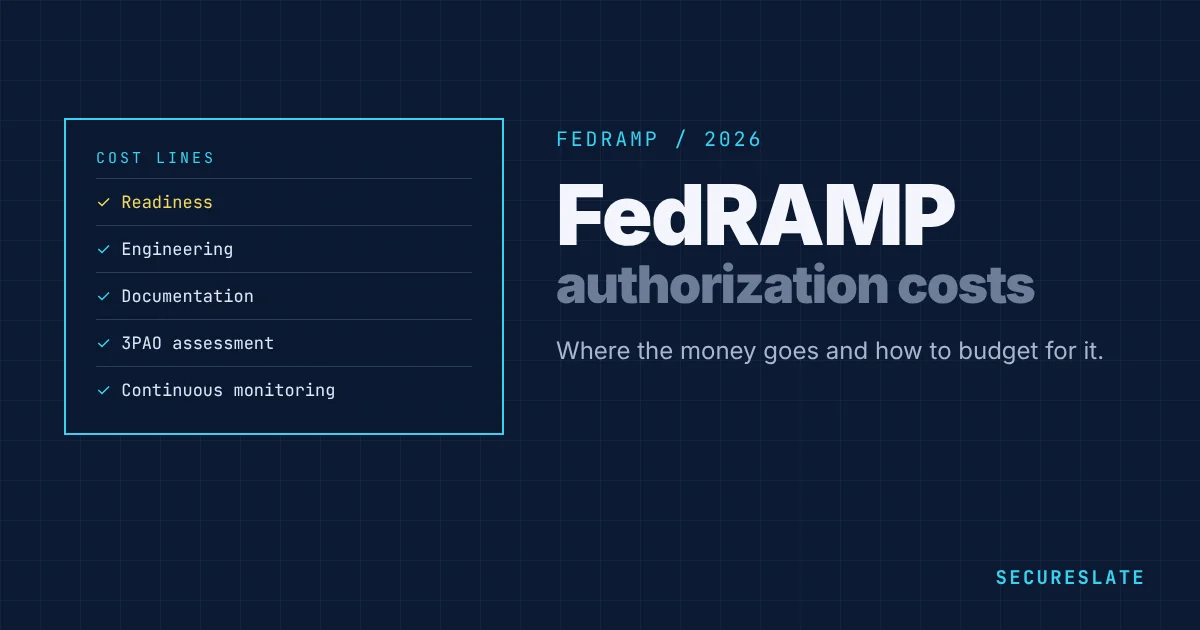
FedRAMP authorization costs are one of the biggest factors in deciding whether to sell a cloud service to US federal agencies. There is no fee to FedRAMP itself, but providers pay for readiness work, engineering changes, documentation, a Third Party Assessment Organization (3PAO) assessment and years of continuous monitoring. Industry estimates for a full Moderate authorization often run into several hundred thousand dollars or more in the first year, and ongoing costs continue after authorization. This guide breaks down the cost categories, the factors that drive them and practical ways to budget.
Related guides: FedRAMP 20x explained · FedRAMP Marketplace guide · FedRAMP vs SOC 2
Key takeaways
- FedRAMP charges no authorization fee, but readiness, engineering, 3PAO and monitoring costs add up.
- The impact level (Low, Moderate, High) is the biggest cost driver.
- Internal staff time and engineering changes often cost more than the 3PAO assessment.
- Continuous monitoring is an ongoing yearly cost, not a one-time expense.
- Reusing existing SOC 2 or ISO 27001 controls, automating evidence and keeping the boundary small reduce costs.
The main cost categories
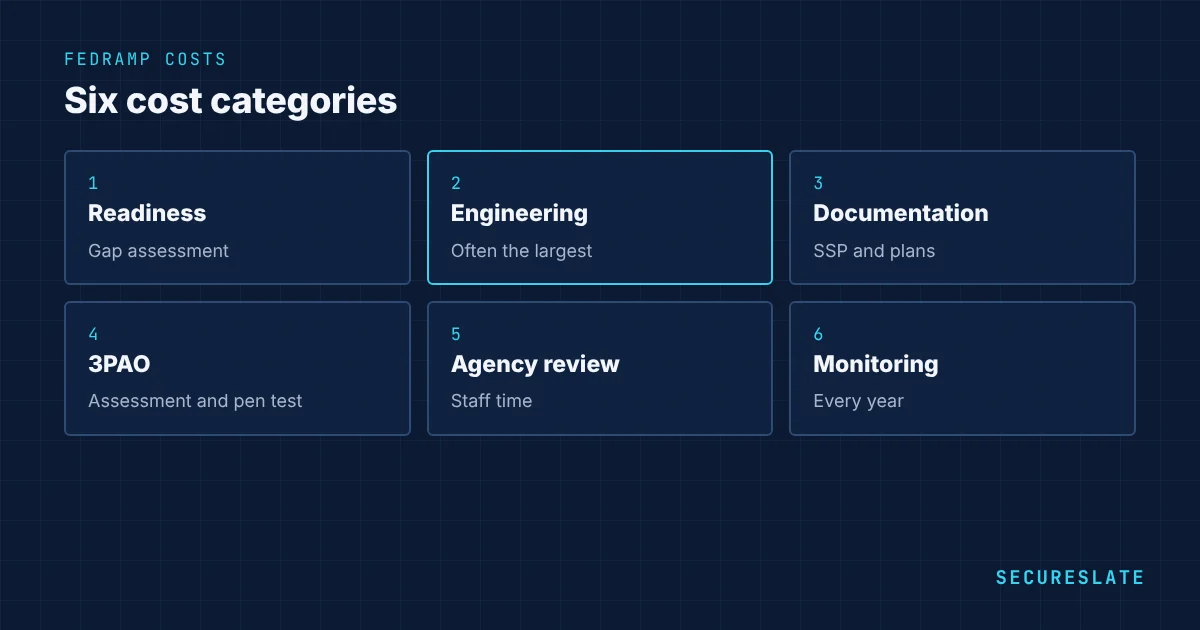
Readiness and gap assessment
Before committing, most providers run a gap assessment against the relevant NIST SP 800-53 Rev 5 baseline. Some pursue a FedRAMP Ready designation, which requires a 3PAO Readiness Assessment Report. Costs depend on whether you use internal staff, a consultant or a 3PAO.
Engineering and remediation
Common engineering work includes FIPS 140 validated encryption, multifactor authentication meeting federal requirements, logging and SIEM, vulnerability scanning, boundary separation from commercial environments, and sometimes hosting in a FedRAMP-authorized infrastructure region. This can be the largest single cost.
Documentation
The System Security Plan and its attachments, including policies, procedures, incident response, contingency and configuration management plans, take significant time to write. Many providers hire consultants for this.
3PAO assessment
The 3PAO develops a Security Assessment Plan, tests controls, performs penetration testing and writes the Security Assessment Report. Fees vary with impact level, boundary size and complexity.
Agency review and authorization
Working with a sponsoring agency takes staff time for meetings, responses and remediation of findings, even though the agency does not charge a fee.
Continuous monitoring
After authorization, providers perform monthly vulnerability scans, manage a POA&M, report significant changes and complete an annual assessment by a 3PAO. Tools, staff time and the annual 3PAO fee make this a permanent line in the budget.
What drives the total cost
| Driver | Why it matters |
|---|---|
| Impact level | High needs more controls and stricter implementation than Moderate or Low |
| Boundary size | More services, components and integrations mean more to document and test |
| Current maturity | Existing SOC 2 or ISO 27001 programs reduce gaps |
| Architecture | Shared infrastructure with commercial customers may need separation |
| Team experience | Experienced staff need less consultant support |
| Automation | Automated evidence reduces documentation and monitoring effort |
| Path chosen | FedRAMP 20x may reduce effort for qualifying services |
Example budget structure
Rather than relying on a single number, build a budget with these lines and get quotes for each:
| Line item | One-time or ongoing | Who to ask |
|---|---|---|
| Gap assessment | One-time | Consultant or 3PAO |
| Engineering remediation | One-time, plus maintenance | Internal engineering estimate |
| Documentation support | One-time, plus annual updates | Consultant |
| 3PAO initial assessment | One-time | Two or three 3PAOs |
| Tools: scanning, SIEM, compliance platform | Ongoing | Vendors |
| Annual 3PAO assessment | Ongoing | 3PAO |
| Internal compliance staff | Ongoing | HR and finance |
| Hosting changes | Ongoing | Cloud provider |
How to reduce FedRAMP costs
- Start from existing frameworks. Map SOC 2 or ISO 27001 controls to NIST SP 800-53 to avoid rebuilding.
- Keep the boundary small. Include only the components needed to deliver the federal offering.
- Use authorized infrastructure. Building on a FedRAMP-authorized IaaS or PaaS lets you inherit many controls.
- Automate evidence and monitoring. Continuous control testing cuts documentation and monthly reporting effort.
- Consider FedRAMP 20x. If your service qualifies, the automation-first path may reduce time and cost.
- Secure a committed sponsor. Delays waiting for agency attention are expensive.
- Consider GovRAMP or state programs first. For some providers, state and local markets are a stepping stone.
Is FedRAMP worth the cost?
FedRAMP opens access to a large federal cloud market, and an authorization can be reused by many agencies. Some state and local governments also accept FedRAMP. The investment makes sense when you have a clear pipeline of federal opportunities, a committed sponsor and the engineering capacity to maintain controls. Without a sponsor or pipeline, it may be better to start with SOC 2, ISO 27001 or GovRAMP and revisit FedRAMP later.
Hidden costs to plan for
- Sponsor delays. Weeks spent waiting for agency reviews keep consultants and staff busy without progress.
- Significant change requests. Adding features or services to the authorized boundary later requires review and sometimes assessment.
- Separate environments. Running a government instance alongside commercial infrastructure doubles some operations work.
- Personnel requirements. Some agencies require background checks or US-based personnel for certain roles.
- Penetration testing. FedRAMP requires penetration testing as part of the 3PAO assessment, which may reveal remediation work.
- Tool upgrades. Some commercial tools are not available in government regions or lack FIPS-validated options.
Timeline and cost together
| Phase | Typical duration | Main costs |
|---|---|---|
| Readiness and gap assessment | 1 to 3 months | Consultant or 3PAO fees, internal time |
| Remediation and documentation | 3 to 9 months | Engineering, documentation, tools |
| 3PAO assessment | 1 to 3 months | 3PAO fee, internal support |
| Agency review and authorization | 1 to 4 months | Internal time, remediation of findings |
| Continuous monitoring | Ongoing | Tools, scans, annual 3PAO, staff |
Durations vary widely, and FedRAMP 20x is designed to shorten them for qualifying services.
Questions to ask 3PAOs when getting quotes
- What is included: readiness assessment, full assessment, penetration testing, annual assessments?
- How do you price changes in boundary size after the quote?
- How many FedRAMP assessments have you completed at our impact level?
- Do you support FedRAMP 20x validation, and what evidence formats do you expect?
- How do you handle findings that need retesting?
Funding the effort
Some providers spread the cost by pursuing FedRAMP Ready first to show progress to agencies, then completing full authorization once a sponsor commits. Others start with GovRAMP to win state and local customers whose revenue helps fund federal work. Whatever path you choose, tie each phase to a business milestone, such as a signed pilot or sponsor letter, so spending follows real demand.
How SecureSlate helps
SecureSlate helps smaller cloud providers prepare for FedRAMP at lower cost. Multi-framework mapping reuses SOC 2 and ISO 27001 work toward NIST SP 800-53, continuous control monitoring across AWS and Google Cloud produces evidence automatically, and audit management organizes artifacts for your 3PAO, all at a price built for startups and SMBs.
FAQ
Does FedRAMP charge a fee for authorization?
No. FedRAMP does not charge providers. Costs come from preparation, engineering, assessment and ongoing monitoring.
How much does a FedRAMP 3PAO assessment cost?
It varies with impact level and system complexity. Get quotes from several 3PAOs, as pricing differs widely.
What is the ongoing cost of FedRAMP?
Continuous monitoring includes monthly scans, POA&M management, an annual 3PAO assessment, tools and staff time. These continue as long as you hold the authorization.
Is FedRAMP Low cheaper than Moderate?
Generally yes. Low and LI-SaaS baselines have fewer controls, so preparation, assessment and monitoring cost less.
Can a small company afford FedRAMP?
It is possible, especially with automation, a small boundary and authorized infrastructure, but it requires a clear federal sales pipeline to justify the investment.
Can startups get FedRAMP authorization?
Yes, some do, especially those built on authorized cloud infrastructure with strong automation. A committed agency customer and clear revenue opportunity are important before investing.
Does FedRAMP High cost more than Moderate?
Yes. High requires more controls and stricter implementation, which increases engineering, documentation, assessment and monitoring costs compared with Moderate.
Are there grants or funding for FedRAMP?
FedRAMP does not provide funding to providers. Costs are usually covered by the provider as an investment in the federal market, sometimes supported by a committed agency customer.
Disclaimer (legal note)
General information only, not legal, audit, or attestation advice. Requirements depend on your contracts, system boundary, and assessor guidance.
Need compliance without the complexity?
SecureSlate automates ISO 27001, SOC 2, GDPR, HIPAA, and more. Built for growing teams. See it in action.
Find compliance gaps in 30 seconds