
Short answer: FISMA is the federal law that makes every US federal agency responsible for securing its information systems, including systems contractors run for it. FedRAMP is a government-wide program, also set in law, that assesses cloud services once so agencies can reuse that work. Cloud vendors pursue FedRAMP. Agencies, and contractors running non-cloud agency systems, work under FISMA.
Related guides: FedRAMP authorization checklist · FISMA compliance software · FedRAMP 20x explained
Key takeaways
- FISMA is a law about agencies. It sets security duties for federal agencies and the systems used or operated on their behalf.
- FedRAMP is a program about cloud services. It standardizes how cloud products that handle federal information are assessed, so agencies do not each repeat the work.
- Both rest on NIST standards, mainly FIPS 199 categorization and SP 800-53 controls.
- FedRAMP does not replace the agency's own decision. Each agency still authorizes its own use, but the law presumes a FedRAMP package is adequate for that purpose.
- As of November 2026, FedRAMP is moving to new 2026 rules, with new terms such as "FedRAMP Certification" and certification classes, so check current guidance before planning.
What is FISMA?
FISMA is the Federal Information Security Modernization Act of 2014, which updated the Federal Information Security Management Act of 2002. It is codified in 44 U.S.C. chapter 35, subchapter II. The core rule in section 3554 is that each agency head is responsible for information security protections for information collected or maintained by the agency and for information systems used or operated by the agency, or by a contractor or other organization on its behalf.
In practice, agencies meet FISMA by following OMB policy and NIST standards. The usual chain is:
- FIPS 199 to categorize a system as low, moderate or high impact.
- NIST SP 800-53 for the security and privacy controls, with baselines in SP 800-53B.
- NIST SP 800-37, the Risk Management Framework, for the steps from categorization to authorization and continuous monitoring. See our NIST RMF vs CSF guide.
- An authorization to operate (ATO) signed by the agency's authorizing official, who accepts the remaining risk.
FISMA also requires annual reporting and an annual independent evaluation of each agency's program. There is no "FISMA certificate" for a vendor. A contractor's system is FISMA compliant in the sense that the sponsoring agency has assessed and authorized it.
What is FedRAMP?
FedRAMP is the Federal Risk and Authorization Management Program, run by the General Services Administration. It started in 2011 under an OMB memo and was written into law by the FedRAMP Authorization Act, enacted in December 2022 as part of the FY2023 National Defense Authorization Act and codified at 44 U.S.C. 3607 to 3616.
FedRAMP's scope is cloud computing products and services, such as IaaS, PaaS and SaaS, that handle federal information for an agency and are not otherwise excluded. Its purpose is "do once, use many times": a cloud service is assessed against a standard set of requirements, the results are packaged, and any agency can review and reuse that package.
FedRAMP requirements have long been built on NIST SP 800-53 baselines. Our guide to FedRAMP impact levels and baselines explains the Low, Moderate and High model that most existing authorizations use.
FISMA vs FedRAMP: what are the key differences?
The main difference is scope: FISMA covers all federal information systems through the agency, while FedRAMP covers cloud services offered to many agencies through a central program.
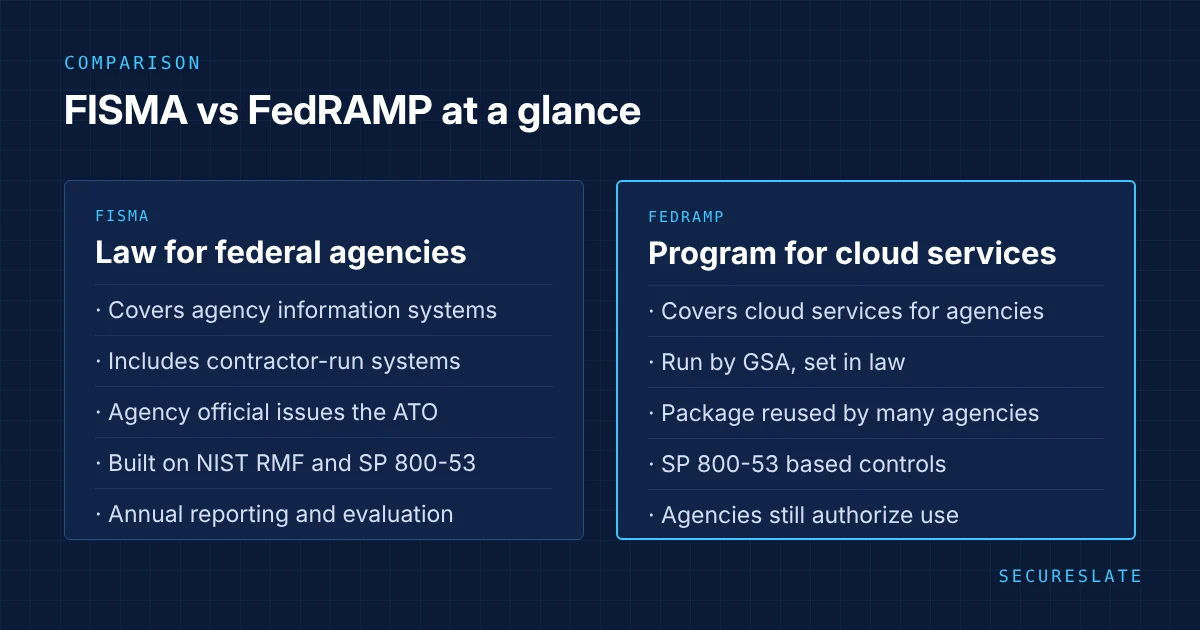
| Aspect | FISMA | FedRAMP |
|---|---|---|
| What it is | A federal law setting agency security duties | A government-wide program, set in law, run by GSA |
| Legal basis | 44 U.S.C. 3551 and following | 44 U.S.C. 3607 to 3616 |
| Who it applies to | Federal agencies and systems operated on their behalf | Cloud services that handle federal information for agencies |
| Who decides | The agency's authorizing official | FedRAMP certifies the cloud offering, and each agency still authorizes its own use |
| Technical basis | FIPS 199, FIPS 200, NIST SP 800-53, NIST RMF | NIST SP 800-53 based controls plus FedRAMP-specific rules |
| Reuse | Usually one agency, one system | One package reused by many agencies |
| Ongoing duty | Agency continuous monitoring and annual reporting | Ongoing requirements to keep the FedRAMP status, plus agency monitoring |
| Typical vendor | Contractor running a dedicated system for an agency | SaaS, PaaS or IaaS provider selling to several agencies |
How do FISMA and FedRAMP work together?
FedRAMP sits inside the FISMA world rather than beside it. When an agency uses a cloud service, the agency is still responsible under FISMA for that use and still issues its own ATO. FedRAMP supplies the security assessment the agency relies on.
The FedRAMP Authorization Act makes this link explicit. Under 44 U.S.C. 3613, an agency must check whether a FedRAMP package exists before starting its own authorization, should reuse existing assessments to the extent practicable, and the assessment in a FedRAMP package is presumed adequate for use in an agency ATO. The same section keeps the agency's power to require additional security where it has a demonstrable need.
So a cloud vendor with FedRAMP status still goes through an agency ATO for each customer agency, but that step is much lighter because the heavy assessment work is already done.
Which one applies to your company?
Which one applies depends on what you sell and how the agency uses it.
| Your situation | What usually applies |
|---|---|
| You sell a multi-tenant cloud product that will store or process federal information | FedRAMP, followed by an ATO from each agency customer |
| You build or operate a dedicated, non-cloud system for one agency | The agency's FISMA process and ATO, with contract security clauses |
| You sell cloud services excluded from FedRAMP scope, such as some negligible-risk services | The agency decides under its own FISMA program |
| You are a defense contractor handling controlled unclassified information on your own systems | Typically DFARS and CMMC, which draw on NIST SP 800-171 rather than FedRAMP |
| You sell to state governments | State programs, which may borrow from FedRAMP |
Agencies decide whether their use of a cloud service falls within FedRAMP scope, so confirm the requirement with the contracting office early.
What changed in FedRAMP in 2026?
As of November 2026, FedRAMP is moving to its Consolidated Rules for 2026. According to FedRAMP's timeline, they opened for optional early adoption on July 4, 2026 and become mandatory on January 1, 2027. The changes that matter most for a FISMA vs FedRAMP comparison are:
- New terms. "FedRAMP Certification" replaces "FedRAMP authorization" so it is not confused with an agency ATO.
- Certification classes. Classes A to D replace the Low, Moderate and High labels for FedRAMP's own purposes. Agencies still categorize their systems under FIPS 199, and FedRAMP describes the classes as only loosely aligned with the NIST baselines.
- Two types. FedRAMP 20x targets cloud-native offerings, while a modernized Rev5 path remains for providers that run their own infrastructure. FedRAMP has said it will stop accepting new Rev5 applications on June 11, 2027.
- New documentation. Rev5 packages are moving from Word and Excel documents to machine-readable JSON, with the traditional System Security Plan being replaced by a Certification Package Overview and a Security Decision Record.
None of this changes FISMA itself. Agencies still own their FISMA duties and still issue ATOs.
How should a vendor prepare?
Prepare by confirming the requirement first, then building controls on the NIST foundation both regimes share.
- Confirm the requirement with the agency. Ask whether the use is in FedRAMP scope and which certification class or impact level it expects.
- Pick the path. Under the 2026 rules, check whether you fit 20x or Rev5 and whether you have an agency sponsor.
- Define the boundary. Identify every component that handles federal information and every external service it relies on.
- Implement SP 800-53 based controls. Most of the work is the same whether the final decision is FedRAMP or an agency-only ATO. Our NIST SP 800-53 guide covers the control families.
- Collect evidence continuously. Both regimes expect ongoing monitoring, not a one-time audit.
- Plan for independent assessment. Most FedRAMP certification classes include an independent assessment, and agencies rely on its results. Check what your class requires.
How SecureSlate helps
SecureSlate includes built-in FedRAMP and NIST CSF frameworks and supports custom frameworks and controls, so you can map one set of controls across FedRAMP, SOC 2 and ISO 27001 and add agency-specific requirements. Agentless read-only cloud integrations, a device agent and access reviews collect evidence continuously, and audit management helps you share it with your independent assessor. SecureSlate does not perform assessments or issue certifications or ATOs.
FAQ
Is FedRAMP part of FISMA?
FedRAMP is a separate program with its own statute, but it supports FISMA. Agencies remain responsible under FISMA and use FedRAMP packages to issue their own ATOs for cloud services.
Does FedRAMP satisfy FISMA requirements?
FedRAMP covers the cloud service's security assessment, which the law presumes adequate for an agency ATO. The agency still has to authorize its own use and meet its other FISMA duties.
Can a company be FISMA certified?
No. FISMA does not certify vendors. An agency authorizes a specific system for use, which is what people usually mean by "FISMA compliant".
Do FISMA and FedRAMP use the same controls?
Both rely on NIST SP 800-53. FedRAMP adds its own rules on top, and under the 2026 rules it lets providers set more of their own control parameters.
Do I need FedRAMP to sell software to a federal agency?
Only if your product is a cloud service that handles federal information and the agency's use falls within FedRAMP scope. Confirm with the agency, since it makes the scope decision.
Disclaimer (legal note)
This article is for general information only and is not legal, regulatory, or professional advice. Requirements vary by framework, industry, and jurisdiction. Consult qualified advisors for your specific obligations.
Need compliance without the complexity?
SecureSlate automates ISO 27001, SOC 2, GDPR, HIPAA, and more. Built for growing teams. See it in action.
Find compliance gaps in 30 seconds