
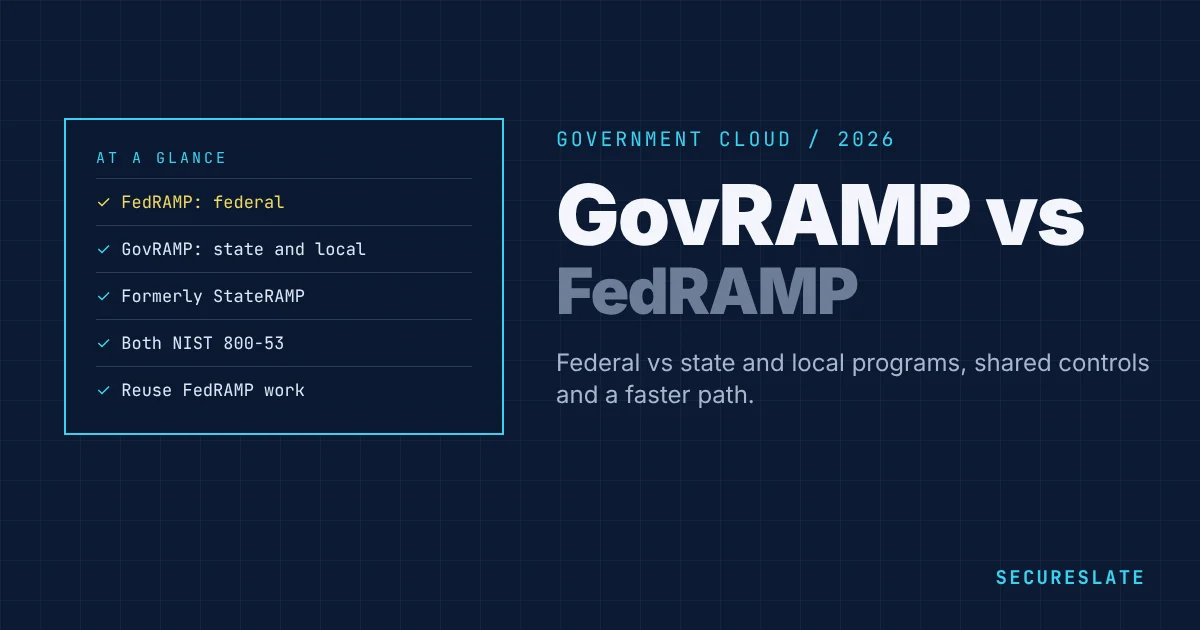
GovRAMP vs FedRAMP is a question for cloud providers selling to government. FedRAMP is the federal program that authorizes cloud services for US federal agencies. GovRAMP, formerly StateRAMP, is a nonprofit program that verifies the security of cloud services for state and local governments, education and other public bodies. Both are based on NIST SP 800-53, and GovRAMP lets providers reuse FedRAMP work. This guide compares them and explains which one you need.
Related guides: FedRAMP levels and baselines · The FedRAMP Marketplace · FedRAMP vs SOC 2 · FedRAMP for startups
Key takeaways
- FedRAMP serves federal agencies and is run by the federal government through GSA.
- GovRAMP serves state and local governments and other public entities and is run by an independent nonprofit. It was called StateRAMP until its 2025 rebrand.
- Both use NIST SP 800-53 controls and third-party assessments, with security levels aligned to FedRAMP baselines.
- Providers with FedRAMP authorization can use a faster path to GovRAMP status.
GovRAMP vs FedRAMP at a glance
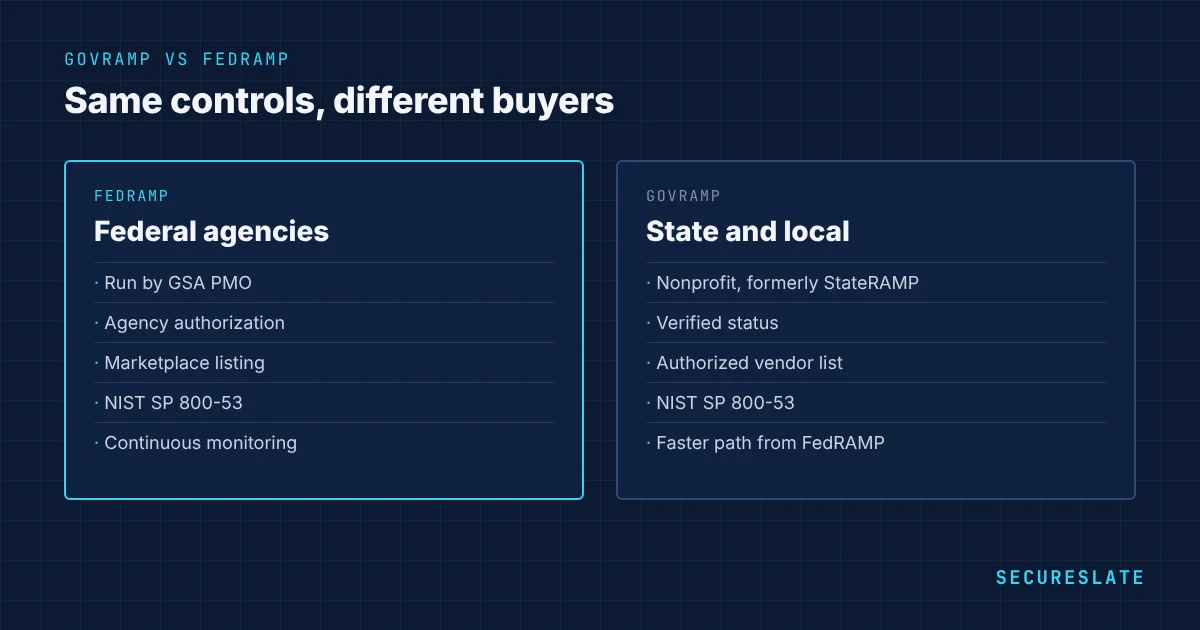
| FedRAMP | GovRAMP | |
|---|---|---|
| Run by | US federal government (GSA-hosted Program Management Office) | Independent nonprofit membership organization |
| Serves | Federal agencies | State and local governments, education and other public bodies |
| Former name | None | StateRAMP |
| Control basis | NIST SP 800-53 Rev 5 baselines | NIST SP 800-53 Rev 5, aligned to FedRAMP baselines |
| Security levels | Low, LI-SaaS, Moderate, High | Levels that map to Low, Moderate and High impact |
| Assessor | FedRAMP-recognized 3PAO | Approved assessors, many of them FedRAMP 3PAOs |
| Result | Agency authorization and Marketplace listing | Verified status on the GovRAMP authorized vendor list |
| Ongoing | Continuous monitoring | Continuous monitoring |
| Legal requirement | Required for cloud services used by federal agencies | Required where a state or local government adopts it in procurement |
Similarities
- Both standardize cloud security assessments so buyers do not each assess the same provider
- Both use NIST SP 800-53 controls and impact levels based on data sensitivity
- Both require an independent assessment and continuous monitoring
- Both publish lists of verified providers that buyers consult
Differences
Who requires it
FedRAMP applies to federal agencies by policy. GovRAMP applies only where a state, county, city or public institution chooses to require or prefer it in procurement, so check each buyer's rules.
Who runs it
FedRAMP is a government program. GovRAMP is a nonprofit funded by memberships, where cloud providers join as members to participate.
Path to status
FedRAMP authorization requires an agency sponsor or the program's own authorization path. GovRAMP works without a federal sponsor, which makes it accessible to providers focused on state and local buyers.
Reuse
GovRAMP offers a faster path for providers that already hold FedRAMP authorization, so FedRAMP work can be leveraged for state and local markets.
GovCloud vs FedRAMP
AWS GovCloud and Azure Government are cloud regions built for government workloads, with their own FedRAMP High authorizations. Hosting on them helps, but your service still needs its own FedRAMP or GovRAMP status. GovCloud is infrastructure; FedRAMP and GovRAMP are security verification programs.
Which do you need?
- Selling cloud services to federal agencies: FedRAMP.
- Selling to state and local governments, schools or universities: GovRAMP where buyers require it, and check which states have adopted it.
- Both: pursue FedRAMP first if federal revenue is the bigger opportunity, then use the faster path to GovRAMP.
- Defense contractors: look at CMMC as well.
The GovRAMP process at a glance
- Join GovRAMP as a provider member.
- Choose the security level that matches the data government customers will store.
- Prepare documentation, including a System Security Plan based on NIST SP 800-53.
- Complete an assessment with an approved third-party assessor, or use the faster path if you hold FedRAMP authorization.
- Receive a verified status listed on the GovRAMP authorized vendor list.
- Maintain continuous monitoring to keep the status current.
GovRAMP also offers a progress-based status for providers still working toward full verification, which helps them compete in procurements while they finish. Check GovRAMP's current status definitions for details.
FedRAMP vs GovRAMP vs SOC 2
| FedRAMP | GovRAMP | SOC 2 | |
|---|---|---|---|
| Buyer | Federal agencies | State and local government, education | Commercial customers |
| Basis | NIST SP 800-53 | NIST SP 800-53 | Trust Services Criteria |
| Result | Authorization | Verified status | Auditor report |
| Effort | Highest | High | Moderate |
Planning for both markets
If you plan to sell to federal, state and local buyers, design one control set mapped to NIST SP 800-53 at the highest impact level you expect to need. Keep the authorization boundary the same for both programs where possible, so one System Security Plan, one evidence set and one continuous monitoring process support FedRAMP and GovRAMP. Add SOC 2 for commercial customers from the same controls.
Common mistakes
- Assuming every state requires GovRAMP. Adoption varies, so check each procurement.
- Choosing a lower security level than government customers need, which forces a reassessment.
- Treating GovCloud hosting as equivalent to authorization.
- Forgetting continuous monitoring costs when pricing government deals.
Example: a SaaS company selling to government
A records management SaaS sells to two federal agencies and twenty county governments. It pursues FedRAMP Moderate with one agency as sponsor, using an authorization boundary that covers only the government version of the product. Once authorized, it uses GovRAMP's faster path for FedRAMP-authorized providers to reach verified status for the county market. Both programs share one System Security Plan, one 3PAO relationship and one continuous monitoring process, and the company's SOC 2 report, built on the same controls, serves its commercial customers.
GovRAMP readiness checklist
- Security level chosen with input from target government buyers
- Authorization boundary defined and diagrammed
- System Security Plan written against NIST SP 800-53
- Vulnerability scanning and patching with documented time frames
- Incident response plan that covers notifying government customers
- Third-party assessor selected
- Continuous monitoring owner and budget in place
Questions to ask government buyers
- Do you require FedRAMP, GovRAMP or another program for cloud services?
- What security level or impact level does the data need?
- Will you accept a progress-based status while we finish verification?
- Do you accept SOC 2 or ISO 27001 for lower-risk services?
- What continuous monitoring reports do you expect after purchase?
How SecureSlate helps
SecureSlate maps your controls to NIST SP 800-53 and FedRAMP baselines, reusing SOC 2 and ISO 27001 work, and keeps evidence and continuous monitoring tasks organized for FedRAMP and GovRAMP assessments.
FAQ
What is the difference between FedRAMP and GovRAMP?
FedRAMP verifies cloud security for federal agencies and is run by the federal government. GovRAMP verifies cloud security for state and local governments and is run by a nonprofit.
Is GovRAMP the same as StateRAMP?
Yes. StateRAMP rebranded as GovRAMP in 2025.
Does FedRAMP authorization count for GovRAMP?
It does not transfer automatically, but GovRAMP offers a faster path for FedRAMP-authorized providers.
Is GovRAMP mandatory?
Only where a state or local government requires it in procurement. Adoption varies by state and agency.
Which is harder, FedRAMP or GovRAMP?
FedRAMP is generally more demanding because of agency sponsorship and federal review. GovRAMP uses similar controls but a more accessible process for state and local markets.
How much does GovRAMP cost?
Costs include GovRAMP membership, the third-party assessment and the work to implement controls and continuous monitoring. Providers with FedRAMP authorization usually spend less through the faster path.
Which states use GovRAMP?
A growing number of states and local governments reference GovRAMP in procurement. Check GovRAMP's list of participating governments and each solicitation.
Can a provider be listed on both the FedRAMP Marketplace and the GovRAMP vendor list?
Yes. Many cloud providers hold both, often using GovRAMP's faster path after FedRAMP authorization.
Does GovRAMP cover schools and universities?
GovRAMP serves public entities beyond state and local governments, including education. Check whether the specific institution references it in procurement.
Is GovRAMP recognized by federal agencies?
No. Federal agencies rely on FedRAMP. GovRAMP is designed for state, local and other public buyers.
Does GovRAMP use the same documents as FedRAMP?
They are similar and built on NIST SP 800-53, which is why FedRAMP work can be reused. Check GovRAMP's current templates for any differences.
Disclaimer (legal note)
General information only, not legal, audit, or attestation advice. Requirements depend on your contracts, system boundary, and assessor guidance.
Need compliance without the complexity?
SecureSlate automates ISO 27001, SOC 2, GDPR, HIPAA, and more. Built for growing teams. See it in action.
Find compliance gaps in 30 seconds