
Short answer: FedRAMP requirements fall into four groups: implement the NIST SP 800-53 controls or Key Security Indicators for your class, document the system and its security decisions, pass an assessment by a FedRAMP Recognized independent assessor, and keep meeting ongoing duties such as vulnerability response, change notification and regular reporting to agencies.
Related guides: FedRAMP authorization checklist · FedRAMP impact levels and baselines · Guide to NIST SP 800-53
Key takeaways
- FedRAMP requirements apply to cloud service offerings used by US federal agencies to handle federal information.
- The control requirements come from NIST SP 800-53 Rev. 5, tailored by FedRAMP. How many apply depends on your baseline or class.
- As of November 2026 the requirements are being reissued as the Consolidated Rules for 2026, mandatory from January 1, 2027, with new terms such as FedRAMP Certified and classes A to D.
- Requirements do not end at certification. Ongoing obligations are a large share of the total effort.
- The provider is responsible for accuracy and cost. Assessors and advisors help, but accountability stays with you.
Who has to meet FedRAMP requirements?
Cloud service providers have to meet FedRAMP requirements when federal agencies use their cloud services to store, process or transmit federal information.
The obligation reaches providers through agencies. Agencies are expected to use FedRAMP when they adopt cloud services, so they ask vendors for FedRAMP status in procurement. That covers infrastructure, platform and software services. It also reaches subcontractors when a certified service depends on another cloud service that handles the same data.
FedRAMP does not cover on-premises software, classified systems, or sales to state and local government. Companies in the defense supply chain should also read CMMC vs FedRAMP, because the two programs apply in different situations.
What are the FedRAMP requirements at a glance?
At a glance, FedRAMP requires work before certification and work that continues for as long as the service is certified.
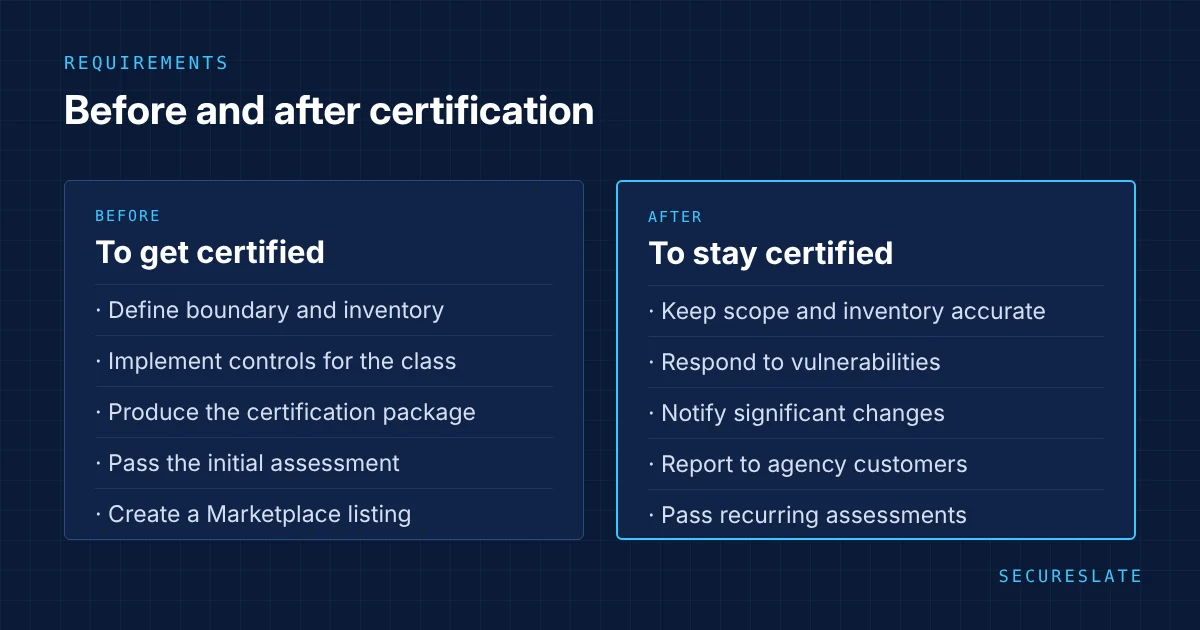
| Requirement area | Before certification | After certification |
|---|---|---|
| Scope | Define the boundary and inventory | Keep both accurate as the system changes |
| Controls | Implement every control or indicator for the class | Keep them operating and evidenced |
| Documentation | Produce the certification package | Maintain it and share it with agencies |
| Assessment | Initial independent assessment | Recurring independent assessment |
| Vulnerabilities | Scan and remediate before submission | Detect, evaluate and respond on a schedule |
| Change and incidents | Baseline the system | Notify significant changes and communicate incidents |
| Listing | Create a Marketplace listing | Keep the listing current |
The rest of this guide takes each area in turn. Where the legacy Rev 5 process and the 2026 rules use different names, both are given.
What security controls does FedRAMP require?
FedRAMP requires the security and privacy controls in NIST SP 800-53 Rev. 5 that FedRAMP has selected for your baseline or class, with FedRAMP-defined parameters.
Under the Rev 5 process, the baseline follows the FIPS 199 categorization of the information, taking the highest impact across confidentiality, integrity and availability.
| Legacy Rev 5 baseline | Approximate control count | Impact if compromised | Class in the 2026 rules (loose alignment) |
|---|---|---|---|
| Low | 156 | Limited adverse effect | Class B |
| Moderate | 323 | Serious adverse effect | Class C |
| High | 410 | Severe or catastrophic adverse effect | Class D |
Two cautions on that table. First, FedRAMP's class guidance says classes loosely align with the NIST SP 800-53B baselines and that there is no direct correlation between class and impact level. Second, control counts change when FedRAMP revises its selections, so use the current ruleset reference for the authoritative list. Class A sits below these and is aimed at commercial products that already have a mature security program.
The controls are grouped into families. The ones that generate the most work are:
- Access control and identification: least privilege, multi-factor authentication, account lifecycle and privileged access.
- Configuration management: hardened baselines, change control and a complete inventory.
- Audit and accountability: logging, retention, protection and review.
- Risk assessment and system integrity: vulnerability scanning, patching and malware protection.
- System and communications protection: boundary protection, segmentation and validated cryptography.
- Incident response and contingency planning: tested plans, backups and recovery.
- Supply chain risk management: oversight of the external services and components you depend on.
FedRAMP 20x works differently. Instead of a narrative for every control, providers show outcomes through Key Security Indicators backed by automated, machine-readable evidence. The underlying security expectations are related, but the proof is not the same. See FedRAMP 20x explained.
What documentation does FedRAMP require?
FedRAMP requires a package that lets an agency understand the service, see how each requirement is met and judge the remaining risk.
| Legacy Rev 5 document | Purpose | Related concept in the 2026 rules |
|---|---|---|
| System Security Plan (SSP) and attachments | Describes the boundary, data flows, inventory and how each control is implemented | Certification Package and Security Decision Record |
| Security Assessment Plan (SAP) | The assessor's test plan | Independent Verification and Validation ruleset |
| Security Assessment Report (SAR) | Assessment results, risks and recommendation | Assessment information within the Certification Package |
| Plan of Action and Milestones (POA&M) | Open findings with owners and dates | Vulnerability rulesets and ongoing reporting |
| Continuous monitoring deliverables | Regular evidence that controls still operate | Ongoing Certification Report |
Supporting documents usually include policies and procedures for each control family, an incident response plan, a contingency plan, a configuration management plan, a rules of behavior document, and a customer responsibility matrix showing which controls the customer must implement.
FedRAMP's Rev5 certification ruleset adds formal steps: the provider must already be listed in the FedRAMP Marketplace, must complete the application itself rather than through a third party, and on the agency path must have completed the authorization to operate process with its sponsor, ending in a signed letter sent to FedRAMP. FedRAMP has also been moving packages toward machine-readable formats, so ask which format applies to your submission date.
What are the assessment requirements?
FedRAMP requires an independent assessment by a FedRAMP Recognized independent assessment service, the role historically called a 3PAO.
According to FedRAMP's description of assessor responsibilities, the assessor checks that your security materials meet the rules, confirms that the service operates the way the materials say, attests to their quality and completeness, and reports gaps and risks. In practice that means:
- Review of documentation for every in-scope requirement.
- Interviews with the people who operate the controls.
- Technical testing, including authenticated vulnerability scans and a penetration test.
- A written report with a recommendation.
- For agency-sponsored Rev 5 certifications, delivery of the materials to the sponsoring agency.
Timing rules apply. The Rev5 Class D ruleset, for example, expects the initial assessment to be fresh at application, completed within the previous three months. The FedRAMP authorization checklist shows where the assessment sits in the wider process.
What are the ongoing requirements after certification?
After certification, FedRAMP requires you to keep the system secure, keep the evidence current and keep agencies informed.
The consolidated rules organize these duties into named rulesets. For Rev5 Class C they include:
- Collaborative Continuous Monitoring: regular reporting and review with agency customers, including the Ongoing Certification Report.
- Vulnerability Detection and Response and Vulnerability Evaluation and Reporting: finding, prioritizing, fixing and reporting vulnerabilities.
- Significant Change Notification: telling the government about changes likely to affect the security posture.
- Incident Evaluation and Communication: assessing and reporting security incidents.
- Certification Data Sharing: making certification data available to agencies through a trust center or similar repository.
- Cryptographic Module Use, Secure Configuration Guide and Marketplace Listing: keeping cryptography, customer configuration guidance and your public listing in order.
Under the legacy Rev 5 continuous monitoring model, these duties took the form of monthly scanning and POA&M updates, remediation of high, moderate and low risk findings within 30, 90 and 180 days respectively, and an annual assessment. If your service is certified under Rev 5 today, check which of those terms your agency customers still apply and when the new rulesets take effect for you.
How do you check your gap against the requirements?
Check your gap by comparing what you can prove today against the ruleset for your target type and class.
- Target type (20x or Rev5), path and class confirmed with agency customers
- Boundary and data flow diagrams current
- Inventory generated automatically and reconciled against scans
- Each control or indicator has an owner, an implementation and evidence
- Inherited controls from your infrastructure provider identified, with your share written down
- All external services in the boundary checked for their own FedRAMP status
- Authenticated vulnerability scanning in place with remediation tracking
- Multi-factor authentication and least privilege enforced everywhere in scope
- Incident response and contingency plans tested
- A named owner and budget for ongoing obligations
Sort the gaps into three piles: architecture changes, control implementation and documentation. Architecture gaps take the longest, so start there.
How SecureSlate helps
SecureSlate helps teams map, evidence and maintain FedRAMP requirements. It does not perform assessments or issue certifications.
- Multi-framework control mapping with a built-in FedRAMP framework, alongside SOC 2, ISO 27001, NIST CSF and CMMC, plus custom frameworks and controls.
- Agentless, read-only cloud integrations and a device agent to collect evidence and maintain inventory.
- Access reviews, risk management and vendor risk management for the control families that need regular attention.
- Audit management to organize evidence for your assessor, and a trust center for sharing security information.
- Code security and secrets detection for the application layer.
FAQ
How many controls does FedRAMP require?
It depends on the baseline or class. The legacy Rev 5 baselines contain roughly 156 controls at Low, 323 at Moderate and 410 at High. Check FedRAMP's current ruleset reference for the list that applies to your class.
Is FedRAMP required by law?
FedRAMP has a statutory basis in the FedRAMP Authorization Act, and federal policy directs agencies to use it for cloud services. The requirement reaches vendors through agency procurement and contracts.
Do FedRAMP requirements apply to SaaS?
Yes. FedRAMP covers infrastructure, platform and software as a service. The same requirement groups apply, although much of the infrastructure layer is usually inherited from the hosting provider.
Are FedRAMP requirements the same as NIST SP 800-53?
No. NIST SP 800-53 is the control catalog. FedRAMP selects controls from it, sets parameters, and adds its own rules for assessment, documentation and ongoing reporting.
Do the requirements change in 2027?
FedRAMP's timeline shows the Consolidated Rules for 2026 becoming mandatory for all stakeholders on January 1, 2027, and applications for new Rev5 certifications ending on June 11, 2027. Check the official timeline for updates.
Disclaimer (legal note)
This article is for general information only and is not legal, regulatory, or professional advice. Requirements vary by framework, industry, and jurisdiction. Consult qualified advisors for your specific obligations.
Need compliance without the complexity?
SecureSlate automates ISO 27001, SOC 2, GDPR, HIPAA, and more. Built for growing teams. See it in action.
Find compliance gaps in 30 seconds