
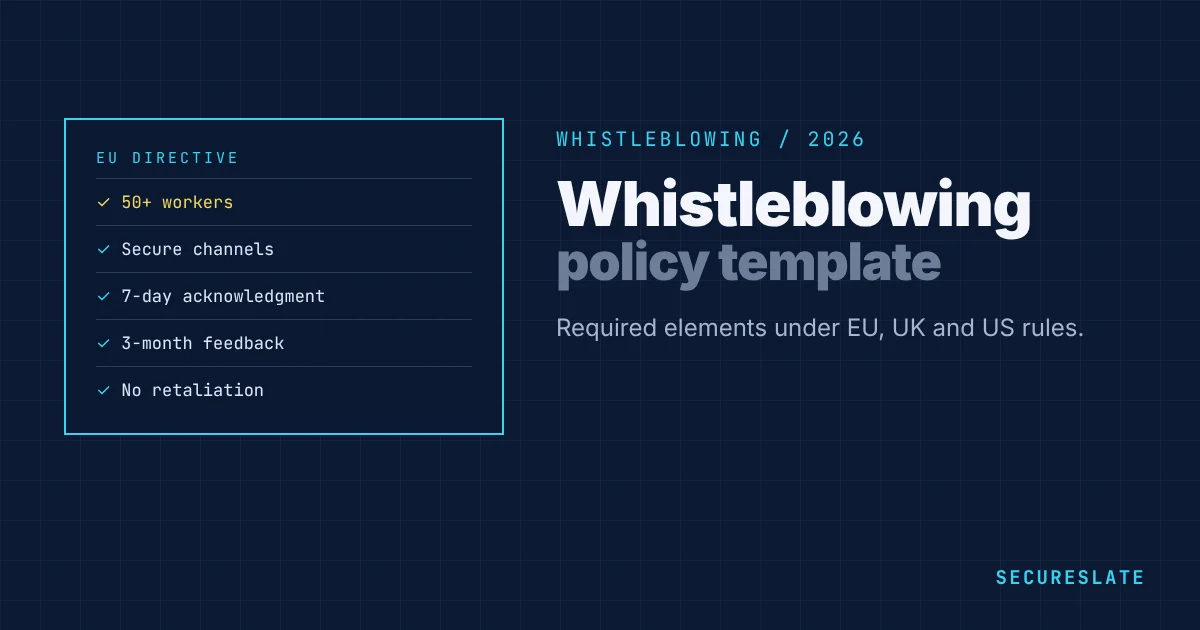
A whistleblowing policy tells employees and others how to report suspected wrongdoing safely, how reports will be handled and how reporters are protected from retaliation. Under the EU Whistleblower Directive (2019/1937), private organizations with 50 or more workers must have internal reporting channels, acknowledge reports within 7 days and give feedback within 3 months. The UK, US and many other countries have their own protections. A clear policy also helps companies find problems early, before they become regulatory or reputational crises. This guide lists the required elements, provides a template and explains how to run the process.
Related guides: GDPR and whistleblowing · Board and audit committee whistleblowing oversight · Incident management policy
Key takeaways
- A policy must explain what can be reported, how, to whom, and what happens next.
- EU rules require secure, confidential channels, acknowledgment in 7 days and feedback within 3 months.
- Confidentiality of the reporter's identity and protection from retaliation are core requirements.
- Anonymous reporting should be supported where national law allows or requires it, and it is good practice anyway.
- Personal data in reports must be handled under GDPR or equivalent privacy laws.
Legal requirements by region
| Region | Main law | Key points |
|---|---|---|
| EU | Directive (EU) 2019/1937, transposed into national laws | Internal channels for employers with 50+ workers; designated impartial handler; 7-day acknowledgment; 3-month feedback; protection for workers, contractors, applicants, volunteers and others; external reporting to authorities |
| UK | Public Interest Disclosure Act 1998 (part of the Employment Rights Act 1996) | Protects workers making qualifying disclosures in the public interest; no general duty to have a channel, but expected by regulators and good practice |
| US | Sarbanes-Oxley Section 806, Dodd-Frank, sector laws and state laws | Public companies need audit committee procedures for complaints about accounting and auditing (SOX 301); anti-retaliation protections; SEC whistleblower program |
| Other | Many countries have their own laws, such as Australia, Japan and South Africa | Requirements vary; check local law |
Required and recommended elements
| Element | Description |
|---|---|
| Purpose and commitment | Leadership commitment to integrity and to protecting reporters |
| Scope of people | Employees, former employees, contractors, suppliers, applicants, volunteers, shareholders and others covered by law |
| Scope of concerns | Examples of reportable wrongdoing: fraud, bribery, data protection breaches, safety risks, harassment where covered, environmental harm, breaches of law |
| Reporting channels | Online platform, phone line, email, in-person meetings; anonymous option |
| External channels | Right to report to competent authorities and how to find them |
| Handling process | Who receives reports, acknowledgment timeline, investigation, feedback |
| Confidentiality | Identity protected and shared only as permitted by law or with consent |
| Anti-retaliation | Clear prohibition on retaliation, with examples and consequences |
| Support for reporters | Guidance, contact person, information on legal protections |
| Rights of persons concerned | Fair treatment, presumption of innocence, right to be heard |
| Data protection | How personal data is processed, retention and rights |
| Records | Record keeping in line with law |
| Oversight | Reporting to the board or audit committee |
| Review | Periodic review and training |
Whistleblowing policy template
1. Purpose
[Company] is committed to the highest standards of integrity. This policy encourages anyone who suspects wrongdoing to speak up, explains how to report and how we protect people who do.
2. Who can report
Current and former employees, contractors, agency workers, volunteers, trainees, job applicants, shareholders, board members, suppliers and their staff.
3. What can be reported
Suspected breaches of law or company policy, including fraud, corruption, financial misreporting, data protection and security breaches, health and safety risks, environmental harm, competition law breaches, money laundering and retaliation against reporters. Personal workplace grievances are usually handled through HR procedures unless they involve wider wrongdoing.
4. How to report
- Online reporting platform: [link], available 24/7, with the option to report anonymously and communicate through a secure mailbox
- Phone: [number]
- Email: [address]
- In person: request a meeting with [designated function]
Reports should include as much detail as possible, but reporters do not need proof, only reasonable grounds to believe the information is true.
5. What happens next
- Acknowledgment within 7 days
- Initial assessment by [designated impartial person or team]
- Investigation where appropriate, by people independent of the matter
- Feedback to the reporter within 3 months of acknowledgment on actions taken or planned
6. Confidentiality and anonymity
The reporter's identity will not be disclosed without consent, except where required by law. Access to reports is limited to designated handlers. Anonymous reports are accepted and assessed.
7. Protection from retaliation
Retaliation of any kind, including dismissal, demotion, harassment, negative references or withholding of promotion, is prohibited. Anyone who retaliates faces disciplinary action. Reporters who believe they have suffered retaliation should report it immediately.
8. False reports
Reports made in good faith are protected even if they turn out to be mistaken. Knowingly false reports may lead to disciplinary action.
9. External reporting
Reporters may also report to competent authorities, such as [list relevant regulators], and in certain conditions make public disclosures as permitted by law.
10. Data protection
Personal data is processed under [GDPR/applicable law] for the purpose of handling reports. Data is kept only as long as necessary and deleted according to our retention schedule. See our privacy notice for the reporting channel.
11. Oversight and review
The [audit committee/board] receives regular reports on whistleblowing activity. This policy is reviewed at least yearly.
Running the process well
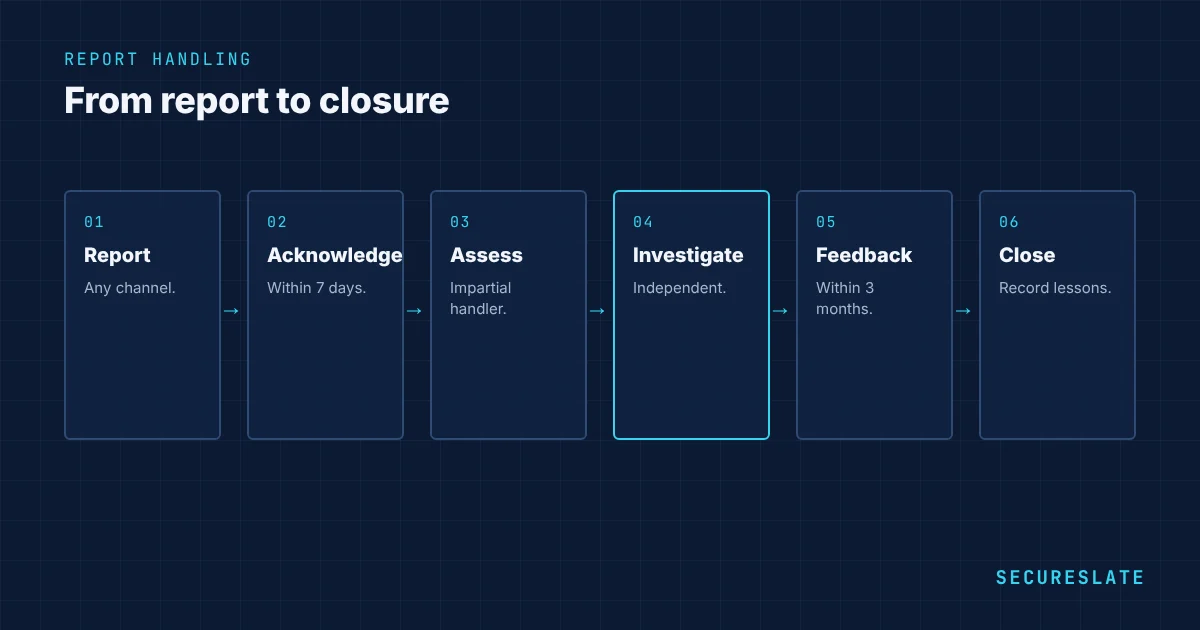
| Step | Good practice |
|---|---|
| Intake | Secure platform with encryption and access control; triage within days |
| Acknowledgment | Within 7 days, with information on next steps |
| Assessment | Decide whether the report is in scope and how to investigate |
| Investigation | Independent investigators; document evidence and interviews |
| Feedback | Within 3 months; explain actions as far as possible |
| Closure | Record outcome, actions and lessons |
| Reporting | Anonymized statistics to leadership and the board |
Metrics to track
- Number of reports per year and per 100 employees
- Percentage acknowledged within 7 days
- Percentage receiving feedback within 3 months
- Average time to close
- Substantiation rate
- Retaliation complaints
- Employee awareness from surveys
A low number of reports can mean low awareness or low trust, not low wrongdoing.
Common mistakes
- Using a general inbox read by many people
- Missing the 7-day and 3-month deadlines
- Revealing the reporter's identity to the person accused
- No training for managers who receive informal reports
- Policies that exclude contractors and suppliers covered by law
- No privacy notice or DPIA for the reporting channel
How SecureSlate helps
SecureSlate helps companies run compliance programs that include whistleblowing policies, with policy templates, employee acknowledgment tracking and training records. Its security and GDPR controls cover access, encryption and retention for the systems holding sensitive reports, and vendor risk reviews help you assess reporting platform providers.
FAQ
Is a whistleblowing policy mandatory?
In the EU, organizations with 50 or more workers must have internal reporting channels and procedures, which are usually set out in a policy. Other countries and sectors have their own requirements.
What are the 7-day and 3-month rules?
Under the EU Directive, reports must be acknowledged within 7 days and the reporter must receive feedback within a reasonable timeframe not exceeding 3 months from acknowledgment.
Must anonymous reports be accepted?
The Directive leaves this to member states, and some require it. Accepting anonymous reports is widely recommended.
Who should handle whistleblowing reports?
An impartial, designated person or team, such as compliance, legal or an external provider, with no conflict of interest in the matter.
Does GDPR apply to whistleblowing reports?
Yes. Reports often contain personal data about reporters, people concerned and witnesses, so GDPR applies to how they are collected, accessed, retained and deleted.
What is the difference between internal and external reporting?
Internal reporting goes through the organization's own channels. External reporting goes to competent authorities designated by law. Under the EU Directive, reporters can choose either, and public disclosure is protected in specific conditions.
Disclaimer (legal note)
SecureSlate is not a law firm, and this article does not constitute or contain legal advice or create an attorney-client relationship. When determining your obligations and compliance with respect to relevant laws and regulations, you should consult a licensed attorney.
Need compliance without the complexity?
SecureSlate automates ISO 27001, SOC 2, GDPR, HIPAA, and more. Built for growing teams. See it in action.
Find compliance gaps in 30 seconds