
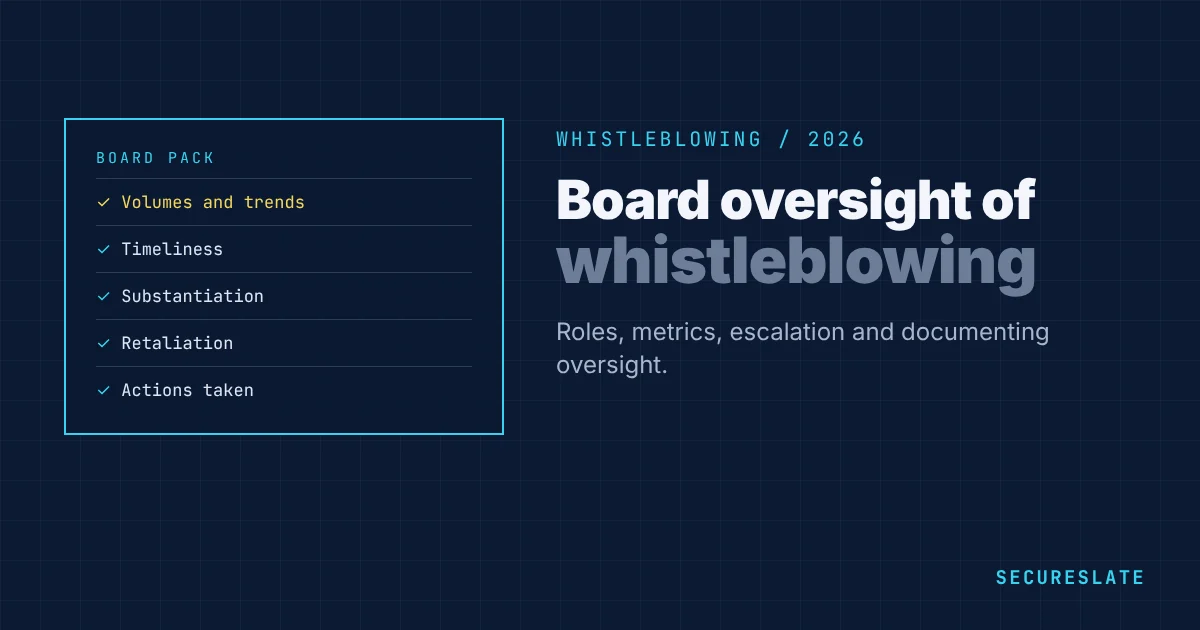
Board and audit committee oversight of whistleblowing is what turns a reporting hotline into a trusted speak-up program. Directors are responsible for making sure the organization hears about misconduct early, investigates fairly, protects reporters from retaliation and learns from what it finds. For US public companies, Sarbanes-Oxley Section 301 requires audit committees to establish procedures for complaints about accounting, internal controls and auditing matters, including confidential, anonymous employee submissions. In the EU, the Whistleblower Directive sets channel and timeline requirements. This guide explains governance roles, the metrics to share with the board, when to escalate cases and how to document oversight.
Related guides: Whistleblowing policy template and required elements · GDPR and whistleblowing · Risk-based internal audit · Internal audit methodology
Key takeaways
- The board, usually through the audit committee, oversees the whistleblowing program's design, operation and results.
- Share aggregated, anonymized metrics regularly, and escalate serious cases promptly.
- Track timeliness, outcomes, retaliation and trends, not only report counts.
- Document oversight in committee minutes and the charter.
- Oversight must protect confidentiality: directors rarely need reporter identities.
Legal and governance basis
| Source | What it requires or expects |
|---|---|
| Sarbanes-Oxley Section 301 | Audit committees of listed companies establish procedures for receiving, retaining and treating complaints about accounting, internal accounting controls and auditing matters, including confidential anonymous employee submissions |
| SEC whistleblower rules | Anti-retaliation protections; companies must not impede communications with the SEC |
| EU Directive 2019/1937 | Internal channels, impartial handlers, 7-day acknowledgment, 3-month feedback, protection from retaliation |
| UK Corporate Governance Code | The board should ensure workforce can raise concerns in confidence and, if they wish, anonymously, and should review the arrangements |
| US Sentencing Guidelines | An effective compliance and ethics program includes a mechanism for reporting misconduct without fear of retaliation, with oversight by the governing authority |
Roles
| Role | Responsibility |
|---|---|
| Board | Sets tone, oversees culture and risk, receives escalations of the most serious matters |
| Audit committee | Owns oversight of the program, especially financial and control matters; approves policy; reviews metrics |
| Chief compliance officer or ethics lead | Runs the program, triages reports, oversees investigations, reports to the committee |
| General counsel | Legal privilege, regulatory reporting, investigation strategy |
| Internal audit | Independent assurance on the program's effectiveness |
| HR | Handles workplace grievances and retaliation prevention |
The board reporting pack
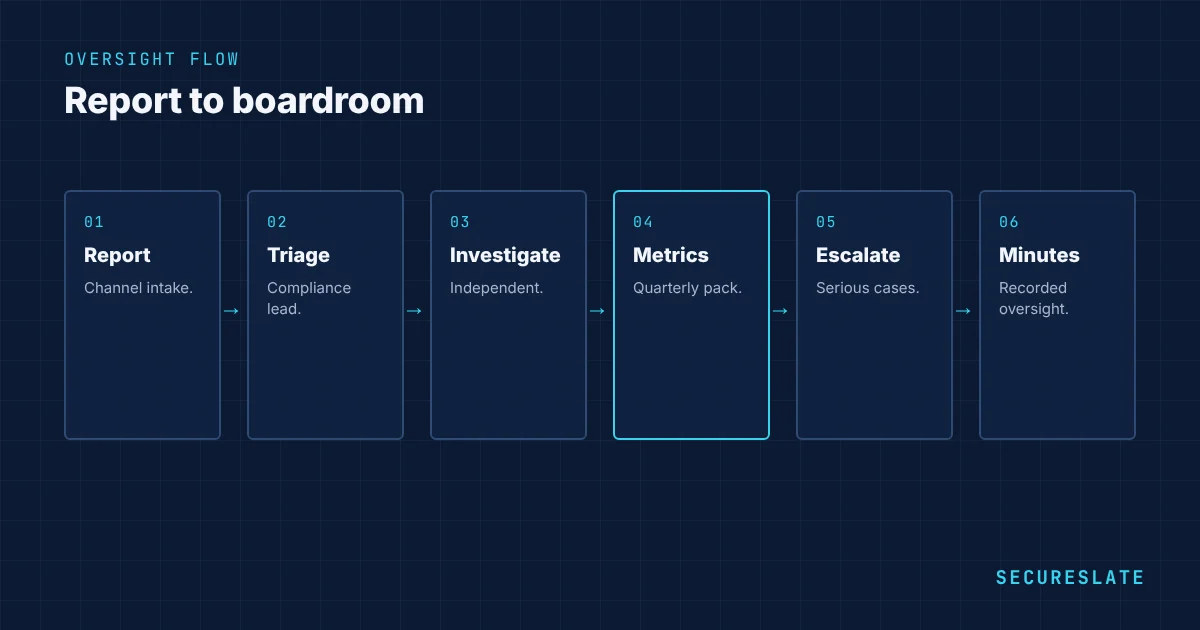
Share these metrics quarterly, anonymized and aggregated:
| Metric | Why directors care |
|---|---|
| Reports received, by channel and category | Shows awareness and where concerns arise |
| Reports per 100 employees, compared over time | Low numbers may signal low trust, not low misconduct |
| Anonymous versus named reports | High anonymity can signal fear of retaliation |
| Percentage acknowledged within 7 days | Compliance with EU rules and responsiveness |
| Percentage receiving feedback within 3 months | Reporter experience and legal compliance |
| Average days to close | Investigation capacity |
| Substantiation rate | Quality of reports and investigations |
| Retaliation allegations and outcomes | Most important indicator of program trust |
| Actions taken | Discipline, control changes, policy updates |
| Open cases older than 90 days | Bottlenecks |
| Themes and root causes | Systemic issues across business units |
Add a short narrative explaining trends and any matters requiring decision.
When to escalate to the committee or board
Escalate promptly, not only at the next meeting, when a report involves:
- Senior executives or directors
- Potential financial statement fraud or material control weaknesses
- Bribery, sanctions violations or other serious legal breaches
- Potential regulatory reporting obligations
- Significant reputational risk or media attention
- Retaliation against a reporter
- Matters involving the external auditor
Define these criteria in the policy or committee charter so escalation does not depend on individual judgment.
Protecting confidentiality in oversight
Directors need enough information to oversee, not the identity of reporters. Share case summaries without identifying details, limit access to escalated case files, and remind directors of confidentiality duties. Where an executive is implicated, route the case directly to the committee chair to avoid conflicts.
Documenting oversight
- Committee charter describing whistleblowing oversight responsibilities
- Approved whistleblowing policy and review dates
- Minutes recording metrics reviewed, questions asked and decisions taken
- Records of escalated cases and committee actions
- Internal audit reports on the program
- Annual review of program effectiveness
Questions directors should ask
- Do employees know how to report and trust the process?
- Are reports handled by people independent of the matter?
- Are we meeting acknowledgment and feedback deadlines?
- What retaliation allegations have we received, and what happened?
- What patterns are we seeing across business units?
- How do findings lead to control or culture changes?
- When was the program last independently reviewed?
Common weaknesses
- Board receives only report counts without outcomes or trends
- No defined escalation criteria
- Management controls what reaches the committee
- Retaliation not tracked
- Program never independently reviewed
Sample quarterly dashboard
| Measure | This quarter | Last quarter | Trend note |
|---|---|---|---|
| Reports received | 18 | 14 | Rise follows awareness campaign |
| Reports per 100 employees | 1.5 | 1.2 | Within peer range |
| Anonymous share | 44% | 52% | Falling, a sign of growing trust |
| Acknowledged within 7 days | 100% | 93% | Process fixed after one miss |
| Feedback within 3 months | 94% | 90% | One complex case extended with reporter informed |
| Substantiated or partly substantiated | 39% | 36% | Stable |
| Retaliation allegations | 1 | 0 | Under investigation by external counsel |
| Cases open over 90 days | 2 | 3 | Both involve external investigators |
A dashboard like this, with two or three sentences on trends, gives directors what they need in a few minutes and highlights where to ask questions.
Annual program review
Once a year, the committee should review the whole program, not only case data. Useful inputs include employee survey results on willingness to speak up, a benchmark of report volumes against peers, internal audit findings on case handling, any regulatory or legal developments, a review of the policy and channels, training completion for managers who receive concerns and lessons from closed cases. The output is a short list of improvements with owners, recorded in the minutes.
Independence of investigations
When a report concerns senior management, the committee should decide who investigates. Options include the head of internal audit, the general counsel if not conflicted, or external counsel or forensic specialists reporting directly to the committee chair. The goal is that people implicated in a matter never control its investigation or the information that reaches directors.
Linking whistleblowing to risk oversight
Whistleblowing data is an early warning system. Themes such as repeated concerns about sales practices in one region, data handling in a product team or safety at a site should feed the enterprise risk register and the internal audit plan. Directors should ask how often case themes have led to audits, control changes or policy updates. A program that produces reports but never changes anything will lose employee trust.
How SecureSlate helps
SecureSlate supports the governance and compliance side of whistleblowing programs. Track policies and acknowledgments, record training, keep risks and corrective actions in the risk register, and use audit management for internal audit reviews of the program, all with evidence for SOC 2, ISO 27001 and other frameworks.
FAQ
Who oversees whistleblowing at board level?
Usually the audit committee, with escalation of the most serious matters to the full board.
What does SOX Section 301 require?
Audit committees of listed companies must establish procedures for complaints about accounting, internal controls and auditing matters, including confidential anonymous employee submissions.
What whistleblowing metrics should the board see?
Volumes and categories, timeliness, substantiation rates, retaliation allegations, actions taken, aging cases and trends.
Should directors know who made a report?
Generally no. Oversight relies on anonymized information, protecting reporter confidentiality.
How often should the audit committee review whistleblowing?
Typically quarterly, with immediate escalation of serious matters.
Should the whole board see whistleblowing metrics?
The audit committee usually reviews detailed metrics. The full board should receive a summary and any escalated matters, especially those involving senior leadership.
Disclaimer (legal note)
SecureSlate is not a law firm, and this article does not constitute or contain legal advice or create an attorney-client relationship. When determining your obligations and compliance with respect to relevant laws and regulations, you should consult a licensed attorney.
Need compliance without the complexity?
SecureSlate automates ISO 27001, SOC 2, GDPR, HIPAA, and more. Built for growing teams. See it in action.
Find compliance gaps in 30 seconds