
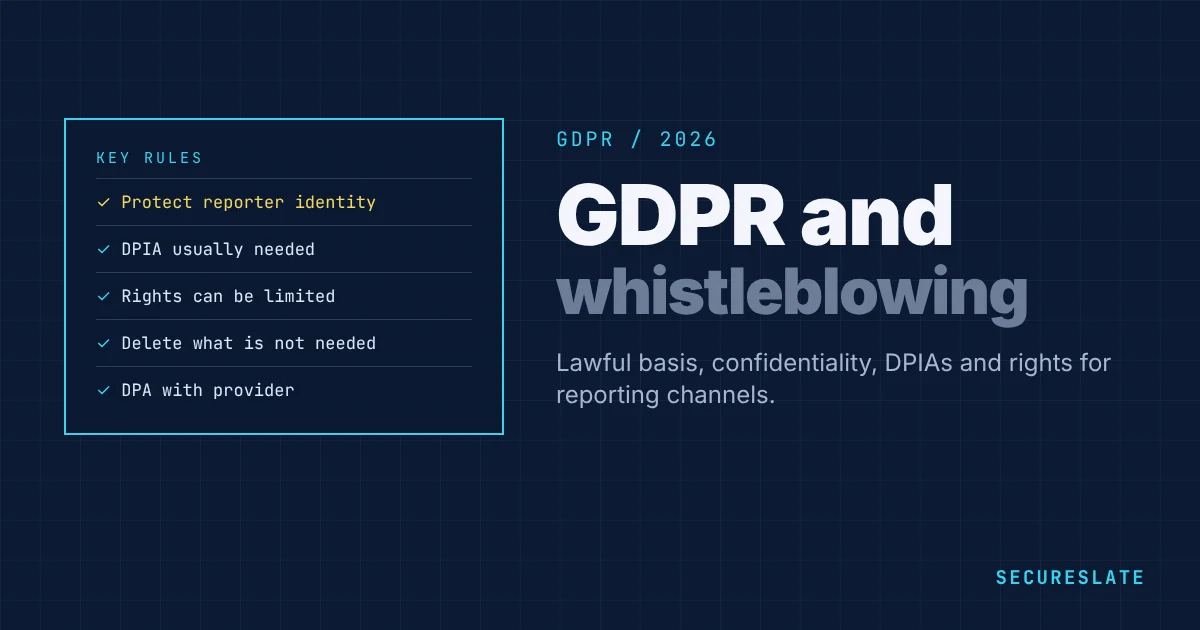
GDPR and whistleblowing meet whenever a company runs a reporting channel. Reports contain personal data about the reporter, the people accused and witnesses, often sensitive, so the channel must meet GDPR as well as the EU Whistleblower Protection Directive and national laws. This guide explains the lawful basis, confidentiality rules, DPIAs, limits on data subject rights, retention and how to run a GDPR compliant whistleblowing channel.
Related guides: EU Whistleblower Directive compliance checklist · How to implement a whistleblowing policy · Data protection impact assessment · GDPR data subject rights
Key takeaways
- The EU Whistleblower Directive (2019/1937) requires internal reporting channels for organizations with 50 or more workers, and its Article 17 requires processing under GDPR.
- The usual lawful basis is a legal obligation (GDPR Article 6(1)(c)) where national law requires the channel, or legitimate interests where it is voluntary.
- Protect the reporter's identity. National laws can restrict data subject rights that would reveal it.
- A DPIA is usually needed, because reports involve sensitive data and possible harm to individuals.
- Keep data only as long as necessary, and delete personal data that is not relevant to the report.
How GDPR applies to whistleblowing
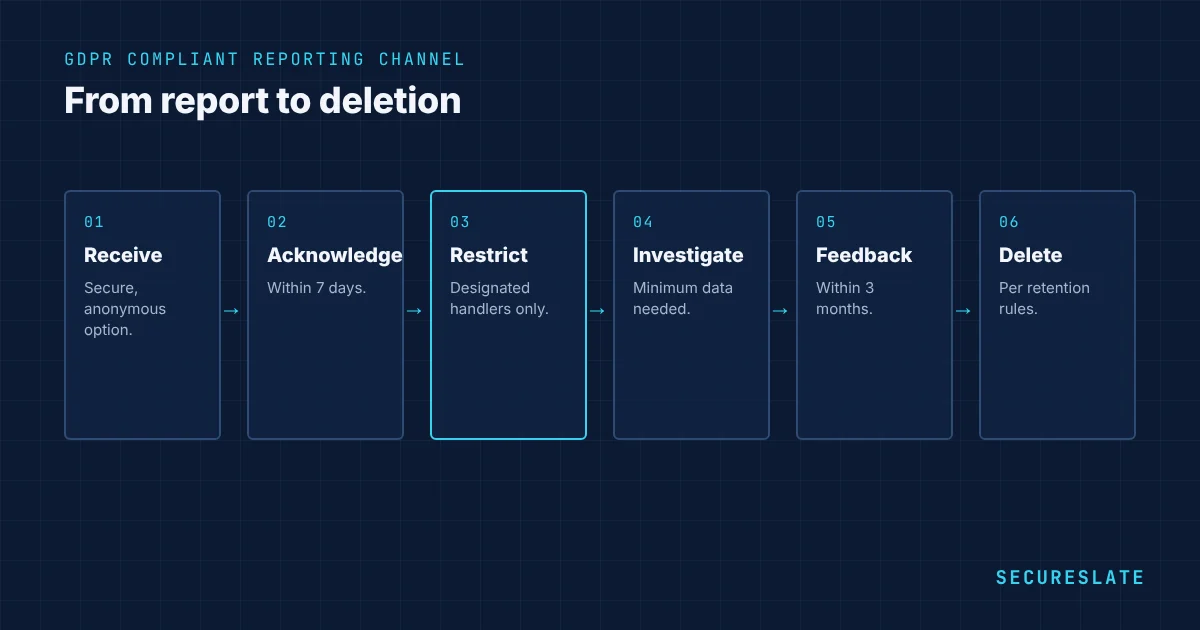
A report can include names, roles, alleged misconduct, health information or criminal allegations about identifiable people. All of that is personal data. GDPR applies to collecting it, storing it, sharing it with investigators and deleting it. The Directive adds specific rules: confidentiality of the reporter, acknowledgment within 7 days and feedback within 3 months.
GDPR requirements for whistleblowing channels
| GDPR principle | What it means for whistleblowing |
|---|---|
| Lawful basis | Legal obligation where national law requires the channel; legitimate interests otherwise. Special category data needs an Article 9 condition |
| Transparency | Privacy notice for the channel explaining purposes, recipients, retention and rights |
| Data minimization | Collect only what the report needs; do not ask for unnecessary details |
| Confidentiality | Restrict access to designated handlers; protect the reporter's identity |
| Security | Encryption, access control, logging and secure storage |
| Retention | Keep data only as long as needed for the investigation and legal obligations |
| Processor contracts | DPA with the whistleblowing software provider |
| Accountability | Records of processing and a DPIA |
Anonymous reporting and GDPR
Anonymous reports are compatible with GDPR and supported by many channels. Even when the reporter is anonymous, the report usually names other people, so GDPR still applies. Use a channel that does not log IP addresses or device details for anonymous reports, and offers a secure way to send follow-up questions without revealing identity.
Data subject rights and their limits
People named in a report have GDPR rights, including access. Full access could reveal the reporter or harm the investigation, so the Directive and national laws allow restrictions under GDPR Article 23. In practice:
- Never disclose the reporter's identity without their explicit consent, unless required by law
- Delay informing the accused person if telling them would risk the investigation, and document why
- Handle access requests case by case with legal advice
- Record every decision to restrict a right
DPIA for whistleblowing
Whistleblowing channels usually meet several high-risk criteria: sensitive data, possible criminal allegations, vulnerable people and potential effects on employment. A DPIA documents the processing, risks to reporters, accused people and witnesses, and the safeguards such as access restrictions and retention limits. Update it when you change provider or process.
Retention
Keep personal data only as long as needed. Delete reports that are clearly unrelated or unfounded promptly. For investigated reports, keep data for the investigation and any legal proceedings, then delete or anonymize it according to national rules and your retention policy.
Who handles whistleblowing reports
Limit access to a small group of designated, trained people who are independent from the matters reported. Typical handlers include compliance, legal or HR leads, or an external provider. Every access should be logged. Investigators should see only what they need, and the reporter's identity should stay with the case handler unless the reporter agrees otherwise.
Choosing a GDPR compliant whistleblowing tool
| Requirement | What to check |
|---|---|
| Anonymous reporting | No IP or device logging for anonymous reports, and a secure two-way mailbox |
| Encryption | Reports encrypted in transit and at rest |
| Access control | Role-based access with MFA and access logs |
| Hosting | EU hosting or a valid transfer mechanism for data outside the EEA |
| Retention | Configurable deletion and anonymization rules |
| Processor terms | A DPA that meets GDPR Article 28 |
| Directive workflows | Acknowledgment within 7 days and feedback within 3 months tracked |
Privacy notice for the reporting channel
The channel needs a clear privacy notice that explains:
- Who the controller is and how to contact the DPO, if there is one
- What personal data is collected and why
- The lawful basis for processing
- Who can access reports, including external investigators
- How long data is kept
- How the reporter's identity is protected
- The rights of reporters, accused people and witnesses, and how they may be restricted
- How to complain to a supervisory authority
Step-by-step: setting up a GDPR compliant channel
- Confirm whether national law requires a channel and which rules apply.
- Choose secure reporting software or an external provider and sign a DPA.
- Complete a DPIA before launch.
- Write the privacy notice and the whistleblowing policy.
- Designate and train case handlers.
- Set retention and deletion rules.
- Add the processing to your records of processing activities.
- Review the channel, DPIA and access logs at least yearly.
Common GDPR mistakes in whistleblowing
- Using a general email inbox that many people can read
- Logging IP addresses for reports submitted anonymously
- Keeping all reports indefinitely, including unrelated ones
- Telling the accused person who made the report
- Running the channel without a DPIA or privacy notice
- Choosing a provider outside the EEA without a valid transfer mechanism
How SecureSlate helps
SecureSlate maps whistleblowing and GDPR requirements to tracked controls, keeps the DPIA, records of processing and the provider's DPA in one place, and monitors the security controls that protect reports.
FAQ
Is a whistleblowing channel GDPR compliant?
It can be, if it has a lawful basis, a privacy notice, strict access controls, confidentiality for reporters, a DPIA, a DPA with the provider and clear retention rules.
Is a DPIA required for whistleblowing?
Usually yes, because whistleblowing involves sensitive data and possible serious effects on individuals. Many supervisory authorities list it as high risk.
Can the accused person access the report under GDPR?
They have rights, but they can be restricted to protect the reporter's identity and the investigation, as allowed by national law under GDPR Article 23.
Is anonymous reporting GDPR compliant?
Yes. Anonymous reporting is allowed, and the channel must still protect the personal data of people named in reports.
How long can whistleblowing data be kept?
Only as long as needed for the investigation and legal obligations. Unrelated reports should be deleted promptly.
Do companies with fewer than 50 employees need a whistleblowing channel?
The Directive's obligation applies to organizations with 50 or more workers, but some national laws and sectors apply it more widely. Check your country's rules.
Can whistleblowing reports include health data?
Yes, reports sometimes contain health or other special category data. Process only what is necessary for the case, restrict access tightly and rely on an appropriate Article 9 condition.
Can whistleblowing reports be shared with external investigators?
Yes, when needed for the investigation, under a contract that meets GDPR processor or controller requirements and with only the data they need.
What is the deadline to respond to a whistleblower?
Under the EU Directive, acknowledge receipt within 7 days and give feedback within a reasonable time, no more than 3 months from the acknowledgment.
Does the UK have the same rules?
The UK is not bound by the EU Directive. It has its own whistleblowing law, and UK GDPR applies to the personal data in reports.
Who is the controller for whistleblowing data?
Usually the employer that runs the channel. An external reporting provider is normally a processor acting on the employer's instructions under a DPA.
Disclaimer (legal note)
SecureSlate is not a law firm, and this article does not constitute or contain legal advice or create an attorney-client relationship. When determining your obligations and compliance with respect to relevant laws and regulations, you should consult a licensed attorney.
Need compliance without the complexity?
SecureSlate automates ISO 27001, SOC 2, GDPR, HIPAA, and more. Built for growing teams. See it in action.
Find compliance gaps in 30 seconds