
 Image by AI
Related guides:
- your guide to soc 2 audits
- the ultimate iso 27001 guide
- us data privacy compliance checklist
- ISO 27001 certification companies
- how ISO 27001 controls are audited
- the ISO 27001 compliance checklist
- achieving ISO 27001 certification
Key takeaways
- The Big Picture: Estimated ISO 27001 Cost by: Before we dive into the granular details, let’s look at the “Total Cost of Ownership” (TCO).
- Phase 1: Preparation and Readiness Costs: The road to certification begins long before the auditor arrives.
- Purchasing the ISO Standards (~$300): Surprisingly, the standard itself is not free.
In 2026, the landscape of cybersecurity is more treacherous than ever. With AI-driven threats and increasing regulatory scrutiny, the ISO 27001 cost is no longer just a line item in an IT budget; it is a strategic investment in business resilience.
But for most business leaders, the pricing of this international standard remains shrouded in mystery. Is it $10,000 or $100,000? The honest answer is that the total ISO 27001 certification cost depends on your organization’s maturity, size, and the path you take to implementation.
In this exhaustive 2026 guide, we break down every single expense associated with the standard. Whether you are a small SaaS startup or a global enterprise, this article will help you calculate your total ISO 27001 cost with precision.
The Big Picture: Estimated ISO 27001 Cost by Company Size
Before we dive into the granular details, let’s look at the “Total Cost of Ownership” (TCO). This includes everything from buying the standard to paying the final auditor.
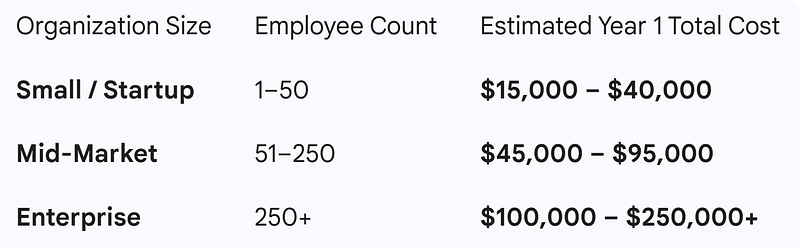
Note: These ranges reflect the ISO 27001 cost in North America and Western Europe. Costs in regions like India or Southeast Asia are typically 30–50% lower due to local labor and audit rates.
Phase 1: Preparation and Readiness Costs
The road to certification begins long before the auditor arrives. This phase is where you define your Information Security Management System (ISMS) and align your internal culture with the rigorous requirements of the standard.
Skimping on preparation is often the leading cause of “audit fail” scenarios, which can double your ISO 27001 cost in the long run.
Purchasing the ISO Standards (~$300)
Surprisingly, the standard itself is not free. To build a compliant system, you must legally purchase the documents from the ISO store or an authorized distributor (like ANSI or BSI).
- ISO/IEC 27001:2022 (Requirements): Approx. $130. This is your “rulebook.” It outlines the mandatory clauses (4 through 10) that your ISMS must satisfy.
- ISO/IEC 27002:2022 (Implementation Guidance): Approx. $170. While not the “test” document, this provides the essential “how-to” for the 93 controls listed in Annex A.
Professional auditors will often ask to see that the organization has access to the official requirements to ensure your team isn’t working from outdated or third-party summaries.
Gap Analysis ($5,000 to $10,000)
A gap analysis is a high-level diagnostic tool. A consultant or a software platform compares your current security “state” against the 93 controls of ISO 27001:2022. It identifies where you are already compliant and where you are missing critical documentation or technical safeguards.
- DIY Gap Analysis: $0 in cash, but it will consume 40+ hours of senior staff time (CTO or IT Manager). Without expert eyes, there is a high risk of “false positives,” thinking you are compliant when you aren’t.
- Professional Consultant: Typically, a flat fee between $5,000 and $8,000.
- The “Insurance” Factor: Investing in a professional gap analysis early on can save you tens of thousands of dollars by preventing you from over-engineering solutions you don’t actually need.

Implementation Method (The Biggest Variable)
How you choose to implement your ISMS is the single largest driver of your ISO 27001 cost. There are three main routes, each with its own pros and cons:
I. The DIY Route (High Internal Cost, Low Cash Outlay)
This is the most “affordable” on paper, but the most expensive in terms of opportunity cost. You typically purchase a documentation toolkit, a set of pre-written policy templates, and your internal team manually customizes them.
- Toolkit Cost: $500 to $2,000.
- The Hidden Cost: You should budget for 200–500 hours of internal labor. If your CTO earns $150/hour, you are looking at a “hidden” ISO 27001 cost of over $30,000 in lost productivity on product development or revenue-generating activities.
II. The Consultant Route (High Cash Outlay, Low Internal Effort)
You hire a specialized firm to act as your “Project Manager.” They write your policies, conduct your risk assessments, and prep your staff for interviews.
- Consulting Fees: $20,000 to $50,000.
This path offers the highest success rate. Consultants know exactly what auditors are looking for, which significantly reduces the stress on your internal team and ensures you pass the first time.
III. The Automation Platform Route (Subscription-Based)
In 2026, many organizations opt for GRC (Governance, Risk, and Compliance) software like SecureSlate and comparable compliance automation platforms. These platforms integrate with your tech stack (AWS, Google Workspace, Jira) to automatically pull evidence of compliance.
- Software Fee: $10,000 to $25,000 per year.
These platforms can reduce the time to get audit-ready by up to 80%. While they don’t replace an auditor, they act as a “continuous monitor,” ensuring your ISO 27001 cost stays predictable and your compliance doesn’t “drift” between audits.
Phase 2: Technical and Security Tooling
ISO 27001 is not a paper-only exercise. While the policies (Phase 1) provide the rules, your technical stack offers the evidence. If your current security posture is “lax,” your ISO 27001 cost will increase as you purchase and integrate the tools required to satisfy the 34 technological controls found in Annex A. In 2026, auditors are increasingly focused on automated, real-time evidence rather than static screenshots.
Endpoint Management & MDM ($2,000 to $10,000)
Under Control A.8.1 (User endpoint devices), you must ensure that every laptop, smartphone, or tablet accessing corporate data is managed and secure. In a remote or hybrid world, “trusting” your employees’ home security is no longer enough for an auditor.
- The Requirement: You must prove devices are encrypted (FileVault/BitLocker), password-protected, running up-to-date OS patches, and capable of being remotely wiped if lost or stolen.
- Typical Pricing: In 2026, leading solutions like Microsoft Intune or Jamf cost between $6 and $12 per user, per month.
- ISO 27001 Cost Impact: For a mid-sized team of 100, this adds roughly $7,200 to $12,000 to your annual recurring costs.
Vulnerability Management ($3,000 to $15,000)
Clause A.8.8 (Management of technical vulnerabilities) requires you to proactively seek out and remediate weaknesses in your software and infrastructure.
- The Requirement: You must perform regular scans of your network and applications. A “one-and-done” scan is rarely sufficient; auditors look for a process where vulnerabilities are identified, prioritized, and patched within a defined timeframe.
- Typical Pricing: Tools like Tenable.io or Qualys often start at around $2,500 to $5,000/year for a basic set of assets. Larger environments with hundreds of cloud instances or IP addresses can see this ISO 27001 cost jump to $15,000+.
- Modern Trend: Many companies now use AI-driven vulnerability management that prioritizes “reachability” and “exploitability,” which saves money on labor even if the tool itself is more expensive.
Security Awareness Training ($1,000 to $5,000)
The “Human Factor” is a major focus of Clause A.6.3. You must provide all employees with regular training to ensure they understand their security responsibilities and can recognize threats like phishing or social engineering.
- The Requirement: It’s not enough to send one email a year. You need a platform that tracks completion rates and tests knowledge (often through simulated phishing attacks).
- Typical Pricing: Platforms like KnowBe4 or Ninjio typically range from $15 to $35 per seat, per year.
- ISO 27001 Cost Impact: For a 50-person startup, this is a negligible $1,500/year , but for a 500-person firm, it’s a standard $10,000+ line item.
Professional Penetration Testing ($5,000 to $20,000)
While the text of the standard doesn’t use the specific phrase “penetration test,” it does require “independent review” and “technical vulnerability management.” In 2026, an ISO 27001 audit without a supporting penetration test report is likely to result in a “Major Non-Conformity.”
- The Requirement: A third-party security firm must attempt to “break in” to your systems to find flaws that automated scanners miss.
- Small Web App: A focused test on a single SaaS product typically costs $5,000 to $8,000.
- Complex Infrastructure: If you are managing a multi-cloud environment with complex APIs, expect this specific ISO 27001 cost to exceed $15,000.
Many certification bodies allow you to use a “Pentest-as-a-Service” (PtaaS) model, which can spread this cost across monthly payments rather than one large annual invoice.
Phase 3: The Certification Audit Fees
This phase is the “point of no return.” Once your ISMS is built and your technical controls are live, you must engage an Accredited Certification Body (CB) to verify your compliance.
Unlike consultants, these bodies are licensed by national accreditation services (like UKAS in the UK or ANAB in the US) to issue the official certificate.
The ISO 27001 cost in this phase is highly regulated. Certification bodies must follow a specific formula found in the ISO/IEC 27006–1:2024 standard to determine exactly how much time they must spend auditing your company.

The Audit Day Rate and “Man-Day” Calculation
In 2026, audit day rates have seen a steady increase due to the specialized nature of cybersecurity expertise.
- The Rate: Expect to pay between $1,500 and $2,200 per day for a qualified auditor.
- The Formula: The number of days is determined primarily by your “effective headcount,” which includes all employees and contractors within the scope of your ISMS.
- ISO 27001 Cost Example: For a 50-person company, the mandatory audit time is typically around 8 to 10 days total for the initial certification. This puts your baseline audit fee at roughly $12,000 to $22,000 before travel or administrative expenses.
Stage 1 Audit: Documentation Review ($3,000 to $8,000)
The Stage 1 audit is essentially a “readiness check.” The auditor will not look at your server logs yet; instead, they review your policies, your Risk Treatment Plan, and your Statement of Applicability (SoA).
- The Goal: To ensure your ISMS is designed correctly on paper.
- The Risk: If the auditor finds “Major Non-Conformities” here, you cannot proceed to Stage 2. You will have to fix the issues and potentially pay for an additional “Follow-up” day, adding to your total ISO 27001 cost.
- Estimated Time: Typically 1 to 3 days.
Stage 2 Audit: The Certification Audit ($7,000 to $25,000)
This is the deep dive into your daily operations. The auditor will look for evidence that you are actually doing what your policies say. They will interview HR about onboarding, ask developers about secure coding, and check with IT about backup restores.
- The Requirement: In 2026, auditors are moving away from simple screenshots and toward “live evidence” walkthroughs.
- Travel Costs: If you have physical offices and the auditor must visit them, you are responsible for their travel and lodging. This is a “hidden” ISO 27001 cost that can add several thousand dollars if you have multiple global sites.
- Estimated Time: Typically 5 to 10+ days, depending on complexity.
How Much Time Does a SOC 2 Audit Take?
The Secrets to a Faster SOC 2 Audit
The Internal Audit ($4,000 to $10,000)
One of the most overlooked mandatory expenses is the Internal Audit. Clause 9.2 of the standard requires you to conduct a full audit of your own system before the external auditor arrives.
- The “Independence” Rule: The person conducting the audit cannot be the same person who built the system. For most SMEs, this means they cannot do it in-house because the IT Manager or CISO is too close to the project.
- Hiring a Third Party: Most companies hire an independent consultant to perform this. This serves as a “dress rehearsal” for the real thing.
- ISO 27001 Cost Impact: A thorough internal audit usually takes 3 to 5 days of a consultant’s time, costing between $4,000 and $10,000. While it feels like an extra expense, it is the best way to ensure you don’t fail the expensive Stage 2 audit.
Phase 4: Maintenance and the 3-Year Cycle
A common budgetary pitfall is treating the ISO 27001 cost as a one-time “project” expense. In reality, ISO 27001 is a permanent commitment to operational excellence. The certificate itself has a three-year expiration date, and maintaining it requires a structured cycle of annual check-ups.
To keep your “active” status, you must account for recurring costs that ensure your ISMS doesn’t become a “shelf-ware” document.
Years 2 & 3: Surveillance Audits ($5,000 to $12,000/year)
Once you have the certificate in hand, you enter the “Surveillance” phase. The certification body will return once a year to ensure you are actually maintaining the system you built.
- The Scope: Surveillance audits are typically shorter than the initial Stage 2 audit (often 1/3 to 1/2 the duration). The auditor won’t look at every single control but will focus on “core” areas like management reviews, internal audits, and how you’ve handled any previous non-conformities.
- The Cost: Expect to pay roughly $5,000 to $12,000 per year. In 2026, many auditors offer “remote-first” surveillance audits for cloud-based companies, which can help eliminate travel-related ISO 27001 costs.
- Recurring Internal Audit: Don’t forget that you must also conduct an internal audit every year before the surveillance audit. This adds another $3,000 to $6,000 if you use a third-party consultant.
Year 4: Recertification ($10,000 to $30,000)
Every three years, your ISMS must undergo a full “Recertification.” This is essentially a “Stage 2” audit all over again.
- The Process: The auditor evaluates every single mandatory clause and Annex A control to ensure the ISMS is still fit for purpose. They will look for three years’ worth of logs and continuous improvement evidence.
- The Cost: Because this is a full-system review, the ISO 27001 cost for recertification is significantly higher than a surveillance audit, usually 80% to 100% of the original Stage 2 fee.
- Budgeting Tip: If you have scaled significantly (e.g., doubled your headcount) since Year 1, your recertification fee will be higher than your initial audit because the “audit days” formula is recalculated based on your current size.
Continuous Compliance & Software Renewals
To keep the system running, you have ongoing operational expenses that aren’t strictly “audit fees” but are necessary to stay certified:
- GRC Platform Renewals: If you use an automation tool like SecureSlate, those annual subscriptions (typically $10k to $25k) are a fixed part of your ISO 27001 cost.
- Security Tooling: Your vulnerability scanners, endpoint management, and training platforms will all have annual renewal fees.
- Internal Resource Allocation: You need an “ISMS Manager.” Even if this isn’t a new hire, you are dedicating a portion of an existing employee’s salary (typically 10%–20% of their time) to ISMS maintenance.
The “True Cost” Formula
When presenting your budget to the Board, don’t just show the Year 1 invoice. Use the Total Cost of Ownership (TCO) for the full 3-year cycle:
Total 3-Year Cost = Initial Implementation + (2 x Surveillance Audits) + (2 x Annual Internal Audits) + Recurring Tech Renewals
For most mid-sized firms, the “Maintenance” phase over years 2 and 3 actually costs more in total than the Year 1 “Get Certified” phase.
Planning for this prevents “compliance fatigue” and ensures you don’t lose your certification due to budget cuts in Year 2.
Factors That Can Blow Your ISO 27001 Budget
Be wary of these “hidden” factors that can double your expected ISO 27001 cost :
Multiple Physical Sites: Each office location adds audit days. If you have 5 global offices, expect your audit fees to skyrocket.
Broad Scope: Trying to certify an entire 1,000-person company at once is much more expensive than certifying a specific “Product Team” or “Data Center.”
Lack of Internal Leadership: If you don’t have a dedicated Project Manager, the project will drag on, increasing consultant hours and software subscription costs.
Conclusion
While the ISO 27001 cost can seem daunting, ranging from $20,000 to over $100,000, it must be weighed against the cost of not being certified.
In 2026, many enterprise procurement teams will not even look at a vendor without an ISO 27001 certificate. Furthermore, the average cost of a data breach is now measured in the millions. Achieving certification is effectively an insurance policy that also serves as a powerful sales tool.
Ready to Streamline Compliance?
Building a secure foundation for your startup is crucial, but navigating the complexities of achieving compliance can be a hassle, especially for a small team.
SecureSlate offers a simpler solution:
- Affordable: Expensive compliance software shouldn’t be the barrier. Our affordable plans start at just $284/month.
- Focus on Your Business, Not Paperwork: Automate tedious tasks and free up your team to focus on innovation and growth.
- Gain Confidence and Credibility: Our platform guides you through the process, ensuring you meet all essential requirements and giving you peace of mind.
Disclaimer (legal note)
SecureSlate is not a law firm, and this article does not constitute or contain legal advice or create an attorney-client relationship. When determining your obligations and compliance with respect to relevant laws and regulations, you should consult a licensed attorney.
Need compliance without the complexity?
SecureSlate automates ISO 27001, SOC 2, GDPR, HIPAA, and more. Built for growing teams. See it in action.
Find compliance gaps in 30 seconds
