
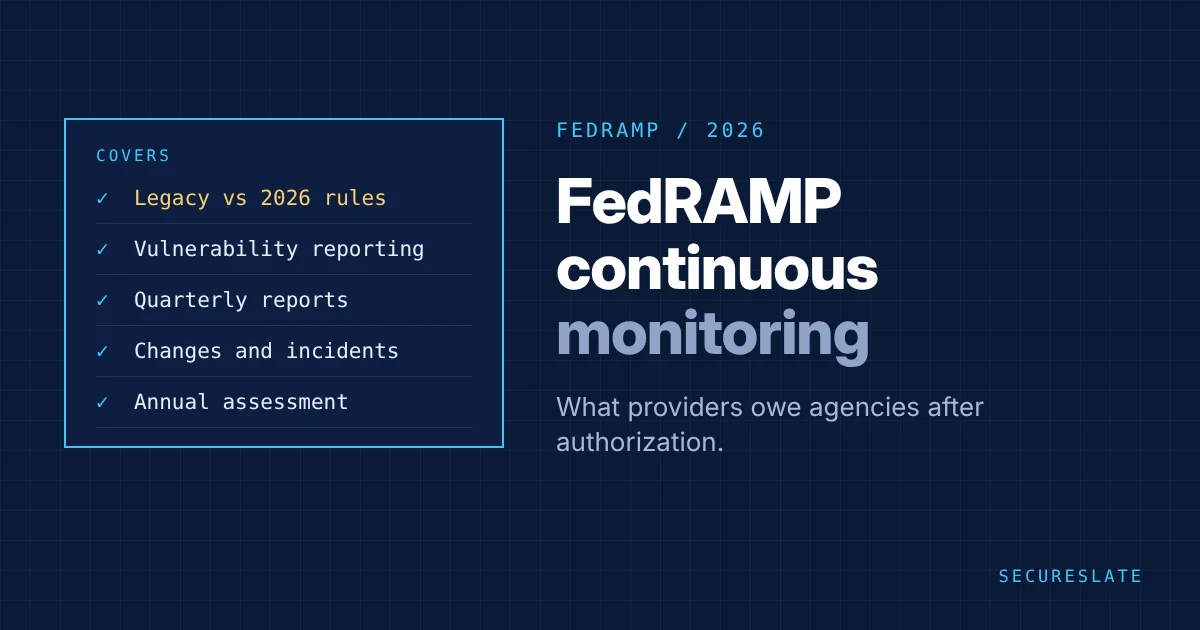
Short answer: After FedRAMP authorization, a cloud provider must keep proving its security posture: detect and remediate vulnerabilities, report to agency customers on a fixed cadence, notify them of significant changes and incidents, and pass an independent assessment every year. As of November 2026, FedRAMP is moving these duties from the legacy monthly POA&M model to "ongoing certification" under its 2026 rules.
Related guides: FedRAMP authorization checklist · FedRAMP 20x explained · FedRAMP impact levels and baselines
Key takeaways
- Authorization is the start of the work. Failing continuous monitoring obligations can lead to corrective action and, ultimately, loss of the authorization.
- The legacy Rev5 model centers on monthly vulnerability scans, a monthly POA&M and inventory, significant change requests and an annual assessment.
- The FedRAMP Consolidated Rules for 2026 rename continuous monitoring to ongoing certification, replace POA&Ms with reporting on accepted vulnerabilities, and add quarterly Ongoing Certification Reports.
- The new rules become mandatory from January 1, 2027, with some rulesets on their own dates. Vulnerability rules apply earlier, from December 7, 2026.
What is FedRAMP continuous monitoring?
FedRAMP continuous monitoring, often shortened to ConMon, is the set of recurring activities a cloud service provider performs after authorization so that agencies can keep trusting the system.
The idea comes from the NIST Risk Management Framework: an authorization decision is only valid while the facts behind it remain true. Control CA-7 in NIST SP 800-53 requires a continuous monitoring strategy, and FedRAMP defines what that strategy must contain for cloud services used by federal agencies.
In practice, the obligations fall into five groups:
- Finding, evaluating and fixing vulnerabilities
- Regular reporting to FedRAMP and agency customers
- Telling customers about significant changes
- Reporting security incidents
- Independent assessment, at least once a year
The details of each group are changing. FedRAMP published its Consolidated Rules for 2026, which took effect for optional adoption on July 4, 2026 and, according to FedRAMP's timeline, become mandatory for all stakeholders on January 1, 2027. If you were authorized under Rev5, you are in a transition period, and both sets of expectations matter.
What changed with the 2026 rules?
The 2026 rules keep the purpose of continuous monitoring but change the vocabulary, the artifacts and the cadence.
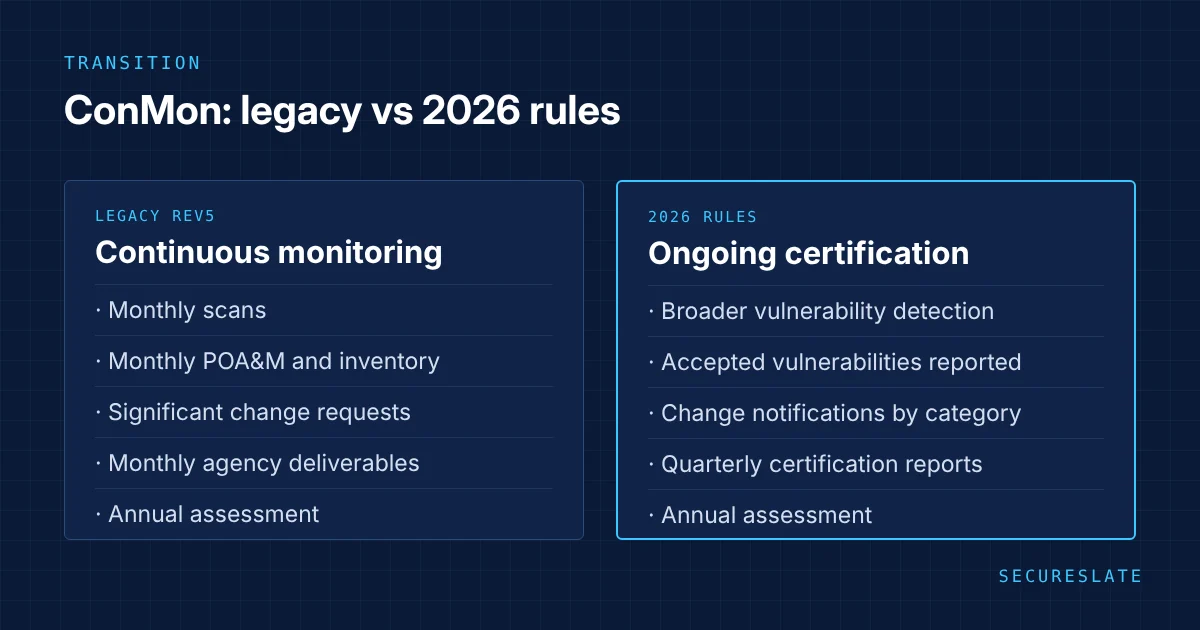
FedRAMP's summary of what is changing lists several shifts that affect post-authorization work:
| Area | Legacy Rev5 approach | Consolidated Rules for 2026 |
|---|---|---|
| Name | FedRAMP authorization and continuous monitoring | FedRAMP Certification and ongoing certification |
| Categorization | Impact levels (Low, Moderate, High) | Certification Classes (A, B, C, D) |
| Open findings | Monthly Plan of Action and Milestones (POA&M) | POA&Ms eliminated; vulnerabilities not resolved in time are reported as accepted |
| Vulnerability work | Monthly scans of operating systems, web applications and databases | Vulnerability Detection and Response covering a broader range of weaknesses |
| Agency reporting | Monthly deliverables and, where applicable, monthly ConMon meetings | Ongoing Certification Reports every 3 months, plus monthly vulnerability reporting |
| Changes | Significant change request reviewed by the authorizing official | Significant Change Notification by category |
| Documents | Word and Excel templates | Machine-readable formats and a trust center as the source of certification data |
FedRAMP also states that it will stop accepting new Rev5 certifications on June 11, 2027, and that existing Rev5 certifications will remain active until at least December 31, 2028. Rev5 providers are therefore expected to adopt the new ongoing certification rules while remaining in the Rev5 program, and to plan a later move to FedRAMP 20x.
What is expected for vulnerability detection and reporting?
You are expected to detect vulnerabilities across the whole system on a recurring basis, evaluate each one, fix it within a defined time and report the status to agencies at least monthly.
Under the legacy Continuous Monitoring Playbook, providers scan operating systems, web applications and databases monthly, with authenticated scans wherever possible for Moderate and High systems. Each unique vulnerability is tracked as its own POA&M item, and the POA&M and system inventory are uploaded every month. Late remediation has consequences: the playbook lists escalation triggers, for example five or more unique High vulnerabilities older than 30 days, or ten or more Moderate vulnerabilities older than 90 days, leading to a Detailed Finding Review, with longer delays leading to a Corrective Action Plan.
Under the 2026 rules, two rulesets apply: Vulnerability Detection and Response and Vulnerability Evaluation and Reporting. The main points:
- Providers must evaluate each detected vulnerability for likely exploitability, whether the affected resource is reachable from the internet, and its potential impact on agencies, which FedRAMP expresses as a Potential Agency Impact N-rating (PAIN).
- Remediation timeframes scale with those three factors and with certification class, so an exploitable, internet-reachable weakness with high agency impact is expected to be fixed far faster than a low-impact internal one.
- Vulnerability detection and response activity must be reported to all necessary parties in a consistent, human-readable format at least monthly.
- Any vulnerability that is not, or will not be, fully mitigated or remediated within 192 days of evaluation must be categorized as an accepted vulnerability and reported with an explanation.
FedRAMP lists these two rulesets as required for maintaining certification from December 7, 2026, with a grace period ending March 7, 2027. That is earlier than the general January 2027 date, so vulnerability reporting is the first area to get right. Our guide to vulnerability scanning frequency compares FedRAMP's cadence with other frameworks.
What do you report to agencies, and how often?
Under the 2026 rules you publish an Ongoing Certification Report every three months, in addition to monthly vulnerability reporting.
The Collaborative Continuous Monitoring ruleset describes the report. It must cover the whole period since the previous one and summarize, where applicable:
- Changes to certification data
- Planned changes for at least the next three months
- Accepted vulnerabilities
- Transformative changes
- Updated security, configuration or usage recommendations
- A list of agencies directly using the product
- FedRAMP reportable incidents, or a statement that none occurred
- Lessons learned and planned changes resulting from those incidents
Class D providers must host a synchronous Quarterly Review meeting for agency customers. FedRAMP lists this ruleset as applying to the maintenance of existing certifications from April 2, 2027, with a grace period ending October 1, 2027.
How are significant changes and incidents handled?
Significant changes are handled by categorizing each change and notifying agencies on a schedule tied to the category, and incidents are handled by reporting within hours through defined initial, ongoing and final reports.
Significant changes. In the legacy process, the provider submits a significant change request and the authorizing official reviews it before implementation. The Significant Change Notification ruleset replaces this with categories:
| Category | Meaning | Notification expectation |
|---|---|---|
| Routine recurring | Regular operations and maintenance | No formal notification |
| Adaptive | Significant changes that are neither routine nor transformative | Notify within 10 business days after completing the change |
| Transformative | Changes that significantly alter the risk profile or customer responsibilities | Initial plans at least 30 business days before starting, final plans at least 10 business days before, and notice within 5 business days after completion |
Incidents. The legacy playbook requires reporting a suspected or confirmed incident within one hour of identification, followed by daily updates. The Incident Evaluation and Communication ruleset defines a reportable incident around the confidentiality or integrity of federal customer data and sets deadlines for initial, ongoing and final incident reports that vary by certification class and estimated agency impact. For incidents rated PAIN-3 or higher, the initial report is due within 6 hours for Class B, 1 hour for Class C and 15 minutes for Class D. Reports go to FedRAMP, to affected agencies through each agency's own procedures, and to other necessary parties through your trust center. Both rulesets have a grace period ending June 1, 2027.
Is an annual assessment still required?
Yes. An independent assessment at least once a year remains part of keeping a FedRAMP authorization.
Under the legacy model, a third-party assessment organization tests a subset of controls each year: FedRAMP-selected core controls, controls affected by changes, validation of closed POA&M items and controls not tested within the last three years. The assessor delivers a Security Assessment Plan and Security Assessment Report, and the provider updates the System Security Plan and tests its incident response and contingency plans annually.
The Independent Verification and Validation ruleset keeps the rhythm. Providers in Classes B, C and D must complete an independent assessment at least once per year, include a class-specific list of Rev5 controls each year, cover all applicable controls at least every three years, and carry controls with negative findings into the next assessment. The grace period for this ruleset ends at the first independent assessment started after January 1, 2027.
Annual assessments are also a recurring budget line. See FedRAMP authorization costs for how to plan for them.
How do you prepare for the transition?
Treat the move to ongoing certification as a project with an owner, a gap analysis and dated milestones.
- Read the rules that apply to your class and path. Start with the Rev5 provider pages in the Consolidated Rules for 2026 and note each ruleset's effective date and grace period.
- Rebuild vulnerability reporting first. Add exploitability, internet reachability and agency impact to your triage, and produce a monthly report that covers all detection sources.
- Convert POA&M items. Decide which open items will be fixed and which will be reported as accepted vulnerabilities, with a documented reason.
- Stand up a trust center. The 2026 rules treat it as the definitive source for certification data, reports and notifications.
- Rehearse incident reporting. Run a tabletop that includes estimating agency impact and meeting the initial report deadline.
- Automate evidence. Machine-readable outputs are expected, so manual spreadsheets become a liability.
How SecureSlate helps
SecureSlate is a compliance automation platform that helps teams keep recurring control evidence current:
- Multi-framework control mapping includes a built-in FedRAMP framework alongside SOC 2, ISO 27001, CMMC and NIST CSF, so controls and evidence are mapped once and reused. Requirements that are not built in can be set up as a custom framework.
- Agentless, read-only cloud integrations and a device agent collect configuration evidence on a schedule.
- Access reviews, risk management and vendor risk management cover recurring tasks in the monitoring calendar.
- Audit management organizes evidence requests for your independent assessor.
- A trust center gives you a controlled place to share security documentation with customers.
- Code security and secrets detection add another detection source for your vulnerability process.
SecureSlate does not perform audits, act as an assessor or issue certifications, and FedRAMP decisions rest with FedRAMP and your agency customers. Start a free trial to see how the control mapping works.
FAQ
What happens if a provider falls behind on FedRAMP continuous monitoring?
FedRAMP uses escalating responses. The legacy playbook describes a Detailed Finding Review, then a Corrective Action Plan, then suspension and revocation. Under the 2026 rules, FedRAMP states that failing ongoing certification requirements results in loss of certification. Agencies can also withdraw their own authorization to operate.
Are POA&Ms still required for FedRAMP?
As of November 2026, FedRAMP's 2026 rules state that POA&Ms have been eliminated and replaced with reporting of accepted weaknesses. Providers still operating under the legacy Rev5 model continue to maintain a monthly POA&M until they adopt the new vulnerability rulesets. Confirm your timeline with FedRAMP and your agency customers.
How often are vulnerability scans required after authorization?
The legacy playbook requires monthly scans of operating systems, web applications and databases. The 2026 Vulnerability Detection and Response ruleset sets detection timeframes that depend on certification class and how prone a resource is to drift, and for Rev5 providers in the higher classes it requires machine-based verification at least monthly.
Does every change need agency approval?
Not under the 2026 rules. Routine recurring changes need no formal notification, adaptive changes are notified after completion, and transformative changes require advance notice. Individual agencies may still set their own expectations.
Disclaimer (legal note)
This article is for general information only and is not legal, regulatory, or professional advice. Requirements vary by framework, industry, and jurisdiction. Consult qualified advisors for your specific obligations.
Need compliance without the complexity?
SecureSlate automates ISO 27001, SOC 2, GDPR, HIPAA, and more. Built for growing teams. See it in action.
Find compliance gaps in 30 seconds