
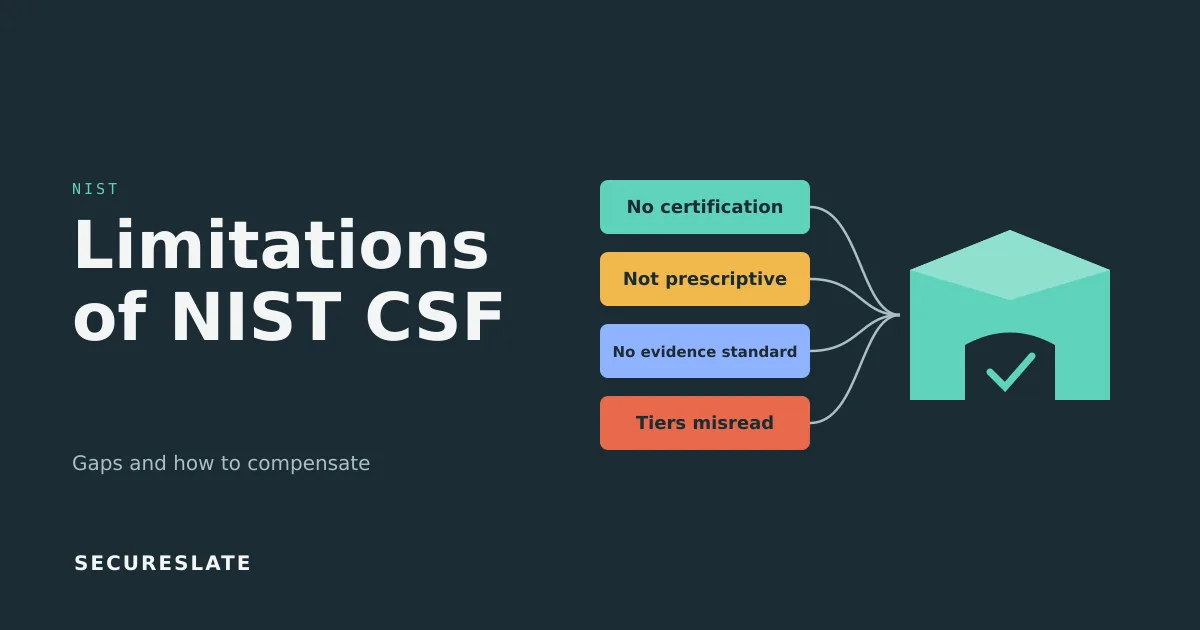
Short answer: The main limitations of NIST CSF are that it is voluntary, offers no official certification, does not prescribe specific controls or an evidence standard, and does not by itself satisfy laws like HIPAA or GDPR. It is still a strong backbone for a security program if you pair it with a certifiable framework, defined controls and continuous monitoring.
Related guides:
- What is NIST CSF and why is it important?
- NIST CSF vs ISO 27001: what's the difference?
- NIST certification: what exists and what does not
Key takeaways
- NIST CSF 2.0 is a voluntary, outcome-based framework. It tells you what good security looks like, not exactly how to build it or prove it.
- There is no official NIST CSF certification, so customers may still ask for a SOC 2 report, ISO 27001 certificate or HITRUST assessment.
- Implementation Tiers describe the rigor of your risk governance. They are not a maturity certification.
- Aligning to the CSF does not make you HIPAA or GDPR compliant.
- Most gaps are fixable: map the CSF to a concrete control set, define evidence for each outcome and monitor continuously.
What are the main limitations of NIST CSF?
The main limitations are no certification, no prescriptive controls, no evidence standard, no legal coverage and profiles that go stale. These are design choices: NIST built the CSF to fit any organization, and that flexibility creates gaps for vendors that must pass audits.
NIST CSF 2.0, released in February 2024, organizes outcomes into six functions: Govern (new in 2.0), Identify, Protect, Detect, Respond and Recover. Our CSF 2.0 overview covers the structure.
| Limitation | Why it matters | How to compensate |
|---|---|---|
| No certification or attestation scheme | Buyers cannot verify your CSF claims independently | Pair the CSF with SOC 2, ISO 27001 or HITRUST |
| Outcome-based, not prescriptive | Teams interpret subcategories differently | Map outcomes to a control set such as SP 800-53 or CIS Controls |
| No built-in evidence or audit standard | Hard to show an outsider that an outcome is actually met | Define evidence, owner and frequency for every control |
| Tiers misused as maturity scores | Leads to misleading claims to buyers | Use tiers for governance rigor only and measure controls separately |
| Resource-heavy for small teams | Full profiles can stall without a dedicated owner | Start with a narrow, risk-based profile |
| Does not satisfy HIPAA or GDPR on its own | Laws have specific requirements | Layer legal requirements on top and map overlaps |
| Profiles drift without monitoring | A point-in-time profile quickly becomes inaccurate | Monitor controls continuously and review profiles on a schedule |
| Limited depth on supply chain practice | GV.SC sets outcomes but not how deep vendor reviews should go | Run a tiered vendor risk program with defined review steps |
Why doesn't NIST CSF give you a certification?
Because NIST does not run a CSF certification or third-party attestation scheme, and the framework was never designed to be certified against. Any "NIST CSF certified" badge comes from a private assessor's own program, not from NIST.
For an SMB selling into enterprise or healthcare, a procurement team cannot rely on your statement that you "follow NIST CSF" the way it relies on an independent SOC 2 report or an accredited ISO 27001 certificate. Healthcare buyers may ask for SOC 2, HITRUST or both instead.
How to compensate:
- Use the CSF as your internal structure and pick a certifiable framework your buyers request.
- Map your CSF profile to that framework so the work is shared, not duplicated. See SOC 2 vs NIST for how the two fit together.
- If a buyer wants CSF-specific assurance, offer an independent assessment and be clear it is not NIST-issued.
Why is NIST CSF hard to scope and prove?
Because the CSF describes outcomes, not controls, and it has no evidence standard telling you what proof is enough. A subcategory may ask that access be managed according to risk without saying whether that means quarterly access reviews, MFA everywhere or just-in-time admin access. Informative references such as SP 800-53, ISO 27001 and the CIS Controls supply that detail, but choosing among them is your job. This creates two problems:
- Scoping varies. One team includes production, corporate IT and support tools, another only the core product. Both can claim CSF alignment.
- Evidence is undefined. SOC 2 and ISO 27001 auditors work from defined criteria and sampling. The CSF has nothing equivalent.
How to compensate:
- Write a scope statement listing in-scope systems, data types (call out ePHI explicitly) and teams.
- Select one primary control catalog and map every CSF subcategory you target to specific controls in it.
- For each control, record the owner, the evidence artifact and how often it is produced. Examples assessors expect: signed access review exports, MFA settings, scan reports with remediation tickets and backup restore tests.
Are NIST CSF Implementation Tiers a maturity score?
No. Implementation Tiers 1 to 4 describe how rigorous and integrated your cybersecurity risk governance and management practices are. They are not a maturity certification and NIST does not assess or award them. Our NIST Implementation Tiers guide explains each tier, so this section focuses only on how tiers get misused.
The misuse is common: a team self-assesses as "Tier 3," puts it in a sales response, and readers treat it like a certified rating. Tiers also say little about whether a specific control works today.
How to compensate:
- Use tiers to set a target for governance rigor that matches your risk appetite. Tier 4 is not a goal every SMB needs.
- Track control effectiveness separately, using the evidence model above.
- In external communications, describe tiers as a self-assessment and back them with independent reports where possible.
Is NIST CSF too heavy for a small team?
It can be, if you try to address every category and subcategory at once without a dedicated owner. Building a current profile, target profile, gap analysis and action plan takes real time that a small security function must balance against product work and customer questionnaires.
How to compensate:
- Scope narrowly first. Start with the systems that store or process customer data and ePHI.
- Prioritize by risk. Target identity, logging, backups, incident response and vendor access first.
- Reuse existing work. If you already hold SOC 2, many controls map directly to CSF outcomes.
- Name one owner. A single accountable person per function keeps the profile moving.
- Automate evidence. Pull configuration evidence from cloud and SaaS systems instead of taking screenshots.
Does NIST CSF satisfy HIPAA or GDPR?
No. The CSF can support compliance, but it does not by itself satisfy HIPAA, GDPR or any other legal obligation.
For HIPAA, a business associate still needs a documented security risk analysis covering ePHI, business associate agreements, breach notification procedures and training records. For GDPR, you still need a lawful basis, records of processing activities, data subject rights handling, DPIAs where required and breach notification processes. GDPR Article 32 asks for "appropriate technical and organisational measures," and a CSF-based program can support that, but it does not replace the rest of the regulation.
How to compensate:
- Treat the law as the requirement and the CSF as one way to organize the security controls that support it.
- Crosswalk HIPAA Security Rule safeguards and relevant GDPR articles to your CSF profile to see what is covered.
- Add non-security items such as BAAs and privacy notices as separate, owned workstreams.
Where else does NIST CSF fall short?
Two more gaps: profile drift and limited supply chain depth.
Profile drift
A CSF profile is a snapshot. Infrastructure, SaaS tools and roles change constantly, so without monitoring your current profile soon stops reflecting reality.
How to compensate: monitor key controls continuously, such as MFA coverage, logging, encryption settings and access changes. Review the profile on a fixed schedule and after major changes such as a new product, acquisition or cloud migration.
Supply chain depth
CSF 2.0 improved this area noticeably by adding a dedicated Cybersecurity Supply Chain Risk Management category (GV.SC) under Govern. It sets outcomes for supplier strategy, contracts, due diligence and monitoring, but leaves depth to you, such as how to tier vendors or how often to reassess a critical subprocessor.
How to compensate: run a tiered vendor risk program. Classify vendors by data access and criticality, define review steps per tier (for example, a SOC 2 report and BAA for any vendor touching ePHI) and reassess critical vendors on a set schedule.
When is NIST CSF still the right choice?
NIST CSF is the right choice when you need a clear structure for your security program and a shared language for risk with leadership. Its limitations matter mostly when people expect it to do what it was never designed to do.
It is a strong fit when:
- You are building a program from scratch and want a logical structure before choosing a certification.
- You run multiple frameworks and need one neutral model to organize SOC 2, ISO 27001, HIPAA and HITRUST work.
- You sell to US public sector or critical infrastructure customers that already speak the CSF's language.
- You want to measure progress with a current and target profile that guides budget decisions.
How SecureSlate helps
SecureSlate helps SMB and HealthTech teams turn the NIST CSF into a working program. Organize your controls once and reuse them for the frameworks your customers ask about, such as SOC 2, ISO 27001 and HIPAA, attach evidence to each control and assign owners.
Policies, a risk register and vendor risk management help with the scoping, evidence and supplier gaps above. The certification gap still needs an independent report such as SOC 2 or ISO 27001.
FAQ
Is there an official NIST CSF certification?
No. NIST does not certify organizations against the CSF or run a third-party attestation scheme. If customers need independent assurance, SOC 2, ISO 27001 or HITRUST are the usual routes.
What is the biggest disadvantage of NIST CSF for a startup?
For most startups, it is the lack of external proof. The CSF helps you build a sound program, but buyers will still ask for a SOC 2 report or similar. Use the CSF to structure the work and a certifiable framework to demonstrate it.
Did NIST CSF 2.0 fix the earlier drawbacks?
Partly. CSF 2.0 added the Govern function, broadened the scope beyond critical infrastructure and strengthened supply chain coverage through GV.SC. It is still voluntary, outcome-based and not certifiable, so the core limitations remain.
Can I use NIST CSF and SOC 2 together?
Yes, and it is a common approach. The CSF gives you a risk-based program structure, while SOC 2 provides an independent CPA report that customers recognize. Mapping one to the other lets the same controls and evidence serve both.
Disclaimer (legal note)
This article is for general information only and is not legal, regulatory or professional advice. Requirements vary by framework, industry and jurisdiction. Consult qualified advisors for your specific obligations.
Need compliance without the complexity?
SecureSlate automates ISO 27001, SOC 2, GDPR, HIPAA, and more. Built for growing teams. See it in action.
Find compliance gaps in 30 seconds
