
NIST CSF 2.0, the second major version of the NIST Cybersecurity Framework, was released on February 26, 2024. It gives organizations of any size and sector a common language for managing cybersecurity risk, organized into six functions: Govern, Identify, Protect, Detect, Respond and Recover. CSF 2.0 widened the framework's audience beyond critical infrastructure, added the Govern function, strengthened supply chain guidance and introduced new resources such as implementation examples and quick start guides. This overview explains the structure, what changed from version 1.1, how to use profiles and tiers, and how CSF 2.0 relates to ISO 27001 and SOC 2.
Related guides: NIST CSF implementation tiers · Security posture best practices · CMMC vs NIST 800-53 · Information assurance vs cybersecurity
Key takeaways
- CSF 2.0 has six functions, 22 categories and 106 subcategories describing cybersecurity outcomes.
- The new Govern function puts cybersecurity strategy, roles, policy, oversight and supply chain risk at the center.
- It is voluntary and outcome-based: it says what to achieve, not exactly how.
- Use Organizational Profiles (current and target) and Tiers to plan and communicate improvements.
- CSF 2.0 maps to ISO 27001, SOC 2, NIST SP 800-53, CIS Controls and others through informative references.
The structure: Core, Profiles and Tiers
| Component | What it is |
|---|---|
| CSF Core | Functions, categories and subcategories describing cybersecurity outcomes |
| Organizational Profiles | Your current and target states, expressed as Core outcomes |
| Community Profiles | Shared target profiles for sectors, technologies or threats |
| Tiers | The rigor of cybersecurity risk governance and management, from Partial to Adaptive |
| Online resources | Informative references, implementation examples, quick start guides |
The six functions
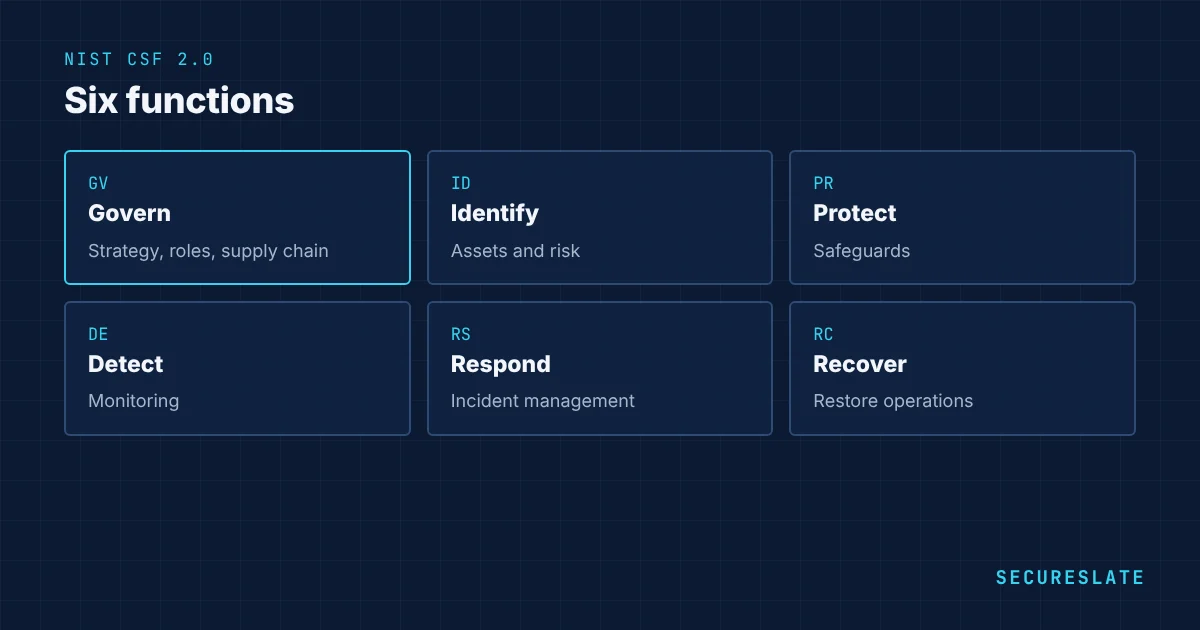
| Function | Purpose | Example categories |
|---|---|---|
| Govern (GV) | Establish and monitor the cybersecurity risk management strategy, expectations and policy | Organizational context, risk management strategy, roles and responsibilities, policy, oversight, cybersecurity supply chain risk management |
| Identify (ID) | Understand current cybersecurity risks | Asset management, risk assessment, improvement |
| Protect (PR) | Use safeguards to manage risks | Identity management, authentication and access control; awareness and training; data security; platform security; technology infrastructure resilience |
| Detect (DE) | Find and analyze possible attacks and compromises | Continuous monitoring, adverse event analysis |
| Respond (RS) | Take action on detected incidents | Incident management, analysis, reporting and communication, mitigation |
| Recover (RC) | Restore assets and operations | Incident recovery plan execution, recovery communication |
Govern sits at the center of the CSF wheel graphic, informing how the other five functions are carried out.
What changed from CSF 1.1
| Area | CSF 1.1 (2018) | CSF 2.0 (2024) |
|---|---|---|
| Audience | Focused on critical infrastructure | All organizations, any size or sector |
| Functions | Five | Six, adding Govern |
| Supply chain | Limited coverage | Dedicated category GV.SC |
| Structure | 23 categories, 108 subcategories | 22 categories, 106 subcategories, with some reorganized |
| Guidance | Mainly the core document | Implementation examples, quick start guides, community profiles, online reference tool |
| Measurement | Less emphasis | More emphasis on assessment and improvement (ID.IM) |
How to use CSF 2.0
- Set scope. Decide which parts of the organization and which systems the profile covers.
- Gather information. Business goals, risk appetite, regulations, existing controls and threats.
- Create a Current Profile. Rate how well you achieve each relevant subcategory today.
- Create a Target Profile. Decide which outcomes you need and to what degree, informed by risk and requirements.
- Analyze gaps. Compare current and target; estimate effort and impact.
- Prioritize and plan. Build a roadmap with owners, budgets and dates.
- Implement and monitor. Track progress and update profiles regularly.
- Communicate. Use the profile to report to leadership and stakeholders.
Mapping to other frameworks
| Framework | Relationship to CSF 2.0 |
|---|---|
| ISO 27001:2022 | Certifiable ISMS; Annex A controls map to most CSF subcategories |
| SOC 2 | Attestation on Trust Services Criteria; many criteria map to CSF outcomes |
| NIST SP 800-53 Rev 5 | Detailed control catalog; official informative references available |
| CIS Controls v8.1 | Prioritized technical safeguards; maps closely to Protect and Detect |
| NIST Privacy Framework | Shares structure for privacy risk |
Many companies use CSF 2.0 as an overall structure for reporting to leadership while certifying to ISO 27001 or reporting SOC 2 to customers.
CSF 2.0 for small businesses
NIST published a Small Business Quick Start Guide for CSF 2.0. A practical approach: start with the Govern function to name owners and priorities, then cover basics in Protect (MFA, updates, backups, training), set up logging and alerting for Detect, write a simple incident response plan for Respond and test backups for Recover.
Common mistakes
- Treating CSF as a checklist to complete rather than a risk-based tool
- Skipping the Govern function
- Targeting maximum outcomes everywhere instead of prioritizing
- Not updating profiles after major changes
- Claiming "CSF certification," which does not exist
Example Current and Target Profile
| Subcategory | Outcome | Current | Target | Gap action |
|---|---|---|---|---|
| GV.RR-01 | Leadership is responsible and accountable for cybersecurity risk | Informal | Formal, with quarterly reporting | Approve charter and reporting cadence |
| GV.SC-04 | Suppliers are known and prioritized by criticality | Partial list | Full inventory with tiers | Build vendor inventory and tiering |
| ID.AM-01 | Hardware inventories are maintained | Spreadsheet | Automated from MDM | Deploy device agent |
| PR.AA-03 | Users, services and hardware are authenticated | MFA for admins | MFA for all users | Enforce SSO with MFA |
| DE.CM-01 | Networks and services are monitored | Basic logs | Centralized with alerts | Central logging and alert rules |
| RS.MA-01 | Incident response plan is executed with relevant parties | Plan exists, untested | Tested yearly | Run tabletop exercise |
| RC.RP-03 | Integrity of backups is verified before use | Not tested | Quarterly restore tests | Schedule restore tests |
Subcategory wording above is paraphrased; use the official CSF 2.0 text in your profile.
CSF 2.0 resources to use
| Resource | What it helps with |
|---|---|
| Quick start guides | Small businesses, profiles, tiers, supply chain and enterprise risk |
| Implementation examples | Practical actions for each subcategory |
| Informative references | Mappings to other frameworks such as SP 800-53 and CIS Controls |
| Community profiles | Sector or use case baselines |
| CSF 2.0 reference tool | Browsing and exporting the Core |
Reporting with CSF 2.0
Boards and executives often find CSF's six functions easy to understand. A quarterly one-page report can show each function's status, the top gaps from the profile, progress on the roadmap and any decisions needed. Keep detailed subcategory scoring in an appendix for security and audit teams.
How SecureSlate helps
SecureSlate helps teams adopt NIST CSF 2.0 alongside other frameworks. Multi-framework mapping links CSF outcomes to ISO 27001, SOC 2 and HIPAA controls; continuous monitoring measures Protect and Detect outcomes; the risk register and vendor risk support Govern and Identify, giving small and mid-size teams a clear current and target picture.
FAQ
What is NIST CSF 2.0?
The 2024 update of the NIST Cybersecurity Framework, a voluntary, outcome-based framework for managing cybersecurity risk, organized into six functions.
What are the six functions of NIST CSF 2.0?
Govern, Identify, Protect, Detect, Respond and Recover.
What is new in CSF 2.0?
The Govern function, broader applicability to all organizations, stronger supply chain guidance, reorganized categories and new implementation resources.
Is there a NIST CSF certification?
No. Organizations can assess themselves or be assessed by third parties, but NIST does not certify CSF compliance.
How does NIST CSF relate to ISO 27001?
They cover similar ground and map to each other. ISO 27001 is certifiable; CSF is a flexible framework often used for planning and reporting.
Who should use NIST CSF 2.0?
Any organization, of any size or sector, that wants a structured way to understand and improve cybersecurity risk management.
How long does a CSF profile take to build?
A first Current and Target Profile for a small organization often takes a few weeks of part-time work.
Disclaimer (legal note)
This article is for general information only and is not legal, regulatory, or professional advice. Requirements vary by framework, industry, and jurisdiction. Consult qualified advisors for your specific obligations.
Need compliance without the complexity?
SecureSlate automates ISO 27001, SOC 2, GDPR, HIPAA, and more. Built for growing teams. See it in action.
Find compliance gaps in 30 seconds